
Industrial Floor Coating Market Demand, Share & Growth by 2034
Coverage: By Resin Type (Epoxy, Polyurethane, Hybrid, Others); Flooring Material (Concrete, Mortar, Terrazzo, Others); Technology (Water-Borne, Solvent-Borne); End-Use Sector (Manufacturing, Aviation and Transportation, Food Processing, Science and Technology, Others) , and Geography (North America, Europe, Asia Pacific, and South and Central America)
- Status : Data Released
- Report Code : TIPRE00021328
- Category : Chemicals and Materials
- No. of Pages : 150
- Available Report Formats :


- Last update date : August 28, 2026


2025 Market Size
US$ 5.98 Bn
Base year value
2034 Forecast
US$ 11.70 Bn
Projected by 2034
CAGR 2026-2034
7.74 %
Growth rate
Addressable Market
US$ 79.59 Bn
(2026-2034)
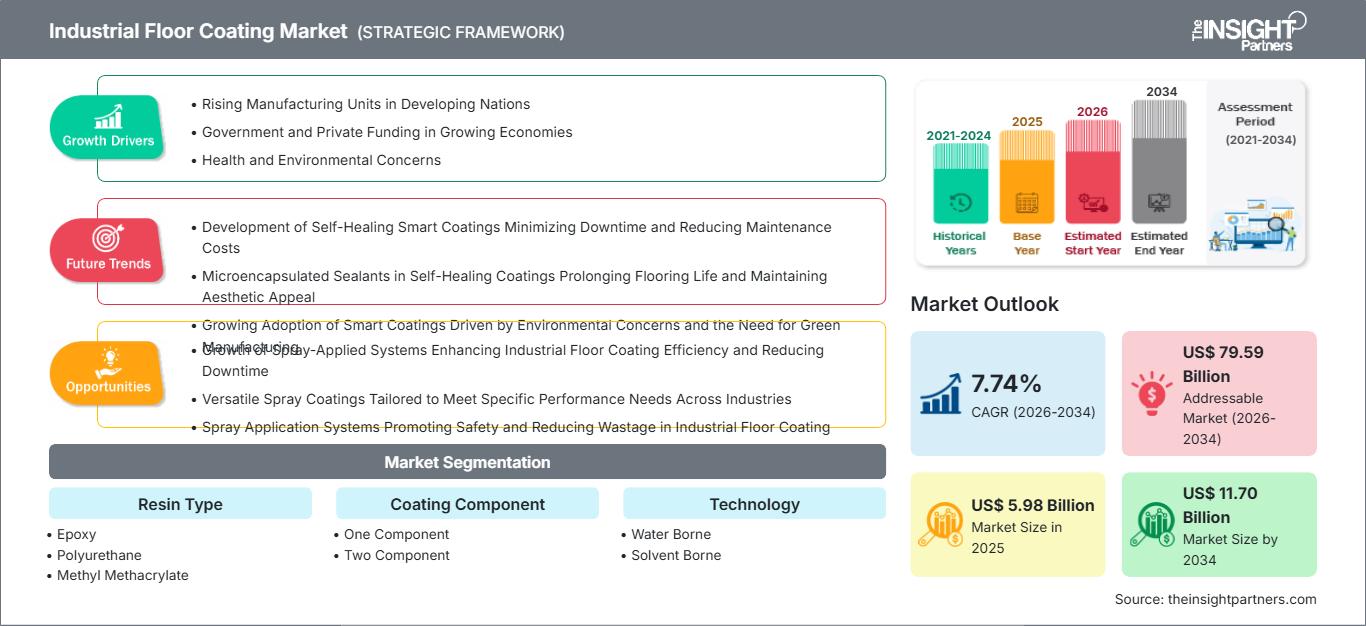
The industrial floor coating market is expanding from US$ 5.98 Billion in 2025 to US$ 11.70 Billion by 2034, registering a CAGR of 7.74% during 2026–2034. Growth is a result of increasing sophistication of durable resin systems in manufacturing, warehousing, food processing, logistics and other high traffic buildings. Increasing maintenance standards and surfaces requiring resistance to chemicals, wear, moisture and temperature changes are driving sustained replacement and new construction activity.
The North American industrial floor coating market size continues to be a significant demand driver, backed by refurbishment of manufacturing infrastructure, warehouse expansions, food and beverages processing and improved workplace performance standards. The market is expected to grow at a CAGR of 6.8%-7.4% between 2022 and 2034, with high performance polyurethane and epoxy systems experiencing growing demands, while low-emission technology systems finding their way into occupied buildings.
Industrial Floor Coating Market Assessment and Insights
- North America Industrial floor coating market in North America is estimated at a 28–32% share in 2025, expanding at a 6.8–7.4% CAGR between 2026–2034, supported by manufacturing refurbishment, logistics facilities, food processing, and maintenance-led replacement demand.
- US The US accounts for 78–82% of North America share in 2025, growing at a 6.7–7.3% CAGR between 2026–2034, led by warehouses, manufacturing plants, and institutional facilities.
- Europe Europe represents a 23–27% share in 2025, growing at a 6.9–7.5% CAGR between 2026–2034. Germany, the UK, France, Italy, and Spain remain leading markets, supported by industrial modernization and low-emission coating requirements.
- Asia Pacific Asia Pacific holds a 31–35% share in 2025, advancing at an 8.2–8.9% CAGR between 2026–2034. China, India, Japan, South Korea, and Australia drive demand through industrial construction, logistics expansion, manufacturing investment, and infrastructure development.
- Largest Segment Epoxy represents a 48–52% market share in 2025, with a 7.2–7.8% CAGR between 2026–2034, reflecting its established chemical, abrasion, and adhesion performance.
- High Growth Segment Methyl Methacrylate accounts for an 8–11% market share in 2025, with an 8.4–9.1% CAGR between 2026–2034, benefiting from rapid curing and maintenance applications.
- Key companies analyzed in detail: 3M Company, Akzo Nobel N.V., Asian Paints Limited, BASF SE, PPG Industries, Inc., RPM International Inc., Sika AG, Tennant Company, The Sherwin-Williams Company, Thermal-Chem Corporation.
Source: The Insight Partners' analysis based on proprietary research, government publications, company annual reports, investor presentations, industry databases, and expert interviews.
Progress has been made from conventional floor paints loaded with resin content to advanced multilayer systems that include primers, bodycoat, aggregates, and chemically resistant finishes. The epoxy will prove essential in heavy-duty floors whereas polyurethane, polyaspartic, and methyl methacrylate paints will be suitable in addressing issues related to UV light, fast turnaround, thermal stress, and maintenance requirements. Water-based materials have become more significant in light of odor and volatile organic compound issues associated with paint application.
The capital expenditure in the forecast period will cover facilities for manufacturing, automated warehousing, food processing, battery manufacturing, data center and repurposed industrial buildings. Additional opportunities for growth will arise in developing countries of Asia while Europe's regulatory framework will support re-formulating of products. There will be substantial investment for renovation in North America leading to replacement in situations where reduced downtime and long paint life justifies initial cost.
Industrial Floor Coating Market Report Scope
| Report Attribute | Details |
|---|---|
| Market size in 2025 | US$ 5.98 Billion |
| Market Size by 2034 | US$ 11.70 Billion |
| Global CAGR (2026 - 2034) | 7.74% |
| Historical Data | 2021-2024 |
| Forecast period | 2026-2034 |
Industrial Floor Coating Market Analysis
This is highly correlated with the use of industrial floorings, the life cycle of concrete floorings, facility expansion, and the performance criteria needed in such an environment. Abrasion and chemical resistance are key concerns for manufacturing facilities, hygiene and cleanability for food facilities, and impact and wear resistance for logistics warehousing. The supply chain in the industrial floor coating market is composed of the following players: resins and additives suppliers, formulators, systems makers, distributors, flooring applicators, and facility owners.
Supply factors include access and prices of epoxy resins and curing agents, polyurethane systems, methacrylate monomers, pigments, aggregates, and specialty additives. The formulators now strive for faster curing time, broader working temperature range, higher water tolerance, and VOC characteristics of formulations instead of merely competing with resin prices. Technical specification, contractor competence, substrate surface, and technical support are essential purchasing factors especially for expensive industrial facilities where any coating failure may stop operation.
There are diversified coatings companies and specialized floorings that are distinguished by differences in chemistry, application, and distribution. For instance, PPG Industries, Inc. provides flooring solutions in the form of epoxy, urethane, methyl methacrylate, and polyaspartic floors, whereas RPM International Inc. participates via Stonhard's seamless epoxy and urethane floorings. Meanwhile, Sika AG and BASF SE specialize in formulation technology and sustainable chemistry such as low emission epoxy systems.
More attention is given to investment in application optimization, reformulation, regional distribution, and digital specification services. The Sherwin-Williams Company, Akzo Nobel N.V., Asian Paints Limited, 3M Company, Tennant Company, and Thermal-Chem Corporation focus on various parts of industrial coatings ecosystem. Competitive differentiation in the industrial floor coating market report becomes based not only on material cost reduction but also on the performance in operation, contractors' network, maintenance efficiency, and availability of solutions reducing downtime.
● REPORT CUSTOMIZATION
Tailor This Report To Align With Your Specific Business Requirements
This report can be customized to align precisely with your business objectives, scope, and target markets. Customization options include tailored segmentation, geography, competitive analysis, and strategic insights to support informed decision-making.
Customize This Report →WHAT YOU CAN ADJUST
- ● Segmentations
- ● Geography
- ● Competitive Analysis
- ● Language Preferences
Industrial Floor Coating Market: Strategic Insights
Regional Insights
North America Industrial Floor Coating Market
North America constitutes 28-32% of the industrial floor coating market share in 2025 and is expected to grow at a CAGR of 6.8-7.4% up to 2034. Growth drivers include industrial floor coatings in the US and Canada, which will be propelled by industrial modernization, distribution center construction, food processing, aircraft hangars and repair facilities, and industrial facility upgrades.
The growing importance of coatings in terms of lifecycle cost analysis, maintenance cycles, safety of employees, and minimal downtime are being evaluated by the owners of the facilities, who increasingly demand abrasion resistance and ability to resist forklift traffic in warehouses and logistics facilities and seamless and non-absorbent coating systems in food and beverage industry. The increased focus on indoor air quality further drives low-VOC technology development. Thus, regional demand for the industry under consideration should prove fairly stable due to maintenance and renovations acting as a balancing factor to industrial construction cycles.
U.S. Industrial Floor Coating Market
US constitutes 78-82% of the share in North America in 2025, with a growth rate expected to range between 6.7-7.3% CAGR till 2034. Factors driving demand include reshoring in manufacturing, development of warehouses, investments in food processing, establishment of semiconductor plants and battery plants, and modernization of aged industrial structures. Favorable demand scenario also comes from the presence of reliable contractors' network and availability of specialized systems for flooring.
Trends in applications show a move towards fast curing, high solids, low odor, and chemically-resistant formulations. PPG Industries, Inc., The Sherwin-Williams Company, RPM International Inc., and others have excellent product lineups in the form of industrial flooring while specialized systems cater to electrostatics, thermal shock, chemical resistance, and traffic considerations. Maintenance will always be an important part of this market since the existing concrete floors need resurfacing regardless of the general construction scenario.
Europe Industrial Floor Coating Market
Europe accounts for a share of 23–27% in 2025 and will grow at a rate of CAGR of 6.9–7.5%. Germany leads in terms of regional consumption. Major markets in Europe include the UK, Germany, France, Italy, and Spain due to manufacturing facilities, logistics centers, food processing plants, and refurbishment requirements. Environmental impact plays an important role in product formulations and procurement.
The UK will gain the benefit of logistics, food processing plants, aircraft maintenance, and industrial revitalization projects. The needs are such that there is an emphasis on long-lasting products that generate minimal odor and emission. Germany has very efficient manufacturing capacity in automotive, machinery, chemical and food processing sectors, which ensures constant need for high-quality epoxy and polyurethane floors. France, Italy, and Spain contribute through manufacturing plants, logistics, refurbishing of commercial and industrial facilities and so forth.
APAC Industrial Floor Coating Market
APAC accounts for 31–35% of the market in 2025 and is expected to register an 8.2–8.9% CAGR, making it the leading regional growth market. China remains the largest country market, followed by Japan, South Korea, India, and Australia. Industrial parks, electronics, automotive, logistics, food processing, and infrastructure investment underpin demand.
The capacity of China’s manufacturing is such that it can help the widespread use of both epoxy and polyurethane. However, Japan and South Korea tend to place a great deal of emphasis on technical control of the production environment. On the other hand, India is currently enjoying the advantage of manufacturing, warehousing, pharmaceutical, and infrastructure developments, while Australia is creating demand from mining operations, logistics, food processing, and industrial revamping.
Middle East & Africa Industrial Floor Coating Market
ME & Africa will see growth of 7.1% – 7.8% CAGR, led by demand in Saudi Arabia. UAE will provide growth in logistics, airports, hotels, industrial facilities, and warehousing segments, while South Africa will drive demand through its manufacturing, mining, food processing, and logistics sectors. RoMEA can provide further growth through diversified industry.
Energy and infrastructure development will increase demand for coatings which are resistant to chemicals, traffic, temperature changes, and harsh maintenance practices. The diversifying industrial sector in Saudi Arabia along with construction pipeline will help in increasing the demand for high performance floors, while the UAE will benefit from logistics and industrial development. South Africa will continue to remain a significant market for maintenance intensive industrial applications.
Segmentation Analysis
Resin Type
The Resin Type segment in the industrial floor coating market is expected to grow at a 7.4–8.0% CAGR during 2026–2034. Resin selection is determined by substrate condition, chemical exposure, traffic intensity, cure requirements, temperature variation, UV exposure, and expected service life. Epoxy remains the principal chemistry because of its adhesion and resistance characteristics, while polyurethane, methyl methacrylate, and polyaspartic systems address more specialized performance requirements.
- Epoxy remains the dominant resin because it provides strong adhesion, abrasion resistance, chemical resistance, and broad compatibility with broadcast, self-leveling, and mortar flooring systems. Its established contractor ecosystem supports extensive industrial adoption.
- Polyurethane serves environments requiring flexibility, impact resistance, UV stability, and resistance to thermal movement. It is particularly relevant where concrete floors experience temperature changes, mechanical stress, or demanding cleaning cycles.
- Methyl Methacrylate is strategically important where rapid curing and low-temperature installation are required. Its ability to return facilities to service quickly supports maintenance projects in food, retail-industrial, logistics, and other time-sensitive environments.
- Polyaspartic systems address applications requiring rapid cure, color stability, abrasion resistance, and improved UV performance. Their positioning is strengthened where contractors seek shorter installation windows and durable topcoat performance.
Coating Component
The Coating Component segment in the industrial floor coating market is projected to advance at a 7.1–7.7% CAGR during 2026–2034. Component architecture influences shelf life, mixing requirements, curing behavior, application consistency, and installed performance. Two-component formulations are especially important for demanding industrial environments because separate resin and curing-agent components enable engineered performance after mixing.
- One Component systems offer operational simplicity because they reduce mixing steps and can support straightforward maintenance applications. Their convenience makes them relevant where application speed, ease of handling, and moderate performance requirements influence procurement.
- Two Component systems provide broader performance customization and are widely used for industrial flooring requiring controlled curing, chemical resistance, abrasion resistance, and stronger mechanical properties. They remain important for heavy-duty production and warehouse environments.
Technology
The Technology segment in the industrial floor coating market is forecast to grow at a 7.3–7.9% CAGR during 2026–2034. Technology selection increasingly balances performance with application conditions, environmental requirements, odor sensitivity, drying time, and regulatory expectations. Water-borne systems are gaining attention in occupied facilities, while solvent-borne products remain relevant where formulation performance and substrate conditions justify their use.
- Water Borne technologies benefit from lower odor, easier application in occupied areas, and reduced reliance on organic solvents. Their role is expanding as facility owners prioritize indoor air quality and contractors seek environmentally preferable installation options.
- Solvent Borne systems continue to serve applications requiring established film formation, penetration, or specialized performance. Their use is increasingly application-specific as formulators improve alternatives and customers evaluate emissions alongside durability and total lifecycle cost.
Opportunity Snapshot
| Resin Type | Revenue Contribution (High/Medium/Low) | Trend Tag (MAX 2 words) | Adoption Stage (Emerging/Scaling/Mature) |
| Epoxy | High | Heavy Duty | Mature |
| Polyurethane | Medium | Thermal Resistance | Mature |
| Methyl Methacrylate | Medium | Rapid Cure | Scaling |
| Polyaspartic | Medium | UV Stability | Scaling |
Industrial Floor Coating Market Growth Drivers and Impact Analysis
Expansion of Automated Warehousing and High-Traffic Logistics Facilities
The expansion of automated warehouses is increasing the performance requirements placed on industrial concrete floors. Automated guided vehicles, forklifts, pallet movement, and continuous pedestrian traffic create concentrated mechanical loads and repetitive abrasion. Flooring systems therefore need strong adhesion, low-maintenance surfaces, and resistance to impact and tire wear. This favors engineered epoxy, polyurethane, and polyaspartic systems over basic floor paints. Higher warehouse utilization also increases the economic cost of maintenance shutdowns, encouraging facility owners to select rapid-curing products that shorten installation windows. The market impact extends beyond new construction because existing distribution centers require resurfacing as traffic intensity rises. Suppliers able to combine durability with rapid return-to-service characteristics can capture specification opportunities in both greenfield logistics projects and renovation programs.
Stricter Hygiene and Chemical-Resistance Requirements in Processing Plants
Food, beverage, pharmaceutical, and chemical facilities are raising flooring specifications because cleaning frequency, chemical exposure, and contamination control directly affect operating reliability. Seamless industrial flooring reduces joints and porous areas where contaminants can accumulate, while chemically resistant formulations protect concrete from aggressive cleaning agents and process materials. Thermal shock is also important in facilities exposed to hot-water cleaning, cold storage, or alternating temperatures. These requirements favor polyurethane cement, high-performance epoxy, and specialized topcoat systems with low permeability and strong adhesion. The commercial effect is a shift toward higher-value flooring systems rather than commodity coatings. Contractors and manufacturers that can document resistance characteristics, hygienic performance, application procedures, and expected service life are better positioned to influence project specifications and secure recurring maintenance work.
Growth of Electrification and Advanced Manufacturing Facilities
Battery plants, semiconductor facilities, electronics manufacturing sites, and other advanced industrial operations are introducing specialized floor requirements. These environments can demand electrostatic control, low contamination, chemical resistance, cleanability, and precise surface characteristics. Flooring therefore becomes part of facility performance rather than a purely decorative or protective layer. Electrostatic-dissipative systems can help control electrical discharge risks, while seamless surfaces support contamination management and maintenance. The expansion of advanced manufacturing in North America and Asia Pacific should create specification opportunities for technically differentiated coatings. Demand can also extend to adjacent rooms, laboratories, storage zones, and maintenance areas, broadening the addressable installation base. Suppliers with technical support capabilities, application guidance, and system-level certification can gain an advantage when projects involve multiple performance requirements and rigorous facility qualification procedures.
Industrial Floor Coating Market Future Trends
Digital Specification and Performance-Based Flooring Selection
Digital tools are likely to influence how industrial flooring systems are selected, especially for complex facilities with multiple operating zones. Rather than choosing a generic coating, facility managers can increasingly compare chemical exposure, traffic intensity, temperature, substrate conditions, cure time, and maintenance requirements before specifying a system. Digital product selectors and technical configurators can shorten specification cycles and improve communication between manufacturers, contractors, engineers, and owners. The trend also supports more consistent system selection across geographically dispersed facilities. Manufacturers may integrate product data, application instructions, performance certifications, and lifecycle information into digital platforms. Over time, purchasing decisions should become more performance-oriented, with suppliers competing on measurable service characteristics, installation efficiency, technical support, and lifecycle economics instead of relying primarily on brand recognition or initial material price.
Low-Emission Formulations Combined with Faster Return-to-Service
Product development in the in the industrial floor coating market trends is likely to combine lower emissions with faster curing and higher mechanical performance. Customers increasingly want coatings that can be installed in operational buildings without prolonged odor or downtime, creating a convergence between environmental performance and productivity. Water-borne urethanes, high-solids systems, low-VOC epoxy technologies, polyaspartics, and rapid-curing methacrylates can address different portions of this requirement. The next stage of formulation development will focus on balancing application tolerance, moisture sensitivity, cure speed, chemical resistance, and durability. Manufacturers are also likely to optimize packaging and mixing systems to reduce application errors. This combination should strengthen demand for premium formulations where facility owners can justify higher upfront costs through shorter shutdown periods, easier compliance management, reduced maintenance, and longer service intervals.
Industrial Floor Coating Market Opportunities
Retrofitting Aging Industrial Floors with Performance-Based Systems
A significant opportunity exists in upgrading aging industrial floors rather than relying exclusively on new-build construction. Older manufacturing plants, warehouses, processing facilities, and maintenance buildings often have cracked, worn, chemically damaged, or difficult-to-clean concrete surfaces. Retrofitting these areas can improve safety, hygiene, durability, and operating efficiency without requiring complete floor replacement. Suppliers can develop systems tailored to moisture-prone slabs, heavily trafficked areas, chemical exposure, and rapid shutdown windows. Contractors can further differentiate through substrate diagnostics, moisture testing, surface preparation, repair, and lifecycle recommendations. The opportunity in the in the industrial floor coating market forecast is particularly attractive in mature markets where the industrial building stock is established. A service-oriented approach combining material supply with technical assessment can create recurring refurbishment demand and improve customer retention across multi-site industrial operators.
Specialized Flooring for Data Centers and Battery Manufacturing
Data centers and battery manufacturing facilities offer attractive opportunities for technically differentiated flooring systems. Data centers can require electrostatic control, cleanable surfaces, abrasion resistance, and reliable performance around equipment-intensive environments. Battery facilities may require resistance to chemicals, contamination control, and carefully managed surface characteristics. These applications can support premium coatings because flooring failure can affect equipment, maintenance schedules, and operational continuity. Suppliers can pursue opportunities by developing system packages that combine primers, conductive layers, protective topcoats, joint treatments, and repair solutions. Partnerships with engineering contractors and facility developers can improve early specification access. As investment in digital infrastructure and electrification expands, specialized flooring can become a higher-value niche within industrial coatings, particularly where technical qualification and application expertise create barriers to low-cost competitors.
Recent Developments
- July 2026: BASF SE — BASF and Carlyle completed the transaction separating BASF Coatings into an independent business, now operating as Surventis. The move materially changes the ownership and operating structure of a major global coatings platform.
- February 2026: AkzoNobel Powder Coatings introduced Eco+ products, a dedicated portfolio that brings together its most sustainable powder coating solutions from the Interpon and Resicoat portfolios under one clear designation, bringing clarity, confidence and proof to sustainable coating choices.
Frequently Asked Questions

- Comprehensive Market Sizing and Forecast Analysis
- Detailed Segmentation Analysis
- In-Depth Market Dynamics Assessment
- Regional and Country-Level Insights
- Competitive Landscape and Company Benchmarking
- Strategic Business Intelligence
Recent Reports
Testimonials

The Insight Partners' SCADA System Market report is comprehensive, with valuable insights on current trends and future forecasts. The team was highly professional, responsive, and supportive throughout. We are very satisfied and highly recommend their services.
RAN KEDEM Partner, Reali Technologies LTDs
I requested a report on a very specific software market and the team produced the report in a few days. The information was very relevant and well presented. I then requested some changes and additions to the report. The team was again very responsive and I got the final report in less than a week.
JEAN-HERVE JENN Chairman, Future Analytica
We worked with The Insight Partners for an important market study and forecast. They gave us clear insights into opportunities and risks, which helped shape our plans. Their research was easy to use and based on solid data. It helped us make smart, confident decisions. We highly recommend them.
PIYUSH NAGPAL Sr. Vice President, High Beam Global
The Insight Partners delivered insightful, well-structured market research with strong domain expertise. Their team was professional and responsive throughout. The user-friendly website made accessing industry reports seamless. We highly recommend them for reliable, high-quality research services
YUKIHIKO ADACHI CEO, Deep Blue, LLC.
This is the first time I have purchased a market report from The Insight Partners.While I was unsure at first, I visited their web site and felt more comfortable to take the risk and purchase a market report.I am completely satisfied with the quality of the report and customer service. I had several questions and comments with the initial report, but after a couple of dialogs over email with their analyst I believe I have a report that I can use as input to our strategic planning process.Thank you so much for taking the extra time and making this a positive experience.I will definitely recommend your service to others and you will be my first call when we need further market data.
JOHN SUZUKI President and Chief Executive Officer, Board Director, BK Technologies
I wish to appreciate your support and the professionalism you displayed in the course of attending to my request for information regarding to infectious disease IVD market in Nigeria. I appreciate your patience, your guidance, and the fact that you were willing to offer a discount, which eventually made it possible for us to close a deal. I look forward to engaging The Insight Partners in the future, all thanks to the impression you have created in me as a result of this first encounter.
DR CHIJIOKE ONYIA MANAGING DIRECTOR, PineCrest Healthcare Ltd.Reason to Buy
- Informed Decision-Making
- Understanding Market Dynamics
- Competitive Analysis
- Identifying Emerging Markets
- Customer Insights
- Market Forecasts
- Risk Mitigation
- Boosting Operational Efficiency
- Strategic Planning
- Investment Justification
- Tracking Industry Innovations
- Aligning with Regulatory Trends





 Get Free Sample for