
Industrial Furnaces Market Growth, Share & Trends by 2034
Coverage: by Arrangement (Tube or Clamshell Type, Box Type, Car Bottom Type); Operation (Gas/Burner Operated, Electrically Operated); Application (Atmosphere, Vacuum); Structure (Batch, Continuous); and Geography (North America, Europe, Asia Pacific, and South and Central America)
- Status : Data Released
- Report Code : TIPRE00008941
- Category : Manufacturing and Construction
- No. of Pages : 150
- Available Report Formats :


- Last update date : August 28, 2026


2025 Market Size
US$ 12.46 Bn
Base year value
2034 Forecast
US$ 22.92 Bn
Projected by 2034
CAGR 2026-2034
7.01 %
Growth rate
Addressable Market
US$ 159.77 Bn
(2026-2034)
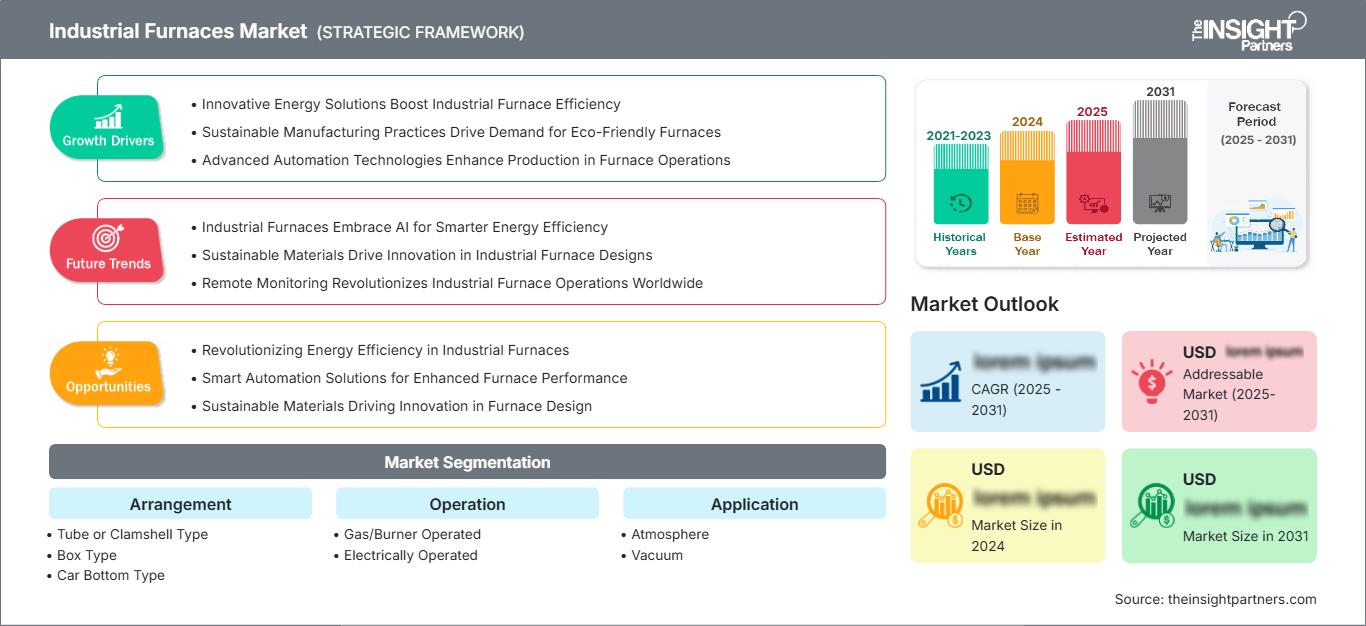
The industrial furnaces market was valued at US$ 12.46 Billion in 2025 and is projected to reach US$ 22.92 Billion by 2034, expanding at a CAGR of 7.01% during 2026–2034. Demand is moving beyond replacement purchases toward integrated thermal-processing systems that improve temperature uniformity, throughput, energy use, and product traceability across metals, advanced materials, automotive components, aerospace parts, electronics, and industrial manufacturing.
In North America, the industrial furnaces market size expansion is expected to track a 6.3–6.8% CAGR through 2034 as manufacturers modernize aging heat-treatment capacity and localize critical-component supply. Federal and private investment in steel, aerospace, defense, semiconductors, and electric-vehicle production supports equipment orders, while tighter emissions management and high labor costs favor electric heating, automation, atmosphere control, predictive maintenance, and retrofit-ready furnace platforms.
Industrial Furnaces Market Assessment and Insights
- North America – Represented 25–28% share in 2025 and is projected to grow at 6.3–6.8% CAGR between 2026–2034, supported by reshoring, defense and aerospace investment, and modernization of aging heat-treatment assets.
- US – Accounted for 78–82% of North American demand in 2025, advancing at 6.4–6.9% CAGR through 2034 as automotive, semiconductor, and specialty-metals capacity expands.
- Europe – Held 27–30% share in 2025 and should record 5.9–6.4% CAGR, led by Germany, Italy, France, Spain, and the UK amid electrification and emissions-compliance retrofits.
- Asia Pacific – Captured 36–40% share in 2025 and is expected to post 8.1–8.7% CAGR, with China leading and India, Japan, South Korea, and Australia sustaining diversified demand.
- Largest Segment – Gas/Burner Operated held 56–60% market share in 2025 and is forecast to register 5.8–6.3% CAGR through 2034, reflecting installed-base depth and high-temperature economics.
- High Growth Segment – Electrically Operated represented 40–44% market share in 2025 and should expand at 8.8–9.4% CAGR through 2034 as decarbonization and precision control accelerate adoption.
- Key companies analyzed in detail: ANDRITZ AG, Tenova S.p.A., Inductotherm Group, SECO/WARWICK S.A., Ipsen International GmbH, Nabertherm GmbH, Carbolite Gero Ltd., Nutec Bickley, Gasbarre Products, Inc., and Despatch Industries, LLC.
Source: The Insight Partners' analysis based on proprietary research, government publications, company annual reports, investor presentations, industry databases, and expert interviews.
Modern thermal processing technology has shifted from standalone devices dependent on operators to digitally monitored processing cells. Modern designs integrate efficient burners or electric resistance heating with programmable control, recipes, atmospheres, load control, and heat recovery systems. Modular furnaces capable of handling various materials, small runs, and closer metallurgical specifications are increasingly demanded by customers. Electric options are being considered where power supply and processing temperatures are favorable, and gas systems remain key for heavier loads and batch processes. The factors such as service, retrofits, and refractory upgrades have become equally important to the equipment choice as life cycle costs.
Investments in thermal processing technology will grow throughout the period up to 2034 in India, Southeast Asia, the Gulf region, and select Africa corridors, as capacity in metal processing and infrastructure expands. Industrial electrification, energy efficiency, and low carbon steel policies will lead investors to invest in hybrid heating, hydrogen-capable burners, vacuum processing, and digital control. The companies offering service, retrofit, and application engineering services are likely to win, as the customers need to reconcile the decarbonization needs with process reliability and other requirements.
Industrial Furnaces Market Report Scope
| Report Attribute | Details |
|---|---|
| Market size in 2025 | US$ 12.46 Billion |
| Market Size by 2034 | US$ 22.92 Billion |
| Global CAGR (2026 - 2034) | 7.01% |
| Historical Data | 2021-2024 |
| Forecast period | 2026-2034 |
Industrial Furnaces Market Analysis
The growth in the industrial furnaces market is based on consistent needs to melt, anneal, harden, sinter, braze, temper, and cool materials. The light weighting of vehicles, aerospace alloys usage, machinery fabrication, and power grid infrastructure require more complex cycles. The supply chain consists of steel fabricators, refractory manufacturers, burner and heating element producers, control providers, furnace installers, and after-sales services companies.
Project nature is still an important feature influencing supply in the industrial furnaces market. The availability of long-lead time electrical components, custom refractories, professional commissioning personnel, and access to power can be limiting factors. Therefore, it is important for buyers to order standard units and retrofits with phases to decrease risks associated with shutdowns. The volatility of energy prices favors regenerative burners, insulation improvements, heat recovery, and energy-intensive processes scheduling.
The industrial furnaces market forecast demonstrates a highly competitive industry among full-range engineering firms, induction furnace makers, vacuum heat treating furnace makers, and customizable laboratory and production systems. ANDRITZ AG and Tenova S.p.A. are competitors in large integrated metals facilities, Inductotherm Group in induction melting furnaces, SECO/WARWICK S.A. and Ipsen International GmbH in highly advanced atmosphere and vacuum furnaces.
Nabertherm GmbH and Carbolite Gero Ltd. meet general configurable needs, while Nutec Bickley, Gasbarre Products, Inc., and Despatch Industries, LLC combine engineering systems with applications knowledge. Increasingly, capital is invested in controls, remote diagnostics, chamber configurability, and service capabilities. The basis for strategic differentiation includes process guarantees, lifecycle economics, reliable installation, support of installed base, and retrofitting capability without disrupting production recipes.
● REPORT CUSTOMIZATION
Tailor This Report To Align With Your Specific Business Requirements
This report can be customized to align precisely with your business objectives, scope, and target markets. Customization options include tailored segmentation, geography, competitive analysis, and strategic insights to support informed decision-making.
Customize This Report →WHAT YOU CAN ADJUST
- ● Segmentations
- ● Geography
- ● Competitive Analysis
- ● Language Preferences
Industrial Furnaces Market: Strategic Insights
Regional Insights
North America industrial furnaces market
North America held 25–28% industrial furnaces market share in 2025 and is expected to expand at 6.3–6.8% CAGR during 2026–2034. The retirement of older batch furnaces, the domestic production of components, and investments in aerospace, defense, vehicles, semiconductors, and specialty metals create varied order opportunities. Higher labor costs make automation more economical, and environmental approvals facilitate more efficient combustion, electrification, insulation, and heat recovery.
Orders in the industrial furnaces market become more focused on retrofitting, cybersecurity, remote support, recipe tracking, and the supply of spare parts. Canada offers opportunities for equipment used in aluminum processing, mining, and energy production, whereas Mexico provides markets from automotive and appliance production. The buyers in these areas frequently opt for staged modernization rather than replacing entire lines, giving control systems, burners, refractories, and material handling capabilities a chance to be updated according to production plans.
U.S. Industrial Furnaces Market
The U.S. represented 78–82% of North American revenue in 2025 and should grow at 6.4–6.9% CAGR through 2034. Domestically manufactured semiconductors, airplanes, defense projects, batteries, tools, and specialty steels generate needs for box, vacuum, atmosphere, and continuous furnaces. Electric furnaces get an edge when high precision and locally favorable economics coincide, whereas gas-fired machines continue to hold ground in situations of throughput and heat requirements.
Leading companies keep sales, engineering, manufacturing, and servicing operations in industrial regions to speed up installation and maintenance. Market applications include distortion management, carburizing, nitriding, brazing, aluminum solution annealing, and controlled-atmosphere processes. Buyers integrate furnace control systems into manufacturing execution systems to track the energy intensiveness of their recipes. The use of tax benefits and buying preference for domestically based production increases chances of success, although transformer backlogs, labor shortages, and permit difficulties may lengthen schedules and encourage modular designs, machine rebuilding, and brownfield expansion.
Europe Industrial Furnaces Market
Europe accounted for 27–30% share in 2025 and is projected to register 5.9–6.4% CAGR through 2034. Germany still leads since automotive engineering, machinery, steel, aerospace, and component cluster industries all need qualified heat treating. Carbon cost exposure, efficiency standards, and volatility of gas prices push burner change, electric heating, heat recovery, and energy management digitization.
The UK caters to aerospace and specialty alloys, with buying policy focused on vacuum technology, traceability, and retrofit technology for existing facilities. Italy is a combination of furnace making skills and metals, ceramic, and machinery demands. France is about aerospace, nuclear supply chains, and low carbon policies, whereas Spain takes advantage of automotive, renewables equipment, and foundries. In these countries, restricted financial resources lead to phased modernization, but the EU’s decarbonization agenda keeps the interest in hydrogen compatible combustion, hybrids, insulating materials, and renewable electricity-related operations alive.
APAC Industrial Furnaces Market
Asia Pacific held 36–40% industrial furnaces market share in 2025 and is forecast to expand at 8.1–8.7% CAGR through 2034. China dominates through sheer size in steel, machinery, automobiles, electronics, and nonferrous metals production. India builds more capacities in infrastructure, automotive, railway, defense, and foundry sectors, whereas Japan and South Korea focus on high specification materials and thermal management.
Australia provides mining equipment and metal consumption. Industrial policies and localization benefits assist in building new capacity, although grid condition and finance are not always consistent. Suppliers that provide local engineering capabilities, effective designs, and modular automation solutions are able to serve both greenfields and brownfield operations.
Middle East & Africa Industrial Furnaces Market
The Middle East and Africa should record 6.7–7.3% CAGR in the industrial furnaces market through 2034. Saudi Arabia leads as industrial diversification expands metals, mining, defense, and construction-material capacity. The UAE develops aluminum, aerospace maintenance, and advanced-manufacturing applications, while South Africa sustains mining, foundry, steel, and automotive demand.
Elsewhere, projects depend on infrastructure pipelines, reliable fuel or power access, and availability of technical service. Energy economics favor gas-fired systems in several Gulf locations, but renewable expansion and efficiency requirements create openings for electric and hybrid configurations. Modular furnaces and regional maintenance partnerships help reduce execution risk across dispersed sites.
Segmentation Analysis
Arrangement
The industrial furnaces market scope by arrangement spans compact tube systems through heavy car-bottom installations, with the main segment projected to grow at 6.6–7.2% CAGR during 2026–2034. Selection depends on load geometry, thermal uniformity, floor space, handling method, production frequency, and maintenance access. Flexible box and clamshell configurations suit varied batches, while car-bottom furnaces address oversized loads and demanding industrial cycles.
- Tube or Clamshell Type – Demand centers on laboratory, pilot, wire, pipe, and specialty-material processing where rapid access, controlled zones, and adaptable tube diameters provide strategic flexibility.
- Box Type – Broad adoption reflects configurable chamber sizes, straightforward loading, and suitability for annealing, hardening, tempering, ceramics, and general heat treatment across mixed production schedules.
- Car Bottom Type – Heavy machinery, forgings, castings, and large fabrications favor movable hearths that support high load capacity, crane access, and controlled treatment of oversized components.
Operation
Operation choices are expected to advance at 7.0–7.6% CAGR during 2026–2034 as users balance fuel cost, temperature requirements, grid capacity, emissions, and control precision. Gas or burner systems retain scale advantages in heavy processes, whereas electric equipment gains in clean, automated settings. Hybrid strategies are emerging where plants need operational resilience or phased decarbonization without immediate replacement of all thermal assets.
- Gas/Burner Operated – Installed-base depth, fast heating, and suitability for continuous high-temperature duty maintain leadership, especially where natural gas infrastructure and waste-heat recovery improve lifecycle economics.
- Electrically Operated – Adoption rises with precision control, cleaner workplaces, renewable-power access, easier automation, and corporate decarbonization targets, particularly in advanced heat treatment and smaller flexible loads.
Application
Application demand is projected to increase at 7.2–7.8% CAGR during 2026–2034. Atmosphere furnaces address scalable protective-gas and thermochemical processes, while vacuum systems serve high-value components requiring low contamination, bright surfaces, repeatability, and tight distortion control. Adoption depends on metallurgy, acceptable cycle time, gas consumption, quality documentation, maintenance capability, and the economic value of reducing rejects or downstream finishing.
- Atmosphere – High-volume automotive, tooling, bearing, and general engineering operations use controlled gases for carburizing, nitriding, annealing, and brazing, balancing process quality with throughput and cost.
- Vacuum – Aerospace, medical, additive-manufactured, and premium alloy components favor clean processing, recipe repeatability, lower oxidation, and integrated quenching despite higher capital and technical requirements.
Structure
Structure configurations should progress at 6.8–7.4% CAGR during 2026–2034. Batch units provide recipe flexibility, lot separation, and practical entry economics, while continuous furnaces deliver stable throughput for standardized products. The choice depends on utilization, product mix, changeover frequency, quality assurance, material handling, and shutdown tolerance. Automation increasingly narrows labor differences, but production variability continues to protect demand for configurable batch equipment.
- Batch – Job shops and mixed-product factories value independent loads, frequent recipe changes, traceability, and lower commitment, making batch systems strategically important for specialized or fluctuating demand.
- Continous – High-volume components, strip, wire, and standardized parts benefit from repeatable flow, integrated handling, consistent thermal profiles, and lower unit processing cost at sustained utilization.
Opportunity Snapshot
| Application | Revenue Contribution | Trend Tag | Adoption Stage |
| Atmosphere | High | Gas Precision | Mature |
| Vacuum | Medium | Clean Processing | Scaling |
Industrial Furnaces Market Growth Drivers and Impact Analysis
Manufacturing Localization and Capacity Renewal
Governments and industry in the industrial furnaces market are investing in domestic capabilities for semiconductors, military hardware, automotive components, electrical equipment, and critical materials. Each new plant dedicated to machining, casting, forming, or materials processes results in new demands for annealing, heat treating, brazing, sintering, and stress relieving. The effect is not limited to new equipment installations as many existing furnaces do not have current control, safety, and data communication systems. Localization also increases the demand for nearby service, spares, and process engineering expertise. Manufacturers can secure recurring revenues through a combination of new machinery sales, retrofits, start-up services, training, and preventative maintenance. Timing, however, will be influenced by the construction of factories, power availability, and trained labor.
Energy Efficiency and Industrial Decarbonization
Thermal operations consume considerable amounts of energy; therefore, fuel prices, CO2 costs, and company emission goals affect investment decisions directly. According to the International Energy Agency, electricity use and renewables deployment are increasing significantly in major world regions, thereby enabling resistance, induction, and hybrid furnace operations where conditions allow. In case of combustion operations, regenerative burners, oxygen management, better refractories, and waste heat recovery can reduce operating costs while retaining existing fuel systems in place. Purchase decisions move from purchase cost to life cycle energy efficiency and emissions reductions. Such approach provides a clear replacement indicator for outdated equipment but limitations related to electric grids and costly peak charges might slow down the electrification process.
Higher Quality Requirements for Advanced Materials
Aerospace alloy, electric-vehicle components, medical devices, tool steels, and parts made via additive manufacturing need tight control on temperature, atmosphere, recipe, and quenching cycle. These requirements drive needs for multi-zone heating, vacuum, gas detection, process simulation, and automatic quenching. The economic impact of quality is essential: savings from less distortion, oxidation, and scraps can justify higher-cost equipment even when energy savings are not enough. With qualification of the furnaces in production under regulations or safety critical conditions, the customers secure their after-market supply and services; but the qualification takes more time. The most commercial effect is seen where the solution includes sensor and control systems along with service and documentation of qualification of the furnace and the recipe.
Industrial Furnaces Market Future Trends
Software-Defined Thermal Processing
The industrial furnaces market trends will focus more and more on software solutions to generate operational decisions based on furnace data. The edge analytics software will analyze temperature curves, burner efficiency, vacuum, load on motors, cycle history, and other parameters compared with the baseline information. Plants will base their maintenance activities not on the scheduled preventive basis but on production risks calculated in advance. Digital twin technology could help design recipes and capacity in the digital space before conducting actual trials. Commercial solutions should develop in the direction of connected services agreements combining monitoring, optimizing, and responding actions. Fastest adoption will occur in expensive downtime situations with mandatory process logging.
Fuel-Flexible and Hybrid Heating Architectures
Furnace technology designs of the future will take into consideration changing energy availability as opposed to being designed on the basis of a permanent fuel source. The hybrid system may include electric heaters and gas burners to allow the operator to address issues such as high cost of electricity during peak hours, capacity limitations in the grid, as well as environmental targets while maintaining production. Hydrogen-capable burner design will move ahead selectively in applications such as steel, among others, where very high temperatures are required, but only depending on fuel supply and economic considerations. Power electronic systems that can be modular, burners that can be standardized, and control systems which can switch energy sources should stand out.
Industrial Furnaces Market Opportunities
Brownfield Retrofit Programs
Scalability is an option provided by the installed base because some plants cannot afford long periods of downtime to replace furnaces. The supplier must be able to offer audits to determine the amount of fuel loss, temperature range differences, maintenance needs, and obsolescence with the controls. Good high-value package deals will incorporate burners, heating elements, insulation, atmosphere, controls, drives, sensors, and material handling equipment. The availability of financing based on savings will expedite decisions when capital budgets are tight. Collaborations with regional contractors will increase implementation capabilities and responsiveness. The provider must develop retrofit kits for various types of furnaces yet maintain engineering flexibility for each unique installation.
Localized Service Hubs in Emerging Industrial Regions
India, South-East Asia, the Gulf region, and some areas in Africa have manufacturing zones that are rapidly growing, but they require more than equipment that comes from abroad. Purchasers would need commissioning, tuning, spare parts, refractory maintenance, and operator training services in the vicinity of their factories. Setting up service centers, establishing network of certified partners, as well as local inventory of components could help decrease the time of downtimes and minimize risks in the projects. Suppliers should target markets that combine the needs for steel production, automotive manufacturing, mining, aerospace maintenance, and investments in infrastructure as these are the markets with diversified demand.
Recent Developments
- June 2026: Tenova S.p.A. – Tenova announced that it would supply Germany’s largest electric arc furnace for HKM’s transformation, reinforcing investment in lower-emissions steelmaking and large-scale electrified melting technology. The project demonstrates how integrated furnace engineering, automation, and plant conversion expertise are becoming central to European metals decarbonization.
- March 2026: ANDRITZ AG – ANDRITZ highlighted continued investment in industrial transformation technologies across its metals portfolio, including equipment, automation, and service capabilities relevant to thermal-processing modernization. The company’s broader green-transition strategy emphasizes lifecycle performance and industrial decarbonization, supporting customer demand for efficient processing lines and upgraded control architectures.
Frequently Asked Questions

- Comprehensive Market Sizing and Forecast Analysis
- Detailed Segmentation Analysis
- In-Depth Market Dynamics Assessment
- Regional and Country-Level Insights
- Competitive Landscape and Company Benchmarking
- Strategic Business Intelligence
Recent Reports
Testimonials

The Insight Partners' SCADA System Market report is comprehensive, with valuable insights on current trends and future forecasts. The team was highly professional, responsive, and supportive throughout. We are very satisfied and highly recommend their services.
RAN KEDEM Partner, Reali Technologies LTDs
I requested a report on a very specific software market and the team produced the report in a few days. The information was very relevant and well presented. I then requested some changes and additions to the report. The team was again very responsive and I got the final report in less than a week.
JEAN-HERVE JENN Chairman, Future Analytica
We worked with The Insight Partners for an important market study and forecast. They gave us clear insights into opportunities and risks, which helped shape our plans. Their research was easy to use and based on solid data. It helped us make smart, confident decisions. We highly recommend them.
PIYUSH NAGPAL Sr. Vice President, High Beam Global
The Insight Partners delivered insightful, well-structured market research with strong domain expertise. Their team was professional and responsive throughout. The user-friendly website made accessing industry reports seamless. We highly recommend them for reliable, high-quality research services
YUKIHIKO ADACHI CEO, Deep Blue, LLC.
This is the first time I have purchased a market report from The Insight Partners.While I was unsure at first, I visited their web site and felt more comfortable to take the risk and purchase a market report.I am completely satisfied with the quality of the report and customer service. I had several questions and comments with the initial report, but after a couple of dialogs over email with their analyst I believe I have a report that I can use as input to our strategic planning process.Thank you so much for taking the extra time and making this a positive experience.I will definitely recommend your service to others and you will be my first call when we need further market data.
JOHN SUZUKI President and Chief Executive Officer, Board Director, BK Technologies
I wish to appreciate your support and the professionalism you displayed in the course of attending to my request for information regarding to infectious disease IVD market in Nigeria. I appreciate your patience, your guidance, and the fact that you were willing to offer a discount, which eventually made it possible for us to close a deal. I look forward to engaging The Insight Partners in the future, all thanks to the impression you have created in me as a result of this first encounter.
DR CHIJIOKE ONYIA MANAGING DIRECTOR, PineCrest Healthcare Ltd.Reason to Buy
- Informed Decision-Making
- Understanding Market Dynamics
- Competitive Analysis
- Identifying Emerging Markets
- Customer Insights
- Market Forecasts
- Risk Mitigation
- Boosting Operational Efficiency
- Strategic Planning
- Investment Justification
- Tracking Industry Innovations
- Aligning with Regulatory Trends





 Get Free Sample for