
Industrial Tubes Market Size, Share & Trends by 2034
Coverage: by Material (Steel, Non-Steel); Manufacturing Process (Welded, Seamless); Type (Process Pipes, Heat Exchanger Tubes, Structural Tubes, Mechanical Tubes, Hydraulic and Instrumentation Tubes, Others); End-use (Construction, Chemical, Oil and Gas, Automotive, Others) , and Geography (North America, Europe, Asia Pacific, and South and Central America)
- Status : Data Released
- Report Code : TIPRE00007032
- Category : Manufacturing and Construction
- No. of Pages : 150
- Available Report Formats :


- Last update date : August 28, 2026


2025 Market Size
US$ 45.42 Bn
Base year value
2034 Forecast
US$ 74.05 Bn
Projected by 2034
CAGR 2026-2034
5.58 %
Growth rate
Addressable Market
US$ 541.57 Bn
(2026-2034)
The industrial tubes market was valued at US$ 45.42 Billion in 2025 and is projected to reach US$ 74.05 Billion by 2034, expanding at a CAGR of 5.58% during 2026–2034. Demand reflects sustained procurement across construction, chemical processing, oil and gas, and automotive manufacturing, where dimensional accuracy, pressure resistance, thermal performance, and lifecycle reliability remain central purchasing criteria for welded and seamless tube products.
North American demand is expected to advance at a modelled 4.8–5.4% CAGR through 2034 as pipeline replacement, data-center construction, domestic manufacturing investment, and lower-carbon energy systems support recurring tube consumption. The industrial tubes market size in the region also benefits from stringent engineering specifications that favor certified, higher-value products, while reshoring programs improve visibility for local welded, mechanical, and heat-transfer tube suppliers.
Industrial Tubes Market Assessment and Insights
- North America: Representing a modelled 27–30% share in 2025, the region is forecast to grow at 4.8–5.4% during 2026–2034 as infrastructure renewal, energy investment, and manufacturing localization sustain specification-led demand.
- US: Accounting for 79–82% of North American revenue in 2025, the country is projected to expand at 4.9–5.5% through 2034.
- Europe: Holding a modelled 23–26% share in 2025, Europe is expected to record 4.2–4.8% growth, led by Germany, Italy, France, the UK, and Spain.
- Asia Pacific: With a modelled 38–41% share in 2025, Asia Pacific is forecast to post a 6.2–6.8% CAGR, supported by China, India, Japan, and South Korea.
- Largest Segment: Steel held a modelled 78–82% market share in 2025 and is projected to grow at 5.2–5.8% during 2026–2034.
- High Growth Segment: Hydraulic and instrumentation tubes represented a modelled 8–11% share in 2025 and are forecast to expand at 6.4–7.0% through 2034.
- Key companies analyzed in detail: Acciai Speciali Terni S.p.A., Divine Tubes Pvt. Ltd., Eisenbau Krämer GmbH, KME Germany GmbH & Co. KG, Macsteel Service Centres SA (Pty) Ltd., Nippon Steel Corporation, Ratnamani Metals & Tubes Limited, Tubos Apolo S.A.S., United States Steel Corporation, and Jindal SAW Limited.
Source: The Insight Partners' analysis based on proprietary research, government publications, company annual reports, investor presentations, industry databases, and expert interviews.
The Industrial Tubes Market trends indicate that production has advanced from the production of standardized carbon steel tube to the manufacture of application-specific products with tighter tolerances, better alloys, automated weld inspection, and digital tracking. Electric resistance welding is still critical to volume production, while cold drawing, hot extrusion, laser measurement, and non-destructive testing help to maintain consistency in seamless and precision tube production. Mills are also becoming more efficient in minimizing waste and cutting down on energy use, as purchasers analyze carbon embedded in the steel, quality certification, and cost of installation.
Capital investment through 2034 must be tilted towards India, Southeast Asia, the Gulf countries, and selected North American regions where industrial parks, water works, LNG facilities, and grids are being built. The procurement policies for domestic content, hydrogen pipeline readiness, and low carbon steel production will shape the supplier selection. Manufacturers that have finishing capacity in the region, proper metallurgy, and execution of projects will thrive.
Industrial Tubes Market Report Scope
| Report Attribute | Details |
|---|---|
| Market size in 2025 | US$ 45.42 Billion |
| Market Size by 2034 | US$ 74.05 Billion |
| Global CAGR (2026 - 2034) | 5.58% |
| Historical Data | 2021-2024 |
| Forecast period | 2026-2034 |
Industrial Tubes Market Analysis
The growth potential of the industrial tubes industry is tied to infrastructure investments based on replacement, chemical expansion capacity, vehicle weight reduction, and modernization of energy systems. The process in tube mills involves the manufacture of welded or seamless products through the use of raw materials such as coil, plate, billets, copper, and special alloy. The manufacturing process also includes heat treatment, sizing, coating, testing, and certification.
Availability of materials continues to be sensitive to changes in the prices of steel, nickel, copper, energy, and transport costs. Nonetheless, automated mills, increased batches, and recycling processes reduce the cost structure. Data from the World Steel Association for 2023 shows a high level of material efficiency of 98.15%.
The industrial tubing market report reveals the presence of a highly fragmented industry landscape that includes integrated steelmakers, regionally focused companies, and manufacturers of precision tubes. The key players in the global industrial tubing market include Nippon Steel Corporation, which benefits from vertical integration in its operations, US Steel Corporation, which enjoys the benefit of upstream integration, Ratnamani Metals & Tubes Limited, and Jindal SAW Limited, which are focused on project-grade tubing and fabrications.
Investments are being made in the area of automated inspection systems, thicker wall capability, corrosion resistant materials, hydrogen compatibility and localized coatings. These companies are competing in terms of their portfolio strength, customer service and regional access. The positioning of players in the industrial tubing market is gradually shifting from capacity to qualification and downstream services.
● REPORT CUSTOMIZATION
Tailor This Report To Align With Your Specific Business Requirements
This report can be customized to align precisely with your business objectives, scope, and target markets. Customization options include tailored segmentation, geography, competitive analysis, and strategic insights to support informed decision-making.
Customize This Report →WHAT YOU CAN ADJUST
- ● Segmentations
- ● Geography
- ● Competitive Analysis
- ● Language Preferences
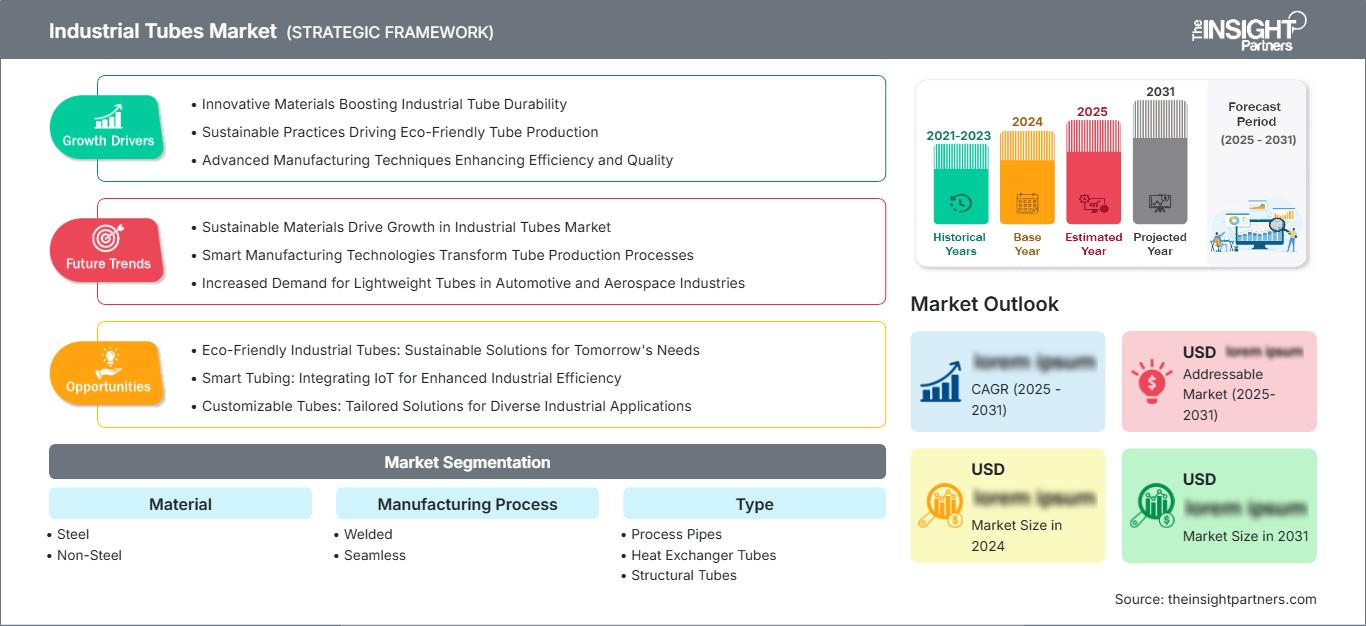
Industrial Tubes Market: Strategic Insights
Regional Insights
North America industrial tubes market
The region’s modelled 27–30% of the global industrial tubes market share in 2025 reflects a broad installed base in energy, chemicals, transportation, and commercial construction. A 4.8–5.4% CAGR through 2034 is supported by replacement of aging water and gas networks, LNG and carbon-management projects, factory construction, and stricter reliability requirements for heat exchangers and process systems.
Canada contributes pipeline, mining, and energy infrastructure demand, while Mexico strengthens automotive and nearshore manufacturing consumption. Regional buyers increasingly specify domestic or traceable material, pressure certification, and corrosion protection. Service centers with inventory near major industrial corridors can capture urgent maintenance demand, while mills offering welded, seamless, mechanical, and instrumentation grades reduce procurement complexity for engineering contractors.
U.S. Industrial Tubes Market
The U.S. represented an estimated 79–82% of North American industrial-tube revenue in 2025 and is forecast to record a 4.9–5.5% CAGR through 2034. The demand is fixed by petrochemical complexes, shale-related refining, power generation, automobiles, data centers, and federal government-sponsored infrastructure. The need for maintenance and renewal ensures an ongoing base of demand, which is not affected by greenfield projects.
United States Steel Corporation retains its domestic steel production capacity and tube exposure; while the global and specialized suppliers compete with the help of distribution agreements and imports. Investment in the storage sector, semiconductors, batteries, and machinery is positive for the structural and mechanical tubes. Pressure-integrity, metallurgy, welding, and test certification help in achieving high prices in heat-exchangers and instrumentation sector.
Europe Industrial Tubes Market
Europe held a modelled 23–26% share in 2025 and is projected to expand at 4.2–4.8% through 2034. Germany stands out in machinery, chemical production, car engineering, and district heating plants. Buyers in Germany have specific requirements such as EN tolerance, certified low-carbon materials, and reliable logistics to pave way for precision machining, heat exchangers, and process tubes.
United Kingdom relies on offshore services, water, and energy transition infrastructures. France contributes through nuclear power, adjacent aerospace engineering, chemicals, and transport machines. Italy is represented by stainless steel processing, machinery exports, and custom mill, while Spain is characterized by renewable energy and industrial structures. It all comes down to alloy expertise, documentation, and fast turn around as European buyers optimize their supplier and carbon footprints.
APAC Industrial Tubes Market
Asia Pacific accounted for a modelled 38–41% share in 2025 and should lead growth at 6.2–6.8% through 2034. China still leads in country market size with manufacturing, infrastructure, petrochemicals, and equipment exports, while India is fast becoming an important growth driver with demand coming from urban construction, water pipelines, refining, and local manufacturing schemes.
Japan and South Korea are strong in high specification automotive, shipping, semiconductors, and energy applications. Australia’s contribution comes from mining, LNG, and water projects. Industrial localization, clean energy, and logistics support policy increases addressable demand, but capacity intensity and competitive exports keep welded tube margins tight.
Middle East & Africa Industrial Tubes Market
The region is forecast to grow at 5.6–6.2% through 2034. Saudi Arabia leads through downstream energy, desalination, utilities, and large urban programs, while the UAE combines petrochemicals, district cooling, logistics, and construction demand. Both markets increasingly favor localized finishing and qualified project supply.
South Africa anchors mining, power, water, and industrial maintenance consumption. The Rest of MEA offers selective opportunities in gas processing, ports, water transmission, and renewable projects. Import reliance remains material, but regional coating, threading, stocking, and fabrication can shorten lead times and improve project responsiveness.
Segmentation Analysis
Material
The material segment is forecast to expand at 5.3–5.9% during 2026–2034. The industrial tubes market scope spans cost-efficient carbon steel, stainless and alloy grades for corrosive service, and non-steel products for conductivity, weight reduction, or specialized chemistry. Selection depends on pressure, temperature, fabrication, compliance, and lifecycle cost.
- Steel: Steel dominates volume because strength, weldability, established standards, and broad grade availability suit structural, process, automotive, and energy applications while supporting economical recycling and fabrication.
- Non-Steel: Copper, aluminum, titanium, and nickel-based tubes address thermal transfer, conductivity, low weight, and severe corrosion, making them strategically important in exchangers, instrumentation, transport, and specialty processing.
Manufacturing Process
Manufacturing process demand is projected to grow at 5.4–6.0% through 2034. Welded production supports scale and dimensional consistency, whereas seamless routes serve high-pressure, high-temperature, and fatigue-sensitive duties. Advanced forming, heat treatment, inline inspection, and traceability are narrowing performance gaps while improving qualification confidence.
- Welded: Welded tubes hold strong volume positions in construction, automotive, water, and low-to-medium pressure service because continuous mills deliver productivity, repeatability, broad dimensions, and competitive conversion costs.
- Seamless: Seamless tubes remain strategically critical for pressure-intensive oil, gas, chemical, boiler, hydraulic, and instrumentation systems where uniform wall integrity and resistance to cyclic stress outweigh higher production costs.
Type
The type segment is expected to advance at 5.5–6.1% during 2026–2034. Product selection increasingly follows functional requirements rather than basic dimensions, encouraging suppliers to combine metallurgy, tolerances, surface condition, test documentation, and fabrication support. Energy transition systems and automated machinery particularly favor higher-value engineered tubes.
- Process Pipes: Process pipes form a major demand pool across refineries, chemical plants, food processing, and utilities, where pressure class, corrosion allowance, weld procedures, and maintenance accessibility guide procurement.
- Heat Exchanger Tubes: Heat exchanger tubes are essential in power, refining, chemicals, HVAC, and desalination, with thermal efficiency, fouling resistance, tube-sheet compatibility, and corrosion performance shaping replacement cycles.
- Structural Tubes: Structural tubes support buildings, warehouses, bridges, industrial frames, and renewable installations, offering high strength-to-weight performance, prefabrication potential, and faster assembly under increasingly standardized design codes.
- Mechanical Tubes: Mechanical tubes serve machinery, automotive components, material handling, agricultural equipment, and precision fabrication, where concentricity, surface finish, machinability, and repeatable tolerances directly influence downstream productivity.
- Hydraulic and Instrumentation Tubes: Hydraulic and instrumentation tubes enable leak-resistant fluid control in factories, energy assets, aerospace-adjacent systems, and mobile equipment, making cleanliness, pressure ratings, bendability, and fitting compatibility decisive.
End-use
End-use demand is forecast to rise at 5.4–6.0% through 2034. Construction supplies scale, oil and gas requires demanding specifications, chemicals drive corrosion-resistant replacement, and automotive programs reward lightweight precision. Suppliers that qualify across multiple sectors can balance investment cycles and improve mill utilization.
- Construction: Construction consumes structural and mechanical tubes in frames, services, façades, temporary works, and utility networks, with urbanization, modular building, safety codes, and project schedules sustaining procurement.
- Chemical: Chemical facilities require process and exchanger tubes resistant to corrosive media, temperature cycling, and shutdown risk, supporting demand for stainless, nickel-alloy, lined, and certified products.
- Oil and Gas: Oil and gas applications prioritize pressure integrity, sour-service resistance, connection quality, and traceability across upstream, midstream, LNG, refining, and petrochemical assets, supporting premium seamless and welded grades.
- Automotive: Automotive demand spans chassis, exhaust, seating, driveline, thermal management, and fluid systems, where lightweighting, crash performance, repeatable forming, and high-volume quality control determine supplier competitiveness.
Opportunity Snapshot
| End-use | Revenue Contribution | Trend Tag | Adoption Stage |
| Construction | High | Modular Frames | Mature |
| Chemical | Medium | Corrosion Control | Scaling |
| Oil and Gas | High | Hydrogen Ready | Scaling |
| Automotive | Medium | Lightweight Chassis | Scaling |
Industrial Tubes Market Growth Drivers and Impact Analysis
Infrastructure renewal expands recurring tube demand
Aging water, gas, industrial, transport, and building systems require replacement regardless of new-project cycles, creating a durable consumption base for the industrial tubes market. Infrastructure development projects, too, create increased pressure on structural components, utility conduit, process piping, and mechanical tubing. The effect goes beyond the weight since the renovation projects involve better coated material with tighter tolerances and known source material. The suppliers with local inventories, machining, and processing facilities can react quickly to fragmented schedule requirements. Engineering specifications ensure lower possibility of substitutions and the use of pre-assembled modules. This, thus, helps the renovating budgets finance not only the bulk welded products but also added value products.
Energy-system investment raises specification intensity
LNG, refining efficiencies, hydrogen, carbon capture, nuclear upkeep, energy production, and electrical grid infrastructure enhance the needs for pressure vessels and corrosion resistance in tubes. According to the International Energy Agency, the world had invested in grid infrastructure above US$ 400 billion in 2024, showing the magnitude of equipment and infrastructure investments, which indirectly include tubes. The energy sector requires high standards of metallurgy, traceability, non-destructive inspection, and certified welding processes, thus driving the value per ton of products up. Seamless tubes have an advantage in high-pressure applications, while welded and heat exchangers' products help in terminals, cooling, substations, and processing facilities. Those companies that qualify for hydrogen-resistant grades and nickel alloy products will see longer projects and stronger margins.
Manufacturing localization strengthens regional supply chains
Reshoring, nearshoring, and domestic-content policies are stimulating factories for semiconductors, batteries, vehicles, machinery, chemicals, and data infrastructure. Each investment results in direct tubulars usage within structural frame, utilities, HVAC, process systems, and manufacturing machines, as well as subsequent repeat purchase for maintenance use. Localization brings different considerations into the decision-making process: guaranteed lead time, local standardization, small lot flexibility, and traceable sourcing, rather than minimum price at the beginning. Regional mills and service centers can address these considerations by matching inventory with industrial clustering and performing finishing adjacent to end customers. This impact would be the greatest if imports require long logistic routes or suffer from trade risks.
Industrial Tubes Market Future Trends
Digital quality records become commercial differentiators
Market trends for industrial tubes will focus increasingly on the digital passport of products relating heat chemistry, process data, testing results, emissions, and chain of custody documentation. Machine vision, ultrasound analysis, and real-time dimension control will contribute to fewer defects and improved efficiency. Users in regulated industries or critical systems may leverage standardized documents for more efficient incoming testing and planning of preventive maintenance. Mills that connect the dots between melting, shaping, heat treatment, surface finishing, and logistics will boost their qualification credibility. Gradually, certified production data will enable condition-based reordering, automated regulatory compliance, and differentiated pricing.
Low-carbon metallurgy reshapes sourcing decisions
The procurement groups will increasingly evaluate embodied carbon together with other characteristics like tensile strength, corrosion resistance, and price. Electric arc furnaces, renewable energy sources, increased recycled material contents, green hydrogen, and mass balance will impact the range of tubes available, especially in Europe and for exports. The emissions intensity of the steel industry in 2023, according to World Steel Association reporting, is 1.92 tonnes of carbon dioxide emitted per tonne of crude steel produced. This reflects how much there is still left to be done. The tube makers will require a reliable way to allocate their carbon emissions and third-party verification.
Industrial Tubes Market Opportunities
Build localized finishing hubs in high-investment corridors
The industrial tubes market forecasts support investment in coating, threading, precision cutting, bending, and testing capacity near Gulf, Indian, Southeast Asian, and North American industrial clusters. Local finishing reduces freight, shortens commissioning schedules, and helps imported or regionally produced mother tubes comply with project-specific requirements. Investors should prioritize corridors with visible pipelines in water, LNG, chemicals, power, data centers, and manufacturing. A hub model can serve multiple end uses while avoiding the capital intensity of integrated steelmaking. Partnerships with distributors and engineering contractors improve demand visibility, and modular equipment allows staged expansion. The strongest returns should come from services that solve certification and lead-time constraints.
Scale high-integrity tubing for hydrogen and carbon management
Hydrogen production, transport, storage, and carbon-capture systems create investable niches for qualified welded, seamless, stainless, and nickel-alloy tubes. Developers face material challenges involving embrittlement, impurities, cyclic pressure, corrosion, and connection integrity, favoring suppliers that can validate performance across realistic operating conditions. Producers should fund testing partnerships, secure relevant approvals, and develop traceable manufacturing windows before project volumes accelerate. Commercial strategies can bundle tube supply with fittings, coatings, spooling, and inspection support. Although timelines remain policy-dependent, early qualification can establish preferred-supplier status and protect margins. Brownfield conversion projects offer nearer-term revenue because existing pipelines and process units require assessment, replacement, or selective upgrading.
Recent Developments
- November 2025: Nippon Steel Corporation renewed a 10-year agreement to supply oil country tubular goods to Shell, reinforcing long-duration demand visibility for premium tubular products used in energy operations and supporting stable supply arrangements amid evolving technical and energy-security requirements
- November 2025: Ratnamani Metals & Tubes Limited advanced capacity projects in Odisha, Kutch, Rajkot, and Saudi Arabia, including expanded spiral-welded pipe, coating, heavy-wall, spooling, and stainless seamless capabilities aligned with infrastructure, hydrogen, nuclear, thermal power, and regional industrial demand
- June 2025: United States Steel Corporation completed its partnership transaction with Nippon Steel Corporation, creating a platform combining U.S. manufacturing assets with technology and capital commitments. The transaction has implications for domestic steel and tubular supply, modernization priorities, and customer access across energy, construction, and industrial applications
Frequently Asked Questions

- Comprehensive Market Sizing and Forecast Analysis
- Detailed Segmentation Analysis
- In-Depth Market Dynamics Assessment
- Regional and Country-Level Insights
- Competitive Landscape and Company Benchmarking
- Strategic Business Intelligence
Recent Reports
Testimonials

The Insight Partners' SCADA System Market report is comprehensive, with valuable insights on current trends and future forecasts. The team was highly professional, responsive, and supportive throughout. We are very satisfied and highly recommend their services.
RAN KEDEM Partner, Reali Technologies LTDs
I requested a report on a very specific software market and the team produced the report in a few days. The information was very relevant and well presented. I then requested some changes and additions to the report. The team was again very responsive and I got the final report in less than a week.
JEAN-HERVE JENN Chairman, Future Analytica
We worked with The Insight Partners for an important market study and forecast. They gave us clear insights into opportunities and risks, which helped shape our plans. Their research was easy to use and based on solid data. It helped us make smart, confident decisions. We highly recommend them.
PIYUSH NAGPAL Sr. Vice President, High Beam Global
The Insight Partners delivered insightful, well-structured market research with strong domain expertise. Their team was professional and responsive throughout. The user-friendly website made accessing industry reports seamless. We highly recommend them for reliable, high-quality research services
YUKIHIKO ADACHI CEO, Deep Blue, LLC.
This is the first time I have purchased a market report from The Insight Partners.While I was unsure at first, I visited their web site and felt more comfortable to take the risk and purchase a market report.I am completely satisfied with the quality of the report and customer service. I had several questions and comments with the initial report, but after a couple of dialogs over email with their analyst I believe I have a report that I can use as input to our strategic planning process.Thank you so much for taking the extra time and making this a positive experience.I will definitely recommend your service to others and you will be my first call when we need further market data.
JOHN SUZUKI President and Chief Executive Officer, Board Director, BK Technologies
I wish to appreciate your support and the professionalism you displayed in the course of attending to my request for information regarding to infectious disease IVD market in Nigeria. I appreciate your patience, your guidance, and the fact that you were willing to offer a discount, which eventually made it possible for us to close a deal. I look forward to engaging The Insight Partners in the future, all thanks to the impression you have created in me as a result of this first encounter.
DR CHIJIOKE ONYIA MANAGING DIRECTOR, PineCrest Healthcare Ltd.Reason to Buy
- Informed Decision-Making
- Understanding Market Dynamics
- Competitive Analysis
- Identifying Emerging Markets
- Customer Insights
- Market Forecasts
- Risk Mitigation
- Boosting Operational Efficiency
- Strategic Planning
- Investment Justification
- Tracking Industry Innovations
- Aligning with Regulatory Trends





 Get Free Sample for