
Interaction Sensor Market Trends, Share & Demand by 2034
Coverage: by Technology (Camera-Based, Voice Recognition, Others); Industry (Consumer Electronics, Entertainment, Automotive, Others) , and Geography (North America, Europe, Asia Pacific, and South and Central America)
- Status : Data Released
- Report Code : TIPRE00012541
- Category : Electronics and Semiconductor
- No. of Pages : 150
- Available Report Formats :


- Last update date : September 21, 2026


2025 Market Size
US$ 5.07 Bn
Base year value
2034 Forecast
US$ 8.1 Bn
Projected by 2034
CAGR 2026-2034
5.34 %
Growth rate
Addressable Market
US$ 59.72 Bn
(2026-2034)
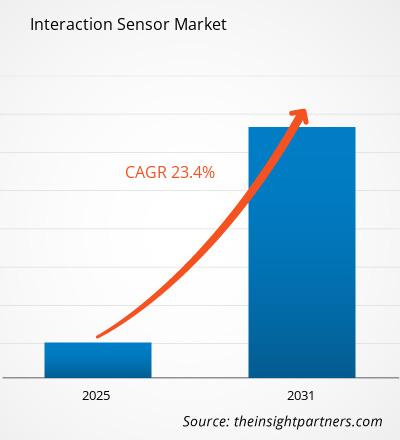
The global Interaction Sensor market was valued at US$ 5.07 billion in 2025 and is expected to reach US$ 8.1 billion by 2034; it is estimated to record a CAGR of 5.34% during 2026-2034.
Interaction Sensor Market Assessment and Insights
- North America: Accounted for 32–35% share in 2025 and is expected to grow at 5.8–6.4% CAGR during 2026–2034, supported by automotive electronics, smart-home penetration, enterprise automation, and advanced semiconductor design ecosystems.
- US: Represented 76–80% of North American revenue in 2025 and is forecast to expand at 5.9–6.5% CAGR, led by connected devices and software-defined vehicle programs.
- Europe: Held 26–29% share in 2025 and is projected to record 5.5–6.1% CAGR, with Germany, the UK, and France leading automotive, industrial, and consumer-interface implementation.
- Asia Pacific: Captured 29–32% share in 2025 and should grow at 6.7–7.4% CAGR, driven by electronics production, vehicle digitization, and smart-device adoption in China, Japan, South Korea, and India.
- Largest Segment: Camera-Based technology represented 43–47% market share in 2025 and is anticipated to grow at 5.8–6.4% CAGR as vision-enabled interfaces scale across devices and vehicles.
- High Growth Segment: Automotive held 20–24% market share in 2025 and is expected to register 7.1–7.8% CAGR as in-cabin monitoring, touchless control, and personalization expand.
- Key companies analyzed in detail: Acconeer AB, Google LLC, Infineon Technologies AG, KEMET Corporation, Microchip Technology Incorporated, Neonode Inc., NXP Semiconductors N.V., Robert Bosch GmbH, TDK Corporation, and Texas Instruments Incorporated.
Source: The Insight Partners' analysis based on proprietary research, government publications, company annual reports, investor presentations, industry databases, and expert interviews.
The technology has come a long way from button-based and basic proximity sensing into fusion technologies such as vision, audio, radar, infrared, and capacitive. The edge inference process removes any interference from ambient noise, lighting differences, and unintended movement from the data before it is sent to the application processor. In addition, production considerations have shifted with sensor module integration, reference software, and common development kits that enable shorter qualification periods. This innovation matches the broader trend in connected displays, smart cabins, gaming systems, home appliances, and collaborative equipment, where dependable recognition becomes a point of differentiation for products.
Up until 2034, the technology adoption could extend further than just premium products thanks to reduced implementation costs via low power processors, standardized interfaces, and scalability of software. Manufacturing investments in Asia Pacific will fuel the growth, whereas vehicle safety regulations in Europe and accessibility demands in North America will spur the multimodal controls trend. Sensor providers that are in a position to build their expertise on top of reusable algorithms, automotive qualifications, and local language voice models can take advantage of design cycles and software's recurring value.
Interaction Sensor Market Report Scope
| Report Attribute | Details |
|---|---|
| Market size in 2025 | US$ 5.07 Billion |
| Market Size by 2034 | US$ 8.1 Billion |
| Global CAGR (2026 - 2034) | 5.34% |
| Historical Data | 2021-2024 |
| Forecast period | 2026-2034 |
Interaction Sensor Market Analysis
The growth of the Interaction Sensor Market is driven by the shift from command-driven to context-sensitive interfaces capable of recognizing gaze, voice, gestures, presence, and proximity. Manufacturers need fewer mechanical controls, increased accessibility, and unique user experiences. In addition, there is a demand for vehicle programs related to driver monitoring and interior customization as well as low-latency spatial input for entertainment applications. Value Chain covers sensing materials and MEMS, cameras and microphones, radar transceivers and microcontrollers, middleware, training data, and software applications.
Market dynamics create advantages for suppliers that have both qualified hardware and reference algorithms. Component sourcing has become more favorable; however, optical components, automotive chips, and advanced packaging still face the risk of extended qualification periods. Therefore, customers source the critical components from multiple vendors and build architectures using general-purpose processors for a wide range of products. Value creation is achieved through optimizing recognition under various lighting, acoustic, and motion conditions as well as enabling edge processing.
The Interaction Sensor Market Report shows that competition arises not from individual sensors, but rather platform readiness, energy constraints, software portability, and qualification assistance. Competition between Infineon Technologies AG, NXP Semiconductors N.V., Texas Instruments Incorporated, Microchip Technology Incorporated, Robert Bosch GmbH, TDK Corporation, and KEMET Corporation relies on their semiconductor portfolio, embedded computing, and application expertise. In addition, Acconeer AB and Neonode Inc. compete on their specialized radar and optical interaction technologies. Google LLC affects the voice recognition and machine learning technology ecosystem.
Multimodal fusion, synthetic data training, private inference, and miniaturization become the direction of future investments. Strategic positioning is contingent upon gaining design wins early due to the prolonged period of work on automotive and appliance projects. Suppliers increase evaluation kits and validated software to reduce development costs for their customers. Collaboration among chip vendors, Tier 1 suppliers, cloud platforms, and original equipment manufacturers becomes increasingly relevant due to the reliance on sensor placement and algorithms coordination for accurate recognition.
● REPORT CUSTOMIZATION
Tailor This Report To Align With Your Specific Business Requirements
This report can be customized to align precisely with your business objectives, scope, and target markets. Customization options include tailored segmentation, geography, competitive analysis, and strategic insights to support informed decision-making.
Customize This Report →WHAT YOU CAN ADJUST
- ● Segmentations
- ● Geography
- ● Competitive Analysis
- ● Language Preferences
Interaction Sensor Market: Strategic Insights
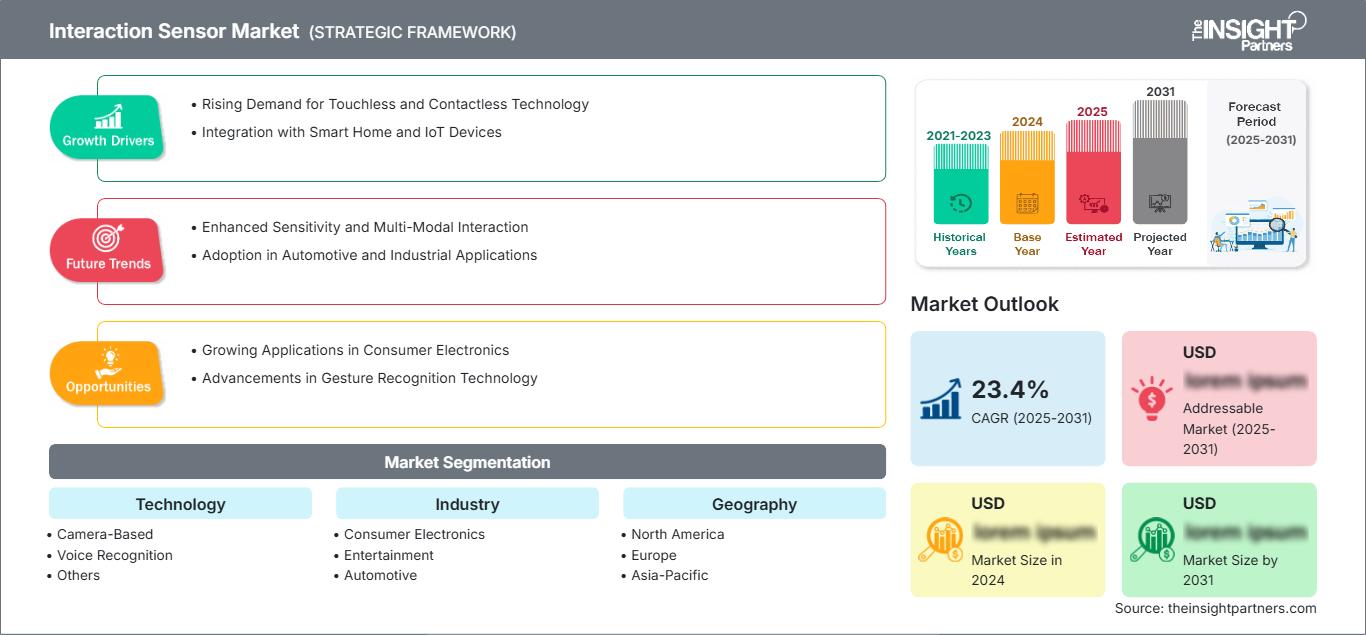
Regional Insights
North America Interaction Sensor Market
The North American region contributed a market share of 32–35% in the year 2025 and will be growing at a CAGR of 5.8–6.4% until 2034. The Interaction Sensor Market Share is attributed to the penetration of smart speakers, superior computing equipment, advanced gaming technology, connected houses, and digitally enabled cars. The robustness of semiconductors, cloud computing, and application software ecosystems speeds up prototyping and commercialization.
Safety in automotive applications, accessibility, and productivity of enterprises form an important criterion in purchases. The manufacturers use the integration of cameras, microphones, radar technology, and proximity sensors to ensure consistency under various operating conditions. The local processing handles the aspects of privacy and latency, and over-the-air software updates increase the utility of the product. Canada adds value through automotive engineering and AI research.
U.S. Interaction Sensor Market
The US accounted for 76%-80% of North American revenues in 2025 and is expected to see 5.9%-6.5% CAGR growth through 2026-2034. Demand will be driven by consumer and platform companies, automotive suppliers, semiconductors, gaming ecosystem providers, and enterprise device manufacturers. Voice technology has been entrenched, yet buyers increasingly pair voice recognition with camera technology, proximity sensing, and short-range radar for enhanced security and better user experience.
Ecosystem designs of the type Google LLC, Texas Instruments Incorporated, and Microchip Technology Incorporated foster localized development of goods, but foreign participants maintain their technical support and customer service. The greatest traction is evident in infotainment, driver monitoring systems, smart displays, home appliances, conferencing tools, and immersive entertainment. Focus on on-device inference, security, efficiency, and compatibility is reflected in purchases. Liability framework in the US and the needs of products will lead to robust fallbacks, thorough performance evaluations, and more knowledgeable consent regarding capture of visuals or sounds.
Europe Interaction Sensor Market
Europe makes up 26-29% of revenue in 2025, with projections of 5.5-6.1% CAGR. Germany holds its place with its automotive engineering, premium cars, industrial automation, and dense Tier 1 system. Its manufacturers are focused on quality, functional safety, and long-term supply agreements, generating demand for camera, radar, touchless, and voice systems designed for complicated operation environment.
The UK brings expertise in AI, games, voice software, and vehicle engineering in combination with strong university and startups ecosystem. France is home to automotive, aerospace, appliance, and smart infrastructure demands. Italian machinery manufacturing and design-driven consumer products generate demand for intuitive controls, while Spanish vehicle assembly and smart building investments support modules deployment. Privacy requirements in Europe promote edge computing and minimization of data, and vehicle safety regulations promote monitoring of drivers and occupants. Under these circumstances, vendors with transparent algorithms, regional languages support, cybersecurity, and product life cycle support are rewarded.
APAC Interaction Sensor Market
In Asia Pacific, revenue generation is in the range of 29-32% in 2025, with an expected CAGR of 6.7-7.4%. China dominates through electronics manufacturing, electric vehicles, appliances, and smart device usage. Japan and South Korea add precision parts, automotive technology, display, and entertainment devices.
India gains from rising demand from the growing number of digital devices and through incentives for manufacturing, while Australia adds its share through smart buildings, mining, and services. Regional policies on semiconductor manufacturing, vehicle safety and automation encourage investment. Cost optimization will remain key, with smaller modules, reuse of software, and multi-language support becoming essential.
Middle East & Africa Interaction Sensor Market
The Middle East & Africa market is expected to expand at 5.3–6.0% CAGR. The UAE leads through smart buildings, aviation, retail, and premium mobility, while Saudi Arabia’s infrastructure programs create demand for intelligent access, entertainment, and automation systems.
South Africa provides contributions through vehicle manufacturing, security systems, and commercial use of technological innovations. The rest of MEA continues to be selective with the deployment of technological innovations in high-value urban applications only. Harsh climates, dust, multilingual user interfaces, and unreliable connectivity call for rugged sensors and edge computing.
Segmentation Analysis
Technology
The technology segment is projected to grow at 5.9–6.5% CAGR during 2026–2034. Interaction Sensor Market scope spans optical capture, acoustic recognition, radar, infrared, capacitive, and proximity architectures. Adoption depends on accuracy, latency, privacy, power consumption, bill of materials, and environmental resilience. Multimodal designs increasingly combine complementary inputs, allowing products to verify intent and maintain performance when lighting, background noise, gloves, or obstructed sightlines reduce the reliability of a single modality.
- Camera-Based: Camera-based systems retain the leading position because they interpret gesture, gaze, posture, and identity, while improving image processors and compact optics support integration into vehicles, displays, and entertainment products.
- Voice Recognition: Voice recognition delivers hands-free control and accessibility across speakers, vehicles, appliances, and enterprise devices, with strategic differentiation increasingly linked to local-language coverage, noise suppression, and on-device processing.
Industry
The industry segment in the Interaction Sensor Market is expected to register 6.1–6.8% CAGR during 2026–2034. Product strategies differ by qualification burden, replacement cycle, user environment, and acceptable latency. Consumer electronics supplies scale, entertainment rewards responsiveness, and automotive programs create longer design visibility with demanding safety and lifecycle requirements. Suppliers increasingly build configurable platforms that share core sensing hardware while adapting algorithms, housings, and interfaces for each sector, improving engineering reuse and purchasing leverage.
- Consumer Electronics: Consumer electronics represents the broadest volume opportunity across phones, computers, appliances, wearables, and smart displays, where compact size, low power, intuitive setup, and competitive component cost determine adoption.
- Entertainment: Entertainment applications prioritize low latency, spatial precision, and continuous tracking for gaming, immersive media, and interactive venues, making sensor fusion and developer-friendly software important for compelling experiences.
- Automotive: Automotive demand is strategically important because driver monitoring, occupant sensing, infotainment, smart access, and touchless control require qualified components, durable software support, and dependable operation across lighting and temperature extremes.
Opportunity Snapshot
| Industry Vertical | Revenue Contribution | Trend Tag | Adoption Stage |
| Consumer Electronics | High | Ambient Computing | Mature |
| Entertainment | Medium | Spatial Input | Scaling |
| Automotive | High | Cabin Intelligence | Scaling |
| Others | Low | Touchless Access | Emerging |
Interaction Sensor Market Growth Drivers and Impact Analysis
Multimodal Interfaces Replace Single-Input Controls
Manufacturers are moving from isolated touch, speech, or gesture functions toward systems that confirm intent through multiple signals. A vehicle can combine gaze direction, spoken commands, hand motion, and occupant position, while a smart display can use presence detection to activate microphones or cameras only when needed. This architecture improves reliability in noisy rooms, low light, and situations where hands are occupied. Commercial impact appears through higher sensor content per device, greater demand for embedded processors, and recurring software calibration. It also creates integration complexity, benefiting suppliers with reference designs, synchronized timing, and tested algorithms. As common computing platforms spread across product families, multimodal capability becomes affordable beyond flagship models and supports differentiated features without redesigning entire hardware stacks.
Edge AI Improves Privacy, Latency, and Operating Efficiency
On-device inference allows interaction systems to classify speech, motion, presence, and posture without continuously transmitting raw audio or images. Lower latency improves gaming, vehicle control, access systems, and appliances, where delayed response undermines trust. Local processing also limits network bandwidth and helps manufacturers implement data-minimization policies. The market impact extends beyond processor demand: developers require optimized models, sensor-fusion middleware, secure memory, and tools that measure accuracy under constrained power budgets. Semiconductor vendors can capture a larger share of system value by bundling sensors, microcontrollers, accelerators, and libraries. Device makers gain predictable operation during connectivity loss, while fleet operators reduce cloud expense. Edge capability therefore converts privacy and performance requirements into concrete hardware and software purchasing decisions.
Vehicle Safety and Cabin Digitization Expand Sensor Content
Software-defined vehicles are replacing mechanical controls with displays, voice, gesture, and contextual automation while adding driver and occupant monitoring. Each function requires dependable sensing that can distinguish deliberate commands from incidental movement. Camera systems identify gaze and posture; radar can detect presence and subtle motion; microphones support hands-free control; proximity sensing enables smart access and trunk activation. Longer vehicle qualification cycles create durable supplier relationships and predictable production volumes after a design win. Safety expectations also push validation across temperature, lighting, vibration, and acoustic conditions, raising barriers to entry. Commercially, the shift increases interaction-sensor content per vehicle and encourages partnerships among semiconductor companies, Tier 1 suppliers, software developers, and automakers to manage integration, cybersecurity, and lifecycle updates.
Interaction Sensor Market Future Trends
Context-Aware Sensor Orchestration
Interaction Sensor Market trends will increasingly center on orchestration rather than continuous operation of every sensing channel. Low-power radar or proximity devices can detect presence and wake higher-power cameras, microphones, or processors only when necessary. Software will select modalities according to lighting, noise, occupancy, privacy settings, and battery status. This approach reduces energy consumption and unnecessary data capture while improving responsiveness. Product differentiation will shift toward policies that determine when sensors activate, how confidence scores are combined, and which information remains local. Suppliers offering interoperable components, secure control layers, and measurable power savings will gain influence over system architecture across vehicles, appliances, computing devices, and buildings.
Synthetic Data and Continuous Model Validation
Development teams will rely more heavily on synthetic data to train and test recognition across rare gestures, cabin layouts, accents, body positions, lighting conditions, and sensor obstructions. Generated scenarios can shorten collection cycles and reduce exposure of personal information, but buyers will demand evidence that simulated performance transfers to physical environments. Continuous validation will become part of lifecycle management as software updates alter behavior after shipment. Suppliers will differentiate through traceable datasets, bias testing, scenario libraries, and monitoring tools that identify performance drift. This trend should expand software and engineering revenue while helping manufacturers launch localized functions faster without collecting every possible real-world condition from scratch.
Interaction Sensor Market Opportunities
Localized Voice and Gesture Platforms for Emerging Markets
Suppliers can address underpenetrated markets by combining regional-language speech models, culturally familiar gestures, offline inference, and low-cost sensor modules. India, Southeast Asia, the Middle East, and Africa present heterogeneous language, connectivity, and device-price conditions that global default interfaces may not serve effectively. Investment should focus on modular software, local testing partnerships, and processors capable of running compressed models without continuous cloud access. Appliance makers, vehicle producers, and public-service operators can adopt these platforms incrementally through common hardware and downloadable language packs. Successful entrants will build distribution and developer support alongside localization, ensuring interfaces remain accurate in crowded acoustic environments, strong sunlight, varied accents, and mixed-language conversations.
Retrofit Interaction Modules for Buildings and Equipment
A substantial opportunity in the Interaction Sensor Market Forecast exists in upgrading installed elevators, kiosks, industrial panels, healthcare-adjacent devices, and commercial access systems without replacing complete assets. Compact camera, radar, infrared, or voice modules can add touchless commands, presence detection, and usage analytics through standard interfaces. Investors should target suppliers that provide rugged enclosures, cybersecurity updates, remote diagnostics, and integration kits for multiple control protocols. Retrofit economics are attractive when installation reduces cleaning, downtime, or manual supervision, but success depends on measurable payback and dependable operation. Channel partnerships with building-service companies, equipment distributors, and system integrators can accelerate deployment and create recurring revenue from software maintenance, calibration, and fleet-level device management.
Recent Developments
- June 2026: NXP Semiconductors N.V. introduced the SAF8444 automotive radar system-on-chip for cost-sensitive Level 2 and Level 2+ platforms. The device integrates camera and radar data processing, supports the 76–81 GHz band, and is designed to reduce thermal, bill-of-material, and central-compute requirements while expanding advanced sensing into mainstream vehicles.
- August 2026: YFORE has unveiled a new ultra-wideband (UWB) radar sensing solution designed to support multiple functions in next-generation vehicles, including occupant safety, intelligent vehicle access and automated parking. The automotive technology company said its latest approach is designed to enable multiple sensing capabilities through a common UWB hardware platform. This could allow automakers to deploy different vehicle functions while reducing the need for separate sensing systems.
- May 2025: NXP Semiconductors N.V. unveiled the S32R47 family of third-generation imaging radar processors. Built in 16 nm FinFET technology, the processors deliver up to twice the processing power of the previous generation and support denser point clouds, improved object separation, and scalable Level 2+ through Level 4 driving applications.
Frequently Asked Questions

- Comprehensive Market Sizing and Forecast Analysis
- Detailed Segmentation Analysis
- In-Depth Market Dynamics Assessment
- Regional and Country-Level Insights
- Competitive Landscape and Company Benchmarking
- Strategic Business Intelligence
Recent Reports
Testimonials

The Insight Partners provided valuable market intelligence that supported our global go-to-market strategy. Their team was professional, responsive, and attentive to our feedback, providing thoughtful analysis and helpful methodological clarifications throughout the project.
Junmo Kim Chief Financial Officer (CFO), Enertech Co., Ltd.
The Insight Partners' SCADA System Market report is comprehensive, with valuable insights on current trends and future forecasts. The team was highly professional, responsive, and supportive throughout. We are very satisfied and highly recommend their services.
RAN KEDEM Partner, Reali Technologies LTDs
I requested a report on a very specific software market and the team produced the report in a few days. The information was very relevant and well presented. I then requested some changes and additions to the report. The team was again very responsive and I got the final report in less than a week.
JEAN-HERVE JENN Chairman, Future Analytica
We worked with The Insight Partners for an important market study and forecast. They gave us clear insights into opportunities and risks, which helped shape our plans. Their research was easy to use and based on solid data. It helped us make smart, confident decisions. We highly recommend them.
PIYUSH NAGPAL Sr. Vice President, High Beam Global
The Insight Partners delivered insightful, well-structured market research with strong domain expertise. Their team was professional and responsive throughout. The user-friendly website made accessing industry reports seamless. We highly recommend them for reliable, high-quality research services
YUKIHIKO ADACHI CEO, Deep Blue, LLC.
This is the first time I have purchased a market report from The Insight Partners.While I was unsure at first, I visited their web site and felt more comfortable to take the risk and purchase a market report.I am completely satisfied with the quality of the report and customer service. I had several questions and comments with the initial report, but after a couple of dialogs over email with their analyst I believe I have a report that I can use as input to our strategic planning process.Thank you so much for taking the extra time and making this a positive experience.I will definitely recommend your service to others and you will be my first call when we need further market data.
JOHN SUZUKI President and Chief Executive Officer, Board Director, BK Technologies
I wish to appreciate your support and the professionalism you displayed in the course of attending to my request for information regarding to infectious disease IVD market in Nigeria. I appreciate your patience, your guidance, and the fact that you were willing to offer a discount, which eventually made it possible for us to close a deal. I look forward to engaging The Insight Partners in the future, all thanks to the impression you have created in me as a result of this first encounter.
DR CHIJIOKE ONYIA MANAGING DIRECTOR, PineCrest Healthcare Ltd.Reason to Buy
- Informed Decision-Making
- Understanding Market Dynamics
- Competitive Analysis
- Identifying Emerging Markets
- Customer Insights
- Market Forecasts
- Risk Mitigation
- Boosting Operational Efficiency
- Strategic Planning
- Investment Justification
- Tracking Industry Innovations
- Aligning with Regulatory Trends





 Get Free Sample for