
IPS Monitor Market Growth, Trends & Forecast by 2034
Coverage: By Type (Under 24 Inch, 24 to 30 Inch, Above 30 Inch); Application (Home Use, Commercial Use) , and Geography (North America, Europe, Asia Pacific, and South and Central America)
- Status : Data Released
- Report Code : TIPRE00019875
- Category : Electronics and Semiconductor
- No. of Pages : 150
- Available Report Formats :


- Last update date : September 21, 2026


2025 Market Size
US$ 13.6 Bn
Base year value
2034 Forecast
US$ 24.35 Bn
Projected by 2034
CAGR 2026-2034
6.69 %
Growth rate
Addressable Market
US$ 171.57 Bn
(2026-2034)
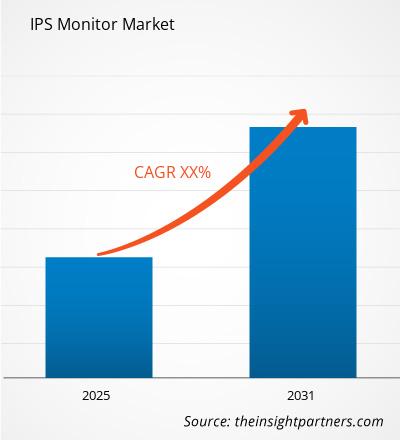
The IPS Monitor Market is projected to expand from US$ 13.6 Billion in 2025 to US$ 24.35 Billion by 2034, registering a 6.69% CAGR during 2026–2034. Demand is supported by monitor replacement cycles, gaming, content creation, hybrid work, and professional visualization. IPS technology remains relevant because of wide viewing angles, color consistency, and improving response performance across mainstream and premium monitor configurations.
North America remains a significant regional market, supported by enterprise hardware refresh, gaming adoption, professional content creation, and demand for larger high-resolution displays. The IPS Monitor Market size benefits from established PC ecosystems and commercial procurement, while energy-efficiency requirements increasingly influence product specifications and purchasing decisions across corporate and institutional customers.
IPS Monitor Market Assessment and Insights
- North America: North America is estimated to hold a 29–33% share in 2025 and grow at a 5.8–6.5% CAGR between 2026–2034, supported by enterprise refresh cycles, gaming, professional workstations, and premium displays.
- US: The US is estimated to represent 80–84% of North America in 2025, expanding at a 5.8–6.5% CAGR between 2026–2034, supported by commercial IT procurement and gaming.
- Europe: Europe is estimated at a 25–29% share in 2025 and a 5.8–6.4% CAGR between 2026–2034, with Germany, the UK, France, Italy, and Spain supporting professional and consumer demand.
- Asia Pacific: Asia Pacific is estimated at a 34–38% share in 2025 and a 7.0–8.0% CAGR between 2026–2034, led by China, Japan, South Korea, India, and Australia.
- Largest Segment: 24 to 30 Inch monitors are estimated at a 52–58% market share in 2025, growing at a 6.3–7.0% CAGR during 2026–2034.
- High Growth Segment: Above 30 Inch monitors represent an estimated 18–22% market share in 2025, with an 8.5–9.5% CAGR during 2026–2034.
- Key companies analyzed in detail: Acer Inc., Sony Corporation, LG Display Co., Ltd., AUO Corporation, Samsung Electronics Co., Ltd., Panasonic Holdings Corporation, Japan Display Inc., BOE Technology Group Co., Ltd., ASUSTeK Computer Inc., Innolux Corporation.
Source: The Insight Partners' analysis based on proprietary research, government publications, company annual reports, investor presentations, industry databases, and expert interviews.
There is a movement away from standard office monitors to differentiated monitors featuring high resolution, fast refresh rates, broad color gamut, ergonomics, and gaming capabilities. Dynamics of monitor production stay largely focused on Asian display ecologies, while brands start balancing panel procurement, contract manufacturing, and product differentiation. According to monitor shipment dynamics, gaming monitors play a role in monitor recovery.
In terms of future growth, there will be a need to focus on premiumization, replacements in the corporate sector, and adoption of large displays in professional settings. Demand in India and South-East Asia is an opportunity to increase sales volume, while the need for energy-efficient products in Europe prompts manufacturers to optimize performance and materials. As a result, investment goes towards technologies and products with visual excellence and compliance.
IPS Monitor Market Report Scope
| Report Attribute | Details |
|---|---|
| Market size in 2025 | US$ 13.6 Billion |
| Market Size by 2034 | US$ 24.35 Billion |
| Global CAGR (2026 - 2034) | 6.69% |
| Historical Data | 2021-2024 |
| Forecast period | 2026-2034 |
IPS Monitor Market Analysis
IPS Monitor Market Growth is driven by replacement of old displays, increasing usage of notebooks and monitors together, gaming, content creation and professional applications requiring uniform picture quality. The supply chain ranges from glass substrates, liquid crystal material, back planes, driver and panel production to monitor assembly, distribution and support. The display supply is clustered in the Asian manufacturing facilities, providing scalability but at the same time making the brands vulnerable to panel prices and logistics variability.
Panel producers and monitor brands are coordinating their product development based on size, resolution, refresh rate and application needs. The Chinese and Taiwanese brands will continue to impact the supply economics of LCDs, while Korean and Japanese companies will keep their positions in advanced display solutions and niche applications. The procurement activities are becoming more oriented toward multiple sourcing due to tariffs, facility relocation and utilization.
As per the IPS Monitor Market Report, competitive positioning will be determined by panel capabilities, branding, industrial design, color performance, refresh rate, connectivity, price, and distribution network. Acer and ASUSTeK Computer Inc. focus on gaming and creator-oriented product lines, whereas Sony Corporation and Panasonic Holdings Corporation enjoy stronger competitive positions in professional and visual applications. Key panel capabilities are provided by LG Display Co., Ltd., AUO Corporation, BOE Technology Group Co., Ltd., Japan Display Inc., and Innolux Corporation.
There is an increasing trend toward investment in premium display segments such as high refresh gaming, Mini-LED, OLED, and large monitors. IPS still holds its strategic significance in the market since the manufacturers can enhance their displays' performance through faster liquid crystal response times, advanced backlighting systems, and faster refresh rates without full conversion into premium self-emitting technology. Data from the industry shows growth in premium monitor categories along with a stable base of monitors.
● REPORT CUSTOMIZATION
Tailor This Report To Align With Your Specific Business Requirements
This report can be customized to align precisely with your business objectives, scope, and target markets. Customization options include tailored segmentation, geography, competitive analysis, and strategic insights to support informed decision-making.
Customize This Report →WHAT YOU CAN ADJUST
- ● Segmentations
- ● Geography
- ● Competitive Analysis
- ● Language Preferences
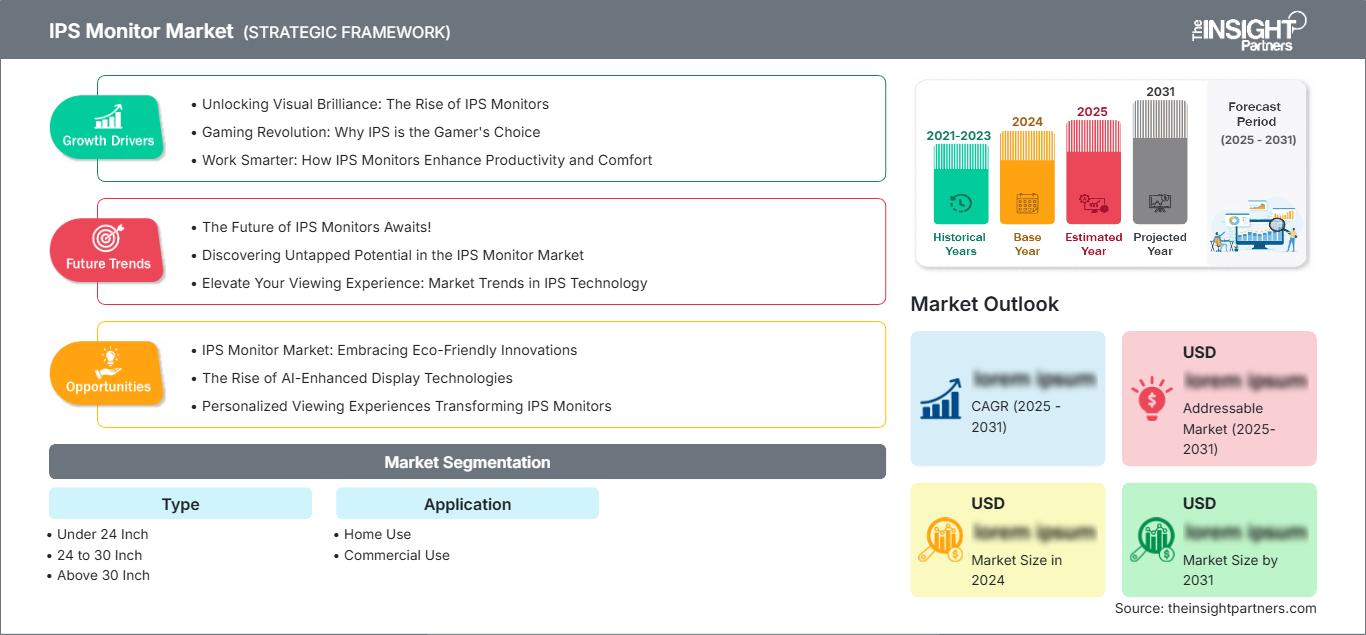
IPS Monitor Market: Strategic Insights
Regional Insights
North America IPS Monitor Market
The North American IPS Monitor Market Share is forecast to hold 29-33% in 2025 with a 5.8-6.5% CAGR up to 2034. The region features mature enterprise IT infrastructure, mature gaming ecosystems, mature professional creative industry, and widespread use of external displays with notebooks. Most regional demand is driven by the US, and Canada adds through business IT, education, government procurement, and creative use.
More and more, the demand is geared towards displays with productivity and performance features. Gaming customers focus on refresh rate and response time, whereas the commercial demand requires ergonomics, connectivity, energy efficiency, and fleet management. The region continues to be a leader of premium monitor technologies even with tariffs uncertainty that might make brands diversify their production and inventory sources. The tracking of shipments in the region confirms that North America is still an important destination of advanced monitor solutions.
U.S. IPS Monitor Market
The U.S. constitutes 80-84% of North America’s 2025 market and will experience a 5.8-6.5% CAGR up to 2034. Enterprise refresh cycles, gaming, working from home, content creation, and professional visualization ensure regular monitor acquisitions by different customer segments.
Competitive offerings include gaming, productivity, creator, and professional line-ups while commercial acquisitions increasingly take into account the energy performance and total cost of ownership. Procurement recommendations for the federal sector promote display acquisition based on energy efficiency; thereby, energy efficiency becomes one of the factors in institutional acquisition. Another driver is the sustained popularity of notebooks since the external monitor offers more space for hybrid workers and professionals.
Europe IPS Monitor Market
Europe is expected to have a share ranging between 25-29%, growing at a CAGR of 5.8-6.4%. Germany has the largest market regionally owing to industrial, corporate and professional computing applications. The UK market is driven by commercial, gaming and media creation applications, while in France, it is both enterprise purchases and consumer purchases. In Italy and Spain, there are more opportunities for small and medium enterprises, gaming, education and household replacement needs. There are more considerations for purchase in Europe with regard to energy efficiency, product longevity and other considerations. Europe's electronic-display directive includes computer monitors through ecodesign and energy labeling requirements.
APAC IPS Monitor Market
APAC will be holding a 34%-38% share by 2025 and will register a growth rate of 7.0-8.0%, becoming the largest regional market. APAC is supported by large-scale display production in China, advanced electronics production in Japan and South Korea, and promising prospects for India thanks to business-oriented IT development, gaming, education and PC penetration, as well as demand from enterprise, educational, creative, and professional applications from Australia.
Middle East & Africa IPS Monitor Market
Middle East and Africa is projected to grow at a 6.0–7.0% CAGR through 2034. Saudi Arabia and the UAE are important demand centers because of digital infrastructure, corporate modernization, education, and gaming investments. South Africa provides opportunities in business computing, education, and creative applications, while the rest of MEA remains more replacement-driven. Demand is gradually moving toward larger and higher-resolution monitors as enterprise digitization and consumer purchasing power improve.
Segmentation Analysis
Type
The Type segment includes Under 24 Inch, 24 to 30 Inch, Above 30 Inch. The segment is projected to expand at a 6.5–7.0% CAGR during 2026–2034. Mainstream sizes remain important for office and household deployments, while larger displays are gaining traction among gamers, creators, and professional users seeking greater workspace and immersive viewing.
- Under 24 Inch: Under 24 Inch monitors remain relevant for compact workstations, education, entry-level computing, and space-constrained deployments, with purchasing decisions emphasizing affordability, low power consumption, and standardized installation.
- 24 to 30 Inch: 24 to 30 Inch monitors occupy the mainstream demand range because they balance workspace, resolution, pricing, and desk requirements across corporate, household, gaming, and general productivity applications.
- Above 30 Inch: Above 30 Inch monitors increasingly address gaming, content creation, professional visualization, and multitasking requirements, supporting premium positioning through larger workspaces, ultrawide formats, and higher resolutions.
Application
The Application segment covers Home Use, Commercial Use and is expected to register a 6.7–7.2% CAGR during 2026–2034. Commercial demand benefits from structured replacement programs, while home demand is increasingly influenced by gaming, entertainment, education, hybrid work, and content creation. The balance between the two applications varies by regional computing maturity and consumer purchasing power.
- Home Use: Home Use demand encompasses personal computing, gaming, entertainment, education, and hybrid work, with buyers increasingly evaluating refresh rates, screen size, connectivity, visual quality, and ergonomic flexibility.
- Commercial Use: Commercial Use remains strategically important for enterprises, government, education, healthcare, and professional services, where standardized fleets, energy performance, reliability, warranty support, and lifecycle costs influence procurement.
Opportunity Snapshot
| Application | Revenue Contribution | Trend Tag | Adoption Stage |
| Home Use | High | Gaming Displays | Mature |
| Commercial Use | High | Fleet Refresh | Mature |
IPS Monitor Market Growth Drivers and Impact Analysis
Gaming and High-Performance Computing Demand
Gaming is strengthening demand for displays that combine high refresh rates, low response times, accurate color reproduction, and increasingly large viewing areas. This benefits IPS manufacturers because improvements in liquid-crystal response and backlighting allow IPS products to compete across mainstream and premium gaming tiers. The impact extends into adjacent creator markets, where users seek high-resolution panels with reliable color performance for video, photography, and design workloads. Competitive gaming also encourages brands to differentiate through refresh-rate specifications and motion clarity. Industry shipment data show gaming monitors have become an important contributor to the broader monitor market recovery, creating a meaningful demand channel for advanced IPS configurations.
Enterprise Display Replacement and Hybrid Work
Enterprise display replacement creates recurring demand because organizations periodically refresh monitors alongside PCs, notebooks, docking infrastructure, and workplace equipment. Hybrid work has also expanded the role of external displays as employees use laptops as primary computing devices while requiring larger screens for productivity. Commercial buyers increasingly evaluate ergonomics, connectivity, energy efficiency, warranty coverage, and fleet standardization rather than focusing only on purchase price. This favors suppliers with broad portfolios and established distribution networks. IPS technology benefits because consistent viewing angles and image quality suit shared offices, financial workstations, design teams, educational environments, and multi-monitor configurations. The resulting procurement cycle supports steady demand even when discretionary consumer spending becomes more cautious.
Expansion of Large-Format and Professional Displays
Demand for larger displays is expanding as users increasingly prioritize multitasking, immersive gaming, professional visualization, and content creation. Larger IPS monitors can replace multi-display setups in some workflows while providing broader horizontal workspace and higher resolution. This creates opportunities for manufacturers to improve average selling prices through ultrawide formats, advanced backlighting, USB-C connectivity, integrated docking, and ergonomic stands. Professional users in design, engineering, finance, and media can justify higher specifications because display quality directly affects workflow efficiency. At the same time, falling panel costs can gradually make larger formats accessible to mainstream consumers. The combination of premiumization and broader affordability supports expansion of the larger-size segment without eliminating demand for established mainstream formats.
IPS Monitor Market Future Trends
Premium IPS Products Will Bridge Mainstream and OLED Categories
The IPS Monitor Market trends increasingly point toward premium IPS products positioned between conventional LCD monitors and OLED displays. Manufacturers are improving IPS response times, contrast, backlighting, HDR performance, resolution, and refresh rates to address applications once associated mainly with premium technologies. Mini-LED backlighting can further enhance brightness control and visual performance while preserving the established IPS production ecosystem. This creates a transitional product category for customers seeking high performance without OLED pricing or long-term burn-in concerns. Brands are likely to maintain multiple technology tiers rather than shift completely toward one panel technology. As premium specifications become more affordable, IPS products can remain relevant across gaming, professional visualization, and high-end productivity applications.
Display Sustainability Will Influence Product Architecture
Environmental performance is expected to become a more important product-design consideration as regulators and institutional buyers emphasize energy efficiency, durability, repairability, and material recovery. European requirements already address electronic displays through energy labelling and ecodesign provisions, while ongoing policy reviews consider further improvements in resource efficiency and circularity. Manufacturers are therefore likely to optimize power consumption, packaging, component accessibility, and product longevity. Software features such as automatic brightness control and power management can complement hardware efficiency improvements. These requirements may influence panel selection, backlight design, electronics, and chassis construction. Suppliers able to document energy and material performance should have stronger access to regulated and institutional markets where procurement criteria extend beyond image quality and purchase price.
IPS Monitor Market Opportunities
Commercial Fleet Modernization
Commercial fleet modernization provides an attractive opportunity because enterprises often manage large installed bases of monitors with different specifications, ages, and connectivity standards. Vendors can target this market with standardized IPS portfolios covering mainstream office sizes, higher-resolution professional models, and specialized multi-display configurations. Bundling displays with USB-C connectivity, docking functionality, ergonomic stands, and centralized procurement can simplify deployment. Buyers increasingly value predictable lifecycle support, warranty service, energy performance, and compatibility with notebook fleets. Suppliers can also develop channel partnerships with system integrators and enterprise resellers to secure recurring replacement contracts. The opportunity is particularly relevant where organizations are consolidating workplace technology after hybrid-work changes and need consistent display experiences across offices and distributed teams.
Professional Visualization and Creator Workflows
Professional visualization offers opportunities for higher-value IPS products serving designers, engineers, photographers, video professionals, architects, financial analysts, and content creators. These users place greater emphasis on color accuracy, resolution, screen area, connectivity, and ergonomic positioning than conventional office buyers. Manufacturers can differentiate through factory calibration, wider color gamuts, high pixel density, Thunderbolt or USB-C connectivity, and integrated workflow features. Large IPS displays can also support multitasking without requiring multiple smaller panels. Investment in creator-oriented products should therefore focus on performance validation and software compatibility rather than simply increasing screen size. Stronger professional positioning can help brands reduce dependence on highly price-sensitive mainstream categories while maintaining the manufacturing advantages of established IPS Monitor Market Forecast.
Recent Developments
- August 2026: Samsung Electronics announced its 2027 Odyssey gaming monitor lineup at Gamescom 2026, the world’s largest gaming event, being held in Cologne, Germany from Aug. 26-30. The new lineup introduces multiple Odyssey models that feature world-first innovations, empowering players with greater versatility across speed, screen size, picture quality, and flexible display modes.
- July 2026: MSI, a global leader in gaming, content creation, and computing hardware, announced the significant expansion of its locally produced monitor portfolio in India. This landmark initiative underscores MSI's steadfast commitment to the Government of India's "Make in India" mission, enabling faster market responsiveness, enhanced product accessibility, and greater value for Indian consumers across the nation.
- June 2025: LG Electronics (LG) is strengthening its B2B market presence with the introduction of the LG UltraFine 40WT95UF, a premium monitor designed to meet the needs of data-intensive industries such as finance and IT. Engineered to boost productivity, the new UltraFine is the world’s first 5K2K (5,120 x 2,160) monitor to support Thunderbolt 5. It features a 40-inch screen with a high refresh rate, along with a variety of convenient multitasking and connectivity options. Available to enterprise customers worldwide, the 40WT95UF underscores LG’s commitment to delivering premium, scalable display solutions for global business needs.
Frequently Asked Questions

- Comprehensive Market Sizing and Forecast Analysis
- Detailed Segmentation Analysis
- In-Depth Market Dynamics Assessment
- Regional and Country-Level Insights
- Competitive Landscape and Company Benchmarking
- Strategic Business Intelligence
Recent Reports
Testimonials

The Insight Partners provided valuable market intelligence that supported our global go-to-market strategy. Their team was professional, responsive, and attentive to our feedback, providing thoughtful analysis and helpful methodological clarifications throughout the project.
Junmo Kim Chief Financial Officer (CFO), Enertech Co., Ltd.
The Insight Partners' SCADA System Market report is comprehensive, with valuable insights on current trends and future forecasts. The team was highly professional, responsive, and supportive throughout. We are very satisfied and highly recommend their services.
RAN KEDEM Partner, Reali Technologies LTDs
I requested a report on a very specific software market and the team produced the report in a few days. The information was very relevant and well presented. I then requested some changes and additions to the report. The team was again very responsive and I got the final report in less than a week.
JEAN-HERVE JENN Chairman, Future Analytica
We worked with The Insight Partners for an important market study and forecast. They gave us clear insights into opportunities and risks, which helped shape our plans. Their research was easy to use and based on solid data. It helped us make smart, confident decisions. We highly recommend them.
PIYUSH NAGPAL Sr. Vice President, High Beam Global
The Insight Partners delivered insightful, well-structured market research with strong domain expertise. Their team was professional and responsive throughout. The user-friendly website made accessing industry reports seamless. We highly recommend them for reliable, high-quality research services
YUKIHIKO ADACHI CEO, Deep Blue, LLC.
This is the first time I have purchased a market report from The Insight Partners.While I was unsure at first, I visited their web site and felt more comfortable to take the risk and purchase a market report.I am completely satisfied with the quality of the report and customer service. I had several questions and comments with the initial report, but after a couple of dialogs over email with their analyst I believe I have a report that I can use as input to our strategic planning process.Thank you so much for taking the extra time and making this a positive experience.I will definitely recommend your service to others and you will be my first call when we need further market data.
JOHN SUZUKI President and Chief Executive Officer, Board Director, BK Technologies
I wish to appreciate your support and the professionalism you displayed in the course of attending to my request for information regarding to infectious disease IVD market in Nigeria. I appreciate your patience, your guidance, and the fact that you were willing to offer a discount, which eventually made it possible for us to close a deal. I look forward to engaging The Insight Partners in the future, all thanks to the impression you have created in me as a result of this first encounter.
DR CHIJIOKE ONYIA MANAGING DIRECTOR, PineCrest Healthcare Ltd.Reason to Buy
- Informed Decision-Making
- Understanding Market Dynamics
- Competitive Analysis
- Identifying Emerging Markets
- Customer Insights
- Market Forecasts
- Risk Mitigation
- Boosting Operational Efficiency
- Strategic Planning
- Investment Justification
- Tracking Industry Innovations
- Aligning with Regulatory Trends





 Get Free Sample for