
Laboratory Informatics Market Trends, Size & Growth by 2034
Coverage: By Solution (Laboratory Information Management Systems, Electronic Lab Notebooks (ELN), Chromatography Data Systems (CDS), Electronic Data Capture (EDC) and Clinical Data Management Systems (CDMS), Laboratory Execution Systems (LES), Enterprise Content Management (ECM), Scientific Data Management Systems); Component (Hardware, Software, Services); Deployment (Cloud Based, Remote, On-Premise), and Geography (North America, Europe, Asia Pacific, and South and Central America)
- Status : Data Released
- Report Code : TIPHE100000963
- Category : Technology, Media and Telecommunications
- No. of Pages : 150
- Available Report Formats :


- Last update date : March 23, 2026


2025 Market Size
US$ 4.8 Bn
Base year value
2034 Forecast
US$ 9.8 Bn
Projected by 2034
CAGR 2026-2034
8.25 %
Growth rate
Addressable Market
US$ 65.57 Bn
(2026-2034)
The global Laboratory Informatics market was valued at US$ 4.8 billion in 2025 and is expected to reach US$ 9.8 billion by 2034; it is estimated to record a CAGR of 8.25% during 2026-2034.
Key market dynamics include an intensifying global push for laboratory automation to minimize human error, the rising volume of data generated by high-throughput clinical research, and the essential integration of AI-driven analytics into scientific workflows. Additionally, the market is expected to benefit from the growing adoption of personalized medicine, increasingly stringent regulatory standards for data integrity (such as 21 CFR Part 11), and the rapid transition toward cloud-based ecosystems that facilitate real-time, cross-border research collaboration.
Laboratory Informatics Market Analysis
The laboratory informatics market analysis reveals a critical transition from isolated data silos to unified, digital laboratory ecosystems. As laboratories face mounting pressure to accelerate R&D cycles and ensure uncompromising data accuracy, the focus has shifted toward actionable intelligence rather than simple data storage. Organizations should prioritize the implementation of interoperable platforms that can seamlessly bridge the gap between bench-side instruments and enterprise-level decision-making tools. Strategic opportunities are expanding in the integration of Artificial Intelligence (AI) and Machine Learning (ML), which transform laboratory informatics from a documentation tool into a diagnostic partner capable of anomaly detection and predictive modeling. For market participants, success depends on offering scalable, cloud-native solutions that address the specific compliance needs of highly regulated sectors like pharmaceuticals and biotechnology.
Laboratory Informatics Market Overview
Laboratory informatics is evolving from a specialized IT niche into the foundational backbone of modern scientific inquiry. This market encompasses a broad suite of software and service solutions, ranging from LIMS to electronic notebooks, designed to optimize the collection, processing, and distribution of laboratory data. The shift toward digital healthcare and the increasing complexity of genomic and proteomic research have made these systems indispensable for maintaining competitive throughput. While traditional on-premise deployments remain relevant for entities with extreme security requirements, the industry is overwhelmingly moving toward Software-as-a-Service (SaaS) models. This evolution is supported by the globalization of clinical trials and the need for decentralized access to scientific data, positioning laboratory informatics as a primary driver of efficiency in the life sciences, chemical, and food and beverage industries. For instance, the market in the US represents the most mature landscape for laboratory informatics, characterized by a high density of pharmaceutical giants and premier research institutions. The market is defined by a rapid pivot toward AI-integrated workflows and cloud-based collaboration, fueled by a robust technological infrastructure and rigorous federal mandates for data security.
Market Assessment and Insights
- Global market for Laboratory Informatics was valued at US$ 4.80 Billion in 2025
- Annual market size is expected to reach US$ 9.80 Billion by 2034
- Total addressable market (TAM) during 2026-2034 is projected to reach approximately US$ 105.63 Billion
- Market is anticipated to register a CAGR of 17.55% during the forecast period
- The United States represents a key market, supported by Rising Demand for Efficiency and Accuracy Drives Adoption, Cloud Computing Transforms Data Management and Collaboration, Compliance with Regulatory Standards Boosts Informatics Adoption, as well as evolving industry dynamics
- Market analysis covers North America, Europe, Asia-Pacific, South and Central America, Middle East and Africa, with growth evaluated across the forecast period
- Market opportunities such as Emerging Economies Present Promising Growth Opportunities, Data Security and Cybersecurity Investment Rise in Laboratories, Emerging Economies Present Promising Growth Opportunities are expected to influence market dynamics and addressable market
- Report profiles industry participants, including Thermo Fisher Scientific Inc., Abbott Informatics, Agilent Technologies, LabWare, LabVantage Solution, Inc, Waters Corporation, IDBS, Perkin Elmer, Autoscribe Informatics, Labworks, Rowland Pharmacy, Optum Rx, Giant Eagle, Inc., Express Script Holding Company, DocMorris, while analyzing competitive strategies and innovation developments
-
Source: The Insight Partners' analysis based on proprietary research, government publications, company annual reports, investor presentations, industry databases, and expert interviews.
● REPORT CUSTOMIZATION
Tailor This Report To Align With Your Specific Business Requirements
This report can be customized to align precisely with your business objectives, scope, and target markets. Customization options include tailored segmentation, geography, competitive analysis, and strategic insights to support informed decision-making.
Customize This Report →WHAT YOU CAN ADJUST
- ● Segmentations
- ● Geography
- ● Competitive Analysis
- ● Language Preferences
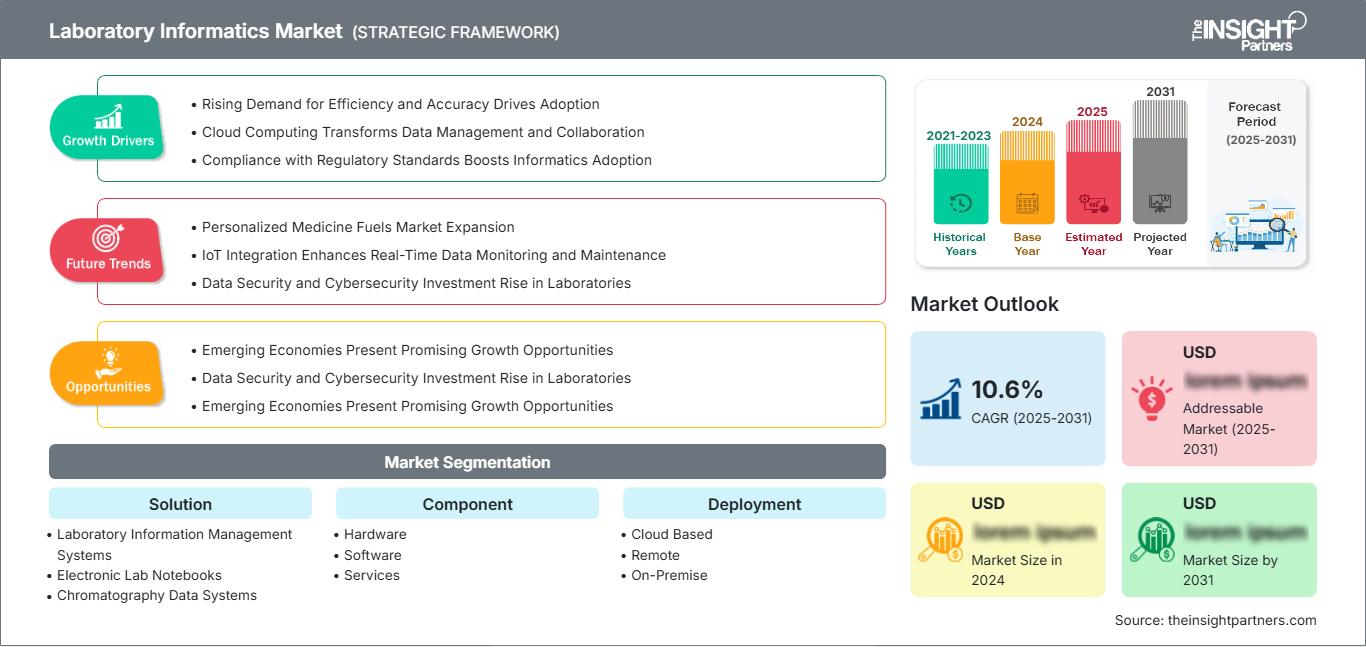
Laboratory Informatics Market: Strategic Insights
-
Get Top Key Market Trends of this report.This FREE sample will include data analysis, ranging from market trends to estimates and forecasts.
Laboratory Informatics Market Drivers and Opportunities
Market Drivers:
- Rising Demand for Laboratory Automation: To combat high rates of manual error in pre-analytical stages, laboratories are increasingly adopting informatics to automate repetitive tasks like sample tracking and pipetting, significantly improving result accuracy and operational speed.
- Stringent Regulatory Compliance and Data Integrity: Increasing global oversight by bodies like the FDA and EMA necessitates robust digital audit trails. Informatics solutions provide the mandatory traceability and electronic signature capabilities required to meet GLP, GMP, and ISO standards.
- Escalation of Research Data Volume: The advent of Omics technologies (genomics, proteomics) produces vast datasets that exceed manual processing capabilities, driving the fundamental need for Scientific Data Management Systems (SDMS) and high-capacity LIMS.
Market Opportunities:
- Integration of AI and Augmented Diagnostics: There is a significant opportunity for vendors to develop NextGen informatics that use AI to move beyond data management into active diagnostic collaboration, helping scientists identify patterns in complex biological data.
- Expansion into Emerging Markets (APAC and MEA): As pharmaceutical outsourcing shifts to regions like India and China, there is a growing demand for Western-standard informatics to ensure that local labs meet international quality and compliance benchmarks.
- Cloud-Enabled Remote Lab Access: The post-pandemic shift toward hybrid work models has created an opening for mobile-compatible, cloud-resident informatics that allow researchers to monitor experiments and validate data from any location.
Laboratory Informatics Market Report Segmentation Analysis
The Laboratory Informatics Market share is analyzed across various segments to provide a clearer understanding of its structure, growth potential, and emerging trends. Below is the standard segmentation approach used in most industry reports:
By Solution:
- Laboratory Information Management Systems (LIMS): Centralized platforms used for sample management and workflow automation; they remain the dominant solution due to their broad utility across various industrial labs.
- Electronic Lab Notebooks (ELN): Digital alternatives to paper notebooks that facilitate the capture of unstructured research data and promote intellectual property protection.
- Chromatography Data Systems (CDS): Specialized software for managing data generated by chromatography instruments, essential for quality control in the chemical and pharma sectors.
- Electronic Data Capture (EDC) & Clinical Data Management Systems (CDMS): Tools designed for clinical trial data collection and management to ensure regulatory readiness.
- Laboratory Execution Systems (LES): Practical how-to systems that guide lab technicians through standard operating procedures (SOPs) to ensure consistency.
- Enterprise Content Management (ECM): Broad systems used to organize and store the entire ecosystem of an organization’s documents and knowledge assets.
- Scientific Data Management Systems (SDMS): Solutions focused on the long-term archiving and retrieval of raw data from various laboratory instruments.
By Component:
- Software: Includes the core applications and licenses; this is a high-growth segment as labs transition to advanced, AI-enabled versions.
- Services: The largest segment by share, encompassing consulting, implementation, training, and ongoing technical support required to maintain complex systems.
- Hardware: Comprises the servers, storage devices, and integrated workstations necessary to host and run informatics platforms.
By Deployment:
- Cloud-Based: The fastest-growing model, offering scalability and lower upfront costs through SaaS, IaaS, and PaaS delivery.
- On-Premise: Preferred by large-scale pharmaceutical companies requiring total control over sensitive data and local server governance.
- Remote: Facilitates off-site management and data access, often used in decentralized or multi-site laboratory networks.
By Geography:
- North America
- Europe
- Asia Pacific
- South & Central America
- Middle East & Africa
Laboratory Informatics Market Report Scope
| Report Attribute | Details |
|---|---|
| Market size in 2025 | US$ 4.8 Billion |
| Market Size by 2034 | US$ 9.8 Billion |
| Global CAGR (2026 - 2034) | 8.25% |
| Historical Data | 2021-2024 |
| Forecast period | 2026-2034 |
| Segments Covered |
By Solution
|
| Regions and Countries Covered |
North America
|
| Market leaders and key company profiles |
|
Laboratory Informatics Market Players Density: Understanding Its Impact on Business Dynamics
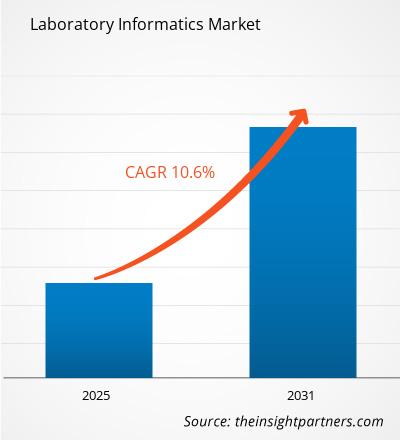
The Laboratory Informatics Market is growing rapidly, driven by increasing end-user demand due to factors such as evolving consumer preferences, technological advancements, and greater awareness of the product's benefits. As demand rises, businesses are expanding their offerings, innovating to meet consumer needs, and capitalizing on emerging trends, which further fuels market growth.
Laboratory Informatics Market Share Analysis by Geography
North America currently commands the largest share of the global laboratory informatics market, while Asia-Pacific region is projected to experience the highest growth rate during the forecast period. The global landscape is characterized by a strategic pivot toward cloud-native ecosystems and AI-integrated analytics, ensuring that laboratories across all geographies can meet the rising demand for high-throughput data processing and uncompromising regulatory compliance.
The laboratory informatics market is undergoing a significant transformation, moving from a secondary support function to the central nervous system of modern scientific research. Growth is driven by the globalization of clinical trials, a surge in personalized medicine R&D, and the increasing adoption of Software-as-a-Service (SaaS) models that reduce capital expenditure. Below is a summary of market share and trends by region:
North America
- Market Share: Holds the dominant global position anchored by a mature pharmaceutical sector and a high density of leading research institutions in the US and Canada.
- Key Drivers:
- Widespread early adoption of cloud-based LIMS and ELN platforms among Big Pharma.
- Stringent FDA 21 CFR Part 11 mandates necessitate advanced digital audit trails.
- High level of federal and private R&D funding for genomic and proteomic research.
- Trends: A rapid shift toward AI-as-a-Service within informatics platforms and the mainstreaming of voice-activated lab assistants and mobile-integrated LIMS for real-time data entry.
Europe
- Market Share: Represents the second-largest market, characterized by robust regulatory frameworks and a strong heritage in chemical and biotech innovation.
- Key Drivers:
- Intense focus on data integrity and GDPR compliance within clinical and diagnostic environments.
- Modernization of aging laboratory infrastructure through the replacement of legacy systems with COTS (Commercial Off-the-Shelf) solutions.
- Strong government initiatives supporting digital health and standardized interoperability.
- Trends: Increasing prioritization of Green Lab informatics that track and optimize resource consumption, alongside the adoption of unified platforms that bridge the gap between R&D and manufacturing (PLM integration).
Asia-Pacific
- Market Share: The fastest-growing region globally, fueled by the massive expansion of Contract Research Organizations (CROs) in China, India, and South Korea.
- Key Drivers:
- Lower operational costs and a growing pool of skilled bioinformatics professionals are driving laboratory outsourcing.
- Government-led digital transformation projects in healthcare and pharmaceutical manufacturing.
- The rising prevalence of chronic diseases necessitates large-scale diagnostic and genomic testing.
- Trends: Heavy reliance on mobile-first informatics solutions and the rapid formalization of Smart Labs that utilize IoT-connected instruments for remote monitoring and automation.
South and Central America
- Market Share: An emerging market with a growing footprint in agricultural research and infectious disease diagnostics.
- Key Drivers:
- Modernization of public health laboratories to improve epidemiological surveillance and data sharing.
- Increasing interest in Mediterranean-style diets and organic exports is driving food safety testing informatics.
- Expanding clinical trial presence by multinational pharmaceutical companies seeking diverse patient populations.
- Trends: Growth of cost-effective, web-based LIMS targeted at small-to-mid-sized labs and the rising use of digital tools for tracking farm-to-table food safety certifications.
Middle East and Africa
- Market Share: Developing market with significant investments in petrochemical research and smart agricultural technology.
- Key Drivers:
- Strategic focus on Smart Agriculture to enhance local food security in arid climates.
- High demand for advanced informatics in the oil and gas sector for quality control and refinery optimization.
- Expansion of specialized genomic centers in GCC countries to support personalized medicine initiatives.
- Trends: Implementation of cloud-resident informatics to overcome local server infrastructure limitations and a focus on high-nutrient pediatric research data management.
High Market Density and Competition
The market is moderately fragmented, with a competitive landscape defined by constant technological upgrades and strategic ecosystem expansions. Key leaders such as Thermo Fisher Scientific, LabWare, and LabVantage Solutions maintain dominance through deep integration with laboratory hardware and comprehensive service offerings.
This competitive environment pushes vendors to differentiate through:
- Ecosystem Connectivity: Developing plug-and-play integrations between informatics software and physical laboratory instruments to create a unified data flow.
- AI and Predictive Analytics: Moving beyond recording data to offering predictive insights on instrument maintenance and experimental outcomes.
- Industry-Specific Specialization: Creating tailored LIMS versions for niche markets such as biobanking, forensics, and environmental testing.
Opportunities and Strategic Moves
- Strategic Mergers & Acquisitions: Industry leaders are acquiring smaller, innovative software firms to quickly add specialized capabilities such as AI-driven notebooks or cloud-native infrastructure.
- Cross-Sector Partnerships: Collaborating with technology firms (e.g., cloud providers or AI specialists) to enhance the scalability and intelligence of laboratory platforms.
Major Companies operating in the Laboratory Informatics Market are:
- Thermo Fisher Scientific Inc.
- Abbott Informatics
- Agilent Technologies
- LabWare
- LabVantage Solution, Inc
- Waters Corporation
- IDBS
- Perkin Elmer
- Autoscribe Informatics
- Labworks
- Rowland Pharmacy
- Optum Rx
- Giant Eagle, Inc.
- Express Script Holding Company
Disclaimer: The companies listed above are not ranked in any particular order.
Laboratory Informatics Market News and Recent Developments
- In January 2026, Thermo Fisher Scientific Inc., the world leader in serving science, announced a strategic collaboration with NVIDIA to power AI-based solutions and laboratory automation at scale. This effort leveraged the NVIDIA Artificial Intelligence (AI) platform alongside Thermo Fisher Scientific solutions to progressively increase the automation, accuracy, and speed of modern facilities. By working together to evolve the digital foundation that powers scientific instruments and infrastructure, the companies successfully integrated advanced Laboratory Informatics to connect vast datasets to powerful AI solutions, helping scientists reduce manual steps and accelerate scientific advancement.
- In September 2025, LabWare, Inc., the global leader in Laboratory Information Management Systems (LIMS) for more than 30 years, announced the release of Clinical Health Solution 5.06. This launch introduced the latest version of its purpose-built Laboratory Informatics platform, specifically designed for managing clinical diagnostics and public health laboratory operations with enhanced efficiency and modern data standards.
Laboratory Informatics Market Report Coverage and Deliverables
The Laboratory Informatics Market Size and Forecast (2021–2034) report provides a detailed analysis of the market covering below areas:
- Laboratory Informatics Market size and forecast at global, regional, and country levels for all the key market segments covered under the scope
- Laboratory Informatics Market trends, as well as market dynamics such as drivers, restraints, and key opportunities
- Detailed PEST and SWOT analysis
- Laboratory Informatics Market analysis covering key market trends, global and regional framework, major players, regulations, and recent market developments
- Industry landscape and competition analysis covering market concentration, heat map analysis, prominent players, and recent developments in the Laboratory Informatics Market.
- Detailed company profiles
Frequently Asked Questions

- Comprehensive Market Sizing and Forecast Analysis
- Detailed Segmentation Analysis
- In-Depth Market Dynamics Assessment
- Regional and Country-Level Insights
- Competitive Landscape and Company Benchmarking
- Strategic Business Intelligence
Recent Reports
Testimonials

The Insight Partners' SCADA System Market report is comprehensive, with valuable insights on current trends and future forecasts. The team was highly professional, responsive, and supportive throughout. We are very satisfied and highly recommend their services.
RAN KEDEM Partner, Reali Technologies LTDs
I requested a report on a very specific software market and the team produced the report in a few days. The information was very relevant and well presented. I then requested some changes and additions to the report. The team was again very responsive and I got the final report in less than a week.
JEAN-HERVE JENN Chairman, Future Analytica
We worked with The Insight Partners for an important market study and forecast. They gave us clear insights into opportunities and risks, which helped shape our plans. Their research was easy to use and based on solid data. It helped us make smart, confident decisions. We highly recommend them.
PIYUSH NAGPAL Sr. Vice President, High Beam Global
The Insight Partners delivered insightful, well-structured market research with strong domain expertise. Their team was professional and responsive throughout. The user-friendly website made accessing industry reports seamless. We highly recommend them for reliable, high-quality research services
YUKIHIKO ADACHI CEO, Deep Blue, LLC.
This is the first time I have purchased a market report from The Insight Partners.While I was unsure at first, I visited their web site and felt more comfortable to take the risk and purchase a market report.I am completely satisfied with the quality of the report and customer service. I had several questions and comments with the initial report, but after a couple of dialogs over email with their analyst I believe I have a report that I can use as input to our strategic planning process.Thank you so much for taking the extra time and making this a positive experience.I will definitely recommend your service to others and you will be my first call when we need further market data.
JOHN SUZUKI President and Chief Executive Officer, Board Director, BK Technologies
I wish to appreciate your support and the professionalism you displayed in the course of attending to my request for information regarding to infectious disease IVD market in Nigeria. I appreciate your patience, your guidance, and the fact that you were willing to offer a discount, which eventually made it possible for us to close a deal. I look forward to engaging The Insight Partners in the future, all thanks to the impression you have created in me as a result of this first encounter.
DR CHIJIOKE ONYIA MANAGING DIRECTOR, PineCrest Healthcare Ltd.Reason to Buy
- Informed Decision-Making
- Understanding Market Dynamics
- Competitive Analysis
- Identifying Emerging Markets
- Customer Insights
- Market Forecasts
- Risk Mitigation
- Boosting Operational Efficiency
- Strategic Planning
- Investment Justification
- Tracking Industry Innovations
- Aligning with Regulatory Trends





 Get Free Sample for