
Small Cell 5G Network Market Size, Share & Demand by 2034
Coverage: by Component (Solutions, Services); Cell Type (Picocells, Femtocells, Microcells); Deployment (Indoor, Outdoor); Radio Technology (5G New Radio Standalone, 5G New Radio Non-Standalone); Application (Enhanced Mobile Broadband, IoT, Machine Type Communications and Ultra Reliable Low Latency Communications, Others) , and Geography (North America, Europe, Asia Pacific, and South and Central America)
- Status : Data Released
- Report Code : TIPRE00006844
- Category : Technology, Media and Telecommunications
- No. of Pages : 150
- Available Report Formats :


- Last update date : March 25, 2026


2025 Market Size
US$ 14.77 Bn
Base year value
2034 Forecast
US$ 183.33 Bn
Projected by 2034
CAGR 2026-2034
32.29 %
Growth rate
Addressable Market
US$ 690.39 Bn
(2026-2034)
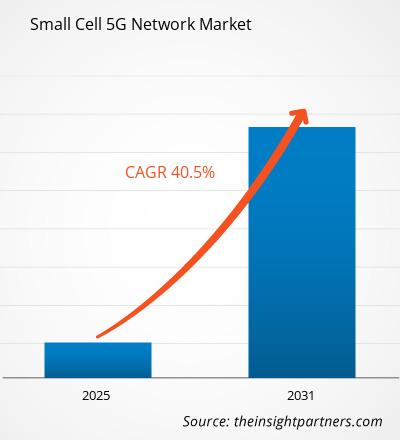
The global Small Cell 5G Network market was valued at US$ 14.77 billion in 2025 and is expected to reach US$ 183.33 billion by 2034; it is estimated to record a CAGR of 32.29% during 2026-2034.
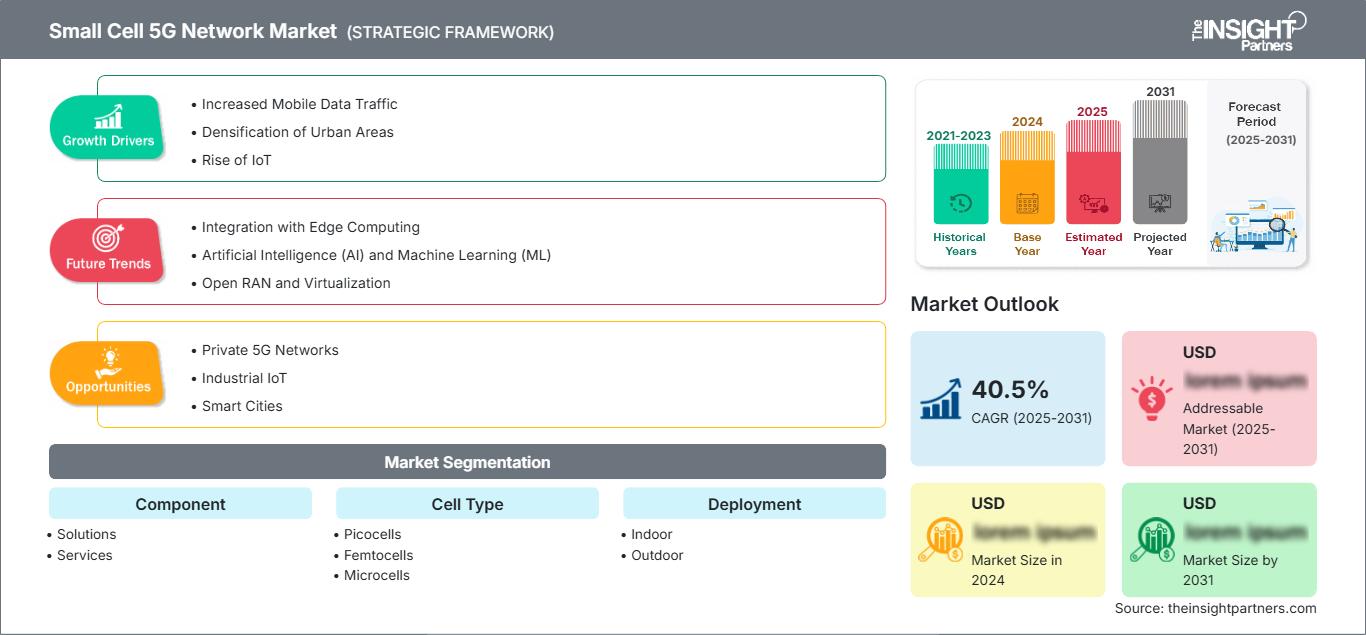
Key market dynamics include the surging demand for high-speed data transmission, the proliferation of Internet of Things (IoT) devices across smart cities, and the critical need for network densification in urban environments. Additionally, the market is expected to benefit from the increasing deployment of private 5G networks in industrial sectors, advancements in Open RAN (Radio Access Network) architectures, and the rising adoption of ultra-reliable low-latency communications (URLLC) for mission-critical applications.
Small Cell 5G Network Market Analysis
The small cell 5G network market analysis indicates a strategic shift toward hyper-dense network architectures as mobile operators struggle to maintain indoor coverage with mid-band and millimeter-wave (mmWave) spectrum. Strategic opportunities are emerging in the Industry 4.0 segment, where small cells serve as the backbone for automated guided vehicles (AGVs) and real-time robotic control. The analysis suggests that vendors should prioritize multi-operator neutral host models to lower deployment costs for enterprises. Furthermore, competitive differentiation is increasingly defined by the integration of Edge Computing capabilities within small cell hardware, allowing for localized data processing. Success in this market depends on navigating complex local regulatory frameworks for site acquisition and ensuring seamless interoperability between macro and small cell layers to optimize user experience.
Small Cell 5G Network Market Overview
The small cell 5G network market is transitioning from a supplemental coverage solution to a primary architectural requirement for 5G standalone (SA) deployments. Unlike previous generations, 5G relies heavily on higher frequency bands, which have limited penetration capabilities, making small cells essential for filling coverage gaps in stadiums, transit hubs, and corporate campuses. The ecosystem involves a mix of traditional telecom equipment giants, neutral host providers, and specialized software-defined networking firms. As global data traffic continues to explode, the market is moving toward plug-and-play small cell solutions that can be easily integrated into existing urban infrastructure like street lamps and utility poles. While early deployments focused on enhanced mobile broadband, the current trend is shifting toward supporting massive IoT and mission-critical communications. For instance, the market in the US is characterized by aggressive mmWave deployments in dense urban centers and a robust transition toward private 5G networks for enterprise use. Federal initiatives to streamline small cell siting and significant investments by major tier-1 carriers are driving the rapid densification of network infrastructure across major metropolitan areas.
Market Assessment and Insights
- Global market for Small Cell 5G Network was valued at US$ 14.77 Billion in 2025
- Annual market size is expected to reach US$ 183.33 Billion by 2034
- Total addressable market (TAM) during 2026-2034 is projected to reach approximately US$ 1,047.12 Billion
- Market is anticipated to register a CAGR of 40.6% during the forecast period
- The United States represents a key market, supported by Increased Mobile Data Traffic, Densification of Urban Areas, Rise of IoT, as well as evolving industry dynamics
- Market analysis covers North America, Europe, Asia-Pacific, South and Central America, Middle East and Africa, with growth evaluated across the forecast period
- Market opportunities such as Private 5G Networks, Industrial IoT, Smart Cities are expected to influence market dynamics and addressable market
- Report profiles industry participants, including Airspan, Cisco Systems, Inc., Comba Telecom Limited, Commscope, Huawei Technologies Co., Ltd., ip.access Ltd., Nokia, SAMSUNG, Telefonaktiebolaget LM Ericsson, ZTE Corporation, while analyzing competitive strategies and innovation developments
-
Source: The Insight Partners' analysis based on proprietary research, government publications, company annual reports, investor presentations, industry databases, and expert interviews.
● REPORT CUSTOMIZATION
Tailor This Report To Align With Your Specific Business Requirements
This report can be customized to align precisely with your business objectives, scope, and target markets. Customization options include tailored segmentation, geography, competitive analysis, and strategic insights to support informed decision-making.
Customize This Report →WHAT YOU CAN ADJUST
- ● Segmentations
- ● Geography
- ● Competitive Analysis
- ● Language Preferences
Small Cell 5G Network Market: Strategic Insights
-
Get Top Key Market Trends of this report.This FREE sample will include data analysis, ranging from market trends to estimates and forecasts.
Small Cell 5G Network Market Drivers and Opportunities
Market Drivers:
- Requirement for Network Densification: As 5G utilizes high-frequency spectrum with shorter ranges, service providers must deploy a higher volume of small cells to ensure consistent signal strength and capacity. This densification is vital for maintaining the high-throughput levels promised by 5G standards in crowded areas.
- Growth of Private LTE/5G Networks: Enterprises are increasingly deploying private networks to gain better control over security, latency, and bandwidth. Small cells are the preferred hardware for these localized networks, particularly in manufacturing, logistics, and mining markets where reliable connectivity is a prerequisite for automation.
- Exponential Increase in Mobile Data Traffic: The surge in high-definition video streaming, augmented reality (AR), and virtual reality (VR) applications is pushing macro cells to their capacity limits. Small cells alleviate this congestion by offloading traffic from the macro network, ensuring a high quality of service for end-users.
Market Opportunities:
- Integration with Smart City Infrastructure: There is a significant opportunity to embed small cells into smart urban projects, such as intelligent lighting and traffic management systems. This neutral host approach allows municipalities to monetize infrastructure while helping carriers expand coverage efficiently.
- Expansion into Rural and Underserved Areas: While the initial focus is urban, small cells offer a cost-effective way to provide high-speed 5G to rural communities and industrial outposts where laying extensive fiber or building large towers is geographically or financially prohibitive.
- Advancements in Open RAN Technology: The move toward open, interoperable interfaces allows smaller vendors to enter the market with specialized small cell components. This fosters innovation and reduces the total cost of ownership for operators by preventing vendor lock-in.
Small Cell 5G Network Market Report Segmentation Analysis
The Small Cell 5G Network Market share is analyzed across various segments to provide a clearer understanding of its structure, growth potential, and emerging trends. Below is the standard segmentation approach used in most industry reports:
By Component:
- Solutions: Includes the physical hardware, such as radio units and baseband units, required for signal processing and transmission.
- Services: Encompass professional services like network planning, installation, maintenance, and managed services that ensure optimal network performance.
By Cell Type:
- Picocells: Small, low-power nodes typically used to boost capacity in large indoor environments like shopping malls or train stations.
- Femtocells: Very low-power base stations primarily used in residential or small office settings to improve localized signal coverage.
- Microcells: Higher-power small cells used in outdoor urban environments to cover larger areas than picocells but smaller than traditional macro cells.
By Deployment:
- Indoor: Targeted at improving coverage inside buildings where macro signals struggle to penetrate walls and glass.
- Outdoor: Focused on urban densification and filling coverage of dead zones in high-traffic outdoor public spaces.
By Radio Technology:
- 5G New Radio Standalone: Networks that run independently of existing 4G infrastructure, offering the full benefits of 5G low latency and slicing.
- 5G New Radio Non-Standalone: Leverages existing 4G LTE cores to facilitate a faster and more cost-efficient initial rollout of 5G services.
By Application:
- Enhanced Mobile Broadband (eMBB): Focuses on providing high data rates for consumer-centric applications like streaming and gaming.
- IoT, Machine Type Communications: Supports the massive connectivity requirements for sensors and smart devices in industrial and urban settings.
- Ultra-Reliable Low Latency Communications (URLLC): Designed for critical applications requiring near-instantaneous response times, such as autonomous vehicles.
- Others: Includes specialized uses in public safety and military communications.
By Geography:
- North America
- Europe
- Asia Pacific
- South & Central America
- Middle East & Africa
Small Cell 5G Network Market Report Scope
| Report Attribute | Details |
|---|---|
| Market size in 2025 | US$ 14.77 Billion |
| Market Size by 2034 | US$ 183.33 Billion |
| Global CAGR (2026 - 2034) | 32.29% |
| Historical Data | 2021-2024 |
| Forecast period | 2026-2034 |
| Segments Covered |
By Component
|
| Regions and Countries Covered |
North America
|
| Market leaders and key company profiles |
|
Small Cell 5G Network Market Players Density: Understanding Its Impact on Business Dynamics
The Small Cell 5G Network Market is growing rapidly, driven by increasing end-user demand due to factors such as evolving consumer preferences, technological advancements, and greater awareness of the product's benefits. As demand rises, businesses are expanding their offerings, innovating to meet consumer needs, and capitalizing on emerging trends, which further fuels market growth.
Small Cell 5G Network Market Share Analysis by Geography
Asia-Pacific is expected to grow fastest in the coming years. Emerging markets in South & Central America, the Middle East, and Africa also have many untapped opportunities for premium infrastructure providers and telecommunications equipment manufacturers to expand.
The small cell 5G network market is undergoing a significant transformation, moving from a traditional coverage supplement to a global high-value digital backbone. Growth is driven by the rising demand for industrial automation, a surge in data consumption, and the expansion of the smart city market. Below is a summary of market share and trends by region:
North America
- Market Share: A dominant and technologically advanced segment driven by early 5G adoption and a robust regulatory environment.
- Key Drivers:
- Rapid deployment of mmWave technology by major telecommunications carriers.
- Strong government support for domestic 5G supply chains and infrastructure modernization.
- High demand for private 5G networks in the healthcare and corporate industries.
- Trends: Increasing focus on neutral host deployments and the integration of small cells with edge computing to support real-time data analytics.
Europe
- Market Share: Holds a significant share globally, anchored by stringent digital transformation goals and the modernization of industrial hubs in Germany, the UK, and France.
- Key Drivers:
- European Union initiatives like the 5G for Europe Action Plan promote cross-border connectivity.
- High concentration of automotive and manufacturing industries requires low-latency connectivity.
- Growing adoption of Open RAN to diversify the vendor ecosystem.
- Trends: A strategic shift toward green energy-powered small cells and the use of urban furniture for discreet outdoor network densification.
Asia-Pacific
- Market Share: The fastest-growing region, with China, South Korea, and Japan acting as the primary engines for large-scale infrastructure deployment.
- Key Drivers:
- Massive consumer base with high mobile penetration and demand for high-bandwidth applications.
- Government-led smart city initiatives and heavy investment in 5G-enabled manufacturing.
- Leading global position in 5G patent filings and hardware manufacturing.
- Trends: Rapid scaling of 5G Standalone networks and a heavy reliance on small cells to support the world's most densely populated urban centers.
South and Central America
- Market Share: Emerging market with a growing focus on improving digital connectivity in major metropolitan areas like Brazil and Argentina.
- Key Drivers:
- Increasing mobile data consumption and the gradual auctioning of 5G spectrum.
- Modernization of telecommunications infrastructure to support digital economy growth.
- Rising interest in 5G for agricultural technology and smart farming.
- Trends: Growth of partnerships between local operators and global equipment vendors to pilot small cell solutions in commercial districts.
Middle East and Africa
- Market Share: Developing market with high-growth pockets in the GCC countries, transitioning toward formalized digital economies.
- Key Drivers:
- Visionary national projects like NEOM and other smart city developments in the Gulf.
- High demand for high-speed connectivity to support digital tourism and finance.
- Strategic investments in 5G infrastructure to diversify economies away from oil.
- Trends: Implementation of small cell networks in luxury real estate developments and a focus on providing 5G connectivity for large-scale international events.
High Market Density and Competition
Competition is intensifying due to the presence of established leaders such as Ericsson, Nokia Corporation, Huawei Technologies Co., Ltd., and Samsung Electronics. Regional experts and niche players like Airspan Networks and CommScope, alongside innovators such as Fujitsu Limited and Rakuten Symphony, also contribute to a diverse and rapidly expanding market landscape.
This competitive environment pushes vendors to differentiate through:
- Energy Efficiency and Design: Positioning small cells as eco-friendly and aesthetically pleasing units that blend into urban environments without requiring significant structural changes.
- Integrated Software Stacks: Companies offer comprehensive software solutions for automated network management, self-healing capabilities, and AI-driven traffic optimization.
- Vertical-Specific Solutions: Providers manage the specialized requirements of different sectors, from intrinsically safe small cells for oil rigs to high-capacity units for sporting arenas.
- Open RAN Compatibility: New processing technologies and open interfaces help create flexible network architectures that allow operators to mix and match hardware and software from different vendors.
Opportunities and Strategic Moves
- Partner with Neutral Host Providers: Collaborate with third-party infrastructure owners to deploy small cells in shared environments, reducing capital expenditure while maximizing network reach.
- Incorporate AI-Driven Analytics: Utilize artificial intelligence to predict traffic patterns and dynamically allocate small cell resources, appealing to operators seeking operational efficiency and reduced power consumption.
Major Companies operating in the Small Cell 5G Network Market are:
- Airspan
- Cisco Systems, Inc.
- Comba Telecom Limited
- Commscope
- Huawei Technologies Co., Ltd.
- ip. access Ltd.
- Nokia
- SAMSUNG
- Ericsson
- ZTE Corporation
Disclaimer: The companies listed above are not ranked in any particular order.
Small Cell 5G Network Market News and Recent Developments
- In February 2026, NTT DATA and Ericsson announced a multi-year strategic partnership to accelerate enterprise adoption of private 5G and unlock advanced edge AI and physical AI use cases. As organizations looked to embed intelligence at the edge across global operations, the partnership combined NTT DATA's IT services with Ericsson's infrastructure to enable an AI-driven, outcome-focused transformation. This collaboration was specifically designed to simplify the deployment and management of a Small Cell 5G Network for industrial and enterprise clients requiring localized, high-performance connectivity.
- In October 2024, Nokia was named a Leader in GlobalData's Small Cells: Competitive Landscape Assessment report. The in-depth study evaluated all leading providers and positioned Nokia as the overall Leader in the Residential and Outdoor categories. In particular, Nokia was commended for being the only vendor to offer an 'All-in-One' Small Cell 5G Network solution for both outdoor and residential use cases available to the global market. GlobalData, a globally recognized data analytics and consulting organization, highlighted the portfolio's compact design and broad spectrum support as key differentiators.
Small Cell 5G Network Market Report Coverage and Deliverables
The Small Cell 5G Network Market Size and Forecast (2021–2034) report provides a detailed analysis of the market covering below areas:
- Small Cell 5G Network Market size and forecast at global, regional, and country levels for all the key market segments covered under the scope
- Small Cell 5G Network Market trends, as well as market dynamics such as drivers, restraints, and key opportunities
- Detailed PEST and SWOT analysis
- Small Cell 5G Network Market analysis covering key market trends, global and regional framework, major players, regulations, and recent market developments
- Industry landscape and competition analysis covering market concentration, heat map analysis, prominent players, and recent developments in the Small Cell 5G Network Market.
- Detailed company profiles
Frequently Asked Questions

- Comprehensive Market Sizing and Forecast Analysis
- Detailed Segmentation Analysis
- In-Depth Market Dynamics Assessment
- Regional and Country-Level Insights
- Competitive Landscape and Company Benchmarking
- Strategic Business Intelligence
Recent Reports
Testimonials

The Insight Partners' SCADA System Market report is comprehensive, with valuable insights on current trends and future forecasts. The team was highly professional, responsive, and supportive throughout. We are very satisfied and highly recommend their services.
RAN KEDEM Partner, Reali Technologies LTDs
I requested a report on a very specific software market and the team produced the report in a few days. The information was very relevant and well presented. I then requested some changes and additions to the report. The team was again very responsive and I got the final report in less than a week.
JEAN-HERVE JENN Chairman, Future Analytica
We worked with The Insight Partners for an important market study and forecast. They gave us clear insights into opportunities and risks, which helped shape our plans. Their research was easy to use and based on solid data. It helped us make smart, confident decisions. We highly recommend them.
PIYUSH NAGPAL Sr. Vice President, High Beam Global
The Insight Partners delivered insightful, well-structured market research with strong domain expertise. Their team was professional and responsive throughout. The user-friendly website made accessing industry reports seamless. We highly recommend them for reliable, high-quality research services
YUKIHIKO ADACHI CEO, Deep Blue, LLC.
This is the first time I have purchased a market report from The Insight Partners.While I was unsure at first, I visited their web site and felt more comfortable to take the risk and purchase a market report.I am completely satisfied with the quality of the report and customer service. I had several questions and comments with the initial report, but after a couple of dialogs over email with their analyst I believe I have a report that I can use as input to our strategic planning process.Thank you so much for taking the extra time and making this a positive experience.I will definitely recommend your service to others and you will be my first call when we need further market data.
JOHN SUZUKI President and Chief Executive Officer, Board Director, BK Technologies
I wish to appreciate your support and the professionalism you displayed in the course of attending to my request for information regarding to infectious disease IVD market in Nigeria. I appreciate your patience, your guidance, and the fact that you were willing to offer a discount, which eventually made it possible for us to close a deal. I look forward to engaging The Insight Partners in the future, all thanks to the impression you have created in me as a result of this first encounter.
DR CHIJIOKE ONYIA MANAGING DIRECTOR, PineCrest Healthcare Ltd.Reason to Buy
- Informed Decision-Making
- Understanding Market Dynamics
- Competitive Analysis
- Identifying Emerging Markets
- Customer Insights
- Market Forecasts
- Risk Mitigation
- Boosting Operational Efficiency
- Strategic Planning
- Investment Justification
- Tracking Industry Innovations
- Aligning with Regulatory Trends





 Get Free Sample for