
Large Language Model Market Share, Demand & Growth by 2034
Large Language Model Market Size and Forecasts (2021 - 2034), Global and Regional Share, Trends, and Growth Opportunity Analysis Report Coverage : By Type (Domain Specific, General Purpose, Multilingual), Model Architecture (Autoregressive Language Models, Autoencoding Language Models, Hybrid Language Models)
- Status : Data Released
- Report Code : TIPRE00039500
- Category : Technology, Media and Telecommunications
- No. of Pages : 150
- Available Report Formats :


- Last update date : July 30, 2026


2025 Market Size
US$ 7.84 Bn
Base year value
2034 Forecast
US$ 121.97 Bn
Projected by 2034
CAGR 2026-2034
35.66 %
Growth rate
Addressable Market
US$ 434.32 Bn
(2026-2034)
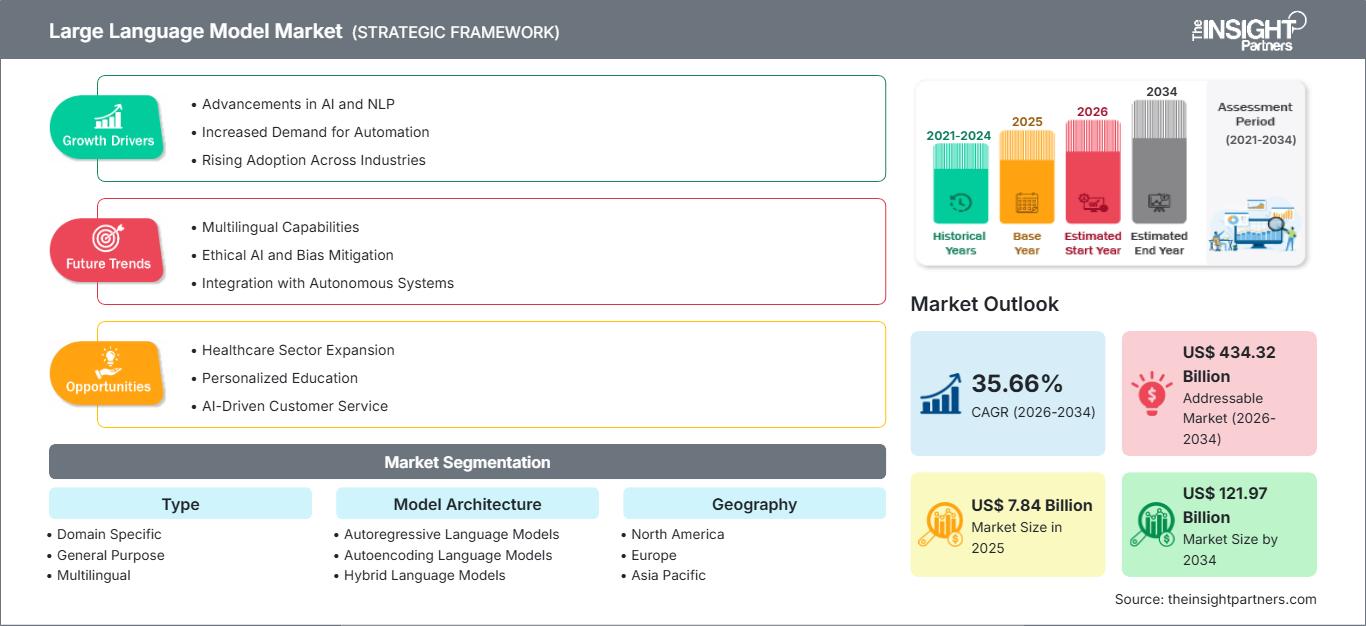
The Large Language Model Market is entering a decisive phase of commercial maturity, with valuation estimated at US$ 7.84 Billion in 2025 and projected to reach US$ 121.97 Billion by 2034, expanding at a CAGR of 35.66% between 2026 and 2034. This trajectory reflects accelerating enterprise adoption, infrastructure investment, and expanding use-case diversity across industries worldwide.
North America is expected to anchor global demand through the forecast period, supported by an estimated regional CAGR range of 34-37% between 2026 and 2034. Current Large Language Model Market size estimates place the region ahead of peers, aided by concentrated hyperscale computing capacity and early enterprise procurement cycles across finance, healthcare, and technology sectors.
Large Language Model Market Assessment and Insights
- North America: The region commands an estimated 36-40% share in 2025 and is projected to grow at a CAGR of 34-37% between 2026 and 2034, driven by dense hyperscaler infrastructure, enterprise AI budgets, and a mature developer ecosystem supporting rapid commercial deployment.
- US: The United States accounts for the majority of North American demand, holding an estimated 84-88% share in 2025 and expanding at a CAGR of 33-36% between 2026 and 2034 on sustained enterprise adoption.
- Europe: Europe holds an estimated 20-24% share in 2025, growing at a CAGR of 33-36% between 2026 and 2034, led by the United Kingdom, Germany, and France, where regulatory clarity and sovereign AI initiatives are shaping deployment models.
- Asia Pacific: Asia Pacific holds an estimated 22-26% share in 2025, expanding at a CAGR of 37-40% between 2026 and 2034, led by China, Japan, and India, where manufacturing digitization and government-backed AI programs accelerate uptake.
- Largest Segment: General Purpose models represent the largest segment, holding an estimated 45-49% share in 2025 and growing at a CAGR of 34-37% between 2026 and 2034, reflecting broad enterprise applicability across functions.
- High Growth Segment: Domain Specific models represent the fastest-growing segment, holding an estimated 27-31% share in 2025 and expanding at a CAGR of 38-41% between 2026 and 2034, as vertical accuracy needs intensify.
- Key companies analyzed in detail: Turing, Cohere Inc., LightOn SA, Stability AI Ltd., OpenAI OpCo, LLC, Anthropic PBC, Meta Platforms, Inc., Microsoft Corporation, NVIDIA Corporation, IBM Corporation, Google LLC, Amazon Web Services, Inc.
Source: The Insight Partners' analysis based on proprietary research, government publications, company annual reports, investor presentations, industry databases, and expert interviews.
The deployment of large language models within enterprises has advanced significantly since early transformer-based implementations, shifting from research-stage experiments to production-level implementations integrated into customer support, software engineering, and analytics processes. Compute-efficient training procedures, retrieval augmented generation, and quantization processes have reduced inference costs, increasing the range of adoptability of the models by businesses. On the other hand, model creators have also widened their model architectures to cater to accuracy, latency, and total cost of ownership, changing buying parameters for their customers.
In the future, adoption will further spread to emerging markets through local or multilingual large language models in an environment with sovereign cloud investments and favorable data governance policies. Improved regulatory environment in leading markets, together with enterprise investment towards generative AI pilots and deployments, will increase the pool of potential buyers of large language models, especially middle-tier businesses that were unable to afford frontier models.
Large Language Model Market Report Scope
| Report Attribute | Details |
|---|---|
| Market size in 2025 | US$ 7.84 Billion |
| Market Size by 2034 | US$ 121.97 Billion |
| Global CAGR (2026 - 2034) | 35.66% |
| Historical Data | 2021-2024 |
| Forecast period | 2026-2034 |
Large Language Model Market Analysis
Enterprise demand for large language models is being propelled by the need for productivity gains in software development, customer engagement, and knowledge management, where automation of repetitive cognitive tasks delivers measurable cost reduction. This Large Language Model Market growth is further reinforced by expanding cloud infrastructure partnerships, which shorten deployment timelines for organizations lacking in-house machine learning expertise, and by falling per-token inference costs that make sustained production use economically viable.
This value chain encompasses semiconductor suppliers, cloud providers, foundation models, and application layer integration players who have distinct pools of margins. The supply chain is limited by the availability of advanced chips and power infrastructure, causing the models to look for customized silicon and distributed data centers as a way to sustain their training and inference capabilities.
Competitive intensity within the Large Language Model Market analysis has increased as OpenAI, Anthropic, and Meta Platforms pursue frontier model leadership while Cohere, LightOn, and Stability AI concentrate on specialized enterprise and multilingual deployments. Microsoft and NVIDIA anchor infrastructure partnerships that determine training throughput, while IBM emphasizes governed enterprise deployment for regulated industries, differentiating on auditability rather than raw benchmark performance.
Investment efforts continue to be centered on better-funded organizations, with partnerships made between chip suppliers and model creators leading to commitments spanning several years regarding compute. Turing has extended itself further by offering training data for models evaluated by humans, along with fine-tuning pipeline evaluation. This trend of positioning indicates that there will be consolidation amongst fewer organizations that can support frontier-scale training economics.
● REPORT CUSTOMIZATION
Tailor This Report To Align With Your Specific Business Requirements
This report can be customized to align precisely with your business objectives, scope, and target markets. Customization options include tailored segmentation, geography, competitive analysis, and strategic insights to support informed decision-making.
Customize This Report →WHAT YOU CAN ADJUST
- ● Segmentations
- ● Geography
- ● Competitive Analysis
- ● Language Preferences
Large Language Model Market: Strategic Insights
Regional Insights
North America Large Language Model Market
North America is projected to maintain its leadership position, holding the largest Large Language Model Market share at an estimated 36-40% in 2025 and expanding at a CAGR of 34-37% between 2026 and 2034. The region benefits from concentrated hyperscale data center capacity, an established venture capital ecosystem, and enterprise procurement cycles that favor rapid pilot-to-production transitions across financial services, technology, and healthcare sectors.
The drivers of structural factors include the investments of the government and private sector into AI infrastructure, the presence of high concentrations of developers of foundation models, and regulations on AI governance in place, which will help enterprises to comply with regulations more easily. The availability of talent in research and development of machine learning and applied engineering only makes the situation even better.
U.S. Large Language Model Market
The United States represents an estimated 84–88% share of the North American Large Language Model Market in 2025, expanding at a CAGR of 33–36% between 2026 and 2034. Model development companies, semiconductor providers, and hyperscale cloud providers are the driving force behind the strong regional positioning in the country due to large corporate IT budgets for their operations in finance, media, and technology segments.
The use of applications focuses on code generation, customer service automation, and enterprise search, with an increasing application in heavily regulated industries, including finance and insurance, due to governance tooling maturation. The list of companies includes OpenAI, Anthropic, Microsoft, NVIDIA, Meta Platforms, and IBM.
Europe Large Language Model Market
Europe is estimated to hold a 20–24% share of the global Large Language Model Market in 2025, growing at a CAGR of 33–36% between 2026 and 2034. Regional demand is shaped by sovereign AI initiatives, data-residency requirements under regional regulation, and enterprise interest in multilingual models suited to fragmented linguistic markets across member states.
The United Kingdom leads regional adoption, supported by a concentrated fintech and professional services base alongside government-backed AI research funding that sustains commercial experimentation among domestic enterprises pursuing early deployment advantages relative to continental peers.
Germany follows closely, with manufacturing and automotive enterprises integrating domain-specific models into engineering and quality workflows, supported by strong public research funding channeled through national AI strategy initiatives targeting industrial competitiveness.
France, Italy, and Spain collectively contribute a growing share, led by France's sovereign model initiatives and public sector digitization programs, while Italy and Spain show rising adoption within banking, telecommunications, and public administration digitization efforts.
APAC Large Language Model Market
Asia Pacific holds an estimated 22-26% share of the global large language model market in 2025, expanding at a CAGR of 37-40% between 2026 and 2034, the fastest among major regions. China leads regional demand through domestic model development and manufacturing digitization, while Japan and South Korea prioritize enterprise automation.
India and Australia contribute to the rising demand, supported by expanding IT services adoption and government digital initiatives. Policy support for domestic AI capability, growing cloud infrastructure investment, and manufacturing sector digitization collectively position Asia Pacific as the region with the strongest structural growth outlook through 2034.
Middle East & Africa Large Language Model Market
The Middle East and Africa are estimated to hold a smaller but rapidly expanding share of the global large language model market in 2025, growing at a CAGR of 36-39% between 2026 and 2034. Saudi Arabia leads regional adoption, backed by sovereign wealth-funded AI infrastructure programs and an economic diversification strategy under national transformation initiatives.
The UAE follows with strong enterprise adoption across finance and government services, while South Africa and the Rest of MEA show early-stage adoption tied to telecommunications modernization. Energy sector digitization and new data center infrastructure investment underpin the region's longer-term growth potential.
Segmentation Analysis
Type
The Type segment of the Large Language Model Market is projected to expand at a CAGR of 35–38% between 2026 and 2034. Enterprises increasingly select model types based on task specificity, balancing generalized capability against domain accuracy requirements, with vendors expanding portfolio breadth to serve both horizontal and vertical use cases simultaneously across regulated and unregulated industries.
- Domain Specific: These models serve specialized industries such as healthcare, legal, and finance, offering higher accuracy on narrow tasks and reduced hallucination risk compared with generalized alternatives in regulated environments.
- General Purpose: These models address broad enterprise use cases including content generation, coding, and analytics, favored for flexibility and lower integration complexity across varied organizational functions.
- Multilingual: These models support cross-border enterprises and public sector deployments requiring accurate performance across multiple languages and regional dialects simultaneously.
Model Architecture
Model Architecture is projected to expand at a CAGR of 34-37% between 2026 and 2034. Architectural choice increasingly reflects latency, context-length, and reasoning requirements, with hybrid designs gaining traction among enterprises seeking to balance generative fluency against structured task accuracy in production environments.
- Autoregressive Language Models: These models dominate current commercial deployment, generating sequential text output well-suited to conversational and creative generation applications across industries.
- Autoencoding Language Models: These models remain preferred for classification, extraction, and understanding tasks where bidirectional context improves accuracy over generative alternatives.
- Hybrid Language Models: These models combine generative and understanding capabilities, gaining adoption among enterprises seeking unified architectures for multi-task deployment.
Opportunity Snapshot
| Industry Vertical | Revenue Contribution | Trend Tag | Adoption Stage |
| BFSI | High | Fraud Detection | Scaling |
| Healthcare and Life Sciences | Medium | Clinical Documentation | Scaling |
| IT and Telecommunications | High | Code Generation | Mature |
| Retail and E-commerce | Medium | Personalized Search | Scaling |
| Manufacturing | Medium | Predictive Maintenance | Emerging |
| Media and Entertainment | Low | Content Automation | Emerging |
| Government and Public Sector | Medium | Citizen Services | Emerging |
Large Language Model Market Growth Drivers and Impact Analysis
Enterprise Productivity Automation Across Cognitive Workflows
Large language models are being used by businesses to automate cognitive processes that would otherwise need specific employee attention, including writing documents, reviewing code, and communicating with clients. Through this practice, the operational costs per transaction decrease and responses become more consistent among departments. Increased productivity is noted by enterprises when coding assistants are adopted in software engineering teams due to quick problem-solving and a shorter training period for new coders. With the decreasing costs of inference due to improved architecture efficiency, the business case for augmenting the workforce becomes even stronger. This will allow not only tech companies, but also laggard sectors like insurance, logistics, and public service to automate their documentation procedures and comply with regulations.
Expanding Cloud Infrastructure and Compute Availability
The hyperscalers are consistently increasing their ability to provide capacity through data centers and AI accelerators, which means lowering barriers for training and deploying large language models for businesses that lack such infrastructure. The collaborations between silicon producers and cloud service providers have significantly lowered the time to access high-performance computing capacity. Small organizations will be able to utilize advanced computing power that is only one step away from being frontier-level by using managed API services rather than spending significant capital on building such infrastructure. In addition, the trend towards democratizing HPC technology is attracting customers that are not the largest tech companies but mid-size corporations in industries like manufacturing, retail, and professional services.
Regulatory Clarity Supporting Enterprise Deployment Confidence
The growing number of AI governance models in significant jurisdictions is giving companies more guidance on how to deploy large language models in areas like finance and healthcare. Accountability for data management, auditing of the model, and its classification in terms of risk lowers legal ambiguity and allows companies to make procurement decisions much faster. Vendors who respond with logging tools, explainability tools, and deployment under governance are getting an outsized market share because of the cautiousness of buyers. With the alignment of jurisdictions and interoperability of governance models, cross-border deployment becomes simpler and allows for larger deployments. This development is anticipated to accelerate the adoption of conservative sectors where the deployment was limited to pilot programs only.
Large Language Model Market Future Trends
Rise of Agentic and Autonomous Task Execution
Large Language Model Market trends are shifting from single-turn conversational interfaces toward autonomous agents capable of executing multi-step workflows with minimal human supervision. These systems increasingly plan, execute, and verify tasks spanning software development, research synthesis, and business process automation across extended sessions. Enterprises are piloting agentic deployment within controlled environments before extending autonomy into production workflows, prioritizing auditability alongside capability. As orchestration frameworks mature, organizations are expected to delegate increasingly complex, multi-tool workflows to autonomous systems, fundamentally reshaping how software teams, operations functions, and knowledge workers structure daily task allocation across enterprise environments over the coming years.
Convergence Toward Specialized and Efficient Model Architectures
Future advancements are predicted to take advantage of specialized, smaller models suited for individual enterprise tasks as opposed to scaling up parameters based on uniformity. Strategies like distillation, routing of a mixture of experts, and efficient fine-tuning have made it possible to achieve similar performance but using fewer computational resources. Such a trend makes it possible for companies to have a range of specialized models for various tasks instead of one general model. As time goes by, it will be more about how flexible, efficient, and broad the ecosystem is when it comes to vendor differentiation.
Large Language Model Market Opportunities
Vertical-Specific Model Development for Regulated Industries
Significant opportunity exists in developing domain-tuned offerings for healthcare, legal, and financial services, where current Large Language Model Market Forecasts point to sustained premium pricing for vendors prioritizing accuracy over raw generative breadth. Partnerships with domain experts and regulators to validate model outputs further differentiate offerings in trust-sensitive markets. As regulated industries mature their AI governance frameworks, vendors with demonstrated compliance credentials and audit-ready deployment architectures stand to capture a disproportionate share of enterprise contracts, particularly in jurisdictions tightening oversight of automated decision-making systems.
Multilingual and Emerging Market Expansion
Increasing capabilities in the domain of multilingual models offers great promise for underserved linguistic markets in Africa, Southeast Asia, and Latin America due to the underperformance of current models with respect to low-resource languages. Companies that choose to invest in localized datasets and regional partnership opportunities have the potential to gain a strong head start before competition starts heating up. Digitization efforts from governments in the same regions further offer government sector opportunities for sovereign and language-specific deployment solutions. Companies that set up shop early are in line to see an outsized slice of the pie as enterprise and government adoption expands.
Frequently Asked Questions

- Comprehensive Market Sizing and Forecast Analysis
- Detailed Segmentation Analysis
- In-Depth Market Dynamics Assessment
- Regional and Country-Level Insights
- Competitive Landscape and Company Benchmarking
- Strategic Business Intelligence
Recent Reports
Testimonials

The Insight Partners provided valuable market intelligence that supported our global go-to-market strategy. Their team was professional, responsive, and attentive to our feedback, providing thoughtful analysis and helpful methodological clarifications throughout the project.
Junmo Kim Chief Financial Officer (CFO), Enertech Co., Ltd.
The Insight Partners' SCADA System Market report is comprehensive, with valuable insights on current trends and future forecasts. The team was highly professional, responsive, and supportive throughout. We are very satisfied and highly recommend their services.
RAN KEDEM Partner, Reali Technologies LTDs
I requested a report on a very specific software market and the team produced the report in a few days. The information was very relevant and well presented. I then requested some changes and additions to the report. The team was again very responsive and I got the final report in less than a week.
JEAN-HERVE JENN Chairman, Future Analytica
We worked with The Insight Partners for an important market study and forecast. They gave us clear insights into opportunities and risks, which helped shape our plans. Their research was easy to use and based on solid data. It helped us make smart, confident decisions. We highly recommend them.
PIYUSH NAGPAL Sr. Vice President, High Beam Global
The Insight Partners delivered insightful, well-structured market research with strong domain expertise. Their team was professional and responsive throughout. The user-friendly website made accessing industry reports seamless. We highly recommend them for reliable, high-quality research services
YUKIHIKO ADACHI CEO, Deep Blue, LLC.
This is the first time I have purchased a market report from The Insight Partners.While I was unsure at first, I visited their web site and felt more comfortable to take the risk and purchase a market report.I am completely satisfied with the quality of the report and customer service. I had several questions and comments with the initial report, but after a couple of dialogs over email with their analyst I believe I have a report that I can use as input to our strategic planning process.Thank you so much for taking the extra time and making this a positive experience.I will definitely recommend your service to others and you will be my first call when we need further market data.
JOHN SUZUKI President and Chief Executive Officer, Board Director, BK Technologies
I wish to appreciate your support and the professionalism you displayed in the course of attending to my request for information regarding to infectious disease IVD market in Nigeria. I appreciate your patience, your guidance, and the fact that you were willing to offer a discount, which eventually made it possible for us to close a deal. I look forward to engaging The Insight Partners in the future, all thanks to the impression you have created in me as a result of this first encounter.
DR CHIJIOKE ONYIA MANAGING DIRECTOR, PineCrest Healthcare Ltd.Reason to Buy
- Informed Decision-Making
- Understanding Market Dynamics
- Competitive Analysis
- Identifying Emerging Markets
- Customer Insights
- Market Forecasts
- Risk Mitigation
- Boosting Operational Efficiency
- Strategic Planning
- Investment Justification
- Tracking Industry Innovations
- Aligning with Regulatory Trends





 Get Free Sample for