
Livestock Monitoring Market Size, Share & Growth by 2034
Coverage: By Component (Hardware, Software, and Services), Animal Type (Cattle, Poultry, Swine, Equine, and Others), and Application (Milk Harvesting Management, Reproduction Management, Feeding Management, Animal Comfort Management and Others), and Geography
- Status : Data Released
- Report Code : TIPTE100001054
- Category : Electronics and Semiconductor
- No. of Pages : 150
- Available Report Formats :


- Last update date : October 13, 2026


2025 Market Size
US$ 3.43 Bn
Base year value
2034 Forecast
US$ 7.59 Bn
Projected by 2034
CAGR 2026-2034
9.22 %
Growth rate
Addressable Market
US$ 49.23 Bn
(2026-2034)
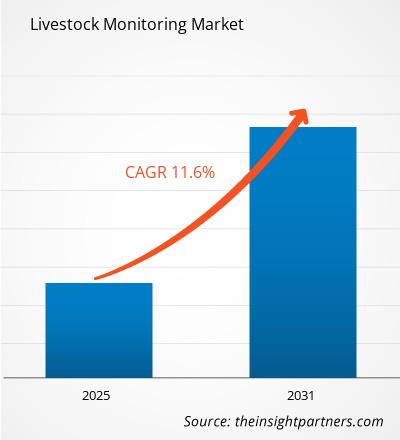
The Livestock monitoring market was valued at US$ 3.43 Billion in 2025 and is projected to reach US$ 7.59 Billion by 2034, registering a CAGR of 9.22% during 2026–2034. Rising emphasis on precision livestock farming, increasing deployment of connected sensing technologies, and the growing need for continuous animal health surveillance are strengthening market adoption. Farmers are increasingly integrating automated monitoring systems to improve herd productivity, optimize operational efficiency, and support sustainable livestock management across commercial farming operations.
Across North America, digital livestock management continues to gain momentum as commercial farms invest in automation, sensor-enabled equipment, and cloud-based analytics to improve production efficiency. The livestock monitoring market size is supported by favorable technology adoption, expanding dairy and meat production, and growing awareness of animal welfare regulations. The regional market is estimated to expand at a CAGR of 8.8%–9.4% during 2026–2034, with the United States accounting for the largest share owing to high technology penetration and advanced farming infrastructure.
Livestock Monitoring Market Assessment and Insights
- North America: The region accounted for 34%–36% share in 2025 and is anticipated to grow at a CAGR of 8.8%–9.4% during 2026–2034, supported by large-scale commercial livestock operations, widespread adoption of precision farming technologies, and favorable digital agriculture initiatives.
- US: The country represented 72%–75% of the North American market in 2025 and is projected to register a CAGR of 8.9%–9.5% during 2026–2034, driven by strong investments in dairy automation, connected farm infrastructure, and herd management technologies.
- Europe: Europe held 27%–29% share in 2025 and is expected to grow at a CAGR of 8.5%–9.1% during 2026–2034. Germany, the Netherlands, France, and the UK continue to lead regional adoption through advanced dairy farming and stringent animal welfare standards.
- Asia Pacific: Asia Pacific captured 23%–25% share in 2025 and is forecast to expand at a CAGR of 10.2%–10.8% during 2026–2034, led by China, India, Australia, and Japan through modernization of livestock production and increasing investments in smart farming.
- Largest Segment: Hardware accounted for 56%–60% market share in 2025 and is expected to grow at a CAGR of 8.7%–9.3% during 2026–2034, reflecting continued deployment of sensors, wearable devices, RFID systems, and automated monitoring equipment.
- High Growth Segment: Animal Comfort Management represented 18%–22% market share in 2025 and is projected to record a CAGR of 10.8%–11.4% during 2026–2034, supported by increasing focus on welfare monitoring, environmental sensing, and productivity enhancement.
- Key companies analyzed in detail: GEA Group AG, Afimilk Ltd., BouMatic LLC, Fullwood Packo Ltd., Fancom B.V., DeLaval Holding AB, Lely Industries N.V., Intervet Inc., Dairymaster, Sensaphone, Inc.
Source: The Insight Partners' analysis based on proprietary research, government publications, company annual reports, investor presentations, industry databases, and expert interviews.
There has been a substantial change in livestock production over the past decade as more and more farmers are moving away from observational practices towards data-based management of their herds. Thanks to the progress of technology such as wearable sensors, RFID tagging, automated milking systems, environmental sensors, and even artificial intelligence, there is now continuous monitoring of health and productivity of animals possible. The technologies help with the early diagnosis of diseases, feed management, fertility monitoring, and increased efficiency. With increased concern regarding food security, traceability, antibiotic resistance, and livestock welfare, the livestock monitoring market growth is further driven by increased investments into precision livestock farming, cloud analytics, and farm management software solutions.
With more emphasis on digital agriculture and sustainable livestock production in emerging markets, there will be an opportunity for new investments in the region in the future. Incentives for the modernization of farms, broadband Internet access, and IoT infrastructure development are facilitating the adoption of the technology by commercial farms. At the same time, evolving regulations for animal health, traceability, and sustainability programs create a favorable environment for solution providers. Such changes should positively impact the competitiveness of the market and its development in the future.
Livestock Monitoring Market Report Scope
| Report Attribute | Details |
|---|---|
| Market size in 2025 | US$ 3.43 Billion |
| Market Size by 2034 | US$ 7.59 Billion |
| Global CAGR (2026 - 2034) | 9.22% |
| Historical Data | 2021-2024 |
| Forecast period | 2026-2034 |
Livestock Monitoring Market Analysis
The market is driven by growing demand for smart farming technologies that increase production efficiency and cut down operational expenses. Modern farmers equip their farms with devices that can monitor movement, eating habits, body temperature, rumination, and reproductive processes in real-time mode. According to the livestock monitoring market report, the integration of cloud computing technologies, artificial intelligence, and predictive analytics has allowed livestock farming to proactively manage herds, lower the mortality rate, and optimize overall production efficiency.
Participants in the supply chain have been building an ecosystem that includes hardware, farm management software, cloud computing platforms, veterinary analytics, and technical support services. Equipment producers more often cooperate with software companies, connectivity solutions providers, and veterinary specialists in order to offer farmers integrated digital solutions for their farms. Improved interoperability of monitoring systems with farm automation technology increases efficiency of decision making and helps meet new requirements for traceability and animal welfare.
Competition remains heightened with the growing innovation, partnerships, and expansion of existing digital platforms by the established agricultural technology companies. Some of the players in the market who remain focused on automation of dairy include GEA Group AG, DeLaval Holding AB, Lely Industries N.V., Afimilk Ltd., and BouMatic LLC. Meanwhile, Fancom B.V., Fullwood Packo Ltd., Dairymaster, Intervet Inc., and Sensaphone, Inc. are developing their monitoring technologies through connectivity, analytics, and animal health monitoring.
Increased investment is taking place in artificial intelligence, machine learning, edge computing, and cloud-enabled livestock intelligence technologies. Technology vendors are now offering software subscriptions along with the hardware systems. Such moves help in generating recurring revenues and retaining customers in addition to improving customer satisfaction. Partnerships with agricultural co-operatives, veterinarians, and digital infrastructure players will enhance the process of commercialization of future livestock monitoring technologies.
● REPORT CUSTOMIZATION
Tailor This Report To Align With Your Specific Business Requirements
This report can be customized to align precisely with your business objectives, scope, and target markets. Customization options include tailored segmentation, geography, competitive analysis, and strategic insights to support informed decision-making.
Customize This Report →WHAT YOU CAN ADJUST
- ● Segmentations
- ● Geography
- ● Competitive Analysis
- ● Language Preferences
Livestock Monitoring Market: Strategic Insights

Regional Insights
North America Livestock Monitoring Market
The North American region represented 34% to 36% of the global livestock monitoring market share in 2025 and is expected to grow at a CAGR of 8.8% to 9.4% in 2026 to 2034. This growth is driven by its high commercialization of dairy, poultry, and swine sectors, which increasingly use digitalization to achieve operational efficiency.
The initiatives from the government for agricultural development, along with high connectivity and farm management tools based on the cloud, are fueling market expansion. Producers are adopting wearable sensors, radio frequency identification technology, automated milking systems, and environmental monitoring systems for higher production in line with animal welfare and traceability criteria. Continuous innovations by technology companies from the region are driving North America's dominant position in the market.
U.S. Livestock Monitoring Market
The USA accounted for 72%–75% of the North American market in 2025 and is expected to witness a CAGR of 8.9%–9.5% from 2026 to 2034. Livestock farming facilities, especially dairy and cattle operations, are turning to connected monitoring systems to enhance their herd health, fertility, feed consumption, and disease control efforts. The presence of technology providers and equipment suppliers is contributing to innovation.
Integration of AI, predictive analytics, and livestock management software in the cloud is helping farmers take more effective decisions based on live animal data. There is high demand for automatic milking systems, health sensor technologies, and smart feeding systems that help boost production without being dependent on manpower.
Europe Livestock Monitoring Market
Europe accounted for 27% to 29% of the total market in 2025 and is anticipated to register a CAGR of 8.5% to 9.1% between 2026 and 2034. Germany continues to dominate the region due to advanced dairy industry, strong automation, and ongoing developments in precision agriculture technologies. Favorable regulatory support for sustainability of livestock continues to drive adoption by commercial farms.
In the UK, the adoption of digital livestock management solutions is increasing with the increased use of animal health technology, farm management technology, and precision dairy technology. In France, Italy, and Spain, adoption of automated feeding systems, reproductive management systems, and environment control systems is rising among farmers to boost their efficiency and compliance with regulation.
APAC Livestock Monitoring Market
Asia-Pacific region held a share of 23%-25% in the global market in 2025 and is predicted to register a CAGR of 10.2%-10.8% in 2026-2034. The dominant region in terms of adoption is China owing to the increased commercial livestock farming, and India, Japan, South Korea, and Australia are further deploying smart farming and digital animal health management solutions.
The increasing government initiatives for the modernization of agriculture sector, awareness regarding livestock production, and growing use of Internet of Things-based monitoring systems will contribute to the growth of demand in the regional market.
Middle East & Africa Livestock Monitoring Market
The Middle East & Africa is projected to record a CAGR of 8.1%–8.7% during 2026–2034, supported by increasing investments in commercial livestock production and modern agricultural infrastructure. Saudi Arabia and the UAE are strengthening technology adoption to improve food security, while South Africa remains a major livestock-producing market within the region.
The use of digital herd management systems, environmental monitoring tools, and automatic feeding equipment is becoming popular among farmers who are trying to increase efficiency while facing tough climate conditions. The government’s efforts to ensure agricultural sustainability and livestock modernization are anticipated to provide positive opportunities for technology companies in RoMEA.
Segmentation Analysis
Component
The component segment represents the technological foundation of the market by integrating physical monitoring devices with intelligent software platforms and support services. Continued investment in connected farming infrastructure, cloud computing, and IoT-enabled livestock management solutions is driving adoption across commercial farms. The segment is expected to expand at a CAGR of 9.0%–9.5% during 2026–2034. The livestock monitoring market scope continues to broaden as integrated ecosystems combine sensors, analytics, and service offerings to deliver real-time operational insights and improve farm productivity.
- Hardware: Hardware maintains the largest market position due to widespread deployment of wearable sensors, RFID tags, smart collars, cameras, gateways, and automated monitoring equipment that enable continuous animal tracking and efficient farm operations.
- Software: Software platforms are increasingly adopted for centralized herd management, predictive analytics, disease detection, production monitoring, and cloud-based reporting. Integration with mobile applications enhances accessibility and supports faster operational decision-making.
- Services: Services include installation, system integration, maintenance, technical support, consulting, training, and software upgrades. Demand continues to increase as livestock producers seek reliable long-term performance and optimized utilization of digital monitoring systems.
Animal Type
Animal type remains a critical segmentation category as monitoring requirements vary according to production objectives, herd size, and disease management priorities. Commercial livestock producers increasingly adopt species-specific technologies that improve productivity, animal welfare, and operational efficiency. This segment is projected to register a CAGR of 9.3%–9.8% during 2026–2034, supported by expanding precision livestock farming across developed and emerging agricultural economies.
- Cattle: Cattle account for the largest adoption owing to extensive use of automated milking systems, health monitoring wearables, reproductive management platforms, and feeding optimization technologies across dairy and beef production facilities.
- Poultry: Poultry producers utilize environmental monitoring, automated climate control, feed optimization, and flock health surveillance systems to improve production efficiency while reducing mortality and disease transmission risks.
- Swine: Swine operations increasingly implement intelligent monitoring solutions for environmental control, feeding management, reproductive tracking, and disease prevention to improve productivity and strengthen biosecurity practices.
- Equine: Equine monitoring technologies support health assessment, movement tracking, recovery monitoring, and performance evaluation for breeding, veterinary care, and professional training applications across commercial equine facilities.
Application
Application-based deployment continues to expand as livestock producers adopt specialized solutions addressing different stages of animal management. Advanced monitoring technologies improve productivity through continuous data collection and automated decision support. The application segment is expected to grow at a CAGR of 9.6%–10.2% during 2026–2034, reflecting increasing investment in intelligent farm management systems across commercial livestock operations.
- Milk Harvesting Management: Automated milking systems, milk quality monitoring, and production analytics improve dairy efficiency, reduce labor requirements, enhance animal comfort, and support consistent milk yield across modern dairy farms.
- Reproduction Management: Digital reproductive monitoring enables accurate estrus detection, breeding optimization, pregnancy tracking, and reproductive performance analysis, helping producers improve herd genetics and overall production efficiency.
- Feeding Management: Intelligent feeding solutions monitor feed intake, optimize nutrition plans, reduce feed waste, and improve livestock growth performance through real-time data collection and automated feeding technologies.
- Animal Comfort Management: Animal comfort management solutions monitor temperature, humidity, ventilation, resting behavior, and environmental conditions, enabling producers to improve welfare, reduce stress, enhance productivity, and support sustainable livestock farming practices.
Opportunity Snapshot
| Application | Revenue Contribution | Trend Tag | Adoption Stage |
|---|---|---|---|
| Milk Harvesting Management | High | Robotic Milking | Mature |
| Reproduction Management | High | Heat Detection | Scaling |
| Feeding Management | Medium | Precision Feeding | Scaling |
| Animal Comfort Management | Medium | Welfare Sensors | Emerging |
Livestock Monitoring Market Growth Drivers and Impact Analysis
Expansion of Precision Livestock Farming Technologies
Precision livestock farming will become an important investment area for commercial livestock producers looking to enhance their productivity and efficiency, as well as animal welfare. Connected sensors, RFID technologies, wearables, automated milking systems, and cloud analytics support real-time tracking of the animals' health and behaviors, allowing early disease detection and improved resource management. Labor shortages in the leading livestock producing countries are pushing farmers toward automation, as there is less need for human interaction. Artificial intelligence and predictive analysis will help implement proactive herd management, reducing production risks and enhancing breeding and feeding processes. With the development of digital agriculture ecosystems, technology vendors are offering increasingly sophisticated software platforms that can be used by farms of various sizes, leading to constant demand for intelligent livestock management solutions.
Growing Focus on Animal Health, Traceability, and Regulatory Compliance
There have been increasing efforts by governments and livestock producers to invest in disease surveillance, food safety, and transparency of the food supply chain, thus favoring the adoption of monitoring technologies. Real-time identification of animals and real-time animal monitoring enhance traceability during the production process while facilitating a quick response to any disease outbreak. The strict welfare requirements in animal rearing are encouraging farmers to embrace real-time monitoring of their environment, as well as feeding and movement of the animals. Veterinarians also get the advantage of access to real-time data regarding the health status of the animals, hence the ability to adopt preventive healthcare.
Advancements in Cloud Computing and Artificial Intelligence Integration
Rapid improvements in cloud computing, edge processing, wireless connectivity, and artificial intelligence are transforming livestock management from reactive practices to predictive decision-making. Modern monitoring platforms consolidate data collected from multiple sensors into centralized dashboards capable of generating actionable insights for producers. Machine learning algorithms identify behavioral changes associated with disease, reproductive cycles, nutritional deficiencies, or environmental stress before visible symptoms appear. Integration with mobile applications enables remote monitoring and faster operational responses across geographically dispersed farms. Subscription-based software platforms also lower adoption barriers by reducing upfront technology investments while providing continuous updates, analytics, and technical support, making digital livestock monitoring increasingly accessible to commercial producers worldwide.
Livestock Monitoring Market Future Trends
Artificial Intelligence Transforming Predictive Herd Management
Artificial intelligence is becoming a defining technology for next-generation livestock operations by converting continuous streams of animal data into predictive recommendations. The livestock monitoring market trends indicate increasing adoption of machine learning algorithms capable of identifying subtle behavioral changes associated with illness, estrus, nutritional imbalance, or environmental stress before clinical symptoms become evident. AI-powered platforms are also improving feed optimization, reproductive planning, and herd productivity through automated decision support. As edge computing, cloud connectivity, and low-power sensors continue to advance, predictive livestock management will become more accurate, scalable, and economically viable for both large commercial enterprises and medium-sized farms, encouraging wider deployment across global livestock production systems.
Integrated Digital Farm Ecosystems Becoming Industry Standard
Future livestock operations are expected to rely on integrated digital ecosystems that connect wearable sensors, automated milking systems, feeding equipment, environmental monitoring devices, veterinary platforms, and enterprise farm management software through unified cloud infrastructure. These interconnected systems reduce operational silos while enabling centralized monitoring across multiple production facilities. Open-platform architectures and standardized communication protocols are improving interoperability between equipment supplied by different manufacturers. Increasing availability of mobile dashboards and remote management capabilities will further enhance operational visibility, reduce downtime, and support data-driven decision-making. This transition toward fully connected farms is expected to strengthen productivity, sustainability, and long-term operational resilience.
Livestock Monitoring Market Opportunities
Expansion Across Emerging Commercial Livestock Economies
Rapid commercialization of livestock farming in Asia Pacific, Latin America, the Middle East, and parts of Africa presents significant long-term investment potential for technology providers. Livestock monitoring market Forecasts suggest increasing adoption of digital herd management platforms as governments encourage agricultural modernization, food security, and productivity improvements. Rising investments in dairy processing, poultry integration, and commercial swine production are creating demand for intelligent monitoring solutions that improve operational efficiency while reducing disease-related losses. Vendors capable of delivering scalable, cost-effective platforms supported by local distribution networks, training programs, and after-sales services are expected to strengthen market penetration across these high-growth agricultural economies.
Subscription-Based Digital Platforms and Managed Services
Technology providers have substantial opportunities to expand recurring revenue through software subscriptions, cloud analytics, predictive maintenance, and managed monitoring services. Rather than relying solely on hardware sales, companies are increasingly introducing integrated service models that include remote diagnostics, system optimization, veterinary analytics, software updates, and technical support. These offerings improve customer retention while lowering initial investment requirements for livestock producers. As internet connectivity improves across rural regions, cloud-enabled platforms will become increasingly attractive for farms seeking continuous operational insights without maintaining extensive on-site information technology infrastructure. This business model is expected to support sustainable revenue growth while accelerating digital transformation across the livestock industry.
Frequently Asked Questions

- Comprehensive Market Sizing and Forecast Analysis
- Detailed Segmentation Analysis
- In-Depth Market Dynamics Assessment
- Regional and Country-Level Insights
- Competitive Landscape and Company Benchmarking
- Strategic Business Intelligence
Recent Reports
Testimonials

The Insight Partners provided valuable market intelligence that supported our global go-to-market strategy. Their team was professional, responsive, and attentive to our feedback, providing thoughtful analysis and helpful methodological clarifications throughout the project.
Junmo Kim Chief Financial Officer (CFO), Enertech Co., Ltd.
The Insight Partners' SCADA System Market report is comprehensive, with valuable insights on current trends and future forecasts. The team was highly professional, responsive, and supportive throughout. We are very satisfied and highly recommend their services.
RAN KEDEM Partner, Reali Technologies LTDs
I requested a report on a very specific software market and the team produced the report in a few days. The information was very relevant and well presented. I then requested some changes and additions to the report. The team was again very responsive and I got the final report in less than a week.
JEAN-HERVE JENN Chairman, Future Analytica
We worked with The Insight Partners for an important market study and forecast. They gave us clear insights into opportunities and risks, which helped shape our plans. Their research was easy to use and based on solid data. It helped us make smart, confident decisions. We highly recommend them.
PIYUSH NAGPAL Sr. Vice President, High Beam Global
The Insight Partners delivered insightful, well-structured market research with strong domain expertise. Their team was professional and responsive throughout. The user-friendly website made accessing industry reports seamless. We highly recommend them for reliable, high-quality research services
YUKIHIKO ADACHI CEO, Deep Blue, LLC.
This is the first time I have purchased a market report from The Insight Partners.While I was unsure at first, I visited their web site and felt more comfortable to take the risk and purchase a market report.I am completely satisfied with the quality of the report and customer service. I had several questions and comments with the initial report, but after a couple of dialogs over email with their analyst I believe I have a report that I can use as input to our strategic planning process.Thank you so much for taking the extra time and making this a positive experience.I will definitely recommend your service to others and you will be my first call when we need further market data.
JOHN SUZUKI President and Chief Executive Officer, Board Director, BK Technologies
I wish to appreciate your support and the professionalism you displayed in the course of attending to my request for information regarding to infectious disease IVD market in Nigeria. I appreciate your patience, your guidance, and the fact that you were willing to offer a discount, which eventually made it possible for us to close a deal. I look forward to engaging The Insight Partners in the future, all thanks to the impression you have created in me as a result of this first encounter.
DR CHIJIOKE ONYIA MANAGING DIRECTOR, PineCrest Healthcare Ltd.Reason to Buy
- Informed Decision-Making
- Understanding Market Dynamics
- Competitive Analysis
- Identifying Emerging Markets
- Customer Insights
- Market Forecasts
- Risk Mitigation
- Boosting Operational Efficiency
- Strategic Planning
- Investment Justification
- Tracking Industry Innovations
- Aligning with Regulatory Trends





 Get Free Sample for