
Middle East & Africa Barcode Software Market Analysis and Forecast by Size, Share, Growth, Trends 2031
Coverage: By Barcode Type (1D Barcodes and 2D Barcodes), Deployment (On-Premises and Cloud), Application [Inventory Management, Point-of-Sale (POS) Operations, Asset Management, Employee Attendance and Time Tracking, and Others], and End-Use Industry (BFSI, Transportation and Logistics, Manufacturing, Healthcare, Retail and E-Commerce, and Others)
- Status : Published
- Report Code : TIPRE00022746
- Category : Technology, Media and Telecommunications
- No. of Pages : 173
- Available Report Formats :


- Last update date : April 14, 2026


2024 Market Size
US$ 65.67 Mn
Base year value
2031 Forecast
US$ 92.15 Mn
Projected by 2031
CAGR 2025-2031
5.2 %
Growth rate
Addressable Market
US$ 565.92 Mn
(2025-2031)
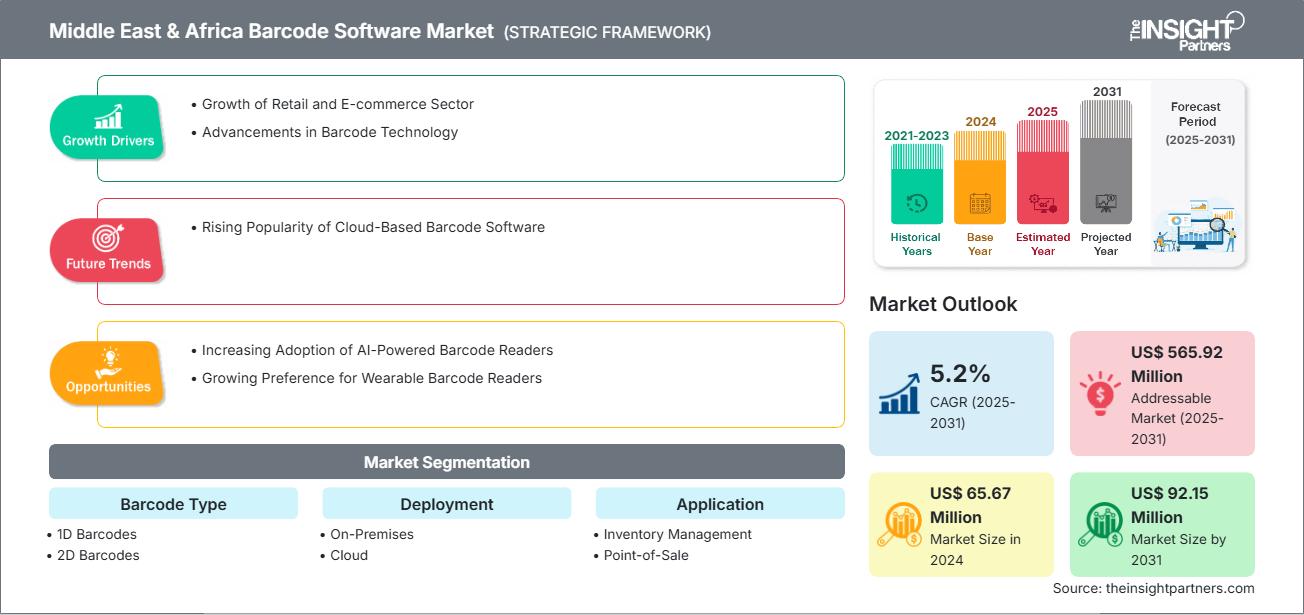
The Middle East & Africa barcode software market size is expected to reach US$ 92.15 million by 2031 from US$ 65.67 million in 2024. The market is estimated to record a CAGR of 5.2% from 2025 to 2031.
Executive Summary and Middle East & Africa Barcode Software Market Analysis:
The MEA barcode software market is segmented into South Africa, Saudi Arabia, the UAE, and the Rest of MEA. The region is projected to witness a rapid rise in industrialization in the coming years. Manufacturers in Middle Eastern countries are focusing on utilizing the latest technological advancements, particularly in logistics tracking and labeling technologies, wide format printing, and fostering the growth of commercial printing into the rapidly advancing segment of flexible packaging. In order to remain competitive, SMEs in the Middle East & Africa are increasingly utilizing digital tools. Barcode software, especially cloud-based solutions, is becoming more accessible to smaller businesses due to its affordability and scalability. Government initiatives such as digital economy projects in Saudi Arabia and the UAE, as well as expanding access to reasonably priced internet and cloud infrastructure throughout Africa, are supporting this digital transformation. Effective inventory management solutions, such as barcode systems, are becoming increasingly necessary as SMEs grow in industries, including manufacturing, food and beverages, and retail.
● REPORT CUSTOMIZATION
Tailor This Report To Align With Your Specific Business Requirements
This report can be customized to align precisely with your business objectives, scope, and target markets. Customization options include tailored segmentation, geography, competitive analysis, and strategic insights to support informed decision-making.
Customize This Report →WHAT YOU CAN ADJUST
- ● Segmentations
- ● Geography
- ● Competitive Analysis
- ● Language Preferences
Middle East & Africa Barcode Software Market: Strategic Insights
-
Get Top Key Market Trends of this report.This FREE sample will include data analysis, ranging from market trends to estimates and forecasts.
Middle East & Africa Barcode Software Market Segmentation Analysis:
Key segments that contributed to the derivation of the Middle East & Africa barcode software market analysis are barcode type, deployment, application, and end-use industry.
- Based on barcode type, the Middle East & Africa barcode software market is bifurcated into 1D barcodes and 2D barcodes. The 1D barcodes segment held a larger share of the market in 2024.
- By deployment, the Middle East & Africa barcode software market is bifurcated into on-premises and cloud. The on-premise segment held a larger share of the market in 2024.
- By application, the Middle East & Africa barcode software market is segmented into inventory management, point-of-sale (pos) operations, asset management, employee attendance and time tracking, and others. The inventory management segment held the largest share of the market in 2024.
- By end-use industry, the Middle East & Africa barcode software market is segmented into BFSI, transportation and logistics, manufacturing, healthcare, retail and e-commerce, and others. The retail and e-commerce segment held the largest share of the market in 2024.
Middle East & Africa Barcode Software Market Report Scope
| Report Attribute | Details |
|---|---|
| Market size in 2024 | US$ 65.67 Million |
| Market Size by 2031 | US$ 92.15 Million |
| CAGR (2025 - 2031) | 5.2% |
| Historical Data | 2021-2023 |
| Forecast period | 2025-2031 |
| Segments Covered |
By Barcode Type
|
| Regions and Countries Covered |
Middle East and Africa
|
| Market leaders and key company profiles |
|
Middle East & Africa Barcode Software Market Players Density: Understanding Its Impact on Business Dynamics
The Middle East & Africa Barcode Software Market is growing rapidly, driven by increasing end-user demand due to factors such as evolving consumer preferences, technological advancements, and greater awareness of the product's benefits. As demand rises, businesses are expanding their offerings, innovating to meet consumer needs, and capitalizing on emerging trends, which further fuels market growth.

Middle East & Africa Barcode Software Market Outlook
Over the past decade, global B2B e-commerce has experienced consistent growth, with sales steadily increasing year over year. This trend is driven by the ongoing digital transformation of industries worldwide, as more businesses embrace e-commerce platforms to streamline operations, improve supply chains, and enhance customer experiences. As stated by the International Trade Administration, by 2026, the global B2B e-commerce market is projected to reach a staggering US$ 36 trillion, highlighting the immense scale and potential of this sector. Widespread digital adoption combined with rising consumer expectations for convenience and speed is the primary driver of e-commerce growth.
The rapid expansion of smartphone usage and digital payment infrastructure in urban hubs such as Dubai, Riyadh, and Lagos is driving a sharp rise in e-commerce adoption in the Middle East and Africa region. Additionally, government-led digital transformation initiatives and the rise of local e-commerce platforms are bridging gaps in traditional retail access across underserved regions. The International Trade Administration stated that the growth of Africa region is largely driven by technological advancements in Africa, where traditional economic infrastructure such as banks and landline telecoms has historically been lacking. By 2025, Africa is anticipated to exceed 500 million e-commerce users, reflecting a consistent 17% CAGR in its online consumer base. Furthermore, The International Trade Centre stated that, the E-commerce Acceleration Programme (eCAP), launched by the United Nations Economic and Social Commission for Western Asia (ESCWA) in collaboration with the ICC-ESCWA Centre of Entrepreneurship and the International Trade Center (ITC), supports the surge of the digital economy and promotes a vibrant entrepreneurial ecosystem across the Arab region. This initiative emphasizes helping businesses adapt to the fast-evolving economy by digitizing their operations, creating jobs, reducing costs, improving efficiency, increasing online sales, and expanding into regional and global markets. As part of this initiative, 100 small and medium-sized enterprises (SMEs) from the Arab region are expected to empower to start selling online, either through their own e-commerce websites or by leveraging existing regional and global online marketplaces. These SMEs will receive tailored support from ITC, including technical and business guidance, e-commerce training, personalized coaching, and opportunities for networking and market exposure. This combination of widespread mobile connectivity, strategic digital initiatives, and targeted SME empowerment is actively fostering market expansion in the Middle East and Africa region by unlocking new digital trade corridors, enhancing regional integration, and enabling broader participation in the global e-commerce ecosystem.
The rapid growth of retail and e-commerce sectors globally is pushing the need for efficient inventory and supply chain management systems. Barcode software allows businesses to improve stock management, track product movement in real time, and offer better customer service. As e-commerce grows, the need for barcode scanning and tracking software becomes even more critical to maintain accurate order fulfillment. Hence, the growing retail and e-commerce sector drives the barcode software market.
Middle East & Africa Barcode Software Market Country Insights
Based on country, the Middle East & Africa Barcode Software Market comprises Saudi Arabia, South Africa, the UAE, and the Rest of Middle East & Africa. Saudi Arabia held the largest share in 2024.
Massive modernization is being pushed by Vision 2030 in a number of industries, including retail, healthcare, and logistics. Automation, traceability, and inventory control are made possible by barcode software, which supports digital infrastructure. Additionally, there is a strong push for e-government services and smart logistics, where barcode systems are essential. Local manufacturing and industrial growth are booming as the Kingdom of Saudi Arabia attempts to lessen its dependency on oil. Throughout supply chains, barcode software facilitates the tracking of components, completed goods, and raw materials. The frequent bundling of barcode systems with ERP, MES, and WMS tools drives the need for integrated solution.
Middle East & Africa Barcode Software Market Company Profiles
Some of the key players operating in the market Bluebird Inc, Honeywell International Inc, Dynamic System Inc., Datalogic SpA, DENSO ADC, General Data Company, Inc., Zebra Technologies Corp, NCR VOYIX Corp, TKX Corp SAS, Archon Systems Inc, Wasp Barcode Technologies, TEC-IT Datenverarbeitung GmbH, BSD InfoTech Pvt. Ltd., Foxit Software Inc, and Zoho Corp Pvt Ltd, among others. These players are adopting various strategies such as expansion, product innovation, and mergers and acquisitions to provide innovative products to their consumers and increase their market share.
Middle East & Africa Barcode Software Market Research Methodology:
The following methodology has been followed for the collection and analysis of data presented in this report:
-
Secondary Research
The research process begins with comprehensive secondary research, utilizing both internal and external sources to gather qualitative and quantitative data for each market. Commonly referenced secondary research sources include, but are not limited to:
- Company websites, annual reports, financial statements, broker analyses, and investor presentations.
- Industry trade journals and other relevant publications.
- Government documents, statistical databases, and market reports.
- News articles, press releases, and webcasts specific to companies operating in the market.
Note: All financial data included in the Company Profiles section has been standardized to USD. For companies reporting in other currencies, figures have been converted to USD using the relevant exchange rates for the corresponding year.
-
Primary Research
The Insight Partners’ conducts a significant number of primary interviews each year with industry stakeholders and experts to validate its data analysis and gain valuable insights. These research interviews are designed to:
- Validate and refine findings from secondary research.
- Enhance the expertise and market understanding of the analysis team.
- Gain insights into market size, trends, growth patterns, competitive dynamics, and future prospects.
Primary research is conducted via email interactions and telephone interviews, encompassing various markets, categories, segments, and sub-segments across different regions. Participants typically include:
- Industry stakeholders: Vice Presidents, business development managers, market intelligence managers, and national sales managers
- External experts: Valuation specialists, research analysts, and key opinion leaders with industry-specific expertise

- Comprehensive Market Sizing and Forecast Analysis
- Detailed Segmentation Analysis
- In-Depth Market Dynamics Assessment
- Regional and Country-Level Insights
- Competitive Landscape and Company Benchmarking
- Strategic Business Intelligence
Recent Reports
Testimonials

The Insight Partners provided valuable market intelligence that supported our global go-to-market strategy. Their team was professional, responsive, and attentive to our feedback, providing thoughtful analysis and helpful methodological clarifications throughout the project.
Junmo Kim Chief Financial Officer (CFO), Enertech Co., Ltd.
The Insight Partners' SCADA System Market report is comprehensive, with valuable insights on current trends and future forecasts. The team was highly professional, responsive, and supportive throughout. We are very satisfied and highly recommend their services.
RAN KEDEM Partner, Reali Technologies LTDs
I requested a report on a very specific software market and the team produced the report in a few days. The information was very relevant and well presented. I then requested some changes and additions to the report. The team was again very responsive and I got the final report in less than a week.
JEAN-HERVE JENN Chairman, Future Analytica
We worked with The Insight Partners for an important market study and forecast. They gave us clear insights into opportunities and risks, which helped shape our plans. Their research was easy to use and based on solid data. It helped us make smart, confident decisions. We highly recommend them.
PIYUSH NAGPAL Sr. Vice President, High Beam Global
The Insight Partners delivered insightful, well-structured market research with strong domain expertise. Their team was professional and responsive throughout. The user-friendly website made accessing industry reports seamless. We highly recommend them for reliable, high-quality research services
YUKIHIKO ADACHI CEO, Deep Blue, LLC.
This is the first time I have purchased a market report from The Insight Partners.While I was unsure at first, I visited their web site and felt more comfortable to take the risk and purchase a market report.I am completely satisfied with the quality of the report and customer service. I had several questions and comments with the initial report, but after a couple of dialogs over email with their analyst I believe I have a report that I can use as input to our strategic planning process.Thank you so much for taking the extra time and making this a positive experience.I will definitely recommend your service to others and you will be my first call when we need further market data.
JOHN SUZUKI President and Chief Executive Officer, Board Director, BK Technologies
I wish to appreciate your support and the professionalism you displayed in the course of attending to my request for information regarding to infectious disease IVD market in Nigeria. I appreciate your patience, your guidance, and the fact that you were willing to offer a discount, which eventually made it possible for us to close a deal. I look forward to engaging The Insight Partners in the future, all thanks to the impression you have created in me as a result of this first encounter.
DR CHIJIOKE ONYIA MANAGING DIRECTOR, PineCrest Healthcare Ltd.Reason to Buy
- Informed Decision-Making
- Understanding Market Dynamics
- Competitive Analysis
- Identifying Emerging Markets
- Customer Insights
- Market Forecasts
- Risk Mitigation
- Boosting Operational Efficiency
- Strategic Planning
- Investment Justification
- Tracking Industry Innovations
- Aligning with Regulatory Trends





 Get Free Sample for