
Mobile Phone Bluetooth Modules Market Share, Size & Demand by 2034
Coverage: By Type (Bluetooth Low Energy (BLE) Modules, Dual-mode Bluetooth Modules, Classic Bluetooth Modules); End User (Ordinary Mobile Phone, Smart Mobile Phone) , and Geography (North America, Europe, Asia Pacific, and South and Central America)
- Status : Data Released
- Report Code : TIPRE00023396
- Category : Electronics and Semiconductor
- No. of Pages : 150
- Available Report Formats :


- Last update date : September 30, 2026


2025 Market Size
US$ 7.11 Bn
Base year value
2034 Forecast
US$ 8.85 Bn
Projected by 2034
CAGR 2026-2034
2.77 %
Growth rate
Addressable Market
US$ 73.54 Bn
(2026-2034)
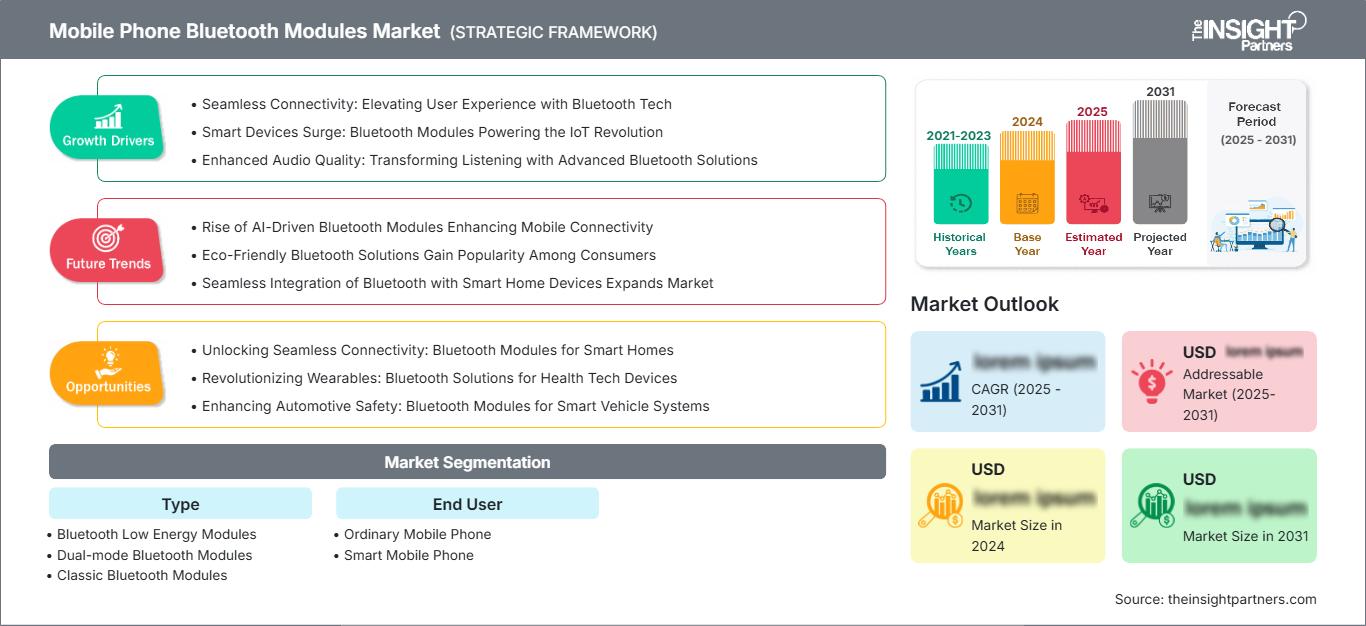
The mobile phone bluetooth modules market was valued at US$ 7.11 Billion in 2025 and is projected to reach US$ 8.85 Billion by 2034, expanding at a CAGR of 2.77% during 2026–2034. The market continues to benefit from sustained integration of wireless connectivity technologies across consumer mobile devices, with manufacturers focusing on enhanced power efficiency, stable data transmission, and seamless interoperability. Ongoing advancements in chipset architecture and antenna integration are also supporting long-term product innovation.
Across North America, the ecosystem remains supported by strong semiconductor innovation, widespread smartphone replacement cycles, and continued investments in wireless communication technologies. The mobile phone bluetooth modules market size in the region is expected to expand at a steady pace through the forecast period, supported by increasing demand for premium smartphones, advanced Bluetooth Low Energy integration, and the growing adoption of connected consumer electronics across the United States and Canada.
Mobile Phone Bluetooth Modules Market Assessment and Insights
- North America: The region benefits from a mature smartphone ecosystem, strong semiconductor innovation, and high consumer adoption of connected devices. Share in 2025: 30–34% and CAGR between 2026–2034: 2.5–3.0%.
- US: The country remains the leading contributor in North America, supported by premium smartphone penetration, chipset innovation, and advanced wireless technology deployment. Share in 2025: 78–82% of North America and CAGR between 2026–2034: 2.6–3.1%.
- Europe: Demand is driven by established consumer electronics markets in Germany, the UK, and France, alongside growing adoption of energy-efficient wireless components. Share in 2025: 24–28% and CAGR between 2026–2034: 2.3–2.8%.
- Asia Pacific: The region remains the global manufacturing hub for smartphones, led by China, South Korea, Japan, and India, supported by integrated semiconductor supply chains. Share in 2025: 36–40% and CAGR between 2026–2034: 3.0–3.5%.
- Largest Segment: Smart Mobile Phone dominates demand owing to widespread Bluetooth-enabled applications, premium device shipments, and integration of advanced wireless features. Market share in 2025: 84–88% and CAGR between 2026–2034: 2.8–3.2%.
- High Growth Segment: Bluetooth Low Energy Modules are witnessing the strongest momentum as manufacturers prioritize lower power consumption and enhanced connectivity for wearable and IoT integration. Market share in 2025: 28–32% and CAGR between 2026–2034: 4.2–4.8%.
- Key companies analyzed in detail: Murata Manufacturing Co., Ltd., Qualcomm Technologies, Inc., Intel Corporation, Broadcom Inc., Panasonic Corporation, Texas Instruments Incorporated, Fujitsu Limited, Hosiden Corporation, STMicroelectronics N.V., and Microchip Technology Incorporated.
Source: The Insight Partners' analysis based on proprietary research, government publications, company annual reports, investor presentations, industry databases, and expert interviews.
The mobile phone bluetooth modules market has progressed alongside rapid advances in wireless communication standards, semiconductor miniaturization, and smartphone hardware integration. The industry has moved away from using stand-alone chips for communication towards system-on-chip integration in order to increase power efficiency, save board space, and stabilize the signal. There has been an increased adoption of Bluetooth Low Energy as more mobile phones support wearable devices, smart homes, and healthcare gadgets. In addition, the geographical distribution of the industry has been diversified with Asia Pacific remaining as the largest region of manufacture, while North America and Europe continue dominating the R&D of the chipsets and IP development in the wireless connectivity value chain.
In the future, the market is likely to experience stable growth as smartphone makers will focus on energy-efficient wireless connectivity and compliance with emerging wireless standards. The emerging economies in Southeast Asia, Latin America, and some Middle Eastern countries are witnessing investments in electronic manufacturing due to their industrial policies and rising demand from consumers. The industry is likely to continue investing in semiconductor fabrication, localization of the components, and development of the new generation of Bluetooth in order to ensure supply chain security and module makers opportunities for premium and mid-range mobile phone makers.
Mobile Phone Bluetooth Modules Market Report Scope
| Report Attribute | Details |
|---|---|
| Market size in 2025 | US$ 7.11 Billion |
| Market Size by 2034 | US$ 8.85 Billion |
| Global CAGR (2026 - 2034) | 2.77% |
| Historical Data | 2021-2024 |
| Forecast period | 2026-2034 |
Mobile Phone Bluetooth Modules Market Analysis
Growing consumer demand for uninterrupted wireless connectivity, lower power consumption, and seamless interaction with connected ecosystems continues to support mobile phone bluetooth modules market growth. Bluetooth modules have become essential components within modern smartphones by enabling reliable communication with wearables, audio accessories, connected vehicles, and smart home devices. Increasing adoption of Bluetooth Low Energy technology also supports battery optimization while maintaining consistent data transfer performance.
The market value chain is supported by semiconductor manufacturers, chipset designers, module assemblers, smartphone original equipment manufacturers, and software developers working together to improve compatibility and device performance. Supply dynamics continue to benefit from expanded semiconductor production capacity, strategic sourcing initiatives, and long-term procurement agreements that reduce component shortages and improve manufacturing flexibility.
Competitive intensity remains strong as leading technology companies invest in advanced radio frequency design, integrated connectivity platforms, and software optimization to strengthen mobile phone bluetooth modules market analysis across diverse smartphone categories. Companies including Qualcomm Technologies, Inc., Broadcom Inc., Murata Manufacturing Co., Ltd., STMicroelectronics N.V., Texas Instruments Incorporated, and Microchip Technology Incorporated persist in their efforts of increasing research capacities while improving the efficiency and interoperability of products used by international smartphone manufacturers.
Investments tend to be made in packaging technologies, artificial intelligence-based wireless optimization, and security systems for connected devices. Moreover, companies in the industry are making greater efforts toward developing stronger relationships with local manufacturers, building up research facilities, and customizing products in accordance with the demands of customers.
● REPORT CUSTOMIZATION
Tailor This Report To Align With Your Specific Business Requirements
This report can be customized to align precisely with your business objectives, scope, and target markets. Customization options include tailored segmentation, geography, competitive analysis, and strategic insights to support informed decision-making.
Customize This Report →WHAT YOU CAN ADJUST
- ● Segmentations
- ● Geography
- ● Competitive Analysis
- ● Language Preferences
Mobile Phone Bluetooth Modules Market: Strategic Insights
Regional Insights
North America Mobile Phone Bluetooth Modules Market
North America accounted for an estimated 30–34% mobile phone bluetooth modules market share in 2025 and is projected to register a CAGR of 2.5–3.0% during 2026–2034. The regional market is driven by semiconductor innovations, a higher share of premium smartphones and persistent consumer demand for connected products. Investment in wireless communications technologies and the presence of leading chipset manufacturers will also continue to drive innovation within the regional value chain.
Both the USA and Canada have established research infrastructure, good intellectual property laws, and constant updates in the area of wireless communications technologies. The growing use of the Bluetooth Low Energy technology in smartphones, rising demand for premium wireless accessories, and cooperation between semiconductor manufacturers and smartphone manufacturers will ensure stable growth in the region.
U.S. Mobile Phone Bluetooth Modules Market
The U.S. represented approximately 78–82% of the North American market in 2025 and is anticipated to expand at a CAGR of 2.6–3.1% during 2026–2034. The nation boasts a highly developed market of smartphones, robust consumer expenditure on high-end mobile gadgets, and prominent semiconductor pioneers. Ongoing funding for research and development enables innovations in Bluetooth technology, power efficiency, and wireless performance.
Large-scale design and engineering operations of top technology firms are well established in the country and provide for the fast introduction of innovative Bluetooth modules. Increasing needs for smooth connectivity between wearable gadgets, cars' entertainment systems, and smart homes keep driving innovations. Widespread usage of flagship smartphones and state-of-the-art wireless technology is anticipated to ensure market stability and leadership in the long run.
Europe Mobile Phone Bluetooth Modules Market
Europe held an estimated 24–28% share of the global Mobile Phone Bluetooth Modules Market in 2025 and is forecast to grow at a CAGR of 2.3–2.8% during 2026–2034. Germany remains the leading regional market due to its advanced electronics manufacturing capabilities and strong automotive technology ecosystem. The country also benefits from extensive semiconductor research activities and increasing collaboration between wireless technology developers and consumer electronics manufacturers.
The United Kingdom continues to strengthen its position through investments in semiconductor innovation, wireless communication research, and digital infrastructure modernization. France, Italy, and Spain collectively contribute to regional demand through expanding smartphone adoption, increasing consumer preference for premium wireless accessories, and growing investments in connected consumer electronics. These markets are further supported by regulatory initiatives encouraging digital transformation and innovation across the European electronics value chain.
APAC Mobile Phone Bluetooth Modules Market
Asia Pacific accounted for an estimated 36–40% of the Mobile Phone Bluetooth Modules Market share in 2025 and is expected to record the fastest regional expansion with a CAGR of 3.0–3.5% during 2026–2034. China leads the region through its extensive smartphone manufacturing ecosystem, while Japan and South Korea contribute advanced semiconductor technologies and wireless communication innovation.
India and Australia continue to experience rising smartphone adoption, expanding electronics manufacturing investments, and supportive industrial policies that encourage domestic production. Strong supply chain integration, increasing exports, and continuous investment in semiconductor fabrication reinforce Asia Pacific's leadership within the global mobile phone Bluetooth modules industry.
Middle East & Africa Mobile Phone Bluetooth Modules Market
The Middle East & Africa Mobile Phone Bluetooth Modules Market is projected to register a CAGR of 2.4–2.9% during 2026–2034. Saudi Arabia and the United Arab Emirates are driving regional demand through digital transformation programs, expanding 5G infrastructure, and increasing smartphone penetration. These developments encourage greater adoption of advanced wireless connectivity components across consumer electronics.
South Africa remains an important consumer electronics market within the region, while the rest of the Middle East & Africa benefits from improving telecommunications infrastructure and expanding internet connectivity. Government-led digital initiatives, infrastructure investments, and increasing demand for connected mobile devices are expected to create stable opportunities for Bluetooth module suppliers throughout the forecast period.
Segmentation Analysis
Type
The Type segment is projected to expand at a CAGR of 2.8–3.3% during 2026–2034. Product innovation within Bluetooth module technology is increasingly focused on improving transmission reliability, reducing power consumption, and enabling seamless compatibility with multiple wireless protocols. Manufacturers continue to optimize module architecture to meet the performance requirements of modern smartphones while supporting compact device designs. Continuous improvements in Bluetooth standards, integrated chipsets, and antenna technologies are expected to sustain demand across all module categories throughout the forecast period. The mobile phone bluetooth modules market scope continues to broaden as manufacturers develop versatile modules that support evolving smartphone connectivity requirements.
- Bluetooth Low Energy Modules – These modules are gaining wider adoption due to their low power consumption, making them suitable for smartphones connecting with wearable devices, fitness trackers, medical peripherals, and smart home ecosystems while extending overall battery efficiency.
- Dual-mode Bluetooth Modules – Supporting both Bluetooth Classic and Bluetooth Low Energy, these modules provide greater flexibility for smartphone manufacturers by ensuring compatibility with legacy accessories and emerging connected devices across multiple application environments.
- Classic Bluetooth Modules – Classic Bluetooth modules continue to serve applications requiring continuous audio streaming and stable high-data-rate communication, maintaining relevance in smartphones supporting wireless headsets, speakers, infotainment systems, and other established Bluetooth-enabled accessories.
End User
The End User segment is anticipated to register a CAGR of 2.6–3.1% during 2026–2034. Market expansion is primarily supported by increasing smartphone penetration, higher consumer expectations for uninterrupted wireless connectivity, and continuous product innovation from mobile device manufacturers. While feature phones continue to maintain demand in selected developing markets, smart mobile phones account for the majority of Bluetooth module consumption owing to their extensive connectivity requirements, integration with multiple wireless ecosystems, and support for advanced applications including digital payments, location services, wearable synchronization, and intelligent consumer electronics.
- Ordinary Mobile Phone – Demand remains concentrated in price-sensitive markets where affordability, extended battery life, and basic wireless communication remain purchasing priorities. Bluetooth modules primarily support hands-free communication, simple file transfers, and essential peripheral connectivity.
- Smart Mobile Phone – This sub-segment represents the dominant source of Bluetooth module demand because smartphones require advanced wireless connectivity for audio devices, wearables, automotive systems, health monitoring, smart home integration, and cloud-connected applications, driving continuous innovation in module performance and energy efficiency.
Opportunity Snapshot
| End User | Revenue Contribution | Trend Tag | Adoption Stage |
| Ordinary Mobile Phone | Low | Cost Optimization | Mature |
| Smart Mobile Phone | High | AI Connectivity | Scaling |
Mobile Phone Bluetooth Modules Market Growth Drivers and Impact Analysis
Rising Adoption of Bluetooth Low Energy in Smartphones
The increased utilization of the Bluetooth Low Energy solution has proven to be one of the most influential catalysts driving the development of the mobile phone Bluetooth modules industry. Mobile phone vendors are increasingly relying on energy-efficient wireless technology to extend battery life and support various devices connected via the mobile device, such as smartwatches, wireless earphones, health sensors, and smart home gadgets. The constant advancements in Bluetooth protocols allow achieving faster connections, lower latency, and better security, thereby providing added value for both smartphone manufacturers and end-users. With the increased adoption of wireless capabilities by premium and mid-range smartphones, there is an ever-increasing demand for highly efficient Bluetooth modules.
Expansion of the Connected Consumer Electronics Ecosystem
The swift proliferation of connected consumer electronics has been rapidly enhancing the need for a robust Bluetooth connection in smartphones. Mobile devices are playing an increasingly critical role as central nodes that link wearable devices, smart speakers, infotainment systems in vehicles, medical peripherals, gaming consoles, and smart home devices. Such a network demands Bluetooth modules that are able to ensure secure, efficient, and consistent connectivity of many devices at once. The rising demands for seamless connectivity from consumers are motivating companies to manufacture highly integrated connectivity platforms. Manufacturers of components are also collaborating more closely with smartphone OEMs to ensure better integration of the modules and shorten product cycles.
Advancements in Semiconductor Integration and Module Miniaturization
Due to the continuous development of technologies of semiconductor manufacturing, Bluetooth modules become progressively smaller, more efficient and advanced, while remaining equally powerful. High integration solutions on chip incorporate Bluetooth functionality, Wi-Fi, location functionality and other wireless communication technologies, allowing smartphone producers to save on components and refine the internal structure of devices. This leads to better cooling of devices, lower costs of production and improved overall reliability of products. At the same time, improvements in packaging technologies and radio-frequency engineering allow for more effective transmission of signals in shrinking smartphones. With further development of semiconductor manufacturing, module producers are expected to release advanced connectivity solutions that will meet the requirements of future wireless standards and improved battery performance of devices.
Mobile Phone Bluetooth Modules Market Future Trends
Integration of AI-Optimized Wireless Connectivity
Artificial intelligence is expected to play an increasingly important role in optimizing Bluetooth connectivity within smartphones over the coming years. Device manufacturers are incorporating AI algorithms to intelligently manage wireless connections, minimize signal interference, optimize power consumption, and improve pairing experiences across multiple connected devices. Future Bluetooth modules are likely to support predictive connectivity by recognizing user behavior and automatically prioritizing frequently used accessories such as wireless earbuds, smartwatches, and vehicle infotainment systems. The mobile phone bluetooth modules market trends indicate that software-driven optimization will become as important as hardware innovation, encouraging semiconductor vendors to integrate AI capabilities directly into connectivity chipsets. This evolution is expected to improve user experience while reducing energy consumption and enabling more responsive wireless communication in increasingly connected mobile ecosystems.
Expansion of Multi-Protocol Integrated Connectivity Platforms
Smartphone design of the future is anticipated to embrace connectivity solutions that incorporate Bluetooth, Wi-Fi, ultra-wideband, and location capabilities within one package of a single semiconductor. Integration of connectivity technologies will result in reduced device component size, lower costs, increased device efficiency and seamless integration of communication with other consumer electronic products. Advancements in semiconductor packaging and system-on-chip design are making it possible for manufacturers to offer smaller semiconductor components that come with increased processing abilities as well as a higher level of security. Smartphones are becoming controllers of connected environments and, thus, the demand for integrated connectivity platforms will continue growing in the future.
Mobile Phone Bluetooth Modules Market Opportunities
Growing Investments in Localized Semiconductor Manufacturing
Governments across North America, Europe, and Asia Pacific are increasing investments to strengthen domestic semiconductor manufacturing capabilities and reduce dependence on geographically concentrated supply chains. These initiatives create favorable conditions for Bluetooth module suppliers to establish regional production facilities, diversify sourcing strategies, and collaborate more closely with smartphone manufacturers. Mobile phone bluetooth modules market forecasts indicate that localized production will improve supply resilience, shorten product development cycles, and reduce logistics-related risks. Companies investing in advanced packaging technologies, automated manufacturing, and regional research centers are expected to strengthen their competitive position while responding more effectively to changing customer requirements. Strategic partnerships with foundries, original equipment manufacturers, and technology developers will further support long-term revenue generation and sustainable business expansion across global smartphone markets.
Emerging Demand from Next-Generation Connected Device Ecosystems
The fast proliferation of the interconnected consumer ecosystems creates great opportunities for the Bluetooth module suppliers to innovate their connectivity solutions further and not limit themselves to the smartphone applications only. The growth of wearable gadgets, AR/VR products, smart health devices, connected cars, and intelligent home appliances is creating a need for Bluetooth modules that have better bandwidth utilization, increased security, and reduced power consumption. Suppliers that will be actively developing next-generation wireless technology solutions and software-based connectivity solutions that can integrate multiple protocols will find themselves well prepared to capitalize on new business opportunities. The continuous cooperation with the smartphone suppliers and application developers will help them innovate faster and create sustainable growth opportunities in the long run.
Frequently Asked Questions

- Comprehensive Market Sizing and Forecast Analysis
- Detailed Segmentation Analysis
- In-Depth Market Dynamics Assessment
- Regional and Country-Level Insights
- Competitive Landscape and Company Benchmarking
- Strategic Business Intelligence
Recent Reports
Testimonials

The Insight Partners' SCADA System Market report is comprehensive, with valuable insights on current trends and future forecasts. The team was highly professional, responsive, and supportive throughout. We are very satisfied and highly recommend their services.
RAN KEDEM Partner, Reali Technologies LTDs
I requested a report on a very specific software market and the team produced the report in a few days. The information was very relevant and well presented. I then requested some changes and additions to the report. The team was again very responsive and I got the final report in less than a week.
JEAN-HERVE JENN Chairman, Future Analytica
We worked with The Insight Partners for an important market study and forecast. They gave us clear insights into opportunities and risks, which helped shape our plans. Their research was easy to use and based on solid data. It helped us make smart, confident decisions. We highly recommend them.
PIYUSH NAGPAL Sr. Vice President, High Beam Global
The Insight Partners delivered insightful, well-structured market research with strong domain expertise. Their team was professional and responsive throughout. The user-friendly website made accessing industry reports seamless. We highly recommend them for reliable, high-quality research services
YUKIHIKO ADACHI CEO, Deep Blue, LLC.
This is the first time I have purchased a market report from The Insight Partners.While I was unsure at first, I visited their web site and felt more comfortable to take the risk and purchase a market report.I am completely satisfied with the quality of the report and customer service. I had several questions and comments with the initial report, but after a couple of dialogs over email with their analyst I believe I have a report that I can use as input to our strategic planning process.Thank you so much for taking the extra time and making this a positive experience.I will definitely recommend your service to others and you will be my first call when we need further market data.
JOHN SUZUKI President and Chief Executive Officer, Board Director, BK Technologies
I wish to appreciate your support and the professionalism you displayed in the course of attending to my request for information regarding to infectious disease IVD market in Nigeria. I appreciate your patience, your guidance, and the fact that you were willing to offer a discount, which eventually made it possible for us to close a deal. I look forward to engaging The Insight Partners in the future, all thanks to the impression you have created in me as a result of this first encounter.
DR CHIJIOKE ONYIA MANAGING DIRECTOR, PineCrest Healthcare Ltd.Reason to Buy
- Informed Decision-Making
- Understanding Market Dynamics
- Competitive Analysis
- Identifying Emerging Markets
- Customer Insights
- Market Forecasts
- Risk Mitigation
- Boosting Operational Efficiency
- Strategic Planning
- Investment Justification
- Tracking Industry Innovations
- Aligning with Regulatory Trends





 Get Free Sample for