
Mobile Photo Printer Market Share, Size & Demand by 2034
Coverage: By Product (Portable Photo Printer, Compact Photo Printer, Desktop Photo Printer); Technology (Inkjet, Dye sublimation, Zink, Laser, Thermal); Connectivity (Wired, Wireless); Printer Output (Monochrome, Color) and Geography (North America, Europe, Asia Pacific, and South and Central America)
- Status : Data Released
- Report Code : TIPRE00008318
- Category : Electronics and Semiconductor
- No. of Pages : 150
- Available Report Formats :


- Last update date : October 15, 2026


2025 Market Size
US$ 4.49 Bn
Base year value
2034 Forecast
US$ 13.75 Bn
Projected by 2034
CAGR 2026-2034
13.24 %
Growth rate
Addressable Market
US$ 79.18 Bn
(2026-2034)
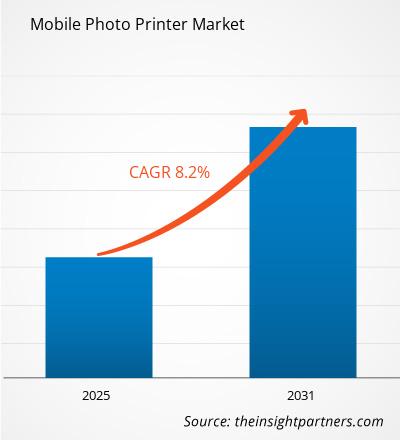
The Mobile photo printer market was valued at US$ 4.49 Billion in 2025 and is projected to reach US$ 13.75 Billion by 2034, expanding at a CAGR of 13.24% during 2026–2034. Growing customer interest in printing photos instantly, rising popularity of smartphones for photography, and increasing need for portable printing solutions across personal, business, and artistic applications keep providing impetus for growth in this market. Improvement in wireless connectivity and integration of printing technologies with mobile apps is adding another dimension of growth potential in product adoption in developed and emerging markets.
North America still retains its position of a mature regional market with high smartphone penetration rates, significant expenditure on connected devices, and high adoption of portable imaging equipment. The mobile photo printer market size in this region will experience a compound annual growth rate of 11.5%–12.5% in 2026–2034 owing to increasing demand for personalized photo solutions, expansion of e-commerce channels, and ongoing product innovations from top consumer electronics companies.
Mobile Photo Printer Market Assessment and Insights
- North America: Accounted for an estimated 33%–36% share in 2025 and is projected to expand at a CAGR of 11.5%–12.5% during 2026–2034, supported by high disposable income, strong consumer electronics adoption, and continued innovation in wireless printing technologies.
- US: Represented approximately 74%–78% of the North American market in 2025 and is expected to register a CAGR of 11.8%–12.8% during 2026–2034, driven by strong demand for premium portable printers and expanding digital photo personalization trends.
- Europe: Held an estimated 25%–28% share in 2025 and is anticipated to grow at a CAGR of 10.8%–11.8% during 2026–2034. Germany, the UK, and France remain the leading revenue contributors owing to established consumer electronics markets and high adoption of connected imaging devices.
- Asia Pacific: Captured approximately 28%–31% Mobile photo printer market share in 2025 and is forecast to register the fastest regional expansion at a CAGR of 14.5%–15.5% during 2026–2034. China, Japan, South Korea, and India continue to benefit from rapid smartphone adoption, expanding middle-class spending, and strong electronics manufacturing ecosystems.
- Largest Segment: Wireless Connectivity accounted for an estimated 67%–71% market share in 2025 and is projected to expand at a CAGR of 13.5%–14.5% during 2026–2034, reflecting increasing consumer preference for seamless smartphone-based printing experiences.
- High Growth Segment: Zink Technology represented approximately 19%–23% market share in 2025 and is anticipated to grow at a CAGR of 15.5%–16.5% during 2026–2034, supported by ink-free printing capabilities, compact product designs, and growing adoption among younger consumers.
- Key companies analyzed in detail: Brother International Corporation, Canon Inc., Fujifilm Holdings Corporation, HiTi Digital, Inc., LG Electronics Inc., Polaroid Corporation, Eastman Kodak Company, HP Inc., Seiko Epson Corporation, Sony Group Corporation.
Source: The Insight Partners' analysis based on proprietary research, government publications, company annual reports, investor presentations, industry databases, and expert interviews.
Recent developments in smartphone camera capabilities, wireless standards, and miniature printers have revolutionized the mobile photo printer industry during the last ten years. Manufacturers have moved away from traditional wire-based devices to more portable, battery-operated products with Bluetooth and Wi-Fi capabilities, mobile apps, and better print qualities. The production process has become focused on developing energy-saving elements, eco-friendly packaging, and streamlined supply chains using dye-sublimation and Zink technology for faster printing rates, better color accuracy, and higher consumer convenience.
As far as future investments in the market are concerned, they will probably be made in Asia Pacific, the Middle East, and some Latin American nations due to the growing number of consumer electronics adoption and digital content generation in the region. Favorable manufacturing policies and an increased availability of semiconductors and localization of electronic goods production in the region are providing good supply conditions for the market growth. The regulatory pressure on reducing electronic waste and adopting sustainable designs leads to the development of recyclable consumables and energy-efficient devices.
Mobile Photo Printer Market Report Scope
| Report Attribute | Details |
|---|---|
| Market size in 2025 | US$ 4.49 Billion |
| Market Size by 2034 | US$ 13.75 Billion |
| Global CAGR (2026 - 2034) | 13.24% |
| Historical Data | 2021-2024 |
| Forecast period | 2026-2034 |
Mobile Photo Printer Market Analysis
Increasing interest from consumers in instant, personalized printing services helps drive mobile photo printer growth especially amongst youth familiar with smartphone photos and creating content for social media networks. Demand is driven by increasing travel, celebrating, gifting, and other creative hobby applications that require physical photos along with digital applications. Growth of e-commerce sites has made products easily available whereas constant improvements in battery power, resolution, wireless capability, and app compatibility have enhanced user experience.
There has been a continued evolution of the value chain in this industry due to increased collaboration between component suppliers, printer makers, mobile app providers, and distribution partners. Semiconductor suppliers, print head manufacturers, specialty paper makers, and software developers are all vital for product performance and user experience. The diversification of supply chains following global logistics challenges in recent years has compelled manufacturers to adopt regional sourcing strategies.
The level of competition in the mobile photo printer market report is associated with ongoing innovations, partnerships, and diversification of the portfolios of leading consumer electronic manufacturers. The continued investments in connectivity printing platforms by Canon Inc., Fujifilm Holdings Corporation, HP Inc., Seiko Epson Corporation, Brother International Corporation, and Sony Group Corporation have been matched by the efforts of Polaroid Corporation, Eastman Kodak Company, HiTi Digital, Inc., and LG Electronics Inc. to increase their market shares through differentiated products, mobile applications, and direct consumer access channels.
Inventories in smart production processes and automation are becoming more and more popular; businesses will pay special attention to the creation of effective printing engines, technologies of image processing, and environmentally friendly consumable materials. It is becoming possible thanks to the expansion of regional manufacturing capacities. In this way, businesses can shorten the time required for product development, improve supply reliability, and react to customers’ preferences quickly.
● REPORT CUSTOMIZATION
Tailor This Report To Align With Your Specific Business Requirements
This report can be customized to align precisely with your business objectives, scope, and target markets. Customization options include tailored segmentation, geography, competitive analysis, and strategic insights to support informed decision-making.
Customize This Report →WHAT YOU CAN ADJUST
- ● Segmentations
- ● Geography
- ● Competitive Analysis
- ● Language Preferences
Mobile Photo Printer Market: Strategic Insights
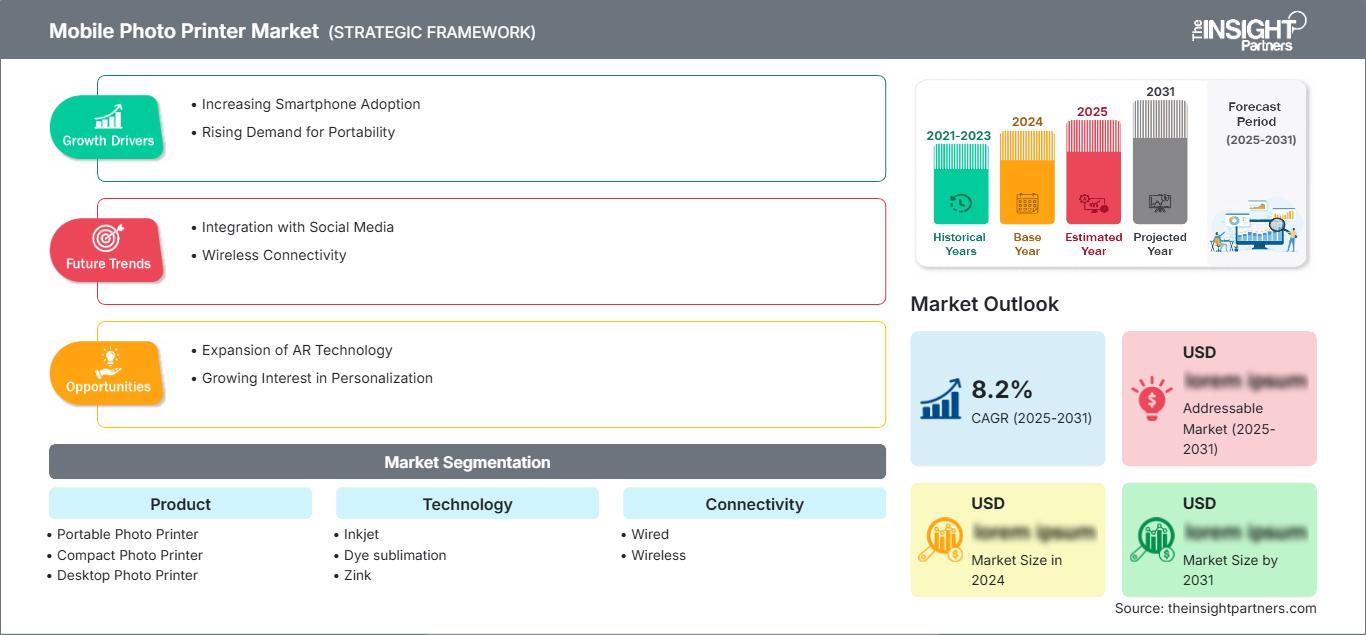
Regional Insights
North America Mobile Photo Printer Market
The North American region held an approximated 33% to 36% Mobile photo printer market share of the total market in 2025 and is expected to register a CAGR of 11.5% to 12.5% over 2026 to 2034. Factors such as high consumer purchasing power, extensive smartphone usage, and increasing demand for customized photos contribute to the regional growth. Companies are extending omnichannel retailing initiatives, and technology companies are increasingly incorporating Bluetooth connectivity, Wi-Fi connection, and applications for improved user experience. The presence of robust consumer electronics industry and adoption of advanced portable electronics devices also drive the regional market.
Innovation in instant imaging technology and the trend of customized gifts, travel photographs, and event photography are generating sustained demand. Educational institutions, professional photographers, and small business organizations are using pocket printers for commercial and personal applications. Investments in environmental and energy-efficient products development and use of sustainable consumable are adding strength to the regional market.
U.S. Mobile Photo Printer Market
The United States represented approximately 74%–78% of the North American market in 2025 and is expected to register a CAGR of 11.8%–12.8% during 2026–2034. The mobile photo printer market share remains the largest within North America due to high consumer spending on connected electronics, rapid adoption of smartphone accessories, and a strong presence of established manufacturers and distribution networks. Growing demand for instant photo printing during social events, travel, and personalized gifting continues to stimulate product sales across both online and offline retail channels.
Some of the key players operating in the market include HP Inc., Canon Inc., Eastman Kodak Company, Polaroid Corporation, and Fujifilm Holdings Corporation, which have vast product lines and distributor networks across the country. Preference of consumers for wireless capabilities, cloud-based services, and portable battery-powered products is leading to higher replacement needs. Development of mobile applications and print quality, along with increased adoption of e-commerce, will continue to drive growth in the market.
Europe Mobile Photo Printer Market
According to the estimates, the Europe Imaging Market is expected to hold a share of 25%-28% of the global market and grow at a rate of 10.8%-11.8% CAGR for the period 2026-2034. The key regional market in Europe continues to be Germany due to its advanced consumer electronics industry, well-developed retail landscape, and the high demand for premium imaging products. Manufacturers in the region continue focusing on sustainability in production, using of recyclable materials and energy-saving products.
The United Kingdom market enjoys high usage rates of smartphones, higher penetration of e-commerce in retail, and the rising demand for personalized photography products. Germany is still continuing the development of innovative technologies of production while experiencing high demand from the consumers' and professionals' imaging segments. France, Italy, and Spain make up the notable regional revenue thanks to the development of the digital photography culture, purchases of tourists, and popularity of portable wireless printers.
APAC Mobile Photo Printer Market
The Asia Pacific region accounted for about 28% to 31% share in 2025 and is projected to grow at the highest regional CAGR of 14.5% to 15.5% from 2026 to 2034. The country of China dominates regional demand because of its well-developed system of consumer electronics manufacturing, while Japan and South Korea are innovation hubs of imaging technologies.
India and Australia have seen an increase in adoption owing to growing disposable income, use of smartphones, and growth of e-commerce. Initiatives of governments in promoting local electronics manufacturing, alongside regular investments in production and digital infrastructures, will make the region more competitive.
Middle East & Africa Mobile Photo Printer Market
CAGR for the Middle East & Africa market is expected to be in the range of 9.5%–10.5% over 2026–2034. Leading regional demand will come from Saudi Arabia, where consumer electronics retail and digital transformation efforts have been growing, whereas UAE will continue to see its benefits from tourism, luxury consumption, and retail connectivity.
Important regional markets include South Africa, driven by increased smartphone usage and better retail connectivity, and the Rest of MEA region, characterized by gradual growth prospects, driven by improvements in digital infrastructure and consumer awareness.
Segmentation Analysis
Product
The Product segment is projected to expand at a CAGR of 12.8%–13.8% during 2026–2034. Product innovation remains a key competitive factor in the market, with manufacturers focusing on portability, print quality, battery efficiency, and seamless smartphone compatibility. Consumer preference continues shifting toward compact and lightweight devices that enable instant printing without compromising image quality. Continuous investments in ergonomic designs, faster print speeds, and improved application ecosystems are expected to support sustained adoption across personal, travel, gifting, and creative applications. The mobile photo printer market scope continues to broaden as manufacturers introduce differentiated products targeting diverse consumer lifestyles.
- Portable Photo Printer: Portable models dominate consumer demand owing to their lightweight construction, rechargeable batteries, and convenient wireless connectivity. Their suitability for travel, social gatherings, and everyday smartphone printing makes them the preferred product category across global markets.
- Compact Photo Printer: Compact photo printers provide a balance between portability and enhanced print quality. They are widely adopted by families, students, and creative users seeking reliable printing performance while maintaining a relatively small device footprint.
- Desktop Photo Printer: Desktop photo printers primarily serve users requiring higher print volumes and superior image quality. Their adoption remains strong among photography enthusiasts, studios, and small commercial establishments requiring consistent printing performance.
Technology
The Technology segment is anticipated to register a CAGR of 13.8%–14.8% during 2026–2034. Technological innovation continues to redefine product capabilities through improvements in print resolution, operating efficiency, media compatibility, and maintenance requirements. Manufacturers increasingly invest in compact printing engines and advanced imaging software while reducing power consumption and operating costs. Consumer demand for faster printing and simplified maintenance is encouraging broader adoption of ink-free and high-efficiency printing technologies across both developed and emerging markets.
- Inkjet: Inkjet technology continues serving users requiring detailed image reproduction and broad media compatibility. Its versatility supports demand among photography enthusiasts and consumers seeking high-quality color printing across multiple print formats.
- Dye Sublimation: Dye sublimation remains highly valued for producing durable, laboratory-quality photographs with smooth color transitions. The technology is widely adopted in premium portable printers intended for long-lasting personal photo collections.
- Zink: Zink technology eliminates the need for ink cartridges by using specially engineered paper. Its compact design, minimal maintenance requirements, and ease of use continue supporting strong adoption among younger consumers and mobile-first users.
- Laser: Laser technology occupies a relatively niche position within this market, offering efficient printing for specialized applications where speed and operational consistency outweigh the need for highly portable device designs.
- Thermal: Thermal printing solutions provide dependable operation, simplified maintenance, and compact hardware configurations. Manufacturers continue refining thermal technologies to improve print quality while maintaining energy-efficient performance.
Connectivity
The Connectivity segment is expected to grow at a CAGR of 13.5%–14.5% during 2026–2034. Connectivity has become a defining purchase criterion as consumers increasingly expect seamless interaction between smartphones and printing devices. Wireless communication technologies continue gaining preference due to their convenience, while wired interfaces remain relevant in professional and institutional environments requiring stable and secure data transmission.
- Wired: Wired connectivity continues supporting enterprise, commercial, and professional users that prioritize reliable communication, uninterrupted printing, and secure device integration within fixed operational environments.
- Wireless: Wireless connectivity represents the leading category, driven by widespread adoption of Bluetooth, Wi-Fi, and mobile applications. Its convenience enables instant printing directly from smartphones and tablets without requiring physical cable connections.
Printer Output
The Printer Output segment is projected to record a CAGR of 12.2%–13.2% during 2026–2034. Consumer preference remains heavily oriented toward visually rich image reproduction, making output quality an essential differentiator among manufacturers. Improvements in color management, print resolution, and image-processing algorithms continue enhancing customer satisfaction while supporting adoption across personal, creative, and commercial applications.
- Monochrome: Monochrome output serves specialized applications where simple image reproduction, lower operating costs, and functional printing requirements remain more important than full-color photographic quality.
- Color: Color output dominates overall demand because consumers primarily purchase these devices for vibrant photograph printing. Continuous improvements in color accuracy, image durability, and print consistency further reinforce its strategic importance across global consumer markets.
Opportunity Snapshot
| Connectivity | Revenue Contribution | Trend Tag | Adoption Stage |
|---|---|---|---|
| Wired | Low | USB Direct | Mature |
| Wireless | High | App Printing | Scaling |
Mobile Photo Printer Market Growth Drivers and Impact Analysis
Growing Smartphone Photography and Instant Print Culture
The wide availability of smartphones that come equipped with sophisticated multi-camera technology has brought about a sea change in the habits of consumer photography, fueling a need for instant picture printers. Tens of billions of digital photographs are taken each year, but the consumers want their pictures printed out because they wish to give their pictures away as gifts, put them in scrapbooks, preserve them for vacation memories, use them as home decorations, and keep them as reminders from special events. This trend is pushing manufacturers towards the development of small printers that have smooth Bluetooth and Wi-Fi connection features, user-friendly applications for mobile devices, and enhanced color printing abilities. The culture of social media has made people more interested in their personalized photo products, which help to link their virtual experience with physical one.
Advancements in Wireless Connectivity and Portable Printing Technologies
Continuous technological innovation is significantly improving the performance and usability of mobile photo printers. Manufacturers are integrating faster wireless communication standards, enhanced battery efficiency, compact printing engines, and intelligent mobile software that simplify the printing process. Developments in dye-sublimation and Zink technologies have improved print quality while reducing maintenance requirements and device size. These innovations enable users to print photographs directly from smartphones within seconds, eliminating dependence on traditional desktop printers. Investments in lightweight materials, energy-efficient components, and intuitive user interfaces are also strengthening product competitiveness. As hardware and software ecosystems become increasingly integrated, consumers benefit from improved reliability, higher image quality, and greater convenience, encouraging repeat purchases and supporting long-term market expansion.
Expansion of E-commerce and Personalized Consumer Electronics
Rapid growth in e-commerce platforms has substantially increased consumer access to portable printing products across developed and emerging economies. Online retail channels allow manufacturers to reach broader customer bases while offering product comparisons, promotional pricing, and direct consumer engagement. Personalized consumer electronics have emerged as a major purchasing trend, with buyers seeking devices that complement digital lifestyles and creative expression. Mobile photo printers align closely with this preference by enabling customized prints, stickers, greeting cards, and memory albums. Manufacturers are also leveraging digital marketing, influencer partnerships, and bundled mobile applications to strengthen customer engagement. These commercial strategies improve product visibility, accelerate purchasing decisions, and support sustained demand across multiple demographic groups, contributing to long-term industry growth.
Mobile Photo Printer Market Future Trends
Artificial Intelligence Enhancing Mobile Printing Experiences
Artificial intelligence is expected to become an increasingly important differentiator in the market over the forecast period. The mobile photo printer market trends indicate growing integration of AI-powered image optimization, automatic scene recognition, facial enhancement, background correction, and personalized print templates within companion mobile applications. These capabilities enable users to produce higher-quality photographs with minimal editing while simplifying the printing workflow. Manufacturers are also incorporating cloud connectivity and machine learning algorithms that recommend layouts, filters, and collage formats based on user preferences. As AI-enabled software becomes a standard feature, companies are likely to strengthen customer engagement, encourage ecosystem loyalty, and differentiate their offerings through superior digital experiences rather than hardware specifications alone.
Sustainable Printing Solutions and Eco-friendly Product Development
Environmental sustainability is emerging as a significant strategic priority across the consumer electronics industry, influencing future product development within the mobile photo printer market. Manufacturers are increasingly investing in recyclable packaging, energy-efficient components, environmentally responsible production processes, and reduced-plastic product designs. Development of longer-lasting consumables and optimized battery performance is expected to lower environmental impact while improving overall product value. Companies are also evaluating sustainable sourcing strategies and expanding compliance with evolving environmental regulations across major markets. Growing consumer awareness regarding responsible purchasing decisions is likely to accelerate adoption of eco-conscious printing solutions, encouraging continuous innovation that balances environmental objectives with print quality, portability, and operational efficiency.
Mobile Photo Printer Market Opportunities
Expansion into Emerging Consumer Electronics Markets
Rapid urbanization, rising disposable incomes, and increasing smartphone ownership across emerging economies present substantial long-term investment opportunities for manufacturers operating in the mobile photo printer industry. Mobile photo printer market Forecasts indicate that demand will accelerate in countries across Asia Pacific, the Middle East, and selected Latin American markets as digital content creation and e-commerce penetration continue expanding. Companies can strengthen their competitive position by establishing regional manufacturing facilities, collaborating with local distributors, and introducing competitively priced product portfolios tailored to evolving consumer preferences. Investment in localized marketing campaigns, multilingual mobile applications, and after-sales service networks can further improve customer engagement while reducing operational costs. These strategies are expected to generate sustainable revenue streams and support broader market penetration throughout the forecast period.
Development of Integrated Digital Photo Ecosystems
Manufacturers have a significant opportunity to expand beyond standalone hardware by developing comprehensive digital ecosystems that integrate mobile applications, cloud storage, social media platforms, and subscription-based personalization services. Such ecosystems can enhance customer retention by enabling seamless photo editing, album creation, customized templates, and direct printing from multiple digital platforms. Strategic collaborations with smartphone manufacturers, online photo-sharing platforms, travel service providers, and event organizers can further increase product visibility and create recurring revenue opportunities. Continued investment in software innovation, artificial intelligence-enabled editing features, and cloud-based user experiences will help companies differentiate their offerings while building long-term customer loyalty in an increasingly competitive global marketplace.
Frequently Asked Questions

- Comprehensive Market Sizing and Forecast Analysis
- Detailed Segmentation Analysis
- In-Depth Market Dynamics Assessment
- Regional and Country-Level Insights
- Competitive Landscape and Company Benchmarking
- Strategic Business Intelligence
Recent Reports
Testimonials

The Insight Partners provided valuable market intelligence that supported our global go-to-market strategy. Their team was professional, responsive, and attentive to our feedback, providing thoughtful analysis and helpful methodological clarifications throughout the project.
Junmo Kim Chief Financial Officer (CFO), Enertech Co., Ltd.
The Insight Partners' SCADA System Market report is comprehensive, with valuable insights on current trends and future forecasts. The team was highly professional, responsive, and supportive throughout. We are very satisfied and highly recommend their services.
RAN KEDEM Partner, Reali Technologies LTDs
I requested a report on a very specific software market and the team produced the report in a few days. The information was very relevant and well presented. I then requested some changes and additions to the report. The team was again very responsive and I got the final report in less than a week.
JEAN-HERVE JENN Chairman, Future Analytica
We worked with The Insight Partners for an important market study and forecast. They gave us clear insights into opportunities and risks, which helped shape our plans. Their research was easy to use and based on solid data. It helped us make smart, confident decisions. We highly recommend them.
PIYUSH NAGPAL Sr. Vice President, High Beam Global
The Insight Partners delivered insightful, well-structured market research with strong domain expertise. Their team was professional and responsive throughout. The user-friendly website made accessing industry reports seamless. We highly recommend them for reliable, high-quality research services
YUKIHIKO ADACHI CEO, Deep Blue, LLC.
This is the first time I have purchased a market report from The Insight Partners.While I was unsure at first, I visited their web site and felt more comfortable to take the risk and purchase a market report.I am completely satisfied with the quality of the report and customer service. I had several questions and comments with the initial report, but after a couple of dialogs over email with their analyst I believe I have a report that I can use as input to our strategic planning process.Thank you so much for taking the extra time and making this a positive experience.I will definitely recommend your service to others and you will be my first call when we need further market data.
JOHN SUZUKI President and Chief Executive Officer, Board Director, BK Technologies
I wish to appreciate your support and the professionalism you displayed in the course of attending to my request for information regarding to infectious disease IVD market in Nigeria. I appreciate your patience, your guidance, and the fact that you were willing to offer a discount, which eventually made it possible for us to close a deal. I look forward to engaging The Insight Partners in the future, all thanks to the impression you have created in me as a result of this first encounter.
DR CHIJIOKE ONYIA MANAGING DIRECTOR, PineCrest Healthcare Ltd.Reason to Buy
- Informed Decision-Making
- Understanding Market Dynamics
- Competitive Analysis
- Identifying Emerging Markets
- Customer Insights
- Market Forecasts
- Risk Mitigation
- Boosting Operational Efficiency
- Strategic Planning
- Investment Justification
- Tracking Industry Innovations
- Aligning with Regulatory Trends





 Get Free Sample for