
Mobile Remittance Money M-Commerce Market Trends, Size & Growth by 2034
Mobile Remittance Money M-Commerce Market Size and Forecasts (2021–2034), Global and Regional Share, Trends, and Growth Opportunity Analysis Report Coverage : By Transaction Type (Person-to-Person, Business-to-Person, Business-to-Business, Government-to-Person), Service Type (Mobile Wallets, Bank Transfers, Cash Pickup, Mobile Money Transfer), End User (Individuals, Small Enterprises, Large Enterprises)
- Status : Data Released
- Report Code : TIPRE00039538
- Category : Technology, Media and Telecommunications
- No. of Pages : 150
- Available Report Formats :


- Last update date : August 04, 2026


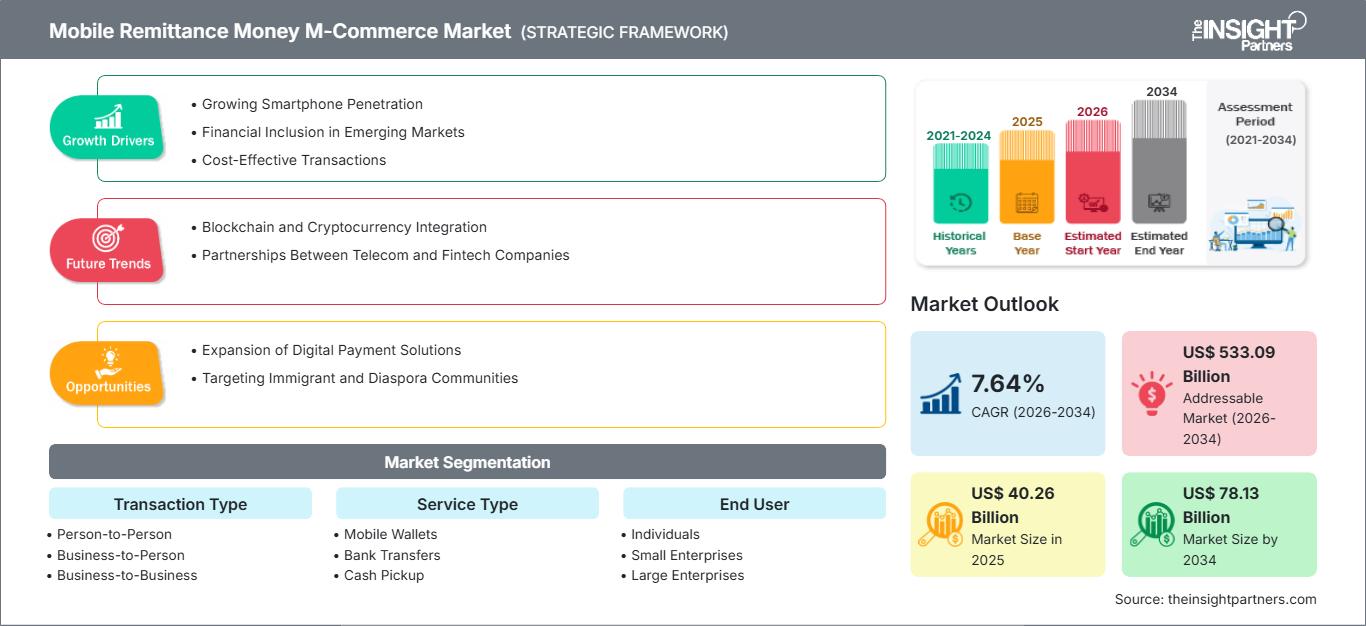
2025 Market Size
US$ 40.26 Bn
Base year value
2034 Forecast
US$ 78.13 Bn
Projected by 2034
CAGR 2026-2034
7.64 %
Growth rate
Addressable Market
US$ 533.09 Bn
(2026-2034)
The Mobile remittance money m-commerce market was valued at US$ 40.26 Billion in 2025 and is projected to reach US$ 78.13 Billion by 2034, expanding at a CAGR of 7.64% during 2026–2034. The market continues to evolve as consumers increasingly prefer mobile-first payment platforms for cross-border transfers, domestic remittances, merchant payments, and digital financial services. Advancements in smartphone penetration, secure payment technologies, and interoperable digital payment ecosystems are supporting sustained adoption across both developed and emerging economies.
Across North America, digital payment infrastructure, strong banking connectivity, and increasing migrant remittance activity continue to strengthen industry momentum. The mobile remittance money m-commerce market size is supported by widespread smartphone usage, expanding digital wallet acceptance, and regulatory initiatives encouraging faster payment systems. Financial institutions and fintech providers are enhancing real-time transfer capabilities, positioning the regional market to expand at an estimated CAGR in the range of 6.8%–7.4% through 2034.
Mobile Remittance Money M-Commerce Market Assessment and Insights
- North America: The region benefits from advanced payment infrastructure, extensive fintech innovation, and high digital wallet adoption. Cross-border remittance demand and real-time payment modernization support steady expansion. Share in 2025: 31–34%. CAGR between 2026–2034: 6.8%–7.4%.
- US: The United States remains the largest contributor within North America due to high migrant remittance volumes, mature digital payment ecosystems, and widespread mobile banking adoption. Share in 2025: 74–78% of North America. CAGR between 2026–2034: 6.7%–7.3%.
- Europe: Strong regulatory support for open banking, growing digital payment adoption, and increasing cross-border commerce drive regional demand. The UK, Germany, and France remain leading contributors. Share in 2025: 24–27%. CAGR between 2026–2034: 7.1%–7.8%.
- Asia Pacific: Rapid smartphone penetration, expanding financial inclusion, rising migrant populations, and government-backed digital payment initiatives position China, India, Japan, and South Korea as leading markets. Share in 2025: 29–32%. CAGR between 2026–2034: 8.6%–9.3%.
- Largest Segment: Individuals account for the largest market position owing to sustained domestic and international person-to-person remittance activity and increasing digital wallet adoption. Market share in 2025: 58–62%. CAGR between 2026–2034: 7.3%–7.9%.
- High Growth Segment: Mobile Wallets are projected to record the fastest expansion as consumers increasingly prefer instant, mobile-based payment experiences integrated with value-added financial services. Market share in 2025: 35–39%. CAGR between 2026–2034: 8.8%–9.5%.
- Key companies analyzed in detail: WorldRemit, MoneyGram International, Inc., PayPal Holdings, Inc., Revolut Ltd., Google LLC (Google Pay), Xoom Corporation, Skrill Limited, Tencent Holdings Ltd. (WeChat Pay), Venmo, Block, Inc. (Cash App), Azimo Limited.
Source: The Insight Partners' analysis based on proprietary research, government publications, company annual reports, investor presentations, industry databases, and expert interviews.
The mobile remittance money m-commerce market has transitioned from conventional bank-centric transfer models toward digitally connected payment ecosystems that combine mobile wallets, cloud-based transaction processing, artificial intelligence, and real-time settlement capabilities. The growth of smartphone penetration, greater internet connectivity, and improved financial inclusion efforts have fast-tracked digital transactions in both developed and developing economies. Financial service providers, payment solutions providers, and fintech firms are now collaborating via open APIs and interoperable payment networks to facilitate smooth domestic and cross-border transactions while increasing transparency in the transaction process, enhancing fraud prevention, streamlining compliance processes, and improving the customer experience. At the same time, improvements in biometric authentication, tokenization, and cloud-based payment systems are continually boosting transaction security and scalability.
In the future, investments are projected to grow rapidly in Southeast Asia, Latin America, the Middle East, and Africa, with an emphasis on the development of a digital financial ecosystem and cashless payment solutions. Regulatory push for the implementation of faster payment platforms, open banking models, and digital ID systems will lead to increased involvement of the banking sector, fintech companies, telecom firms, and IT organizations in these initiatives. Collaboration, embedded finance models, and cross-border interoperability initiatives will increase access to digital remittance services in other areas.
Mobile Remittance Money M-Commerce Market Report Scope
| Report Attribute | Details |
|---|---|
| Market size in 2025 | US$ 40.26 Billion |
| Market Size by 2034 | US$ 78.13 Billion |
| Global CAGR (2026 - 2034) | 7.64% |
| Historical Data | 2021-2024 |
| Forecast period | 2026-2034 |
Mobile Remittance Money M-Commerce Market Analysis
Growing international migration, increasing cross-border employment, and expanding smartphone connectivity continue to strengthen the mobile remittance money m-commerce market growth worldwide. Consumers increasingly prefer mobile-based transfer platforms because they provide faster settlement, transparent pricing, and convenient access compared with conventional remittance channels. The ecosystem is further supported by digital wallets, banking institutions, payment processors, telecommunications providers, and regulatory authorities working together to enhance transaction efficiency. Continuous investments in cybersecurity, artificial intelligence-driven fraud monitoring, and interoperable payment infrastructure are improving reliability while supporting higher transaction volumes across domestic and international payment corridors.
Digital transformation across financial services has significantly reshaped the competitive environment, with global payment companies emphasizing platform innovation, ecosystem expansion, and strategic partnerships. This mobile remittance money m-commerce market analysis indicates that established providers, including PayPal Holdings, Inc., MoneyGram International, Inc., Revolut Ltd., WorldRemit, Xoom Corporation, and Skrill Limited, continue enhancing cross-border capabilities through real-time settlement technologies and broader digital wallet integration. Meanwhile, Tencent Holdings Ltd., through WeChat Pay, Google LLC with Google Pay, Block, Inc., through Cash App, Venmo, and Azimo Limited, focus on expanding mobile-first payment experiences, strengthening customer retention, and improving regulatory compliance to capture emerging opportunities across high-growth international remittance markets.
● REPORT CUSTOMIZATION
Tailor This Report To Align With Your Specific Business Requirements
This report can be customized to align precisely with your business objectives, scope, and target markets. Customization options include tailored segmentation, geography, competitive analysis, and strategic insights to support informed decision-making.
Customize This Report →WHAT YOU CAN ADJUST
- ● Segmentations
- ● Geography
- ● Competitive Analysis
- ● Language Preferences
Mobile Remittance Money M-Commerce Market: Strategic Insights
Regional Insights
North America Mobile Remittance Money M-Commerce Market
North America accounted for an estimated 31–34% share of the mobile remittance money m-commerce market in 2025 and is projected to register a CAGR of 6.8%–7.4% during 2026–2034. The mobile remittance money m-commerce market share in the region is supported by widespread smartphone adoption, high digital banking penetration, and a mature fintech ecosystem. Remittance through mobile-based services providing immediate transactions, clear fee structures, and secure authentication processes is now becoming the preferred option among consumers, prompting financial institutions and fintech companies to extend their digital payment facilities.
Banks, payment companies, and tech firms are continuously focusing on deploying systems for immediate payments, cloud-based transactions, and AI-based fraud prevention solutions. Regulatory approval of faster payment frameworks and open banking programs is enhancing the interoperability of payment systems. The trends towards cross-border migration, growth of e-commerce, and growing preference for international remittances are anticipated to drive steady growth in the market going forward.
U.S. Mobile Remittance Money M-Commerce Market
The United States represented approximately 74–78% of the North American market in 2025 and is anticipated to expand at a CAGR of 6.7%–7.3% between 2026 and 2034. Strong consumer confidence in digital financial services, widespread mobile wallet usage, and high migrant remittance volumes continue to support market leadership. Continuous innovation by global payment providers has strengthened digital payment accessibility across consumer and business applications, as highlighted in the Mobile Remittance Money M-Commerce Market Report.
Major players in the industry, such as PayPal Holdings, Inc., MoneyGram International, Inc., Google LLC, Block, Inc., and Xoom Corporation, have a substantial operational footprint in the country. Digital wallet, real-time payments technology, embedded finance products, and AI-powered fraud prevention technology developed by these companies are enhancing user experience and accommodating rising transaction volumes. Adoption rates among younger customers and small businesses are likely to enhance competitiveness in the long run.
Europe Mobile Remittance Money M-Commerce Market
Europe held an estimated 24–27% share of the global market in 2025 and is projected to record a CAGR of 7.1%–7.8% during 2026–2034. Regulatory initiatives promoting open banking, standardized payment frameworks, and cross-border interoperability continue to support digital remittance expansion. The United Kingdom remains the leading country owing to its established fintech ecosystem, followed closely by Germany and France, contributing significantly to the growth of the Mobile Remittance Money M-Commerce Market.
The UK has the advantage of having good adoption of digital banking, migrants, and fintech innovation, which ensures the quick implementation of mobile money transfer services. The country of Germany shows continued growth due to digital payment acceptance and the digitalization of businesses. France provides support for the development of the market because of the efforts made by the government in digital finance projects. Italy and Spain continue seeing a rise in mobile payments as consumers move to cashless transactions.
APAC Mobile Remittance Money M-Commerce Market
Asia Pacific accounted for an estimated 29–32% share of the global market in 2025 and is forecast to register the highest CAGR of 8.6%–9.3% during 2026–2034. China remains the regional leader, supported by mature digital payment ecosystems, while India continues demonstrating rapid adoption through financial inclusion initiatives and expanding smartphone penetration, driving robust growth in the Mobile Remittance Money M-Commerce Market.
Japan, South Korea, and Australia contribute through advanced payment infrastructure, whereas Southeast Asian economies increasingly adopt mobile-first financial services. Government support for digital payments, expanding internet accessibility, and strong fintech investment continue to strengthen regional market prospects.
Middle East & Africa Mobile Remittance Money M-Commerce Market
The Middle East & Africa market is anticipated to expand at a CAGR of 8.0%–8.6% during 2026–2034, supported by increasing cross-border worker remittances, improving mobile connectivity, and expanding digital financial inclusion. Saudi Arabia and the United Arab Emirates remain the leading regional markets due to significant expatriate populations and advanced payment infrastructure.
South Africa continues to strengthen digital payment adoption through fintech innovation and expanding banking accessibility, while other MEA countries are investing in digital financial ecosystems to reduce reliance on cash transactions. Continued infrastructure development and supportive government initiatives are expected to create favorable long-term growth opportunities.
Segmentation Analysis
Transaction Type
The Transaction Type segment in the mobile remittance money m-commerce market includes Person-to-Person, Business-to-Person, Business-to-Business, and Government-to-Person transfers. This segment is projected to expand at a CAGR of 7.2%–7.8% during 2026–2034. Increasing demand for faster cross-border payments, digital payroll solutions, and automated fund transfers is improving transaction efficiency. Person-to-person transfers remain central due to migrant remittances, while enterprise and government applications are gaining traction through digital disbursement systems and financial inclusion programs. The mobile remittance money m-commerce market scope continues broadening as transaction platforms integrate multiple payment channels, compliance tools, and real-time settlement capabilities.
- Person-to-Person: This sub-segment represents a major transaction category due to consumer remittance needs, family support payments, and international money transfers. Mobile applications enable faster settlements and improved accessibility.
- Business-to-Person: Demand is increasing as organizations adopt digital platforms for employee payments, customer refunds, and incentive distribution, improving payment transparency and operational efficiency.
- Business-to-Business: Enterprises increasingly use mobile transaction platforms for supplier payments, cross-border settlements, and streamlined financial operations across international business networks.
- Government-to-Person: Digital government disbursement programs are expanding through mobile channels, enabling efficient delivery of subsidies, social benefits, and emergency financial assistance.
Service Type
The Service Type segment consists of Mobile Wallets, Bank Transfers, Cash Pickup, and Mobile Money Transfer services. This segment is expected to register a CAGR of 7.6%–8.2% during 2026–2034 as consumers and enterprises increasingly seek convenient digital payment alternatives. Mobile wallets are gaining importance through instant transactions, integrated financial services, and improved user accessibility. Bank transfers continue benefiting from established financial infrastructure, while cash pickup services remain relevant in regions with limited banking penetration. Mobile money transfer platforms are strengthening their position through expanded networks, lower transaction friction, and improved cross-border connectivity.
- Mobile Wallets: Mobile wallets are becoming increasingly important through smartphone-based payment access, digital identity integration, and value-added financial services supporting everyday transactions.
- Bank Transfers: Bank transfer services maintain strong adoption due to established trust, regulatory alignment, and integration with digital banking platforms used by individuals and enterprises.
- Cash Pickup: Cash pickup solutions continue serving users in markets with limited banking access by connecting digital remittance platforms with physical collection networks.
- Mobile Money Transfer: Mobile money transfer services support financial inclusion by enabling convenient transactions through telecom-enabled platforms and accessible digital payment ecosystems.
End User
The End User segment includes Individuals, Small Enterprises, and Large Enterprises. This segment is projected to grow at a CAGR of 7.3%–7.9% during 2026–2034. Individuals represent the largest adoption base due to domestic and international remittance requirements, while enterprises increasingly leverage mobile payment platforms for operational efficiency. Small enterprises are adopting digital payment solutions to improve cash flow management and customer transactions, whereas large enterprises are integrating advanced payment systems into global financial operations. The increasing need for secure, scalable, and accessible payment infrastructure is expected to support broad adoption across all user categories.
- Individuals: Individuals remain the dominant user group due to personal remittance requirements, digital wallet adoption, and increasing preference for convenient mobile-based financial transactions.
- Small Enterprises: Small enterprises are adopting mobile payment solutions to improve transaction management, expand digital acceptance, and enhance financial connectivity with customers and suppliers.
- Large Enterprises: Large enterprises utilize mobile remittance platforms for international operations, employee payments, vendor settlements, and integrated corporate financial management.
Opportunity Snapshot
| End Users | Revenue Contribution (High/Medium/Low) | Trend Tag | Adoption Stage |
| Individuals | High | Digital Wallets | Mature |
| Small Enterprises | Medium | SME Payments | Scaling |
| Large Enterprises | Medium | Enterprise Transfers | Scaling |
Mobile Remittance Money M-Commerce Market Growth Drivers and Impact Analysis
Expansion of Digital Financial Inclusion Networks
Increased use of digital financial inclusion networks is leading to more access to mobile finance services in markets that have been underprivileged. The governments, financial institutions, and technology firms are making investments in terms of digital identification systems, mobile connectivity, and simpler payment systems in order to target those customers who do not have access to banks. The result of this trend is increased engagement of people and small enterprises that were dependent on cash-based transactions in the past. There is improved connectivity, reduced transaction cost, and acceptance of digital payments by mobile remittance platforms.
Increasing Demand for Faster Cross-Border Transactions
Increased mobility on a global scale, the movement of global workforces, and an increased rate of cross-border business transactions are some factors that are contributing to the need for more efficient means of sending and receiving money. Consumers and businesses require systems that have reduced settlement times and competitive prices, along with easy mobile accessibility. This shift is influencing the competitive structure of the mobile remittance money m-commerce market as companies focus on enhancing user experience and expanding international payment corridors. The continued growth of digital commerce and remote work arrangements is expected to further increase the requirement for efficient mobile-based transaction solutions.
Integration of Advanced Security and Payment Technologies
AI, biometric authentication, tokenization, and automated compliance systems have enhanced the level of trust and efficiency in digital payment environments. Through the use of such systems, service providers can detect any form of fraud in transactions, comply with regulations, and keep transaction details confidential. The financial sector and FinTech firms have begun implementing enhanced security systems that facilitate the processing of greater numbers of transactions without jeopardizing customer trust. Technology infrastructure has also enhanced interoperability between mobile wallets, banking services, and payment platforms. With enhanced security systems, users are likely to embrace digital remittance services in the future.
Mobile Remittance Money M-Commerce Market Future Trends
Growth of Embedded Finance and Integrated Payment Experiences
The coming era of embedded finance will be a major future trend for businesses since they incorporate payment functionality into digital platforms, applications, and customer experiences. Fintech companies, retail platforms, marketplaces, and enterprise software vendors are increasingly looking at integrating financial services to enhance transaction convenience and customer experience. This will drive collaboration among fintech companies, banks, and technology companies while increasing the adoption of mobile financial services. The future platforms will include remittances, savings, loans, insurance, and payments. The mobile remittance money m-commerce market trends will increasingly reflect a shift toward interconnected financial ecosystems designed around personalized and seamless digital experiences.
Expansion of Artificial Intelligence-Driven Financial Services
The impact that artificial intelligence will have on future payment systems will be through improved fraud detection, automated customer service, transaction analysis, and financial advice. Intelligent algorithms will allow payment systems to analyze transactions, optimize processes, and conduct monitoring. The AI-based systems are expected to facilitate rapid decisions and improved risk analysis in international payment systems. With the increasing complexities of digital transactions, it will be important to employ intelligent automation to ensure efficient and secure transactions. Businesses that implement AI-based payment systems are likely to benefit in terms of competitive advantage.
Mobile Remittance Money M-Commerce Market Opportunities
Development of Emerging Market Payment Infrastructure
There are also numerous opportunities that exist with emerging markets since digital payment infrastructure is continually being developed and extended by both government organizations and private companies. The increased usage of smartphones, enhanced mobile coverage and appropriate policies on digital finance provide great opportunities for businesses. There can be partnerships formed with telecom companies, banks, and local payment operators. Expansion of service offerings into under-serviced areas would help fill the gap in low-cost money transfer services. The mobile remittance money m-commerce market Forecasts indicate that continued investment in digital infrastructure, regulatory modernization, and financial inclusion initiatives will create new opportunities for companies seeking long-term growth across developing markets.
Strategic Partnerships Across Global Payment Ecosystems
Strategic collaborations among fintech companies, banks, technology firms, and regional payment networks are another area of great potential. They can increase connectivity beyond national borders, facilitate compliance procedures, and allow businesses to reach out to new customer categories. Partnerships will help companies deliver more financial services, optimize their sales and marketing processes, and simplify operations. The growing need for interoperability of payment systems makes companies think about developing a larger ecosystem instead of just transactions. Businesses that are capable of blending innovation in finance with regional know-how are bound to benefit from opportunities that emerge because of shifting consumer behavior.
Frequently Asked Questions

- Comprehensive Market Sizing and Forecast Analysis
- Detailed Segmentation Analysis
- In-Depth Market Dynamics Assessment
- Regional and Country-Level Insights
- Competitive Landscape and Company Benchmarking
- Strategic Business Intelligence
Recent Reports
Testimonials

The Insight Partners' SCADA System Market report is comprehensive, with valuable insights on current trends and future forecasts. The team was highly professional, responsive, and supportive throughout. We are very satisfied and highly recommend their services.
RAN KEDEM Partner, Reali Technologies LTDs
I requested a report on a very specific software market and the team produced the report in a few days. The information was very relevant and well presented. I then requested some changes and additions to the report. The team was again very responsive and I got the final report in less than a week.
JEAN-HERVE JENN Chairman, Future Analytica
We worked with The Insight Partners for an important market study and forecast. They gave us clear insights into opportunities and risks, which helped shape our plans. Their research was easy to use and based on solid data. It helped us make smart, confident decisions. We highly recommend them.
PIYUSH NAGPAL Sr. Vice President, High Beam Global
The Insight Partners delivered insightful, well-structured market research with strong domain expertise. Their team was professional and responsive throughout. The user-friendly website made accessing industry reports seamless. We highly recommend them for reliable, high-quality research services
YUKIHIKO ADACHI CEO, Deep Blue, LLC.
This is the first time I have purchased a market report from The Insight Partners.While I was unsure at first, I visited their web site and felt more comfortable to take the risk and purchase a market report.I am completely satisfied with the quality of the report and customer service. I had several questions and comments with the initial report, but after a couple of dialogs over email with their analyst I believe I have a report that I can use as input to our strategic planning process.Thank you so much for taking the extra time and making this a positive experience.I will definitely recommend your service to others and you will be my first call when we need further market data.
JOHN SUZUKI President and Chief Executive Officer, Board Director, BK Technologies
I wish to appreciate your support and the professionalism you displayed in the course of attending to my request for information regarding to infectious disease IVD market in Nigeria. I appreciate your patience, your guidance, and the fact that you were willing to offer a discount, which eventually made it possible for us to close a deal. I look forward to engaging The Insight Partners in the future, all thanks to the impression you have created in me as a result of this first encounter.
DR CHIJIOKE ONYIA MANAGING DIRECTOR, PineCrest Healthcare Ltd.Reason to Buy
- Informed Decision-Making
- Understanding Market Dynamics
- Competitive Analysis
- Identifying Emerging Markets
- Customer Insights
- Market Forecasts
- Risk Mitigation
- Boosting Operational Efficiency
- Strategic Planning
- Investment Justification
- Tracking Industry Innovations
- Aligning with Regulatory Trends





 Get Free Sample for