
Mobile Light Tower Market Growth, Size & Forecast by 2034
Coverage: By Type (Light Emitting Diode, Metal HalideElectric, Others); Fuel Type (Diesel Engine, Battery, Solar, Hydrogen, Others); Mobility (Mobile, Stationary), Application (Construction, Oil & Gas, Mining, Military & Defence, and Others), and Geography (North America, Europe, Asia Pacific, and South and Central America)
- Status : Data Released
- Report Code : TIPRE00027585
- Category : Electronics and Semiconductor
- No. of Pages : 150
- Available Report Formats :


- Last update date : October 14, 2026


2025 Market Size
US$ 220.43 Mn
Base year value
2034 Forecast
US$ 309.52 Mn
Projected by 2034
CAGR 2026-2034
4.33 %
Growth rate
Addressable Market
US$ 2,466.93 Mn
(2026-2034)
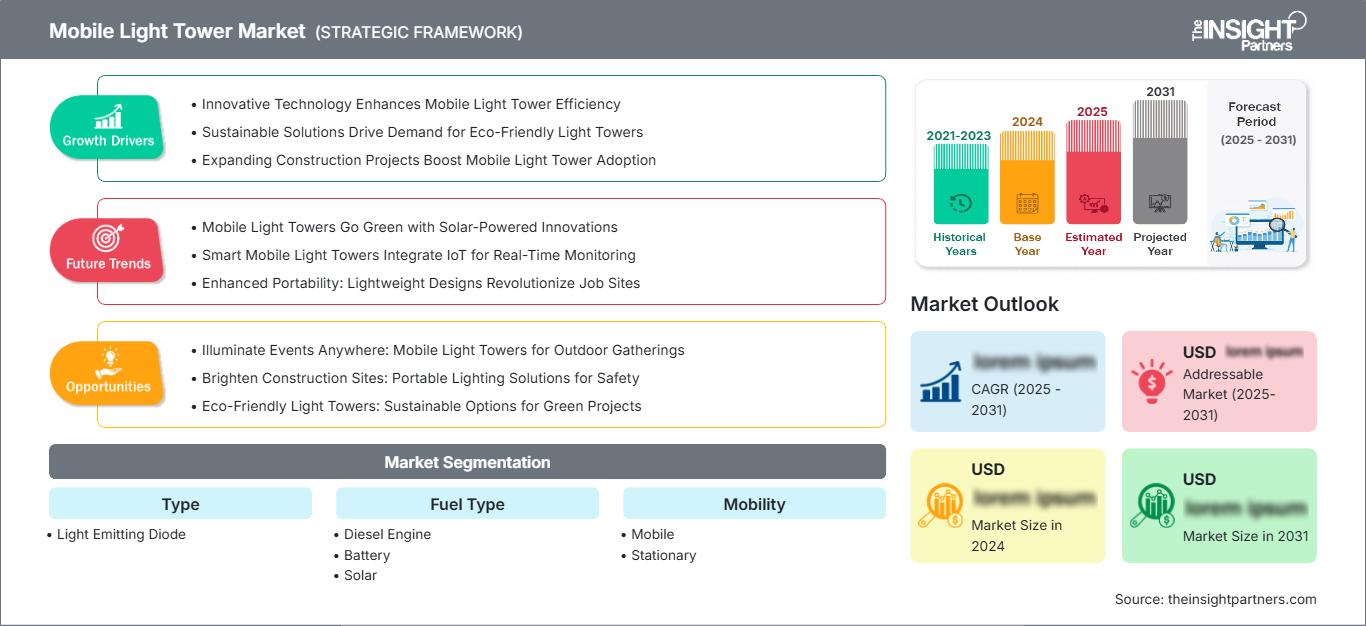
The Mobile Light Tower Market was valued at US$ 220.43 Million in 2025 and is projected to reach US$ 309.52 Million by 2034, expanding at a CAGR of 4.33% during 2026–2034. Demand is supported by the need for dependable temporary illumination across construction, mining, oil and gas, defense, infrastructure, and emergency applications, while efficiency improvements are reshaping equipment selection toward LED, battery, solar, and hybrid configurations.
North America Mobile Light Tower Market size remains a structurally attractive market because extensive construction activity, equipment rental penetration, and requirements for safe nighttime operations sustain replacement and fleet demand. The regional outlook also benefits from infrastructure modernization, expanding energy projects, and increasing customer preference for lower-maintenance lighting systems that can reduce fuel consumption, operating interruptions, and site-level emissions.
Mobile Light Tower Market Assessment and Insights
- North America: North America is expected to represent a 38–42% share in 2025 and expand at a 4.5–5.5% CAGR between 2026–2034, supported by infrastructure construction, rental fleets, oil and gas activity, and stringent worksite requirements.
- US: The US is estimated to account for 82–87% of North American demand in 2025, with a 4.6–5.6% CAGR during 2026–2034, led by construction and rental applications.
- Europe: Europe is projected to hold a 25–29% share in 2025 and grow at a 3.8–4.8% CAGR during 2026–2034, with Germany, the UK, France, Italy, and Spain supporting demand through construction modernization and emissions-conscious procurement.
- Asia Pacific: Asia Pacific is expected to capture a 19–23% share in 2025 and record a 5.8–6.8% CAGR during 2026–2034, led by China, India, Japan, South Korea, and Australia across infrastructure, mining, and industrial projects.
- Largest Segment: Light Emitting Diode is estimated at a 55–60% market share in 2025, with a 5.0–6.0% CAGR during 2026–2034, reflecting efficiency, durability, and lower maintenance.
- High Growth Segment: Solar is estimated at a 7–11% market share in 2025 and a 9.0–10.5% CAGR during 2026–2034, benefiting from low-emission operation and remote-site suitability.
- Key companies analyzed in detail: Atlas Copco AB, Generac Holdings Inc., Italtower S.r.l., Allmand Bros., Inc., Herc Holdings Inc., Terex Corporation, Wacker Neuson SE, Doosan Portable Power, Wanco Inc., Multiquip Inc.
Source: The Insight Partners' analysis based on proprietary research, government publications, company annual reports, investor presentations, industry databases, and expert interviews.
The evolution of Mobile Light Towers market has gone from mainly diesel-operated, metal halide mobile light towers to high-efficiency LED-based platforms with various power sources. The innovations include reduction in fuel consumption, smaller footprint, automation, better lighting area, and less maintenance. Current products of Atlas Copco are already moving towards LED, electric, battery, and solar-powered light towers, while Wacker Neuson incorporates LED lighting and automatic light sensing and timing capabilities into its products.
For the future, the market is expected to expand in new infrastructure markets where mobile lighting plays a role in lighting for road construction, mining, power generation projects, and municipal projects. Products capable of working autonomously with low emissions and maintenance will get more investments. European regulations and procurement policies are favoring cleaner products, while North American rental companies prefer robust products.
Mobile Light Tower Market Report Scope
| Report Attribute | Details |
|---|---|
| Market size in 2025 | US$ 220.43 Million |
| Market Size by 2034 | US$ 309.52 Million |
| Global CAGR (2026 - 2034) | 4.33% |
| Historical Data | 2021-2024 |
| Forecast period | 2026-2034 |
Mobile Light Tower Market Analysis
Growth of the Mobile Light Tower industry depends on construction schedules, mining activities, energy facilities, road building, and temporary lighting. Typically, demand goes through equipment producers, engines and battery producers, lighting components producers, distributors, rentals, contractors, and end-users. The trend to use LED is growing as it helps increase lighting efficiency and saves energy due to the presence of directional optics. Atlas Copco suggests that certain LED systems may illuminate areas of up to 5,000 sq m at 20 lux.
Supply is increasingly determined by diversity of components. While diesel engines continue to play an important role where autonomy and quick refueling matter, the batteries, solar panels, electric power devices and hybrid units become strategically significant. For example, Allmand's Hybrid LT-Series uses diesel engine and two 7 kWh batteries.
According to Mobile Light Tower Market report, there is an increasing change in the dynamics of competition from just illumination components towards more differentiated total cost of ownership, runtime, noise reduction, mobility, and emissions. Some examples of competing companies through equipment variety include Atlas Copco, Generac Holdings Inc., Wacker Neuson SE, Allmand Bros., Inc., and Doosan Portable Power. On the other hand, Wanco Inc. and Multiquip Inc. serve specialized markets such as construction and rentals. Other competitors include Italtower S.r.l. and Terex Corporation.
Investments in the future will be directed towards development of LED technology, batteries, solar panels, electronics, and fleets. In this regard, Generac produces a battery-driven MLTB that is made from a 22 kWh lithium-ion battery with the ability to run for 75 hours.
● REPORT CUSTOMIZATION
Tailor This Report To Align With Your Specific Business Requirements
This report can be customized to align precisely with your business objectives, scope, and target markets. Customization options include tailored segmentation, geography, competitive analysis, and strategic insights to support informed decision-making.
Customize This Report →WHAT YOU CAN ADJUST
- ● Segmentations
- ● Geography
- ● Competitive Analysis
- ● Language Preferences
Mobile Light Tower Market: Strategic Insights
Regional Insights
North America Mobile Light Tower Market
It is predicted that North America will comprise a Mobile Light Tower Market share of 38-42% in the in 2025 and 4.5-5.5% CAGR up until 2034. Construction, roads refurbishing, energy projects, mining, and leasing represent a diverse range of applications. While the United States comprises the largest share in the consumption of the market in the region, Canada supplies from its mining sector, infrastructure projects, and offsite activities.
North America slowly shifts towards combining the reliability of diesel light towers with efficiency of LED lights, batteries, and hybrid designs. The regulations regarding emission levels and safety on the construction site push this trend, but diesel engines still play an important role for extended and offsite uses. Wanco’s diesel towers prove their importance and efficiency, while LED and battery-powered light towers show diversity of technology development in the region.
U.S. Mobile Light Tower Market
U.S. constitutes roughly 82-87% share in terms of demand in North America Mobile Light Tower Market till 2025 and forecasted to grow at 4.6-5.6% CAGR up to 2034. Construction constitutes the core application and is driven by transportation, utilities, energy, rental services, and other applications demanding temporary lighting.
Demand for the products focuses increasingly on LED technology, low noise, ease of transport and low maintenance requirements. Major manufacturers have extensive networks, whereas rental firms drive procurement by emphasizing usage rate, robustness, and standardization in maintenance requirements. Large-scale constructions and energy projects in the country ensure repeat demand for the products, as well as battery and hybrid light towers due to restrictions on noise and emissions or indoor vicinity.
Europe Mobile Light Tower Market
Europe is expected to constitute 25–29% of the Mobile Light Tower Market in 2025 and grow at a 3.8–4.8% CAGR up to 2034. The market is headed by Germany for industrial applications, followed by the United Kingdom, France, Italy, and Spain that offer large construction and infrastructure uses. Environmental regulations are driving efficient light systems and reducing fuel use.
APAC is forecast to account for 19%-23% of the global Mobile Light Towers market in 2025 and grow at a 5.8%-6.8% CAGR until 2034, headed by China. Opportunities are abundant in infrastructure construction in China and India, whereas Japan and South Korea focus on industrial application of light towers.
Sustained infrastructure expenditure under government policy, urbanization, mining investment, and industrial growth will drive demand. The need for solar-powered and battery-powered systems will be greater in areas where electricity grid supply is inadequate, while diesel-powered units will continue to play a role where utilization is higher. Efficiency considerations will favor LED and hybrid systems gradually.
APAC Mobile Light Tower Market
APAC is forecast to account for 19%-23% of the global Mobile Light Towers market in 2025 and grow at a 5.8%-6.8% CAGR until 2034, headed by China. Opportunities are abundant in infrastructure construction in China and India, whereas Japan and South Korea focus on industrial application of light towers.
Sustained infrastructure expenditure under government policy, urbanization, mining investment, and industrial growth will drive demand. The need for solar-powered and battery-powered systems will be greater in areas where electricity grid supply is inadequate, while diesel-powered units will continue to play a role where utilization is higher. Efficiency considerations will favor LED and hybrid systems gradually.
Middle East & Africa Mobile Light Tower Market
Middle East & Africa is expected to grow at a 4.2–5.2% CAGR through 2034. Saudi Arabia and the UAE lead demand through large infrastructure, construction, energy, and development programs, while South Africa contributes through mining and industrial activity. Remote sites continue to favor dependable diesel equipment.
The regional opportunity is strengthened by energy projects, logistics infrastructure, construction activity, and mining operations requiring autonomous illumination. Solar configurations can address remote locations and emission-sensitive projects, while diesel remains preferred where long runtime and rapid refueling are essential. Demand is therefore likely to remain technology-diverse rather than shifting uniformly toward one power architecture.
Segmentation Analysis
Type
Type segmentation remains central to Mobile Light Tower Market scope because illumination technology determines energy consumption, maintenance requirements, operating life, and suitability for different worksites. The segment is expected to grow at a 4.8–5.8% CAGR during 2026–2034, with LED strengthening its position as users evaluate lifecycle economics alongside illumination performance.
- Light Emitting Diode: LED systems hold the leading position because directional illumination, long service life, low maintenance, and reduced energy consumption support construction, mining, rental, and infrastructure applications.
- Metal Halide: Metal halide equipment retains relevance where high-intensity illumination and established operating practices outweigh efficiency considerations, particularly among users with existing fleets and servicing capabilities.
- Electric: Electric configurations serve grid-connected and emission-sensitive environments, offering quiet operation and simplified maintenance for events, urban projects, and locations where combustion equipment is restricted.
- Others: Other technologies address specialized lighting requirements and niche operating conditions, providing manufacturers with flexibility to serve applications that do not align with mainstream LED, metal halide, or electric configurations.
Fuel Type
Fuel architecture is becoming a major purchasing consideration as users balance runtime, refueling infrastructure, emissions, noise, and total ownership costs. Fuel Type is expected to expand at a 4.9–5.9% CAGR during 2026–2034 as conventional and low-emission systems coexist.
- Diesel Engine: Diesel remains important for remote and high-utilization applications because established fueling infrastructure, long runtimes, and rapid refueling support demanding construction, mining, and energy operations.
- Battery: Battery-powered towers address low-noise and emission-sensitive sites, with adoption supported by improving storage technology and the ability to operate without engine maintenance during temporary lighting assignments.
- Solar: Solar systems provide autonomous illumination for remote locations and projects with sustainability targets, reducing fuel requirements while combining photovoltaic generation with battery storage for nighttime operation.
- Hydrogen: Hydrogen-based configurations represent an emerging pathway for lower-emission temporary power, particularly where infrastructure projects and industrial users seek alternatives to conventional combustion while retaining extended operating capability.
Mobility
Mobility determines deployment flexibility and asset utilization across temporary worksites. The segment is forecast to grow at a 4.4–5.4% CAGR during 2026–2034, supported by rental demand and projects requiring lighting to move as work fronts change.
- Mobile: Mobile systems remain strategically important because trailer-based deployment allows contractors and rental providers to reposition illumination rapidly across construction, mining, infrastructure, and event sites.
- Stationary: Stationary systems serve locations requiring recurring illumination at fixed points, where installation stability, dependable operation, and reduced relocation requirements can outweigh the flexibility of trailer-mounted equipment.
Application
Application demand is diversified across infrastructure-intensive industries and temporary operating environments. The segment is expected to expand at a 4.7–5.7% CAGR during 2026–2034, with construction maintaining the broadest demand base while mining and energy applications require ruggedized equipment.
- Construction: Construction represents the broadest demand pool because road, bridge, building, utility, and civil projects frequently require safe illumination beyond daylight hours.
- Oil & Gas: Oil and gas operators require dependable lighting for drilling, processing, maintenance, logistics, and remote installations where equipment reliability and operating autonomy are critical.
- Mining: Mining applications favor rugged towers with high illumination coverage, extended runtimes, and reliable performance under dusty, remote, and continuously operating conditions.
- Military & Defence: Defense applications prioritize transportability, dependable operation, rapid deployment, and low logistical burden for temporary bases, field operations, maintenance areas, and emergency support.
- Others: Other applications include events, emergency response, municipal work, utilities, and temporary public lighting, creating diversified demand outside conventional industrial worksites.
Opportunity Snapshot
| Application | Revenue Contribution (High/Medium/Low) | Trend Tag (MAX 2 words) | Adoption Stage (Emerging/Scaling/Mature) |
| Construction | High | Site Safety | Mature |
| Oil & Gas | Medium | Remote Operations | Mature |
| Mining | Medium | Mine Electrification | Scaling |
| Military & Defence | Low | Field Mobility | Scaling |
| Others | Medium | Emergency Lighting | Scaling |
Mobile Light Tower Market Growth Drivers and Impact Analysis
Infrastructure Expansion Extends Nighttime Equipment Utilization
There will be continued need for temporary illumination in the process of infrastructure construction due to the fact that the construction of roads, bridges, utilities, and civil projects is done on a schedule of extensive shifts. This effect will be most pronounced in cases where the projects' schedule will necessitate the continued production, and insufficient lighting will limit equipment use. The rental companies will be favored since the contractors will often require the towers for limited time projects and not for long-term possession. Continued investments in infrastructure will lead to equipment replacement in order to have transportable and efficient equipment.
Efficiency Requirements Accelerate LED and Hybrid Adoption
Energy efficiency is changing buying habits as contractors consider the operational cost of machines as opposed to the buying price alone. LED lights can cut the amount of energy needed while increasing the frequency at which service is conducted and hybrid machines can make the engine available along with the batteries. Allmand’s Hybrid LT-Series is an example of this approach where the engine is combined with two 7kWh batteries and the option of different operating modes. Generac has also come up with battery-powered machines that are able to operate for long without the engine. These kinds of machines can minimize maintenance costs, noise, and fuel consumption during appropriate cycles. Energy efficiency is thus becoming a fleet management issue rather than just an environmentally friendly practice.
Remote and Resource-Intensive Operations Sustain High Reliability Demand
Projects involving mining, oil and gas, utilities, and remote infrastructure have the need for lighting solutions which can operate independently of the reliable availability of grid connections. The runtime, environmental toughness, mobility, maintenance and ease of start up have a higher priority compared to the cost factor alone. The use of diesel is still economical in such scenarios due to the fast refueling capability of the system and there are other alternatives in the form of solar or batteries in case emissions and noise are an issue. The coexistence of these technologies helps in achieving a diverse product range. Companies producing lighting solutions with a tough mechanical design and flexible power options are able to cater to varying duty cycles without restricting customers to a particular technology.
Mobile Light Tower Market Future Trends
Connected Fleet Management and Intelligent Lighting Controls
Connected control systems in the Mobile Light Tower Market trends are likely to gain more significance as rental firms and big contractors look for ways to understand better the utilization, maintenance, run time, fuel consumption, and location of the machinery. The future towers are going to use more sensors and remote diagnostics, automation of starting and stopping processes, and application-based monitoring. Connected intelligent control will even be able to regulate the lighting based on the operation schedule, minimizing the run time while maintaining safety standards. Wacker Neuson uses sensors of light and time in some LED lamps to show the way connected machines are going to operate.
Hybrid Energy Architectures Become More Application-Specific
The upcoming phase of product development will probably not involve diesel replacement in general but rather power architecture tailored to the particular duty cycle. Hybrid technology will allow keeping the engine-powered independence in tough conditions, while battery-powered operations could be performed at low loads. Solar-battery technologies can be utilized for lighting needs where the energy consumption per day is certain and where remote locations require the operation in isolation. The second-generation solar system by Atlas Copco, which uses PV panels and lithium-ion batteries for remote operations, shows an example of such technology utilization.
Mobile Light Tower Market Opportunities
Rental-Focused Low-Emission Fleets
Rental companies represent an attractive investment opportunity because customers increasingly seek temporary lighting without long-term asset ownership. Fleet operators can improve utilization by combining conventional diesel units with battery, solar, and hybrid models matched to different duty cycles. Low-emission equipment can command greater relevance in urban projects, public-sector work, and environmentally constrained sites, while diesel units remain available for remote and high-runtime applications. Investors and manufacturers can strengthen this opportunity through standardized batteries, remote diagnostics, modular lighting assemblies, and simplified service procedures. Fleet segmentation based on application rather than technology alone can improve asset allocation and reduce idle time. The resulting opportunity in the Mobile Light Tower Market forecast is centered on lifecycle economics, utilization, and differentiated rental propositions.
Remote Infrastructure and Mining Electrification
Remote infrastructure and mining projects offer opportunities for manufacturers able to combine autonomous operation with lower logistical requirements. Solar-battery towers can reduce fuel deliveries for suitable low-load applications, while hybrid systems can maintain dependable operation during periods of limited renewable generation. Mining operators also increasingly evaluate energy efficiency across auxiliary equipment as electrification expands across core processes. This creates an opportunity to integrate lighting with broader site-energy strategies rather than treating towers as isolated assets. Suppliers can differentiate through rugged construction, high illumination coverage, modular storage, rapid deployment, and monitoring capabilities. Partnerships with mining contractors, infrastructure developers, and rental providers can further reduce market-entry barriers and provide application-specific validation.
Frequently Asked Questions

- Comprehensive Market Sizing and Forecast Analysis
- Detailed Segmentation Analysis
- In-Depth Market Dynamics Assessment
- Regional and Country-Level Insights
- Competitive Landscape and Company Benchmarking
- Strategic Business Intelligence
Recent Reports
Testimonials

The Insight Partners provided valuable market intelligence that supported our global go-to-market strategy. Their team was professional, responsive, and attentive to our feedback, providing thoughtful analysis and helpful methodological clarifications throughout the project.
Junmo Kim Chief Financial Officer (CFO), Enertech Co., Ltd.
The Insight Partners' SCADA System Market report is comprehensive, with valuable insights on current trends and future forecasts. The team was highly professional, responsive, and supportive throughout. We are very satisfied and highly recommend their services.
RAN KEDEM Partner, Reali Technologies LTDs
I requested a report on a very specific software market and the team produced the report in a few days. The information was very relevant and well presented. I then requested some changes and additions to the report. The team was again very responsive and I got the final report in less than a week.
JEAN-HERVE JENN Chairman, Future Analytica
We worked with The Insight Partners for an important market study and forecast. They gave us clear insights into opportunities and risks, which helped shape our plans. Their research was easy to use and based on solid data. It helped us make smart, confident decisions. We highly recommend them.
PIYUSH NAGPAL Sr. Vice President, High Beam Global
The Insight Partners delivered insightful, well-structured market research with strong domain expertise. Their team was professional and responsive throughout. The user-friendly website made accessing industry reports seamless. We highly recommend them for reliable, high-quality research services
YUKIHIKO ADACHI CEO, Deep Blue, LLC.
This is the first time I have purchased a market report from The Insight Partners.While I was unsure at first, I visited their web site and felt more comfortable to take the risk and purchase a market report.I am completely satisfied with the quality of the report and customer service. I had several questions and comments with the initial report, but after a couple of dialogs over email with their analyst I believe I have a report that I can use as input to our strategic planning process.Thank you so much for taking the extra time and making this a positive experience.I will definitely recommend your service to others and you will be my first call when we need further market data.
JOHN SUZUKI President and Chief Executive Officer, Board Director, BK Technologies
I wish to appreciate your support and the professionalism you displayed in the course of attending to my request for information regarding to infectious disease IVD market in Nigeria. I appreciate your patience, your guidance, and the fact that you were willing to offer a discount, which eventually made it possible for us to close a deal. I look forward to engaging The Insight Partners in the future, all thanks to the impression you have created in me as a result of this first encounter.
DR CHIJIOKE ONYIA MANAGING DIRECTOR, PineCrest Healthcare Ltd.Reason to Buy
- Informed Decision-Making
- Understanding Market Dynamics
- Competitive Analysis
- Identifying Emerging Markets
- Customer Insights
- Market Forecasts
- Risk Mitigation
- Boosting Operational Efficiency
- Strategic Planning
- Investment Justification
- Tracking Industry Innovations
- Aligning with Regulatory Trends





 Get Free Sample for