
Mobile Phone Application Processor Market Demand, Share & Growth by 2034
Coverage: By Operating System (Android, IOS, Others); Component (ARM cores, Graphical Processing Units (GPU), Cache Memories, Memory Controllers, Audio and Video Decoders, Others); Application (Gaming, Photo and Video Editing, Camera applications); Type (Smartphone Application Processor, Integrated Smartphone Application Processor, 32-Bit Smartphone Application Processor, And 64-Bit Smartphone Application Processor) , and Geography (North America, Europe, Asia Pacific, and South and Central America)
- Status : Data Released
- Report Code : TIPRE00016992
- Category : Electronics and Semiconductor
- No. of Pages : 150
- Available Report Formats :


- Last update date : October 13, 2026


2025 Market Size
US$ 24.03 Bn
Base year value
2034 Forecast
US$ 50.37 Bn
Projected by 2034
CAGR 2026-2034
8.57 %
Growth rate
Addressable Market
US$ 333.65 Bn
(2026-2034)
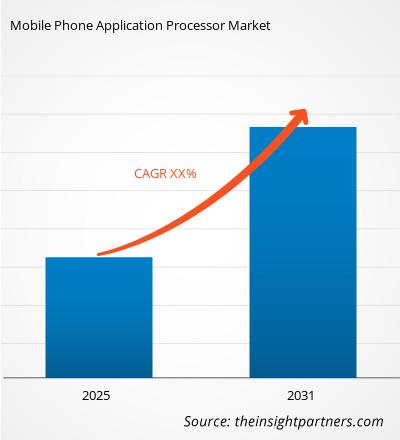
Mobile phone application processor market was valued at US$ 24.03 Billion in 2025 and is projected to reach US$ 50.37 Billion by 2034, registering a CAGR of 8.57% during 2026–2034. The market is supported by continuous advancements in semiconductor process technologies, growing demand for premium smartphones, rising on-device artificial intelligence capabilities, and increasing integration of high-performance computing architectures that improve graphics, multimedia processing, connectivity, and energy efficiency across next-generation mobile devices.
Across North America, sustained investments in advanced semiconductor research, expanding adoption of artificial intelligence-enabled smartphones, and strong intellectual property ecosystems continue to strengthen industry development. The mobile phone application processor market size in the region is expected to expand at an estimated CAGR of 7.4%–8.2% during 2026–2034, supported by premium handset demand, leading fabless chip designers, strategic collaborations with foundries, and increasing enterprise adoption of AI-powered mobile computing solutions.
Mobile Phone Application Processor Market Assessment and Insights
- North America: Accounted for 30–34% share in 2025 and is projected to expand at a CAGR of 7.4%–8.2% during 2026–2034. Growth is supported by advanced semiconductor design capabilities, strong premium smartphone demand, AI-enabled mobile computing, and continued investments in high-performance processor architectures.
- US: Represented 74–78% of the North American market in 2025 and is anticipated to register a CAGR of 7.5%–8.3% during 2026–2034, supported by leading fabless semiconductor companies, extensive research investments, and rapid commercialization of AI-powered mobile devices.
- Europe: Held 21–25% share in 2025 and is forecast to grow at a CAGR of 7.2%–8.0% during 2026–2034. Germany, the UK, and France remain leading contributors owing to semiconductor innovation, automotive electronics integration, and expanding investments in advanced chip technologies.
- Asia Pacific: Captured 39–43% share in 2025 and is expected to record the fastest regional expansion at a CAGR of 9.2%–10.0% during 2026–2034. China, South Korea, Japan, and India continue to drive production, smartphone manufacturing, semiconductor investments, and consumer electronics demand.
- Largest Segment: Operating System accounted for a 43–47% market share in 2025 and is projected to grow at a CAGR of 8.4%–9.1% during 2026–2034, driven by widespread Android adoption and increasing optimization of application processors for advanced operating system capabilities.
- High Growth Segment: Application – Gaming represented 27–31% market share in 2025 and is anticipated to register a CAGR of 10.2%–11.1% during 2026–2034, supported by high-refresh-rate displays, AI-assisted graphics rendering, cloud gaming, and demand for console-grade mobile gaming experiences.
- Key companies analyzed in detail: Advanced Micro Devices, Inc., Apple Inc., Broadcom Inc., Huawei Technologies Co., Ltd., Intel Corporation, MediaTek Inc., NVIDIA Corporation, Qualcomm Technologies, Inc., Renesas Electronics Corporation, Samsung Electronics Co., Ltd.
Source: The Insight Partners' analysis based on proprietary research, government publications, company annual reports, investor presentations, industry databases, and expert interviews.
Ongoing innovations in semiconductor processing technologies, heterogeneous computing platforms, and intelligent AI engines have dramatically transformed the mobile application processors landscape over the last ten years. There has been a greater emphasis on achieving high transistor density, efficient heat dissipation, and enhanced CPU-GPU-NPU designs that can meet the requirements of next-generation mobile workloads. Increasing use of 5G phones, computational photography, edge-based AI, and immersive mobile games will continue to drive mobile application processor players to launch cutting-edge chipsets developed using latest process nodes, along with strategic engagements with foundry partners, smartphone makers, software firms, and component suppliers worldwide.
Moving forward, increased adoption of smartphones in emerging economies, growing semiconductor manufacturing capacity within respective countries, and favorable industrial policies are likely to drive future growth opportunities for mobile application processors over the forecast period. Incentives provided by governments in Asia Pacific, North America, and Europe are promoting advanced semiconductor chip development, and greater adoption of generative AI, secure mobile computing, and energy-efficient computing will offer additional market prospects through 2034.
Mobile Phone Application Processor Market Report Scope
| Report Attribute | Details |
|---|---|
| Market size in 2025 | US$ 24.03 Billion |
| Market Size by 2034 | US$ 50.37 Billion |
| Global CAGR (2026 - 2034) | 8.57% |
| Historical Data | 2021-2024 |
| Forecast period | 2026-2034 |
Mobile Phone Application Processor Market Analysis
The development of the mobile phone application processor market is expected to be driven by rising consumer demands for advanced artificial intelligence-powered smartphones that can offer high-performance computing while ensuring optimal battery performance. There are smartphone brands that now use application processors with neural processing units, enhanced graphics processing systems, and image signal processors to achieve computational photography, multi-language intelligent assistants, augmented reality apps, and content creation. The rise in 5G technology, high refresh rate displays, and immersive multimedia experiences has raised the demands for better processing capabilities, which is pushing semiconductor vendors to develop new products while increasing their manufacturing efficiencies using advanced processes.
Resilient supply chains have also become increasingly important as innovations in performance. Semiconductor vendors are increasingly diversifying in wafer manufacturing, advanced packaging, and assembly capabilities in order to minimize manufacturing risks and increase flexibility in manufacturing. Foundries' investments in sub-5 nanometer and other advanced processes will help increase density of transistors, lower power consumption, and integrate different types of computing blocks within a single chip.
The mobile phone application processor market analysis reveals that competition is based on technological superiority, ecosystem integration, patent portfolio, and customer loyalty and not on price alone. Qualcomm Technologies, Inc., MediaTek Inc., Apple Inc., and Samsung Electronics Co., Ltd. will continue to consolidate their competitive advantage through the use of AI-enabled processors, integrated modems, and software ecosystems. On the other hand, Huawei Technologies Co., Ltd., Broadcom Inc., Intel Corporation, Advanced Micro Devices, Inc., NVIDIA Corporation, and Renesas Electronics Corporation will continue making strategic investments in semiconductor designs, connectivity technologies, graphics, and special computing capabilities that will drive innovation in the industry.
Investment strategies will focus more on advanced package designs, chiplets, AI accelerators, and security processors for next-generation mobile devices. Collaborations among semiconductor manufacturers, electronic design automation companies, foundry companies, smartphone original equipment manufacturers (OEM), and cloud AI service providers will continue to shorten the commercialization process and enhance the resilience of the global supply chain. With the increase in complexity of workloads in mobile devices, research and development spending will continue to be the key point of differentiation for players in the mobile application processor value chain.
● REPORT CUSTOMIZATION
Tailor This Report To Align With Your Specific Business Requirements
This report can be customized to align precisely with your business objectives, scope, and target markets. Customization options include tailored segmentation, geography, competitive analysis, and strategic insights to support informed decision-making.
Customize This Report →WHAT YOU CAN ADJUST
- ● Segmentations
- ● Geography
- ● Competitive Analysis
- ● Language Preferences
Mobile Phone Application Processor Market: Strategic Insights

Regional Insights
North America Mobile Phone Application Processor Market
North America accounted for 30–34% of the global market in 2025 and is projected to expand at a CAGR of 7.4%–8.2% during 2026–2034. The region benefits from a mature semiconductor ecosystem, strong intellectual property protection, and significant investments in advanced processor design. Increasing demand for premium smartphones, on-device artificial intelligence, and high-performance mobile gaming continues to stimulate innovation among chipset developers. The mobile phone application processor market share remains supported by collaboration between fabless semiconductor companies, foundries, and smartphone manufacturers.
The US is still at the center of regional growth, whereas Canada is playing its part with respect to semiconductor R&D, AI, and electronics innovation. Government initiatives in favor of chip production within the country and building resilient semiconductor supply chain have added to the region’s competitive position. Growing use of edge AI, secure mobile computing, and multimedia is anticipated to continue demand for processors, especially for flagship phones.
U.S. Mobile Phone Application Processor Market
The United States represented 74–78% of the North American market in 2025 and is forecast to register a CAGR of 7.5%–8.3% during 2026–2034. Several global semiconductor innovators, design centers, and technology firms that have been instrumental in the development of processors operate within the country. The current demand for premium smartphones, enterprise mobility, and consumer electronics with AI features is high, hence there is need for investment in the latest semiconductor architectures and energy-efficient mobile platforms.
Leading organizations are continually carrying out research on heterogeneous computing, neural processing units, and graphic integration technology. Collaboration between chip makers, software developers, and phone makers is instrumental in bringing new mobile platforms into the market. Deployment of generative AI systems, mobile security, and advanced camera processing technologies will also ensure processor demand in the coming years.
Europe Mobile Phone Application Processor Market
Europe held 21–25% of the global market in 2025 and is anticipated to grow at a CAGR of 7.2%–8.0% through 2034. Germany is still the dominant player because of its already existing infrastructure for semiconductor production, good engineering base, and electronics research. Moreover, the European Chips Act and other technology initiatives are continuing to facilitate the innovation in semiconductors and competitiveness in processor design and production.
The UK has strengths in semiconductor intellectual property rights, semiconductor architecture development, and software research related to artificial intelligence, which helps encourage further innovation in mobile computing devices. France, Italy, and Spain are increasing their investments into semiconductors and electronics manufacturing and implementing digital transformation, thus creating more demand for efficient application processors.
APAC Mobile Phone Application Processor Market
Asia Pacific captured 39–43% of the global market in 2025 and is projected to register the fastest regional expansion at a CAGR of 9.2%–10.0% during 2026–2034. China leads regional production, while South Korea, Japan, India, and Australia strengthen semiconductor manufacturing, research, and smartphone innovation through expanding investments and supportive industrial policies.
With the rising smartphone penetration rate, growth in the export of electronics, and domestic production of semiconductors, the demand for processors will keep growing. Semiconductors incentives in nations together with AI-based smartphones and advanced manufacturing technology will make the Asia Pacific region the main production and consumption base.
Middle East & Africa Mobile Phone Application Processor Market
The Middle East and Africa is expected to record a CAGR of 6.8%–7.5% during 2026–2034. Saudi Arabia and the United Arab Emirates continue investing in digital infrastructure, artificial intelligence, and advanced technology ecosystems, while South Africa remains an important consumer electronics market supporting smartphone adoption across the region.
Demand is supported by expanding mobile broadband connectivity, increasing digital services, and government-led technology diversification initiatives. Although local semiconductor manufacturing remains limited, strategic investments in innovation, smart city development, and digital transformation are expected to create favorable conditions for long-term adoption of advanced mobile application processors.
Segmentation Analysis
Operating System
The Operating System segment is projected to register a CAGR of 8.4%–9.1% during 2026–2034. Demand is driven by the need for optimized hardware-software integration, enhanced security, AI-assisted computing, and efficient power management. The mobile phone application processor market scope continues to expand as operating systems increasingly require processors capable of supporting advanced graphics, machine learning workloads, and seamless multitasking across flagship and mid-range smartphones.
- Android: Android-based smartphones account for the majority of global processor demand due to broad OEM adoption, diverse pricing strategies, and continuous software enhancements supporting AI applications, gaming, and advanced multimedia experiences.
- iOS: Apple's tightly integrated ecosystem enables highly optimized processor performance, delivering efficient power consumption, enhanced security, superior computational photography, and advanced machine learning capabilities that differentiate premium smartphones.
Component
The Component segment is expected to grow at a CAGR of 8.7%–9.4% during 2026–2034. Continuous advancements in semiconductor architecture are increasing integration of specialized processing blocks within application processors. Vendors are emphasizing higher computing efficiency, improved graphics performance, lower latency, and enhanced AI acceleration to support increasingly sophisticated smartphone workloads while maintaining energy efficiency.
- ARM Cores: ARM-based CPU architectures remain the foundation of modern mobile processors, providing scalable performance, low power consumption, and compatibility across entry-level, mid-range, and premium smartphones.
- Graphical Processing Units: Mobile GPUs continue evolving to deliver console-quality graphics, real-time ray tracing support, AI-assisted rendering, and higher frame rates for gaming and immersive augmented reality applications.
- Cache Memories: Larger and faster cache memories reduce processing latency, improve application responsiveness, and optimize processor efficiency during multitasking, AI inference, and multimedia processing workloads.
- Memory Controllers: Advanced memory controllers enhance communication between processors and high-speed memory modules, supporting faster application execution, improved bandwidth utilization, and efficient resource allocation.
- Audio and Video Decoders: Dedicated decoding engines enable efficient playback of high-resolution video, immersive audio formats, and streaming content while minimizing processor workload and extending smartphone battery life.
Application
The Application segment is forecast to expand at a CAGR of 9.3%–10.1% during 2026–2034. Increasing consumer expectations for AI-enhanced user experiences, advanced photography, and premium entertainment continue encouraging processor manufacturers to optimize computing architectures for specialized mobile applications. Hardware acceleration and dedicated processing engines are becoming key differentiators across flagship smartphone platforms.
- Gaming: Mobile gaming drives demand for processors featuring high-performance CPUs, advanced GPUs, AI-assisted graphics optimization, and thermal management technologies capable of sustaining demanding workloads over extended gaming sessions.
- Photo and Video Editing: Growing creator economies increase demand for processors supporting real-time rendering, AI image enhancement, HDR processing, and accelerated video encoding directly on smartphones.
- Camera applications: Dedicated image signal processors and neural processing units enable computational photography, object recognition, real-time scene optimization, low-light enhancement, and professional-grade mobile imaging capabilities.
Type
The Type segment is anticipated to register a CAGR of 8.8%–9.6% during 2026–2034. Continuous migration toward higher-performance processor architectures and greater system integration supports innovation across smartphone categories. Manufacturers are increasingly prioritizing efficient chip designs that combine advanced computing, graphics, connectivity, and AI capabilities within compact semiconductor packages.
- Smartphone Application Processor: Standard application processors deliver balanced computing performance for mainstream smartphones while supporting multimedia, connectivity, security, and everyday productivity applications.
- Integrated Smartphone Application Processor: Integrated processors combine multiple functional modules onto a single chip, improving power efficiency, reducing manufacturing complexity, lowering component count, and enabling compact smartphone designs.
- 32-Bit Smartphone Application Processor: Although gradually declining, 32-bit processors continue serving cost-sensitive smartphone categories where affordability, basic computing requirements, and energy efficiency remain primary purchasing considerations.
- 64-Bit Smartphone Application Processor: Advanced 64-bit processors dominate premium and mid-range smartphones by supporting larger memory capacity, AI acceleration, enhanced security, faster application execution, and superior multitasking performance.
Opportunity Snapshot
| Application | Revenue Contribution | Trend Tag | Adoption Stage |
|---|---|---|---|
| Gaming | High | AI Gaming | Mature |
| Photo and Video Editing | Medium | Creator Tools | Scaling |
| Camera applications | High | Computational Imaging | Mature |
Mobile Phone Application Processor Market Growth Drivers and Impact Analysis
Growing adoption of AI-enabled smartphones and edge computing
The quick deployment of artificial intelligence in smartphones is driving up demand for advanced application processors that feature dedicated neural processing units. The mobile device companies have started incorporating generative AI assistants, instant language translators, computational photography, and intelligent battery management directly in the smartphone, thus lowering the need for cloud support. This demands a chip that provides enhanced computing capabilities and energy efficiency. Therefore, semiconductor companies have been increasing their efforts in developing advanced CPU, GPU, and AI accelerators. With the growth of enterprise mobility, content creation, and intelligent consumer apps, the chip providers that offer improved AI capabilities will gain better competitive advantage and commercial prospects.
Expansion of advanced semiconductor manufacturing capabilities
Increasing investments in semiconductor fabrication plants, advanced packaging technologies, and leading-edge manufacturing processes continue strengthening the global supply chain for mobile application processors. There are various efforts being made by governments in North America, Europe, and Asia Pacific in encouraging their industries to develop semiconductors domestically. This will increase the ability to manufacture processors and will allow their development on smaller fabrication nodes. The manufacturing process also allows more transistors per unit area and less power consumption. It will result in faster commercialization of chipsets used in artificial intelligence, graphics, and 5G connectivity applications. This will lead to better processors for smartphones which will consume less power.
Increasing demand for premium mobile gaming and multimedia experiences
Consumer expectations for immersive entertainment continue driving innovation in mobile application processors. High-refresh-rate displays, advanced graphics rendering, augmented reality applications, and ultra-high-definition video recording require processors capable of delivering sustained computing performance without excessive heat generation. Manufacturers increasingly integrate sophisticated graphics engines, dedicated multimedia accelerators, and intelligent thermal management technologies to satisfy these performance requirements. Rising subscriptions to cloud gaming services and expanding creator economies further reinforce processor demand. These trends encourage semiconductor vendors to introduce specialized chipset platforms optimized for graphics-intensive workloads, positioning gaming and multimedia performance as major competitive differentiators across premium smartphone portfolios.
Mobile Phone Application Processor Market Future Trends
Integration of generative AI capabilities into mobile chipsets
Processor vendors are increasingly embedding dedicated AI acceleration hardware capable of supporting generative artificial intelligence directly on smartphones. The mobile phone application processor market trends indicate that future chipsets will prioritize local AI inference, privacy-focused computing, intelligent content generation, and multimodal processing without relying extensively on cloud connectivity. Continued advances in semiconductor design, memory optimization, and software frameworks are expected to improve responsiveness while reducing latency and energy consumption, enabling broader adoption of sophisticated AI-powered mobile experiences.
Migration toward heterogeneous computing architectures
Future smartphone processors are expected to integrate increasingly specialized computing engines that efficiently distribute workloads across CPUs, GPUs, NPUs, image processors, and multimedia accelerators. This architectural evolution improves power efficiency while delivering higher performance for gaming, photography, security, and productivity applications. As smartphone functionality expands, heterogeneous processing will become a fundamental design principle supporting increasingly complex mobile computing environments across both premium and mainstream device categories.
Mobile Phone Application Processor Market Opportunities
Expanding semiconductor investment across emerging manufacturing hubs
Growing investments in semiconductor manufacturing across India, Southeast Asia, and selected Middle Eastern economies are creating attractive opportunities for processor designers and ecosystem partners. The mobile phone application processor market Forecasts indicate that regional fabrication capacity, advanced packaging facilities, and semiconductor design centers will continue expanding over the coming decade. Companies establishing strategic partnerships with regional manufacturers, research institutions, and government-supported innovation programs can diversify supply chains while improving production resilience. Early investment in localized semiconductor ecosystems is expected to strengthen long-term competitiveness as smartphone production increasingly expands beyond traditional manufacturing centers.
Development of processors optimized for next-generation connected devices
The convergence of smartphones with wearable electronics, mixed reality devices, connected vehicles, and Internet of Things ecosystems is opening new avenues for processor innovation. Semiconductor manufacturers have opportunities to design scalable architectures capable of supporting cross-device artificial intelligence, ultra-low-power operation, advanced security, and seamless connectivity. Strategic investments in software optimization, developer ecosystems, and heterogeneous computing technologies will allow processor vendors to extend their product portfolios beyond smartphones while addressing emerging requirements for intelligent connected consumer devices and enterprise mobility solutions.
Frequently Asked Questions

- Comprehensive Market Sizing and Forecast Analysis
- Detailed Segmentation Analysis
- In-Depth Market Dynamics Assessment
- Regional and Country-Level Insights
- Competitive Landscape and Company Benchmarking
- Strategic Business Intelligence
Recent Reports
Testimonials

The Insight Partners provided valuable market intelligence that supported our global go-to-market strategy. Their team was professional, responsive, and attentive to our feedback, providing thoughtful analysis and helpful methodological clarifications throughout the project.
Junmo Kim Chief Financial Officer (CFO), Enertech Co., Ltd.
The Insight Partners' SCADA System Market report is comprehensive, with valuable insights on current trends and future forecasts. The team was highly professional, responsive, and supportive throughout. We are very satisfied and highly recommend their services.
RAN KEDEM Partner, Reali Technologies LTDs
I requested a report on a very specific software market and the team produced the report in a few days. The information was very relevant and well presented. I then requested some changes and additions to the report. The team was again very responsive and I got the final report in less than a week.
JEAN-HERVE JENN Chairman, Future Analytica
We worked with The Insight Partners for an important market study and forecast. They gave us clear insights into opportunities and risks, which helped shape our plans. Their research was easy to use and based on solid data. It helped us make smart, confident decisions. We highly recommend them.
PIYUSH NAGPAL Sr. Vice President, High Beam Global
The Insight Partners delivered insightful, well-structured market research with strong domain expertise. Their team was professional and responsive throughout. The user-friendly website made accessing industry reports seamless. We highly recommend them for reliable, high-quality research services
YUKIHIKO ADACHI CEO, Deep Blue, LLC.
This is the first time I have purchased a market report from The Insight Partners.While I was unsure at first, I visited their web site and felt more comfortable to take the risk and purchase a market report.I am completely satisfied with the quality of the report and customer service. I had several questions and comments with the initial report, but after a couple of dialogs over email with their analyst I believe I have a report that I can use as input to our strategic planning process.Thank you so much for taking the extra time and making this a positive experience.I will definitely recommend your service to others and you will be my first call when we need further market data.
JOHN SUZUKI President and Chief Executive Officer, Board Director, BK Technologies
I wish to appreciate your support and the professionalism you displayed in the course of attending to my request for information regarding to infectious disease IVD market in Nigeria. I appreciate your patience, your guidance, and the fact that you were willing to offer a discount, which eventually made it possible for us to close a deal. I look forward to engaging The Insight Partners in the future, all thanks to the impression you have created in me as a result of this first encounter.
DR CHIJIOKE ONYIA MANAGING DIRECTOR, PineCrest Healthcare Ltd.Reason to Buy
- Informed Decision-Making
- Understanding Market Dynamics
- Competitive Analysis
- Identifying Emerging Markets
- Customer Insights
- Market Forecasts
- Risk Mitigation
- Boosting Operational Efficiency
- Strategic Planning
- Investment Justification
- Tracking Industry Innovations
- Aligning with Regulatory Trends





 Get Free Sample for