
Non-protein Nitrogen Market Share, Growth & Forecast by 2034
Coverage: by Form (Pellet, Dry, Liquid); Type (Ammonia, Urea, Biuret, Other); Livestock (Sheep and Goat, Cattle, Other) , and Geography (North America, Europe, Asia Pacific, and South and Central America)
- Status : Data Released
- Report Code : TIPRE00010028
- Category : Chemicals and Materials
- No. of Pages : 150
- Available Report Formats :


- Last update date : September 17, 2026


2025 Market Size
US$ 1.92 Bn
Base year value
2034 Forecast
US$ 3.28 Bn
Projected by 2034
CAGR 2026-2034
6.10 %
Growth rate
Addressable Market
US$ 23.51 Bn
(2026-2034)
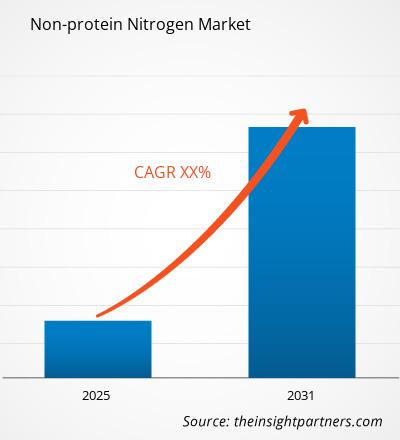
The non-protein nitrogen market is valued at US$ 1.92 billion in 2025 and is projected to reach US$ 3.28 billion by 2034, expanding at a CAGR of 6.10% from 2026 to 2034. Demand will be driven by the application of nitrogen sources in the feed ration of ruminants, where conventional protein sources tend to be expensive or insufficiently nutritious. Urea, ammonia, and biuret continue to be significant raw materials in increasing rumen microbial protein production.
North America's Non-Protein Nitrogen Market Size is forecast to grow at a CAGR of 5.4–6.2% in the period 2026-2034, backed by well-established cattle feeding practices, and the high usage of supplemented feeds. The focus on efficiency and the adoption of precision ration management systems is motivating ranchers to maximize the efficiency of nitrogen usage while minimizing protein supplement expenses.
Non-protein Nitrogen Market Assessment and Insights
- North America: The region is expected to represent a 24–28% share in 2025 and grow at a 5.4–6.2% CAGR between 2026–2034, supported by established cattle production, commercial feed manufacturing, and adoption of controlled nitrogen supplementation.
- US: The US is estimated to account for 20–23% share in 2025, with growth of 5.3–6.1% CAGR between 2026–2034, driven by large-scale beef and dairy operations and formulated feed demand.
- Europe: Europe is projected to hold a 19–23% share in 2025 and expand at 5.0–5.8% CAGR between 2026–2034, led by Germany, France, Spain, Italy, and the UK, where feed efficiency and regulated feed additive quality are priorities.
- Asia Pacific: Asia Pacific is estimated at 29–33% share in 2025, with the strongest regional trajectory of 6.8–7.6% CAGR between 2026–2034, led by China, India, Japan, South Korea, and Australia through expanding livestock production and feed modernization.
- Largest Segment: Cattle is estimated to hold a 68–72% market share in 2025, expanding at 6.0–6.7% CAGR from 2026–2034, reflecting its broad use in dairy and beef feeding programs.
- High Growth Segment: Liquid is estimated at 17–21% market share in 2025, growing at 6.8–7.5% CAGR from 2026–2034, supported by easier dosing and integration into liquid feed systems.
- Key companies analyzed in detail: ADM Animal Nutrition, Antonio Tarazona, CF Industries Holdings, Inc., Fertiberia, S.A., GROUP DF, Kemin Industries, Inc., Nutrien Ltd., OCI N.V., Orica Limited, and SABIC.
Source: The Insight Partners' analysis based on proprietary research, government publications, company annual reports, investor presentations, industry databases, and expert interviews.
In terms of Non-Protein Nitrogen Market trends concerning consumption and production patterns, there is a shift towards a controlled nitrogen supply due to the need for consistency in terms of rumen availability and nutrient synchronization. Urea remains a main source of NPN while biuret and controlled-release forms address issues of fast nitrogen release. Integrated producers usually manage ammonia and urea production along with further feed-grade processing, transportation, quality assurance and application services.
When speaking about the future of the industry, it can be stated that there will be growth in livestock-oriented countries where there is an improvement in terms of ration formulation by feed companies and substitution of expensive protein by farmers. Investment in nitrogen production, ammonia with low carbon footprint, better granulation technology and traceability of feed-grade product will positively affect supply.
Non-protein Nitrogen Market Report Scope
| Report Attribute | Details |
|---|---|
| Market size in 2025 | US$ 1.92 Billion |
| Market Size by 2034 | US$ 3.28 Billion |
| Global CAGR (2026 - 2034) | 6.10% |
| Historical Data | 2021-2024 |
| Forecast period | 2026-2034 |
Non-protein Nitrogen Market Analysis
Rising livestock productivity requirements are increasing the importance of economical nitrogen supplementation. The non-protein nitrogen market growth is closely linked to the ability of ruminants to convert suitable nitrogen sources into microbial protein when adequate fermentable energy is available. The value chain begins with ammonia and urea production, followed by purification, feed-grade processing, formulation, blending, packaging, distribution, and incorporation into compound feeds or supplements.
Supply behavior is heavily determined by the cost of natural gas, ammonia supply, fertilizer capacity utilization, cost of transportation, and inter-regional trade dynamics. Manufacturers catering to animal nutrition markets have to be stricter on the quality standards compared to traditional agricultural fertilizers, especially in terms of purity, biuret content, moisture, granulation, and traceability. Finally, the feed manufacturers will blend the NPN input with carbohydrates, minerals, and vitamins for a balanced ration.
Diversified nitrogen producers, animal nutrition specialty producers, and feed manufacturers are some of the key competitors mentioned in the Non-Protein Nitrogen Market Report. While ADM Animal Nutrition has an integrated approach towards feed manufacturing and production of specialized ruminant feeds, Kemin Industries, Inc. emphasizes on efficiency in nutrition and ruminant feeds. CF Industries Holdings, Inc., Nutrien Ltd., OCI N.V., Fertiberia, S.A., and SABIC are among the largest nitrogen producers having significant upstream capabilities.
The strategic positioning is becoming more reliant on production efficiency, geographic closeness to livestock, feed grade capabilities, and developing new delivery methods for differentiated nitrogen. Investments are also going into lower carbon ammonia and production facilities. Formulation skills are one way in which ADM Animal Nutrition and specialty manufacturers can compete, while economies of scale are some of the key strengths of the larger nitrogen producers.
● REPORT CUSTOMIZATION
Tailor This Report To Align With Your Specific Business Requirements
This report can be customized to align precisely with your business objectives, scope, and target markets. Customization options include tailored segmentation, geography, competitive analysis, and strategic insights to support informed decision-making.
Customize This Report →WHAT YOU CAN ADJUST
- ● Segmentations
- ● Geography
- ● Competitive Analysis
- ● Language Preferences
Non-protein Nitrogen Market: Strategic Insights
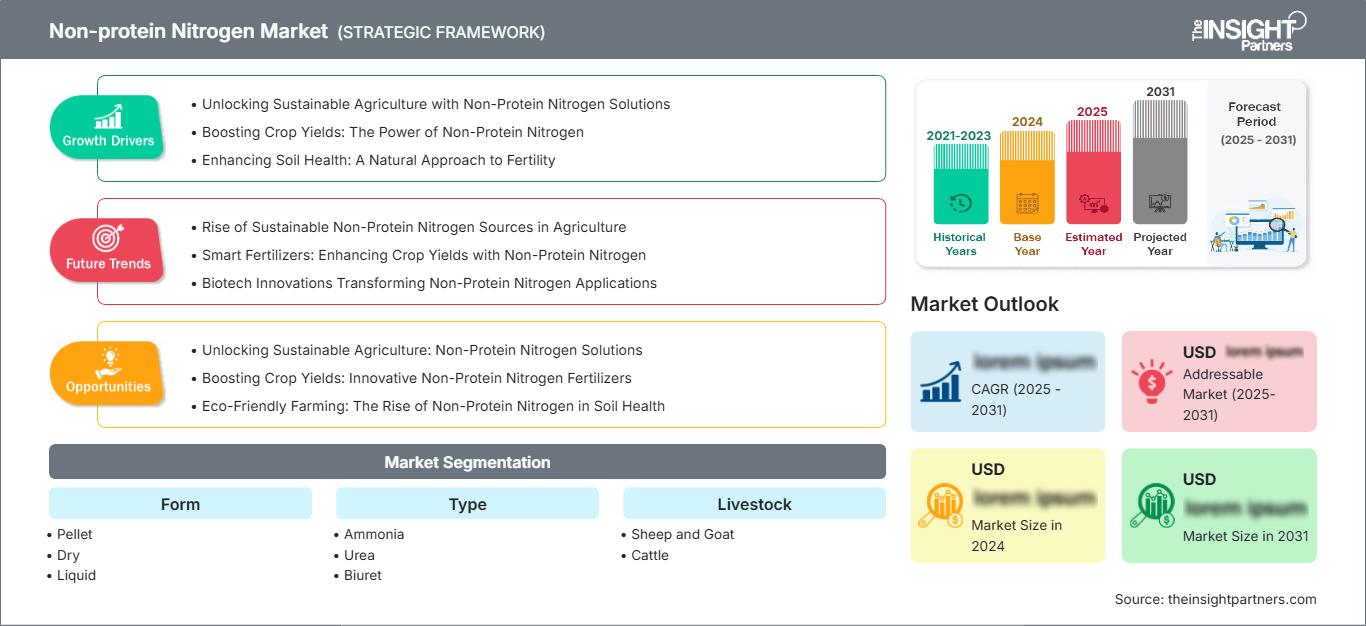
Regional Insights
North America Non-protein nitrogen market
North America is estimated to represent a 24–28% Non-Protein Nitrogen Market share in 2025 and is projected to grow at 5.4–6.2% CAGR through 2034. The US dominates regional demand because of its large commercial dairy and beef industries, extensive compound-feed infrastructure, and established use of urea-containing supplements. Canada contributes through cattle production and integrated feed manufacturing.
Regional consumption is becoming increasingly affected by feed cost management, ration balancing, and the need for consistent availability of nitrogen. Big feedlots and dairies require consistency with respect to product, which could be easily included in pellets, dry mixing systems, or as liquid supplementation. Safety and traceability of the product, along with inclusion control, continues to be a buying consideration. Availability is based on significant domestic production of ammonia and urea, as well as imports to supplement.
U.S. Non-protein nitrogen Market
The US constitutes about 83-87% of the North American demand up to 2025, backed by significant beef cattle and dairy operations. This country is projected to grow at 5.3-6.1% CAGR until 2034, with demand for NPN products in the areas of formulated feeds, protein supplementations, mineral mixes, and feedlots.
For its part, ADM Animal Nutrition has direct operations in the form of cattle nutrition products utilizing NPN sources, while major N producers help secure supplies upstream. The demand trend is becoming more related to precision feeding, feed efficiency, and the economic replacement of traditional protein meals. While pellets and dry forms continue to hold sway, controlled release and liquid formulations have potential in markets looking for improved nitrogen utilization.
Europe Non-protein nitrogen Market
Europe is predicted to have a market share of 19–23%, growing by a CAGR of 5.0–5.8% till 2034. Key demand centers in Europe are Germany, France, the UK, Spain, and Italy. Germany is favored by its dairy and mixed livestock basis. France boasts both significant cattle breeding and advanced technology of feed production. The UK satisfies its demand by supplementing dairy and beef production, while Spain and Italy offer more by means of intensive livestock breeding.
Regulation, traceability, and ecological aspects play a crucial role in making purchase decisions. European producers pay special attention to controlled usage of nutrients, strict product standards, and less reliance on foreign protein sources. Hence, feed grade urea has to compete not in terms of nitrogen concentration but in terms of high quality and accurate application. Production location and conformity with feed additive regulations are especially important for suppliers of compound feed manufacturers and premixes.
APAC Non-protein nitrogen Market
APAC is projected to command 29–33% share in 2025 and grow at 6.8–7.6% CAGR through 2034, making it the fastest-growing major region. China leads, followed by India, Japan, South Korea, and Australia. Expanding commercial livestock production, feed mill modernization, and greater use of formulated rations support consumption.
Industrial investment in nitrogen manufacturing and improvements in livestock productivity provide extra momentum. India and Australia present opportunities in cattle and sheep nutrition especially where there is a seasonal problem of protein deficiency due to poor pasture quality. In China, advantage comes from having a huge feed industry and commercial agricultural systems. Australia continues to be significant due to its cattle and sheep resource base and past practice of supplementation.
Middle East & Africa Non-protein nitrogen Market
It is anticipated that the Middle East and Africa will experience growth at around 5.8 to 6.6 percent compound annual growth rate until 2034, with key demand drivers being Saudi Arabia, United Arab Emirates, and South Africa. Ammonia and urea are available from combined energy and chemicals industries, thus supporting the supply chain. In Africa, the need to supplement NPN helps overcome the shortage of forages seasonally.
This market region has feed manufacturing and cold storage investments improving demand steadily, albeit affordability, logistics, and uneven distribution channels have been some of the limitations in many of the countries in this region. South Africa has an existing cattle and sheep feed system, while Saudi Arabia enjoys intensive dairy production systems.
Segmentation Analysis
Form
The form segment is expected to expand at 5.8–6.8% CAGR from 2026–2034. Product format determines storage, handling, mixing, dosing, and compatibility with different feed manufacturing systems. Dry and pellet formats remain established, while liquid products gain attention where automated dosing and homogeneous incorporation are priorities.
- Pellet: Pelletized NPN products support uniform distribution within compound feeds and supplements. Their controlled physical format improves handling, reduces segregation, and fits established feed-mill processes serving cattle and other ruminants.
- Dry: Dry NPN materials remain important because they offer comparatively simple storage, transportation, and incorporation into feed formulations. Their broad compatibility with premixes and concentrates supports continued use across commercial livestock operations.
- Liquid: Liquid formulations enable automated dosing and rapid incorporation into liquid feed systems. Their strategic value increases where producers prioritize precise inclusion, continuous mixing, and flexible delivery through automated supplementation equipment.
Type
The type segment is forecast to grow at 5.9–6.6% CAGR during 2026–2034. Product selection depends on nitrogen concentration, release characteristics, formulation requirements, animal tolerance, and the availability of fermentable energy. Urea remains the principal commercial NPN source.
- Ammonia: Ammonia serves primarily as an upstream nitrogen input and can contribute to NPN applications through controlled formulations. Its high nitrogen concentration makes production economics and safe handling central considerations.
- Urea: Urea represents the dominant commercial NPN source because of its high nitrogen concentration, established availability, and compatibility with cattle feed formulations. It remains central to cost-effective protein supplementation.
- Biuret: Biuret provides slower nitrogen availability than conventional urea and can support formulations requiring more controlled rumen nitrogen release. Its use is strategically relevant where gradual microbial utilization is prioritized.
Livestock
The livestock segment is projected to grow at 5.8–6.7% CAGR through 2034. Cattle account for the majority of consumption because dairy and beef systems widely use nitrogen supplementation, while sheep and goat production creates additional demand in pasture-based and small-ruminant systems.
- Sheep and Goat: Sheep and goat applications are important in regions with seasonal pasture shortages and extensive grazing systems. NPN supplementation can improve utilization of lower-quality forage when properly balanced with energy and other nutrients.
- Cattle: Cattle represent the principal application base across dairy and beef operations. Commercial feedlots, dairy farms, and grazing systems use NPN to support microbial protein synthesis and optimize the nutritional value of available feed resources.
Opportunity Snapshot
| Livestock | Revenue Contribution | Trend Tag | Adoption Stage |
|---|---|---|---|
| Sheep and Goat | Medium | Pasture Supplement | Scaling |
| Cattle | High | Ration Efficiency | Mature |
Non-protein Nitrogen Market Growth Drivers and Impact Analysis
Increasing cost pressure on conventional protein ingredients
Feed manufacturers and livestock producers increasingly evaluate nitrogen sources according to cost per unit of usable nitrogen rather than crude protein concentration alone. Volatility in soybean meal and other protein ingredients can encourage the partial substitution of true protein with suitable NPN sources in ruminant diets. This creates a structural opportunity because microbial populations in the rumen can convert available nitrogen into microbial protein when energy supply is properly balanced. The resulting economics are particularly relevant for dairy and beef producers operating under narrow margins. As feed costs remain a major component of livestock production expenses, demand for economical supplementation can support wider use of urea and biuret-based formulations, particularly in mature feed markets with established ration-management capabilities.
Expansion of commercial dairy and beef production
Commercialization of livestock production is increasing demand for standardized feed ingredients that can be incorporated into repeatable nutrition programs. Larger dairy farms, feedlots, and integrated livestock operations generally require predictable nutrient specifications, consistent mixing, and reliable year-round supply. This favors manufactured NPN products over irregular farm-level supplementation practices. Expansion is particularly relevant in Asia Pacific, Latin America, and selected Middle Eastern markets, where modernization of livestock systems is increasing compound-feed utilization. Larger operations also have greater capacity to use automated dosing, pelletized supplements, and professionally formulated rations. Consequently, growth in organized livestock production can increase addressable demand for standardized NPN ingredients while encouraging suppliers to provide technical guidance on inclusion rates, mixing uniformity, storage, and safe feeding practices.
Development of controlled-release nitrogen formulations
Rapid hydrolysis can limit the efficiency of conventional urea when nitrogen release is not synchronized with fermentable carbohydrate availability. This technical constraint is encouraging development of coated urea, biuret, and other controlled-release approaches that seek to moderate ammonia availability in the rumen. Such technologies can expand the addressable market by providing feed formulators with additional tools for managing nitrogen utilization and improving formulation flexibility. The opportunity is particularly relevant for high-value dairy systems, where consistent nutrient supply is closely linked with milk production and feed efficiency. As producers become more receptive to precision nutrition, suppliers capable of demonstrating reliable release characteristics, safety, compatibility with existing feed processes, and measurable nutritional outcomes can capture premium segments within the broader category.
Non-protein Nitrogen Market Future Trends
Greater synchronization of nitrogen with rumen energy
Future product development will increasingly focus on synchronizing nitrogen availability with fermentable energy in the rumen. Instead of treating NPN as a simple protein substitute, formulators are likely to evaluate release kinetics, carbohydrate availability, microbial growth, and total ration composition together. Digital ration formulation tools can support this shift by enabling nutritionists to model nutrient availability more precisely across feeding cycles. Controlled-release urea, biuret, and coated products could therefore gain importance in applications where conventional urea creates an excessive short-term ammonia peak. Suppliers may also develop application-specific formulations for dairy, beef, sheep, and goat systems. This transition should encourage differentiation based on functional performance rather than commodity nitrogen content alone.
Traceable and lower-carbon nitrogen supply chains
Environmental reporting requirements and customer interest in lower-carbon agricultural inputs are likely to influence future procurement decisions. Nitrogen producers are investing in lower-emission ammonia pathways, energy efficiency, carbon capture, and improved production reliability. Although feed-grade NPN remains a relatively specialized downstream application, its suppliers can increasingly differentiate through traceability of raw materials, manufacturing standards, carbon intensity information, and consistent quality documentation. Feed manufacturers may incorporate these attributes into supplier qualification programs as sustainability reporting expands across livestock value chains. Over time, lower-carbon nitrogen products could receive greater preference from integrated food producers seeking to reduce emissions associated with animal production. This trend may also encourage closer collaboration between nitrogen manufacturers, feed companies, and livestock nutrition specialists.
Non-protein Nitrogen Market Opportunities
Expansion of feed-grade products in emerging livestock markets
Suppliers can target emerging livestock economies where commercial feed adoption remains below the level observed in mature markets. India, Southeast Asia, parts of Africa, and selected Middle Eastern countries offer opportunities because cattle, sheep, and goat producers frequently face seasonal forage-quality constraints. Local production or regional distribution of feed-grade urea can reduce dependence on imported protein ingredients while improving access to standardized nitrogen supplementation. Market participants can strengthen their position by developing packaging suited to smaller farms, establishing distributor networks, and providing technical guidance on safe mixing and ration balancing. Partnerships with feed mills and veterinary nutrition channels can further accelerate adoption. The strongest Non-Protein Nitrogen Market Forecast are likely to emerge where nitrogen products are paired with minerals, energy sources, and complete supplementation programs.
Premium controlled-release solutions for intensive dairy systems
Intensive dairy production provides an opportunity for differentiated NPN products that address nitrogen synchronization, feed efficiency, and formulation flexibility. Suppliers can invest in coated urea, biuret-based formulations, precision-release technologies, and application-specific blends designed for high-producing cattle. These products can command greater value when their performance is demonstrated through measurable improvements in nitrogen utilization, feed efficiency, or ration consistency. Commercial partnerships with feed manufacturers and dairy nutrition specialists can provide a route to market while reducing the technical burden on individual farmers. Suppliers should prioritize controlled release profiles, consistent particle characteristics, feed safety certification, and compatibility with automated mixing systems. As precision feeding expands, premium formulations can create a higher-value segment beyond commodity feed-grade urea.
Recent Developments
- September 17, 2025: ADM Animal Nutrition introduced Digest Carb, a new feed solution for dairy cows at SPACE 2025. The solution is designed to improve rumen fermentation, fiber utilization, milk production, and feed efficiency, reflecting the broader movement toward precision ruminant nutrition and better synchronization of dietary nutrients.
- September 24, 2025: Archer-Daniels-Midland Company (ADM) announced a joint venture with Alltech involving its US feed mills as part of a strategy to simplify operations and shift its animal nutrition portfolio toward higher-margin specialty ingredients. ADM retained its US premix and additive operations, making the move relevant to the restructuring of the commercial ruminant nutrition value chain.
Frequently Asked Questions

- Comprehensive Market Sizing and Forecast Analysis
- Detailed Segmentation Analysis
- In-Depth Market Dynamics Assessment
- Regional and Country-Level Insights
- Competitive Landscape and Company Benchmarking
- Strategic Business Intelligence
Recent Reports
Testimonials

The Insight Partners provided valuable market intelligence that supported our global go-to-market strategy. Their team was professional, responsive, and attentive to our feedback, providing thoughtful analysis and helpful methodological clarifications throughout the project.
Junmo Kim Chief Financial Officer (CFO), Enertech Co., Ltd.
The Insight Partners' SCADA System Market report is comprehensive, with valuable insights on current trends and future forecasts. The team was highly professional, responsive, and supportive throughout. We are very satisfied and highly recommend their services.
RAN KEDEM Partner, Reali Technologies LTDs
I requested a report on a very specific software market and the team produced the report in a few days. The information was very relevant and well presented. I then requested some changes and additions to the report. The team was again very responsive and I got the final report in less than a week.
JEAN-HERVE JENN Chairman, Future Analytica
We worked with The Insight Partners for an important market study and forecast. They gave us clear insights into opportunities and risks, which helped shape our plans. Their research was easy to use and based on solid data. It helped us make smart, confident decisions. We highly recommend them.
PIYUSH NAGPAL Sr. Vice President, High Beam Global
The Insight Partners delivered insightful, well-structured market research with strong domain expertise. Their team was professional and responsive throughout. The user-friendly website made accessing industry reports seamless. We highly recommend them for reliable, high-quality research services
YUKIHIKO ADACHI CEO, Deep Blue, LLC.
This is the first time I have purchased a market report from The Insight Partners.While I was unsure at first, I visited their web site and felt more comfortable to take the risk and purchase a market report.I am completely satisfied with the quality of the report and customer service. I had several questions and comments with the initial report, but after a couple of dialogs over email with their analyst I believe I have a report that I can use as input to our strategic planning process.Thank you so much for taking the extra time and making this a positive experience.I will definitely recommend your service to others and you will be my first call when we need further market data.
JOHN SUZUKI President and Chief Executive Officer, Board Director, BK Technologies
I wish to appreciate your support and the professionalism you displayed in the course of attending to my request for information regarding to infectious disease IVD market in Nigeria. I appreciate your patience, your guidance, and the fact that you were willing to offer a discount, which eventually made it possible for us to close a deal. I look forward to engaging The Insight Partners in the future, all thanks to the impression you have created in me as a result of this first encounter.
DR CHIJIOKE ONYIA MANAGING DIRECTOR, PineCrest Healthcare Ltd.Reason to Buy
- Informed Decision-Making
- Understanding Market Dynamics
- Competitive Analysis
- Identifying Emerging Markets
- Customer Insights
- Market Forecasts
- Risk Mitigation
- Boosting Operational Efficiency
- Strategic Planning
- Investment Justification
- Tracking Industry Innovations
- Aligning with Regulatory Trends





 Get Free Sample for