
Paper Pigment Market Growth, Trends & Forecast by 2034
Coverage: by Type (Calcium carbonate, Kaolin, Others); Application (Coated, Uncoated) , and Geography (North America, Europe, Asia Pacific, and South and Central America)
- Status : Data Released
- Report Code : TIPRE00005332
- Category : Chemicals and Materials
- No. of Pages : 150
- Available Report Formats :


- Last update date : September 17, 2026


2025 Market Size
US$ 20.04 Bn
Base year value
2034 Forecast
US$ 30.95 Bn
Projected by 2034
CAGR 2026-2034
4.95 %
Growth rate
Addressable Market
US$ 231.43 Bn
(2026-2034)
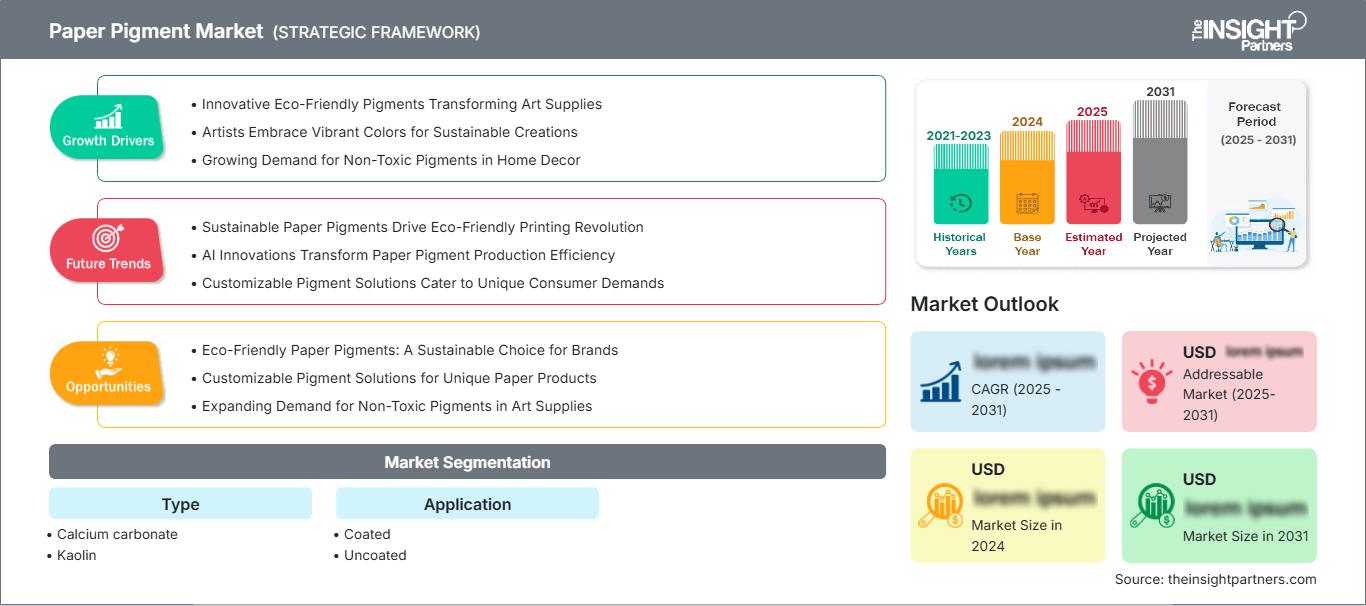
The Paper Pigment market was valued at US$ 20.04 Billion in 2025 and is projected to reach US$ 30.95 Billion by 2034, registering a CAGR of 4.95% during 2026–2034. Drivers include packaging conversion, resource efficiency, and print quality requirements. Demand for Paper Pigments includes a mineral input for enhancing opacity, brightness, smoothness, printability, and performance properties for both coated and uncoated papers
The North American Paper Pigment market size represents an advanced and stable demand base due to packaging grade paperboards, specialized papers, and substitution of virgin wood fibers with mineral fillers. The market in North America is forecast to grow at around 3.8-4.4% CAGR during 2026-2034.
Paper Pigment Market Assessment and Insights
- North America: North America is expected to hold a 28–32% share in 2025 and expand at a 3.8–4.4% CAGR between 2026 and 2034. Packaging conversion, specialty paper demand, and efficient mineral loading support steady regional consumption.
- U.S.: The U.S. is estimated to represent 70–74% of North America in 2025, growing at a 3.7–4.3% CAGR during 2026–2034, supported by packaging board and high-performance coated grades.
- Europe: Europe is projected to account for a 20–24% share in 2025 and grow at a 3.5–4.1% CAGR between 2026 and 2034. Germany, France, Italy, and the UK remain important paper-producing and converting markets.
- Asia Pacific: Asia Pacific is expected to capture a 38–42% share in 2025 and register a 5.4–6.0% CAGR between 2026 and 2034. China, Japan, India, and South Korea lead demand through packaging expansion and paperboard capacity additions.
- Largest Segment: Calcium carbonate is estimated at a 50–54% market share in 2025, with a 4.5–4.9% CAGR during 2026–2034, reflecting broad filler and coating use.
- High Growth Segment: Kaolin is estimated at a 46–50% share in 2025, with a 5.1–5.6% CAGR during 2026–2034, supported by premium coating requirements.
- Key companies analyzed in detail: BASF SE, Imerys S.A., J.M. Huber Corporation, KaMin LLC, Kemira Oyj, Minerals Technologies Inc., Omya AG, The Chemours Company, Thiele Kaolin Company, Sibelco Group.
Source: The Insight Partners' analysis based on proprietary research, government publications, company annual reports, investor presentations, industry databases, and expert interviews.
Paper Pigment has developed into engineered particle systems optimizing brightness, opacity, rheology, drainage, and coating coverage, from traditional mineral fillers. Calcium Carbonate has become crucial since GCC and PCC can be used both as fillers and coating pigments, whereas kaolin provides particle shapes and surfaces necessary for top-end coated papers. Moreover, Packaging Conversion will shift pigment requirements towards printing needs of board grades.
Looking ahead, the focus will gradually change in favor of pigment manufacturers capable of integrating mineral quality with application technology, local service support, and reliability of supply. The leading region of growth will be Asia-Pacific due to increasing capacities of paperboard, e-commerce packaging, and advanced retail logistics infrastructure. In Europe and North America, there will be emphasis on lightweighting, recycling compatibility, and process efficiency. Recyclable packaging regulation is another factor stimulating the development of coatings retaining fiber recoverability.
Paper Pigment Market Report Scope
| Report Attribute | Details |
|---|---|
| Market size in 2025 | US$ 20.04 Billion |
| Market Size by 2034 | US$ 30.95 Billion |
| Global CAGR (2026 - 2034) | 4.95% |
| Historical Data | 2021-2024 |
| Forecast period | 2026-2034 |
Paper Pigment Market Analysis
The expansion of Paper Pigment Market depends largely on the specifications of the paper and board manufacturers. Mineral extraction, beneficiation, grinding or precipitation, surface treatment, formulation and distribution to paper mills are all part of the process in which pigments are included in the value chain. Calcium carbonate offers brightness, opacity, bulk and fiber substitution, whereas kaolin is useful in terms of gloss, smoothness and printability. In terms of packaging, there is a growing need for tailored pigment blends instead of single-mineral mixes.
The supply of the minerals depends on limestone and kaolin deposits, beneficiation capabilities, energy sources, logistics and closeness to paper mills. In-house PCC production and satellite plants can help in minimizing logistics and offering a consistent blend. Omya, Minerals Technologies Inc. and others who specialize in minerals increasingly offer their technical assistance along with the supply of pigments.
Paper Pigment Market Report reveals a competitive market structure that includes global mineral suppliers, specialist chemical companies, and regional kaolin suppliers. Omya AG is focused on calcium carbonate coating pigments and mineral fillers, whereas Minerals Technologies Inc. runs integrated paper and packaging satellite plants. Participation of BASF SE in the market happens through paper coating chemistry, dispersions, binders, and additives affecting the use of pigments.
Technical differentiation is becoming an important competitive strategy in the market apart from the availability of minerals. J.M. Huber Corporation, KaMin LLC, Thiele Kaolin Company, Sibelco Group, and Imerys S.A. have mineral capability, whereas Kemira Oyj provides coating formulation through binders and process chemistry. The key investment strategies include local manufacturing, application labs, process controls, low energy formulations, and recyclable paper packages.
● REPORT CUSTOMIZATION
Tailor This Report To Align With Your Specific Business Requirements
This report can be customized to align precisely with your business objectives, scope, and target markets. Customization options include tailored segmentation, geography, competitive analysis, and strategic insights to support informed decision-making.
Customize This Report →WHAT YOU CAN ADJUST
- ● Segmentations
- ● Geography
- ● Competitive Analysis
- ● Language Preferences
Paper Pigment Market: Strategic Insights
Regional Insights
North America Paper Pigment Market
North America is projected to have 28–32% Paper Pigment market share in 2025, growing at a 3.8–4.4% CAGR till 2034. The United States dominates regional consumption in terms of packaging board, specialty papers, labels, and high-performance printing grades. Contributions from Canada come in the form of integration in pulp and paper production. Structural demand is more associated with substitution of plastics in packaging with fibers and higher fiber yields and production efficiencies from the mills.
Regional supply chain dynamics are facilitated by availability of calcium carbonate and kaolin minerals, technical services, and the proximity of mineral manufacturers and large paper mills. Mineral manufacturers such as Minerals Technologies Inc., J.M. Huber Corporation, KaMin LLC, BASF SE and others cater to multiple nodes of the formulation ecosystem. Growth is relatively moderate owing to the limited consumption of graphic papers, but packaging and specialty grades provide relief to this situation. Pigments with improved opacity and print qualities will see greater adoption.
U.S. Paper Pigment Market
The United States comprises approximately 70-74% of North America in 2025 and is projected to register a CAGR of 3.7-4.3% during the period up to 2034. The demand focus is on packaging boards, coated specialty papers, labels, and selected printing uses. Mineral producers will leverage existing connections with paper mills and technical expertise in the country.
Key application needs are now brightness, opacity, coating coverage, ink holdout, and lightweighting. The companies having the needed mineral or coating chemistry technologies are Omya AG, Minerals Technologies Inc., BASF SE, J.M. Huber Corporation, KaMin LLC, and Thiele Kaolin Company. Formulations for preserving the recyclability of paper and food-contact packaging are being considered by paper producers. Shifting from graphic paper use to packaging will make the demand side more demanding of application-specific grades instead of mineral commodities.
Europe Paper Pigment Market
The share in Europe is forecasted to be 20-24% in 2025, while the compound annual growth rate is expected to reach 3.5-4.1% between 2025 and 2034. Germany is one of the major markets, driven by high conversion and packaging activities. Other countries that participate include the United Kingdom, France, Italy, and Spain with their contribution being made via packaging, specialty paper, paperboard, publishing, and industry needs.
In the UK market, there is a shift towards packaging, labels, and specialty grades as the needs for graphic papers have been reached. Germany's combination of high-grade paper production and engineering helps to make high-performance minerals. There are demand trends for publishing and packaging in France and Italy, while the Spanish market is supported by food packaging and converting operations. The European producers start to assess the mineral systems in relation to the lifecycle efficiency, reduced amount of fibers, coating solids, and recyclability.
APAC Paper Pigment Market
Asia Pacific is forecasted to account for a 38–42% Paper Pigment market share in 2025 and grow at a 5.4–6.0% CAGR until 2034. The region includes China (leading), Japan, India, South Korea, and Australia. Demand growth will be driven by the development of packaging, e-commerce, urbanization, and increasing capacity for paperboard.
China benefits from huge volume of paper production along with its coating and packaging needs. India is becoming an important player due to growing paperboard capacity and organized consumption, Japan and South Korea focus on high-quality specialty and printing grades, and Australia is a smaller but technologically advanced market. Local manufacturers pay more attention to efficiency of mineral application, productivity of machines, and quality of recyclable packaging. Investment into mineral capacity close to paper mills would help improve supply flexibility and the use of calcium carbonate and kaolin systems.
Middle East & Africa Paper Pigment Market
MEA and Africa provide a smaller regional footprint but have the potential for gradual growth. Saudi Arabia and the UAE see advantages in packaging, food processing, and infrastructure investment, whereas South Africa is still the established market for paper products. This region is forecasted to experience an annual growth rate of around 3.2-3.8% through 2034.
The Rest of MEA demand is driven by consumer goods packaging, tissue, printing, and converting production. Industrial diversification and logistics infrastructure are the key factors supporting Saudi Arabia and the UAE, whereas South Africa provides the developed base for production and converting. Supply of minerals is less dependent on regional processing or imports compared to North America, Europe, and APAC markets. In such case, suppliers that offer regional logistics, formulation expertise, and delivery schedules can secure themselves a strong position. Modernization of packaging will be the leading demand driver.
Segmentation Analysis
Type
Type segmentation in the Paper Pigment market is centered on Calcium carbonate and Kaolin, with each mineral serving different formulation and performance requirements. The type segment is expected to expand at approximately 4.7–5.1% CAGR during 2026–2034. Calcium carbonate maintains broad usage because of its filler and coating functionality, while kaolin retains importance in premium coated papers requiring controlled surface characteristics.
- Calcium carbonate: Calcium carbonate maintains the leading position because GCC and PCC improve brightness, opacity, bulk, and fiber efficiency. Suppliers increasingly engineer particle size and morphology for coating coverage, drainage, and packaging-board performance.
- Kaolin: Kaolin remains strategically important for coated grades requiring smoothness, gloss, print definition, and controlled coating structure. Its platy particle morphology supports premium surface performance and complements calcium carbonate in blended formulations.
Application
Application segmentation in the Paper Pigment market covers Coated and Uncoated papers. The segment is projected to grow at approximately 4.8–5.2% CAGR during 2026–2034, supported by packaging, specialty printing, and functional paper requirements. Coated grades remain more pigment-intensive because manufacturers use mineral systems to engineer optical and printing properties.
- Coated: Coated papers use pigments to create smooth, bright, printable surfaces. Demand is increasingly concentrated in packaging, labels, specialty graphics, and applications where image quality and ink control justify additional formulation complexity.
- Uncoated: Uncoated grades remain important for office, writing, packaging, and specialty uses. Pigments support opacity, formation, bulk, and printability while helping producers balance material efficiency with acceptable surface characteristics.
Opportunity Snapshot
| Application | Revenue Contribution | Trend Tag | Adoption Stage |
|---|---|---|---|
| Coated | High | Premium Print | Mature |
| Uncoated | Medium | Fiber Efficiency | Scaling |
Paper Pigment Market Growth Drivers and Impact Analysis
Packaging conversion increases demand for performance-oriented mineral formulations
Packaging conversion is strengthening pigment demand because paperboard producers require high brightness, opacity, print definition, and surface consistency without excessive fiber consumption. Calcium carbonate can function as both filler and coating pigment, giving mills flexibility in balancing material efficiency and optical performance. Growth in food, beverage, pharmaceutical, and consumer-goods packaging also creates demand for papers that withstand high-speed printing and converting. Suppliers are therefore shifting from commodity mineral supply toward application-specific grades, technical service, and mill-side optimization. The commercial impact is strongest in packaging boards, where pigment selection can influence coating coverage, drying, machine speed, and final print quality. As brand owners increase fiber-based packaging usage, mineral suppliers with packaging-focused formulations should capture incremental demand while helping mills meet lightweighting and resource-efficiency objectives.
Demand for higher optical performance supports engineered pigment adoption
Paper producers increasingly require pigments that deliver predictable brightness, opacity, gloss, ink holdout, and coating coverage at controlled dosage levels. Engineered particle size distributions and surface characteristics can improve the performance of coating colors while supporting production consistency. This is particularly relevant for premium packaging, labels, specialty papers, and selected graphic applications where visual quality remains commercially important. Suppliers with mineral processing expertise can differentiate products through controlled morphology, high solids, dispersion behavior, and compatibility with existing coating equipment. The resulting market impact extends beyond pigment volume because technically optimized grades can reduce formulation variability and improve machine runnability. Producers are consequently more willing to evaluate performance on a total-process basis, considering energy, drying, fiber consumption, and reject reduction alongside the purchase price of individual mineral products.
Resource efficiency encourages mineral substitution for fiber-intensive production
Resource efficiency is becoming a direct economic consideration for paper mills facing fiber, energy, water, and transportation pressures. Mineral fillers and coating pigments can increase opacity and brightness while enabling more efficient use of fibrous raw materials. Calcium carbonate is particularly relevant because it can improve optical properties and support fiber replacement in suitable grades. Higher-solids coating systems can also reduce water handling and drying requirements. These advantages create an investment case for mills seeking productivity improvements without materially reducing product quality. Suppliers that combine mineral products with application engineering can help customers optimize loading, drainage, coating coverage, and machine speed. Consequently, purchasing decisions are increasingly based on measurable operating benefits rather than pigment unit price alone, strengthening demand for customized formulations and technical support.
Paper Pigment Market Future Trends
Data-driven formulation and precision mineral engineering
The next phase of Paper Pigment Market trends will increasingly involve data-assisted formulation and precision control of particle characteristics. Paper mills are collecting more process information on coating viscosity, solids, drainage, drying, formation, and print performance. Suppliers can use these datasets to optimize mineral combinations for individual machines and paper grades. Digital monitoring may allow mills to adjust pigment loading in response to furnish changes, coating conditions, and printing requirements rather than relying on fixed recipes. At the mineral-production level, tighter particle-size control and surface engineering should improve consistency between batches. This trend will favor suppliers with application laboratories, process expertise, and digital capabilities. Over time, the competitive value of technical support is likely to rise as customers seek measurable improvements in productivity and material efficiency rather than simply higher pigment volumes.
Recyclability-focused coating architectures gain commercial importance
Future formulations will increasingly be designed around recyclability from the beginning of product development. Packaging producers are seeking paper-based structures that provide grease, moisture, and print performance while remaining compatible with established recovery systems. Pigments will therefore be selected alongside binders, dispersants, barrier components, and printing technologies rather than as isolated ingredients. Calcium carbonate and kaolin can contribute optical and surface functions within these integrated systems, while coating formulators optimize coverage and fiber recovery. European packaging rules and broader global sustainability commitments are reinforcing this direction. Suppliers that demonstrate compatibility with repulping, reduced material intensity, and efficient coating application should gain stronger positions in packaging-focused applications. The shift also creates opportunities for co-development between mineral suppliers, coating formulators, paper mills, converters, and brand owners.
Paper Pigment Market Opportunities
Localized mineral supply hubs near expanding Asian paper capacity
Asia Pacific offers a strong opportunity for localized mineral supply because paper and packaging capacity is expanding across China and India, while manufacturers seek reliable inputs and shorter supply chains. Suppliers can invest in satellite operations, regional processing, technical laboratories, and customer-specific formulation centers positioned near major paper mills. Such infrastructure can reduce transportation exposure and allow mineral grades to be adjusted to local furnish, equipment, and application requirements. The Paper Pigment Market Forecasts should therefore account for not only volume expansion but also increasing localization of technical services and production. Companies that establish integrated mineral-to-mill models can improve supply reliability and customer retention. Strategic investment should prioritize packaging-board clusters, high-volume mills, and regions where imported mineral costs remain significant. Partnerships with mills can further accelerate qualification and recurring demand.
Premium sustainable pigments for lightweight paper packaging
A second opportunity lies in developing premium mineral formulations that support lightweighting and recyclable paper packaging without sacrificing print quality. Paperboard manufacturers increasingly need to reduce material intensity while preserving brightness, coverage, surface smoothness, and image reproduction. Suppliers can formulate engineered calcium carbonate and kaolin combinations that enable thinner coating layers, higher solids, or greater fiber replacement while maintaining required specifications. This opportunity extends beyond mineral sales into application development, pilot trials, technical consulting, and lifecycle assessment. Companies that demonstrate quantifiable reductions in material consumption, drying energy, or transportation weight can strengthen value propositions with converters and brand owners. Commercial development should focus on food packaging, folding cartons, labels, and high-quality corrugated applications where performance requirements justify specialized mineral formulations and where sustainability objectives are becoming part of supplier qualification.
Recent Developments
- July 2026: Burgess Pigment — Acquisition of Thiele Kaolin Company. Burgess Pigment completed its acquisition of Thiele Kaolin Company, combining two established kaolin producers headquartered in Sandersville, Georgia. Thiele supplies kaolin clay and silica products to coated board, coated paper, packaging, construction, and industrial applications. The transaction expands the combined portfolio and strengthens technical and R&D capabilities across kaolin-based products.
- January 2026: Minerals Technologies Inc. — Paper and packaging satellite expansion in Asia. Minerals Technologies Inc. announced the expansion of its paper and packaging business through three satellite plants started in 2025, two in China and one in India, alongside doubled capacity at an existing Indian facility. The company also planned another Chinese satellite for early 2026, with 50% of its 2025–2026 Asian expansions dedicated to packaging applications.
Frequently Asked Questions

- Comprehensive Market Sizing and Forecast Analysis
- Detailed Segmentation Analysis
- In-Depth Market Dynamics Assessment
- Regional and Country-Level Insights
- Competitive Landscape and Company Benchmarking
- Strategic Business Intelligence
Recent Reports
Testimonials

The Insight Partners' SCADA System Market report is comprehensive, with valuable insights on current trends and future forecasts. The team was highly professional, responsive, and supportive throughout. We are very satisfied and highly recommend their services.
RAN KEDEM Partner, Reali Technologies LTDs
I requested a report on a very specific software market and the team produced the report in a few days. The information was very relevant and well presented. I then requested some changes and additions to the report. The team was again very responsive and I got the final report in less than a week.
JEAN-HERVE JENN Chairman, Future Analytica
We worked with The Insight Partners for an important market study and forecast. They gave us clear insights into opportunities and risks, which helped shape our plans. Their research was easy to use and based on solid data. It helped us make smart, confident decisions. We highly recommend them.
PIYUSH NAGPAL Sr. Vice President, High Beam Global
The Insight Partners delivered insightful, well-structured market research with strong domain expertise. Their team was professional and responsive throughout. The user-friendly website made accessing industry reports seamless. We highly recommend them for reliable, high-quality research services
YUKIHIKO ADACHI CEO, Deep Blue, LLC.
This is the first time I have purchased a market report from The Insight Partners.While I was unsure at first, I visited their web site and felt more comfortable to take the risk and purchase a market report.I am completely satisfied with the quality of the report and customer service. I had several questions and comments with the initial report, but after a couple of dialogs over email with their analyst I believe I have a report that I can use as input to our strategic planning process.Thank you so much for taking the extra time and making this a positive experience.I will definitely recommend your service to others and you will be my first call when we need further market data.
JOHN SUZUKI President and Chief Executive Officer, Board Director, BK Technologies
I wish to appreciate your support and the professionalism you displayed in the course of attending to my request for information regarding to infectious disease IVD market in Nigeria. I appreciate your patience, your guidance, and the fact that you were willing to offer a discount, which eventually made it possible for us to close a deal. I look forward to engaging The Insight Partners in the future, all thanks to the impression you have created in me as a result of this first encounter.
DR CHIJIOKE ONYIA MANAGING DIRECTOR, PineCrest Healthcare Ltd.Reason to Buy
- Informed Decision-Making
- Understanding Market Dynamics
- Competitive Analysis
- Identifying Emerging Markets
- Customer Insights
- Market Forecasts
- Risk Mitigation
- Boosting Operational Efficiency
- Strategic Planning
- Investment Justification
- Tracking Industry Innovations
- Aligning with Regulatory Trends





 Get Free Sample for