
Railway Traction Motors Market Trends, Demand & Growth by 2034
Coverage: by Motor Type (DC Traction Motors, AC Traction Motors, and Synchronous Alternating Current Traction Motor); Application (Diesel Locomotive, Electric Multiple Units, Electric Locomotives, and Diesel Electric Locomotives), and Geography (North America, Europe, Asia Pacific, and South and Central America)
- Status : Data Released
- Report Code : TIPMC00002525
- Category : Manufacturing and Construction
- No. of Pages : 150
- Available Report Formats :


- Last update date : September 02, 2026


2025 Market Size
US$ 12.64 Bn
Base year value
2034 Forecast
US$ 19.5 Bn
Projected by 2034
CAGR 2026-2034
4.94 %
Growth rate
Addressable Market
US$ 145.90 Bn
(2026-2034)
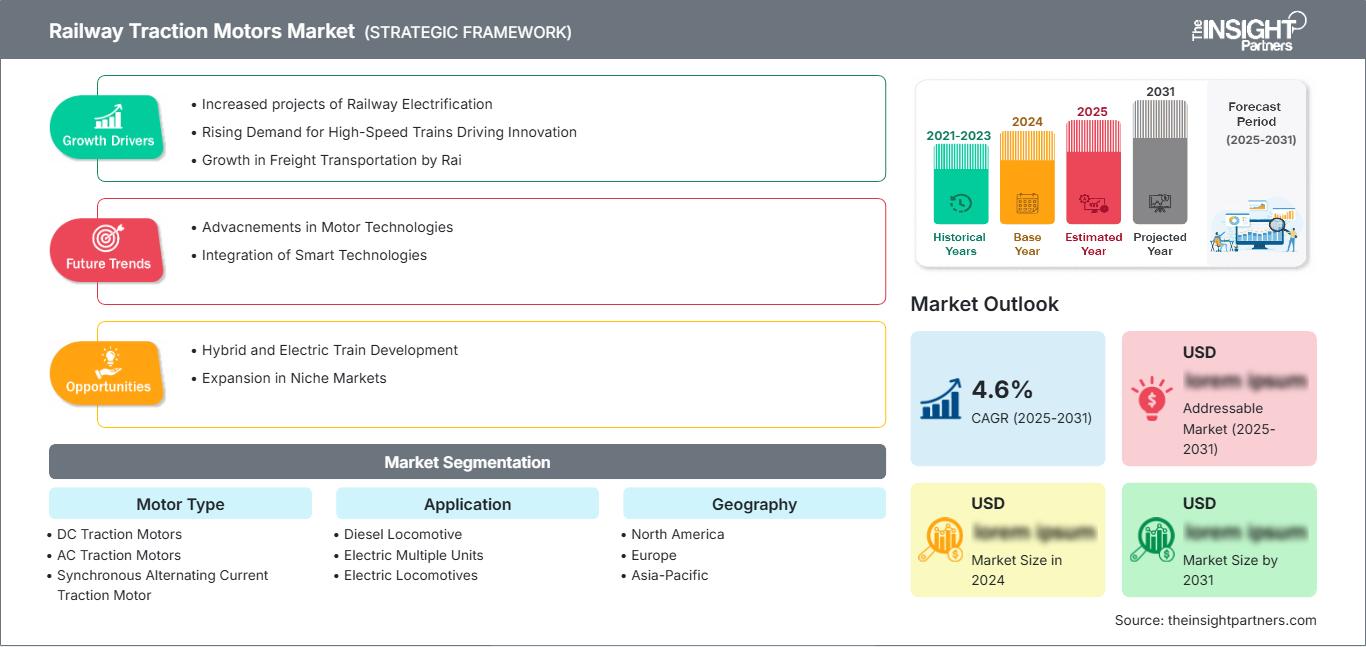
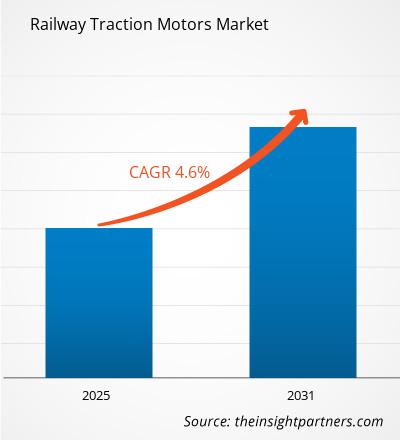
The railway traction motors market is being shaped by rising rail electrification, fleet renewal, and demand for higher propulsion efficiency. The market was valued at US$ 12.64 Billion in 2025 and is projected to reach US$ 19.5 Billion by 2034, registering a CAGR of 4.94% during 2026–2034. Expansion of electric passenger and freight fleets, replacement of legacy propulsion equipment, and increasing emphasis on energy-efficient railway operations are supporting sustained demand for traction motor technologies.
North America presents a mature but steadily expanding opportunity, supported by fleet modernization, urban transit investment, and replacement of aging locomotive propulsion systems. The railway traction motors market size is expected to advance at an estimated 3.2–4.0% CAGR through 2034. Demand is strengthened by investments in commuter rail, freight locomotive upgrades, metro extensions, and efforts to improve lifecycle efficiency across existing rolling-stock fleets.
Railway Traction Motors Market Assessment and Insights
- North America: North America is projected to account for a 18–22% share in 2025 and grow at a CAGR of 3.2–4.0% between 2026–2034, supported by fleet renewal, freight modernization, commuter rail investment, and propulsion replacement programs.
- US: The US is estimated to represent 76–81% of the North American market in 2025 and expand at a CAGR of 3.1–3.9% through 2034, led by locomotive and transit fleet modernization.
- Europe: Europe is estimated to hold a 25–29% share in 2025 and grow at a CAGR of 4.2–5.0% through 2034, with Germany, France, Italy, Spain, and the UK supporting demand through electrification and rolling-stock renewal.
- Asia Pacific: Asia Pacific is expected to command a 38–43% share in 2025 and grow at a CAGR of 5.6–6.5% during 2026–2034, with China, India, Japan, and South Korea leading fleet expansion and railway electrification.
- Largest Segment: AC traction motors are expected to represent a 58–63% market share in 2025 and expand at a CAGR of 5.0–5.8%, reflecting their suitability for modern electric rolling stock.
- High Growth Segment: Synchronous Alternating Current Traction Motor is estimated at a 7–11% market share in 2025 and is projected to grow at a CAGR of 6.4–7.3%, supported by efficiency-oriented propulsion development.
- Key companies analyzed in detail: ABB Ltd, Hyundai Rotem Company, Saini Group, Sulzer Ltd., Alstom S.A., Bharat Heavy Electricals Limited, Siemens AG, Mitsubishi Electric Corporation, Škoda Transportation a.s., VEM Group.
Source: The Insight Partners' analysis based on proprietary research, government publications, company annual reports, investor presentations, industry databases, and expert interviews.
Technology evolution in the railway traction motors market has shifted from conventional DC architectures toward AC and digitally controlled propulsion systems. Current designs stress greater torque density, compactness, cooling, regeneration, and lower maintenance. Manufacturing approaches have become more geared toward incorporating the motor along with the traction converter and control electronics, enabling the supplier to optimize entire power packages rather than treating motors as standalone mechanical devices.
Further growth will likely move beyond traditional electrified lines to include battery-electric, hybrid, and dual-mode railcars. New railway initiatives in India, Southeast Asia, the Middle East, and certain parts of Latin America may increase the addressable equipment pool. Public sector tenders are increasingly favoring considerations such as energy efficiency, localization, and maintainability, offering chances to companies capable of balancing efficient motors with long-term performance.
Railway Traction Motors Market Report Scope
| Report Attribute | Details |
|---|---|
| Market size in 2025 | US$ 12.64 Billion |
| Market Size by 2034 | US$ 19.5 Billion |
| Global CAGR (2026 - 2034) | 4.94% |
| Historical Data | 2021-2024 |
| Forecast period | 2026-2034 |
Railway Traction Motors Market Analysis
Railway fleet electrification, passenger capacity expansion, and locomotive replacement are the principal demand foundations. The railway traction motors market growth is closely connected to rolling-stock orders because propulsion systems are generally specified alongside motors, converters, gearboxes, and control equipment. Ecosystem comprises motor manufacturers, rolling stock original equipment manufacturers, railway operators, infrastructure agencies, maintenance providers, and component suppliers. As such, demand is driven both by new build procurement cycles and refurbishment cycles.
Factors influencing supply include the availability of copper, electrical steel, insulation materials, permanent magnet materials wherever applicable, bearings, cooling technologies, and power electronics components. Manufacturers need to find a balance between standard platforms and customer requirements based on factors including axle loads, voltages, speed, environmental considerations, and bogie availability.
Competition in the railway traction motors market combines large diversified industrial groups with specialist propulsion suppliers and railway OEMs. ABB Ltd. and Siemens AG possess comprehensive propulsion systems, while Alstom S.A. provides traction technology as part of broader rolling stock programs. Mitsubishi Electric Corporation offers its differentiation through energy-saving motors and inverters, while Bharat Heavy Electricals Limited takes advantage of its existing expertise in manufacturing rolling stock in India.
Positioning will be more dependent on localization, service agreements, and integration with the entire propulsion system. Hyundai Rotem Company, Škoda Transportation a.s., and VEM Group operate in specialized areas of rolling stock and traction technologies, while Sulzer Ltd. and Saini Group supply engineering competencies. Future investments will focus on motor efficiency, digital condition monitoring, modularity, and manufacturing close to large railway markets.
● REPORT CUSTOMIZATION
Tailor This Report To Align With Your Specific Business Requirements
This report can be customized to align precisely with your business objectives, scope, and target markets. Customization options include tailored segmentation, geography, competitive analysis, and strategic insights to support informed decision-making.
Customize This Report →WHAT YOU CAN ADJUST
- ● Segmentations
- ● Geography
- ● Competitive Analysis
- ● Language Preferences
Railway Traction Motors Market: Strategic Insights
Regional Insights
North America railway traction motors market
North America is estimated to hold an 18–22% share of the railway traction motors market in 2025 and record a 3.2–4.0% CAGR through 2034. The US continues to be the major market, facilitated by locomotive replacements, commuter rail upgrades, metros, and the refurbishing of existing electric drives. Canada adds its contribution via transit system upgrades and freight train fleet renewal.
More and more railway companies tend to consider the economics of their locomotive fleet operation over its lifetime and not only its cost of acquisition. High efficiency engines, good thermal performance, regeneration capabilities, and condition-based maintenance could lower the operational costs for many years to come. Also, there is a chance for the package of retrofits where a full replacement of trains would cost much more.
U.S. railway traction motors Market
The US is estimated to represent 76–81% of North America railway traction motors market in 2025 and grow at a CAGR of 3.1–3.9%. Demand is concentrated in freight locomotives, commuter rail, metro systems, and specialized passenger fleets. Suppliers, including ABB Ltd and Siemens AG, benefit from established relationships with operators and rolling-stock manufacturers.
Application priorities differ from high-density Asian networks because freight locomotives account for a substantial portion of propulsion requirements. Electric and hybrid propulsion initiatives are gradually broadening the addressable market, while transit authorities prioritize reliability and maintainability. Retrofit opportunities remain important because operators can extend fleet service lives through traction motor replacement, refurbishment, and propulsion upgrades.
Europe railway traction motors Market
Europe is estimated to account for 25–29% of the global railway traction motors market in 2025 and expand at a CAGR of 4.2–5.0%. Germany leads regional demand, followed by France, Italy, the UK, and Spain. Mature electrified networks create recurring requirements for replacement motors, fleet upgrades, and high-performance propulsion systems.
The UK is strengthening rail capacity and rolling-stock modernization, while Germany combines freight, regional, and high-speed applications. France continues to require propulsion equipment for intercity and regional fleets. Italy and Spain provide opportunities through high-speed, metro, and commuter projects, with European interoperability requirements supporting standardized yet adaptable traction architectures across national networks.
APAC railway traction motors Market
APAC is expected to hold a 38–43% of the railway traction motors market share in 2025 and grow at a CAGR of 5.6–6.5%, making it the leading regional market. China represents the largest demand center, while Japan, South Korea, India, and Australia provide additional opportunities through high-speed, metro, freight, and regional rail programs.
Industrial localization, railway electrification, and public infrastructure programs support procurement. India is particularly significant because domestic manufacturing requirements encourage local production of propulsion equipment. China combines extensive electric locomotive and high-speed rail deployment with large domestic suppliers, while Japan and South Korea emphasize high reliability, compact engineering, and energy efficiency.
Middle East & Africa railway traction motors Market
The Middle East and Africa are expected to expand at a CAGR of 4.0–5.0% through 2034. Saudi Arabia and the UAE represent important Middle Eastern opportunities, while South Africa remains a significant African rail market. New passenger corridors, freight modernization, and industrial transport requirements support equipment demand.
Saudi Arabia's infrastructure development and the UAE's urban transport investment create opportunities for modern propulsion systems. South Africa combines freight and commuter requirements, whereas the rest of MEA remains more project-driven. Energy efficiency, harsh operating environments, and long maintenance intervals increase the importance of robust motors with strong thermal management and serviceability.
Segmentation Analysis
Motor Type
The Motor Type segment is projected to expand at a CAGR of 4.8–5.6% from 2026–2034, according to the Railway Traction Motors Market Report. Modern railway procurement favors AC-based propulsion because of controllability, efficiency, regenerative braking compatibility, and reduced maintenance requirements. DC technology remains relevant in legacy fleets, while synchronous architectures are gaining attention where energy efficiency and power density justify higher system complexity.
- DC Traction Motors: DC traction motors remain strategically relevant for legacy locomotives and EMUs where replacement compatibility is more important than complete propulsion redesign. Their established maintenance ecosystem supports continued refurbishment demand across mature networks.
- AC Traction Motors: AC traction motors dominate modern electric rolling stock because they provide efficient variable-speed operation, robust construction, and compatibility with contemporary inverter-based propulsion. They remain central to locomotives, EMUs, metros, and high-speed trains.
- Synchronous Alternating Current Traction Motor: Synchronous traction architectures support applications requiring high efficiency and power density. Their strategic relevance is increasing as operators seek lower energy consumption and manufacturers improve control systems, thermal management, and component integration.
Application
The Application segment is forecast to grow at a CAGR of 4.6–5.5% during 2026–2034, according to the Railway Traction Motors Market Forecast. Procurement is increasingly influenced by electrification, fleet replacement schedules, passenger capacity requirements, and freight efficiency. Electric multiple units and electric locomotives represent important demand pools, while diesel-electric locomotives retain a substantial installed-base replacement opportunity.
- Diesel Locomotive: Diesel locomotives continue to require traction motors within diesel-electric propulsion architectures, particularly in freight and non-electrified networks. Replacement and overhaul requirements sustain demand even where new locomotive procurement increasingly favors lower-emission propulsion configurations.
- Electric Multiple Units: EMUs require compact, efficient propulsion systems capable of frequent acceleration and braking. Urban and regional services make energy consumption, thermal performance, low maintenance requirements, and high availability particularly important for traction motor selection.
- Electric Locomotives: Electric locomotives represent a significant application for high-power traction motors used in passenger and freight operations. Electrification programs and heavier freight requirements support demand for motors offering high torque, reliability, and continuous-duty performance.
- Diesel Electric Locomotives: Diesel-electric locomotives retain an extensive installed base worldwide. Traction motor replacement, refurbishment, and efficiency upgrades provide continuing opportunities, especially where operators prioritize extending locomotive service lives instead of purchasing entirely new fleets.
Geography
The Geography segment is expected to progress at a CAGR of 4.7–5.5% through 2034, reflecting key Railway Traction Motors Market Trends. Asia Pacific remains the principal demand center, while Europe and North America provide stable replacement and modernization opportunities. South and Central America, and the Middle East and Africa offer project-led expansion potential.
- North America: Demand is concentrated in freight, commuter, and metro fleets, with refurbishment programs creating a durable aftermarket requirement alongside selected new-build projects.
- Europe: Mature electrified networks create recurring replacement opportunities, while interoperability, energy efficiency, and high-speed rail investments encourage advanced propulsion specifications.
- Asia-Pacific: Large-scale railway construction, electrification, metro expansion, and domestic manufacturing policies create the broadest new-equipment opportunity across the regional market.
- South and Central America: Urban mobility projects and freight modernization provide selective opportunities, particularly where existing fleets require propulsion rehabilitation or replacement.
- Middle East and Africa: New rail corridors, industrial freight systems, and urban transit projects create demand for durable traction motors designed for demanding environmental and operational conditions.
Opportunity Snapshot
| Application | Revenue Contribution (High/Medium/Low) | Trend Tag | Adoption Stage |
| Diesel Locomotive | Medium | Fleet Retrofit | Mature |
| Electric Multiple Units | High | Metro Electrification | Scaling |
| Electric Locomotives | High | Freight Electrification | Scaling |
| Diesel Electric Locomotives | Medium | Motor Refurbishment | Mature |
Railway Traction Motors Market Growth Drivers and Impact Analysis
Railway Electrification and Fleet Modernization
The electrification of the railway system is one such key structural determinant, due to the need for effective propulsion technology that can cope with high rates of acceleration, regenerative braking, and high utilization. Fleet modernization is another key driver, which is independent of any expansion in the network, owing to the inefficiency of aged motor technology, which may be hard to maintain or not compatible with advanced control technology. Today, operators use total life cycle costing when making the decision regarding replacement projects, therefore making efficiency and reliability key determinants of supply. The effect will be felt in areas of motors, converters, cooling technology, gears, bearings, and monitoring technology.
Higher Efficiency Requirements in Rail Propulsion
The use of energy is growing as an important factor when it comes to the procurement of railway vehicles, as companies are looking to reduce their costs of operation while not sacrificing acceleration capabilities, load capability, or frequency of service delivery. Increased efficiency of the motors, inverter controls, thermal systems, and regeneration of braking is a way in which efficiency can be increased with repeated usage. The economic benefit of the same becomes quite significant when dealing with commuter trains with frequent runs, as well as freight locomotives that operate over thousands of hours. Companies, therefore, have to look into the efficient use of a combination of motors and converters rather than trying to increase the efficiency of motors alone.
Expansion of Electric and Hybrid Rolling Stock
The use of electric and hybrid rolling stock has increased the diversity of requirements regarding the configuration of traction motors by railway companies. Overhead lines have been a key element in railway electrification, but battery-driven trains and dual-mode trains necessitate the use of traction motors that are able to work under different power conditions. While hybrid technology could be useful on railways that cannot afford to be fully electrified, the battery-powered trains could help on short non-electrified segments of the tracks. Thus, there is an increasing need for traction motors that would fit well into the system of power electronics, onboard energy sources, thermal management and regeneration of power. However, the effect is not limited to modern trains, since railway companies may consider hybridization and reconfiguration of their existing rolling stock.
Railway Traction Motors Market Future Trends
Permanent-Magnet-Free and Resource-Efficient Propulsion
Future propulsion innovation is expected to put much focus on motor design that reduces reliance on materials that are difficult to obtain, yet ensures high efficiency and torque density. Examples of such trends can be seen in synchronous reluctance designs that do away with permanent magnets in the rotor and avoid the dependency on rare earth supply. Railway use will need testing in terms of duty cycles, vibration, temperature, and maintenance environments. The more advanced electronics become, the more motor performance at varying speeds and loads can be fine-tuned. This might eventually lead to a greater variety of technologies other than those used conventionally (induction and permanent magnet).
Digital Monitoring Integrated With Propulsion Systems
It is evident that traction motors have become part of a digitally managed propulsion structure rather than being individually maintained pieces of equipment. The future technology will rely on measuring temperature, vibrations, current, torque, and insulating elements to detect failure before disruption takes place. This will give room for predicting maintenance based on real-time component health, hence reducing the need for unnecessary workshop time. Data integration in the diagnostic system will enable comparison between the motors in terms of performance along various routes, climate conditions, and duty cycles. In the long run, such an approach might affect the design of the motor since suppliers will have to incorporate sensors and a diagnostic interface in their propulsion units.
Railway Traction Motors Market Opportunities
Localized Propulsion Manufacturing in High-Growth Rail Markets
Investment opportunities can be realized through the development of localized production, testing, and maintenance systems in those countries that are looking to grow their rail manufacturing within their own countries. India presents an opportunity for manufacturers to develop localized systems, given that more rolling stock initiatives are now taking into consideration the need for localized engineering and parts procurement. Such investments could also be made within Southeast Asia and certain regions of the Middle East, where there is currently investment in rail development. Such investments would ensure reduced risk of logistics exposure, quick repair processes, and responsiveness to operator-specific specifications.
Aftermarket Retrofit and Life-Extension Services
The already existing portfolio of locomotives, EMU, and other types of railcars is an area that presents opportunities for the supplier’s products to grow into the refurbishing market rather than stay limited to the supply of new equipment. Refurbishing of motors, their rewinding, bearing replacement, cooling system upgrade, insulation improvement, and transitioning to a more effective powertrain architecture will prolong the life of the locomotive fleet and avoid the replacement of the entire railcar. The solution is suitable for those companies that have a limited budget and/or a long delivery time for the new rolling stock. The service provider can offer standardized kits for popular motor types and combine part replacement with diagnosis of the components.
Frequently Asked Questions

- Comprehensive Market Sizing and Forecast Analysis
- Detailed Segmentation Analysis
- In-Depth Market Dynamics Assessment
- Regional and Country-Level Insights
- Competitive Landscape and Company Benchmarking
- Strategic Business Intelligence
Recent Reports
Testimonials

The Insight Partners provided valuable market intelligence that supported our global go-to-market strategy. Their team was professional, responsive, and attentive to our feedback, providing thoughtful analysis and helpful methodological clarifications throughout the project.
Junmo Kim Chief Financial Officer (CFO), Enertech Co., Ltd.
The Insight Partners' SCADA System Market report is comprehensive, with valuable insights on current trends and future forecasts. The team was highly professional, responsive, and supportive throughout. We are very satisfied and highly recommend their services.
RAN KEDEM Partner, Reali Technologies LTDs
I requested a report on a very specific software market and the team produced the report in a few days. The information was very relevant and well presented. I then requested some changes and additions to the report. The team was again very responsive and I got the final report in less than a week.
JEAN-HERVE JENN Chairman, Future Analytica
We worked with The Insight Partners for an important market study and forecast. They gave us clear insights into opportunities and risks, which helped shape our plans. Their research was easy to use and based on solid data. It helped us make smart, confident decisions. We highly recommend them.
PIYUSH NAGPAL Sr. Vice President, High Beam Global
The Insight Partners delivered insightful, well-structured market research with strong domain expertise. Their team was professional and responsive throughout. The user-friendly website made accessing industry reports seamless. We highly recommend them for reliable, high-quality research services
YUKIHIKO ADACHI CEO, Deep Blue, LLC.
This is the first time I have purchased a market report from The Insight Partners.While I was unsure at first, I visited their web site and felt more comfortable to take the risk and purchase a market report.I am completely satisfied with the quality of the report and customer service. I had several questions and comments with the initial report, but after a couple of dialogs over email with their analyst I believe I have a report that I can use as input to our strategic planning process.Thank you so much for taking the extra time and making this a positive experience.I will definitely recommend your service to others and you will be my first call when we need further market data.
JOHN SUZUKI President and Chief Executive Officer, Board Director, BK Technologies
I wish to appreciate your support and the professionalism you displayed in the course of attending to my request for information regarding to infectious disease IVD market in Nigeria. I appreciate your patience, your guidance, and the fact that you were willing to offer a discount, which eventually made it possible for us to close a deal. I look forward to engaging The Insight Partners in the future, all thanks to the impression you have created in me as a result of this first encounter.
DR CHIJIOKE ONYIA MANAGING DIRECTOR, PineCrest Healthcare Ltd.Reason to Buy
- Informed Decision-Making
- Understanding Market Dynamics
- Competitive Analysis
- Identifying Emerging Markets
- Customer Insights
- Market Forecasts
- Risk Mitigation
- Boosting Operational Efficiency
- Strategic Planning
- Investment Justification
- Tracking Industry Innovations
- Aligning with Regulatory Trends





 Get Free Sample for