
Residential Water Heater Market Size, Trends & Growth by 2034
Coverage: by Type (Gas, Instant, Storage, Solar); Distribution Channel (Online, Offline) , and Geography (North America, Europe, Asia Pacific, and South and Central America)
- Status : Data Released
- Report Code : TIPRE00012277
- Category : Manufacturing and Construction
- No. of Pages : 150
- Available Report Formats :


- Last update date : September 15, 2026


2025 Market Size
US$ 2.87 Bn
Base year value
2034 Forecast
US$ 3.99 Bn
Projected by 2034
CAGR 2026-2034
3.73 %
Growth rate
Addressable Market
US$ 31.16 Bn
(2026-2034)
The global Residential Water Heater market was valued at US$ 2.87 billion in 2025 and is expected to reach US$ 3.99 billion by 2034; it is estimated to record a CAGR of 3.73% during 2026-2034.
Residential Water Heater Market Assessment and Insights
- North America accounted for an estimated 31–34% share in 2025 and is expected to grow at a CAGR of 4.6–5.2% during 2026–2034, driven by replacement demand, energy-efficiency rebates, and higher adoption of heat pump and tankless units.
- US represented an estimated 78–82% of North America in 2025 and is projected to grow at a CAGR of 4.7–5.3%, supported by housing renovation, federal efficiency standards, and broader retail availability.
- Europe held an estimated 24–27% share in 2025 and is forecast to expand at a CAGR of 3.8–4.4%, led by Germany, the UK, France, Italy, and Spain as electrification and building-performance rules influence replacement choices.
- Asia Pacific accounted for an estimated 29–32% share in 2025 and is expected to grow at a CAGR of 4.8–5.6%, with China, India, Japan, South Korea, and Australia supporting demand through urbanization and appliance upgrades.
- Largest Segment: Storage water heaters held an estimated 42–46% market share in 2025 and are projected to grow at a CAGR of 3.2–3.8% during 2026–2034, supported by affordability and familiarity.
- High Growth Segment: Instant water heaters held an estimated 24–28% share in 2025 and are expected to grow at a CAGR of 5.0–5.8%, reflecting demand for compact, on-demand hot water and reduced standby losses.
- Key companies analyzed in detail: A. O. Smith Corporation, Ariston Group N.V., Bradford White Corporation, Ferroli S.p.A., GE Appliances, Lennox International Inc., Racold, Rheem Manufacturing Company, Rinnai Corporation, and Whirlpool Corporation.
Source: The Insight Partners' analysis based on proprietary research, government publications, company annual reports, investor presentations, industry databases, and expert interviews.
Market expansion is indicative of a shift from merely focusing on storage capabilities to a focus on efficiency-based product designs as well. Manufacturers are integrating high-quality insulations, effective burners, heat pumps, connectivity, and leak detection systems to achieve improved lifecycle value. Production is moving towards a modular platform that can cater to gas, electric, instantaneous, and storage types.
Future demand will be influenced by policies, residential electrification, and the replacement of old water heaters. Geographies with growing incomes have been adding installations, while mature geographies are upgrading their existing systems towards the Uniform Energy Factors system. The residential water heater market share will therefore remain fragmented, but suppliers with strong retail, installer, and after-sales networks are positioned to capture premium replacement demand.
Residential Water Heater Market Report Scope
| Report Attribute | Details |
|---|---|
| Market size in 2025 | US$ 2.87 Billion |
| Market Size by 2034 | US$ 3.99 Billion |
| Global CAGR (2026 - 2034) | 3.73% |
| Historical Data | 2021-2024 |
| Forecast period | 2026-2034 |
Residential Water Heater Market Analysis
The residential water heater market growth is anchored in daily household hot-water needs, but purchase decisions increasingly depend on operating cost, space availability, and local fuel economics. Homeowners and builders are evaluating options among gas, instant, storage, and solar water heaters using total cost of ownership criteria instead of price alone. Supply issues include fluctuations in the prices of steel, electronic controls, insulation material, thermostats, and installers' availability.
The importance of distribution is paramount since replacement purchases are immediate and installer-driven. Offline distribution offers choice, sizing assistance, and emergency supply capability, while online distribution is growing due to product comparisons, bundle installation, and consumer-direct promotions. This hybrid system keeps products visible and offers manufacturers several paths to homeowners, builders, remodeling companies, and facility managers of residential buildings.
Competitive market analysis shows that A. O. Smith Corporation, Rheem Manufacturing Company, Bradford White Corporation, Rinnai Corporation, and Ariston Group N.V. are emphasizing efficiency, connected controls, and broader application coverage. GE Appliances, Whirlpool Corporation, Racold, Ferroli S.p.A., and Lennox International Inc. support competition through retail access, regional portfolios, and space-conditioning adjacency.
Investment is moving toward heat pump water heaters, condensing tankless designs, smart diagnostics, and product lines that comply with future efficiency requirements. Suppliers are also targeting installer training because installation quality directly affects performance, warranty cost, and customer satisfaction. Strategic positioning is therefore increasingly based on technical support, rebate readiness, and product availability rather than price alone.
● REPORT CUSTOMIZATION
Tailor This Report To Align With Your Specific Business Requirements
This report can be customized to align precisely with your business objectives, scope, and target markets. Customization options include tailored segmentation, geography, competitive analysis, and strategic insights to support informed decision-making.
Customize This Report →WHAT YOU CAN ADJUST
- ● Segmentations
- ● Geography
- ● Competitive Analysis
- ● Language Preferences
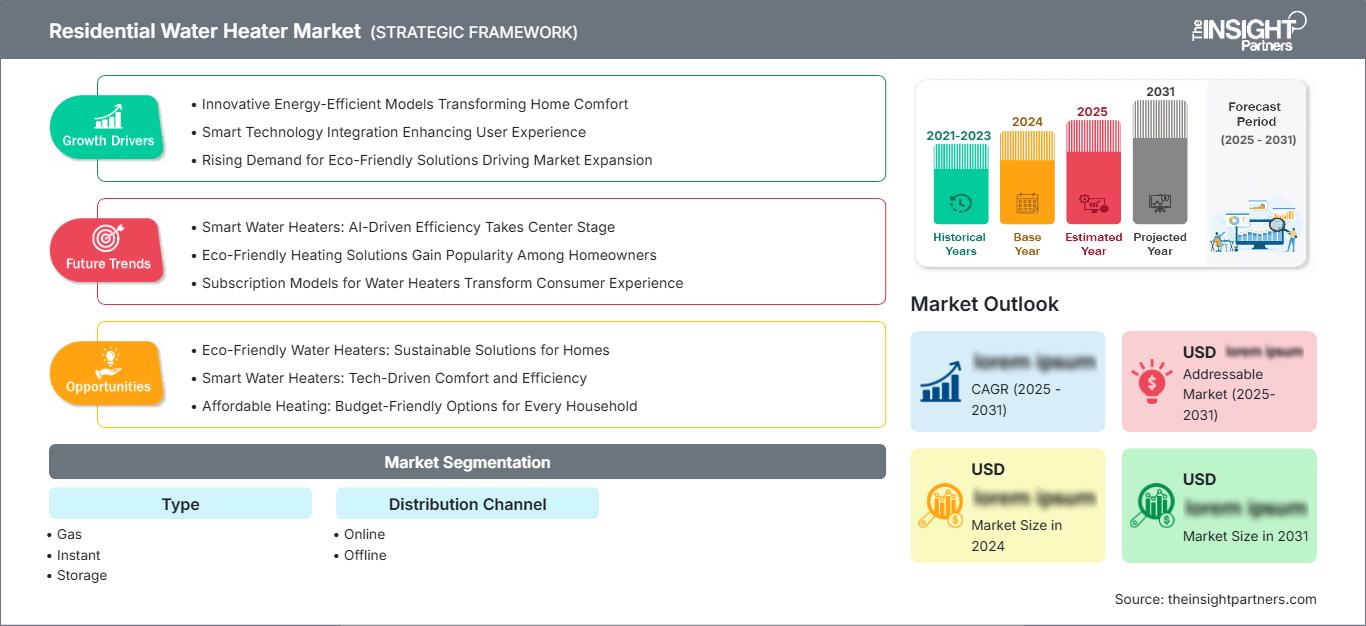
Residential Water Heater Market: Strategic Insights
Regional Insights
North America residential water heater market
North America held an estimated 31–34% residential water heater market share in 2025, supported by replacement-led demand and an installed base of aging storage systems. Upcoming efficiency standards and state-level incentive programs are encouraging homeowners to evaluate heat pump, condensing gas, and instant configurations. The region is expected to grow at a CAGR of 4.6–5.2% during 2026–2034.
Demand is strongest where housing renovation, colder climates, and utility-cost sensitivity converge. Manufacturers benefit from mature installer networks and large retail channels, but higher upfront costs remain a barrier for premium systems. Connected features, leak protection, and demand-response compatibility are becoming practical differentiators for households seeking reliability and lower operating expenses.
U.S. residential water heater Market
The US accounted for an estimated 78–82% of North America demand in 2025, making it the region’s central revenue contributor. Its CAGR is projected at 4.7–5.3% during 2026–2034. Replacement sales take precedence due to homeowner reaction to failures; however, renovations have been producing planned upgrades with high-efficiency tankless and hybrid electric products.
The companies operate on a wide scale, with A.O. Smith Corporation, Rheem Manufacturing Company, Bradford White Corporation, Rinnai Corporation, GE Appliances, and Whirlpool Corporation being involved in wholesale, retail, and professional distribution. The current trends of applications include an increase in popularity of smart leak detection, recirculating, compact installations, and heat pumps that qualify for rebates in some states.
Europe residential water heater Market
Europe represented an estimated 24–27% share in 2025 and is expected to grow at a CAGR of 3.8–4.4% during 2026–2034. Germany and the UK remain leading country markets because appliance replacement is influenced by energy prices, building renovation policies, and consumer attention to energy labels. France, Italy, and Spain add demand through multifamily housing upgrades and electric water heating adoption.
The European market is more regulation-sensitive than price-sensitive in several urban areas, particularly where electrification and lower-emission heating are prioritized. Ariston Group N.V., Ferroli S.p.A., and other regional suppliers compete with global brands by offering compact systems suited to apartments, mixed-fuel homes, and retrofit constraints across older housing stock.
APAC residential water heater Market
APAC accounted for an estimated 29–32% share in 2025 and is forecast to grow at a CAGR of 4.8–5.6% during 2026–2034. China is the leading country, while India, Japan, South Korea, and Australia contribute through urban housing growth, rising appliance ownership, and policy support for more efficient residential equipment.
Demand differs by climate and income level. Electric storage systems remain common in many markets, while instant gas and solar units serve space-constrained or energy-cost-sensitive households. Premium adoption is rising in urban centers as consumers seek safety features, compact design, longer warranties, and digitally controlled water-temperature management.
Middle East & Africa residential water heater Market
The Middle East & Africa is projected to grow at a CAGR of 3.6–4.2% during 2026–2034. Saudi Arabia and the UAE lead demand through residential construction and hospitality-linked housing, while South Africa and the rest of MEA show selective adoption based on affordability, grid reliability, and water-heating fuel availability.
Solar water heating has relevance in high-irradiance markets, although adoption depends on installation cost and building suitability. Gas and electric storage systems continue to serve mainstream households. Infrastructure investment, urban housing expansion, and distributor-led availability are expected to improve product penetration gradually across mid-income residential communities.
Segmentation Analysis
Type
Type is expected to grow at a CAGR of 4.0–4.6% during 2026–2034 as households choose systems based on fuel access, usage pattern, installation space, and efficiency expectations. The market scope spans conventional storage replacement, compact instant adoption, gas-based high-output applications, and solar-assisted installations in sunny regions.
- Gas systems remain important where natural gas or LPG access supports faster recovery, higher flow rates, and established installer familiarity, particularly in detached homes and colder regions.
- Instant systems are gaining momentum because they reduce standby heat loss, fit smaller spaces, and support households seeking on-demand hot water with better energy control.
- Storage systems retain the largest base due to lower upfront cost, predictable supply, easier replacement, and wide availability through retail and contractor channels.
- Solar systems serve regions with strong sunlight, supportive incentives, and households seeking lower operating costs, although installation complexity limits broader short-term penetration.
Distribution Channel
Distribution Channel is projected to grow at a CAGR of 4.1–4.7% during 2026–2034 as purchase journeys blend online research with installer-led conversion. Offline channels retain strength in emergency replacement, while online channels provide transparent comparisons, rebate visibility, customer reviews, and bundled installation services.
- Online channels are expanding as homeowners compare product ratings, capacity, energy factors, warranty terms, and installation options before engaging retailers or contractors.
- Offline channels remain dominant because sizing, code compliance, urgent replacement, and installer trust are critical when households need dependable hot-water restoration.
Opportunity Snapshot
| Type | Revenue Contribution | Trend Tag | Adoption Stage |
| Gas | High | High Recovery | Mature |
| Instant | Medium | On Demand | Scaling |
| Storage | High | Retrofit Base | Mature |
| Solar | Low | Solar Assist | Emerging |
Residential Water Heater Market Growth Drivers and Impact Analysis
Efficiency Standards Accelerating Product Replacement
Regulatory push is a crucial factor owing to the significant proportion that water heating contributes to residential energy consumption in developed nations. The future minimum efficiency requirements of the US Department of Energy will compel bigger electric storage heaters to move towards heat pump technology and increase the performance requirements of the gas heaters.
Renovation and Aging Installed Base Supporting Stable Demand
Residential water heaters get replaced on a regular basis whenever they malfunction, hence ensuring steady demand despite construction cycles. The vast numbers of water heaters already in use in North America and Europe result in high replacement rates, whereas home renovations present opportunities for increasing capacity and improving performance and safety standards. This driver favors offline distributors and contractors since homes have to be fitted with water heaters.
Shift Toward Compact and Connected Hot-Water Systems
Compact systems, instant systems, and intelligent-enabled systems have gained more attention due to urban homes, small-sized utility rooms, and growing consumer demand. These systems have features such as remote temperature adjustment, leak detection, recycling, vacation mode, and performance tracking that make them expensive. Connectivity assists suppliers in providing better services and retaining consumers. The most affected consumers are rich people or those having utility tariffs for their appliances.
Residential Water Heater Market Future Trends
Heat Pump Water Heater Adoption
The residential water heater market trends will increasingly include hybrid electric and heat pump systems as efficiency standards, rebates, and consumer education improve. These systems may lower electrical usage than traditional electric resistance heating units, although their success is dependent on installation space, environmental conditions, cost, and installer know-how. Manufacturers who make the process easier regarding sizing, sound reduction, and rebates will have an advantage with replacement customers.
Grid-Interactive Water Heating
Water heater connections to utility demand response programs will continue to rise, especially in areas that employ time-of-use pricing and incorporate renewable power sources into their grids. Water heaters can easily be programmed to move the heating process around and avoid high loads without requiring any significant changes in behavior on the part of the end-user.
Residential Water Heater Market Opportunities
Premium Retrofit Packages for Contractors
The residential water heater market forecasts indicate that contractors can capture higher value by offering bundled retrofit packages that combine product selection, removal, installation, permits, rebate guidance, leak protection, and maintenance plans. This approach reduces friction for homeowners making urgent replacement decisions and helps manufacturers differentiate through certified installer networks. The opportunity is strongest in mature markets where replacement volume is high and consumers are willing to pay for reliability.
Solar-Assisted Systems in High-Irradiance Housing Markets
Solar water heating continues to be underutilized in various sunshine-bathed residential areas despite its cost-saving potential. These three groups could encourage the uptake of this technology by focusing on new home estates, villas, and medium-level residential projects, which would benefit from the installation of this technology due to the availability of roofs and predictable hot water requirements. The use of electric power backup could make it more acceptable to buyers.
Frequently Asked Questions

- Comprehensive Market Sizing and Forecast Analysis
- Detailed Segmentation Analysis
- In-Depth Market Dynamics Assessment
- Regional and Country-Level Insights
- Competitive Landscape and Company Benchmarking
- Strategic Business Intelligence
Recent Reports
Testimonials

The Insight Partners' SCADA System Market report is comprehensive, with valuable insights on current trends and future forecasts. The team was highly professional, responsive, and supportive throughout. We are very satisfied and highly recommend their services.
RAN KEDEM Partner, Reali Technologies LTDs
I requested a report on a very specific software market and the team produced the report in a few days. The information was very relevant and well presented. I then requested some changes and additions to the report. The team was again very responsive and I got the final report in less than a week.
JEAN-HERVE JENN Chairman, Future Analytica
We worked with The Insight Partners for an important market study and forecast. They gave us clear insights into opportunities and risks, which helped shape our plans. Their research was easy to use and based on solid data. It helped us make smart, confident decisions. We highly recommend them.
PIYUSH NAGPAL Sr. Vice President, High Beam Global
The Insight Partners delivered insightful, well-structured market research with strong domain expertise. Their team was professional and responsive throughout. The user-friendly website made accessing industry reports seamless. We highly recommend them for reliable, high-quality research services
YUKIHIKO ADACHI CEO, Deep Blue, LLC.
This is the first time I have purchased a market report from The Insight Partners.While I was unsure at first, I visited their web site and felt more comfortable to take the risk and purchase a market report.I am completely satisfied with the quality of the report and customer service. I had several questions and comments with the initial report, but after a couple of dialogs over email with their analyst I believe I have a report that I can use as input to our strategic planning process.Thank you so much for taking the extra time and making this a positive experience.I will definitely recommend your service to others and you will be my first call when we need further market data.
JOHN SUZUKI President and Chief Executive Officer, Board Director, BK Technologies
I wish to appreciate your support and the professionalism you displayed in the course of attending to my request for information regarding to infectious disease IVD market in Nigeria. I appreciate your patience, your guidance, and the fact that you were willing to offer a discount, which eventually made it possible for us to close a deal. I look forward to engaging The Insight Partners in the future, all thanks to the impression you have created in me as a result of this first encounter.
DR CHIJIOKE ONYIA MANAGING DIRECTOR, PineCrest Healthcare Ltd.Reason to Buy
- Informed Decision-Making
- Understanding Market Dynamics
- Competitive Analysis
- Identifying Emerging Markets
- Customer Insights
- Market Forecasts
- Risk Mitigation
- Boosting Operational Efficiency
- Strategic Planning
- Investment Justification
- Tracking Industry Innovations
- Aligning with Regulatory Trends





 Get Free Sample for