
Robotic Vision Market Share, Size & Demand by 2034
Coverage: by Component (Smart Camera, Lighting, Optics, Frame Grabber, Computer, Software, Others); Technology (2D, 3D); End User (Automotive, Packaging, Aerospace, Food Processing, Metal Processing, Electrical and Electronics, Others) , and Geography (North America, Europe, Asia Pacific, and South and Central America)
- Status : Data Released
- Report Code : TIPRE00012053
- Category : Electronics and Semiconductor
- No. of Pages : 150
- Available Report Formats :


- Last update date : September 10, 2026


2025 Market Size
US$ 3.93 Bn
Base year value
2034 Forecast
US$ 6.24 Bn
Projected by 2034
CAGR 2026-2034
5.27 %
Growth rate
Addressable Market
US$ 46.13 Bn
(2026-2034)
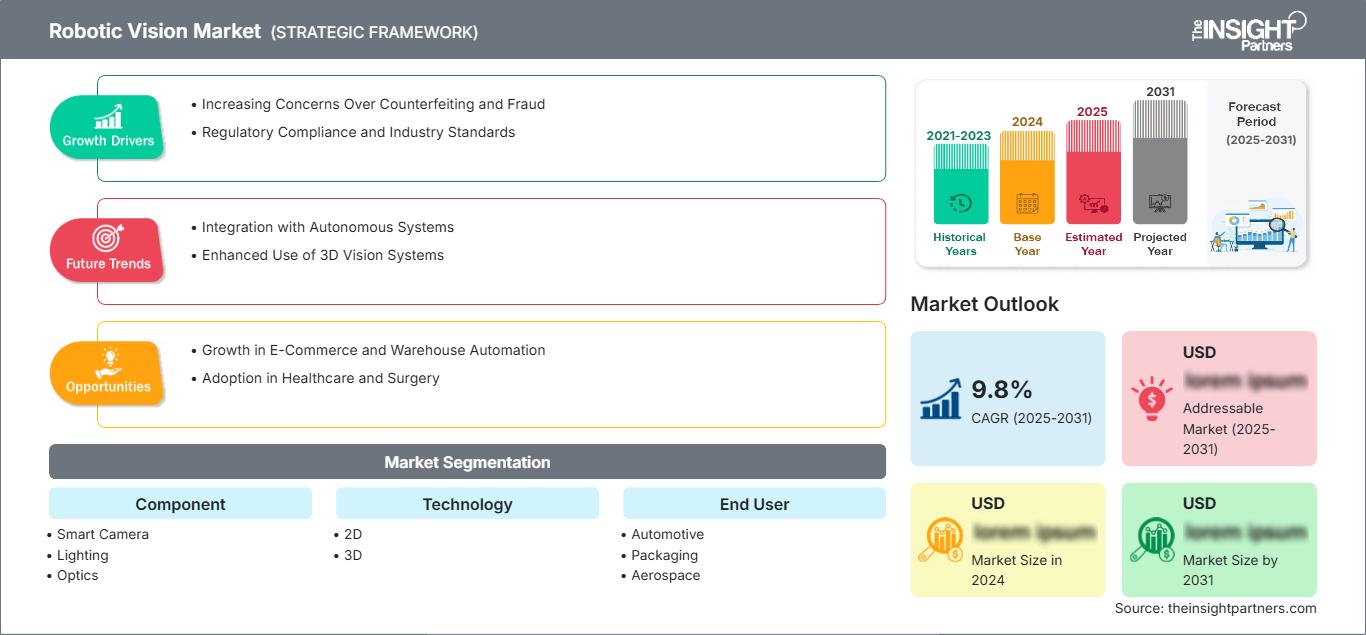
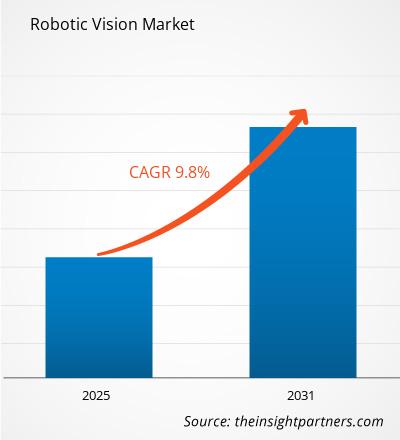
The global Robotic Vision market was valued at US$ 3.93 billion in 2025 and is expected to reach US$ 6.24 billion by 2034; it is estimated to record a CAGR of 5.27% during 2026-2034.
Robotic Vision Market Assessment and Insights
- North America: North America held 37–39% share in 2025 and is projected to grow at a CAGR of 6.4–7.2% between 2026–2034, supported by automation.
- US: The US represented approximately 82–84% of North America's 2025 market and is expected to grow at a CAGR of 6.5–7.3% between 2026–2034, driven by modernization.
- Europe: Europe represented 17–19% share in 2025 and is projected to expand at a CAGR of 5.4–6.1% between 2026–2034, led by Germany, the UK, France, Italy, and Spain.
- Asia Pacific: Asia Pacific represented 34–36% share in 2025 and is expected to record a CAGR of 7.8–8.6% between 2026–2034, led by China, Japan, South Korea, and India.
- Largest Segment: 2D technology held 56–59% market share in 2025 and is projected to grow at a CAGR of 5.0–5.7% during 2026–2034, reflecting broad inspection use.
- High Growth Segment: 3D technology represented 34–38% market share in 2025 and is projected to grow at a CAGR of 9.5–10.5% during 2026–2034, supported by depth perception.
- Key companies analyzed in detail: Cognex Corporation; ISRA Vision AG; Keyence Corporation; Matrox; MVTec Software GmbH; National Instruments Corporation; Qualcomm Technologies, Inc.; SICK AG; Teledyne Digital Imaging, Inc.; Tordivel AS.
Source: The Insight Partners' analysis based on proprietary research, government publications, company annual reports, investor presentations, industry databases, and expert interviews.
The market has progressed from conventional camera-based inspection toward integrated perception systems capable of supporting robot positioning, quality control, identification, and adaptive handling. Smart cameras, specialized optics, high-speed lighting, frame grabbers, processors, and software are increasingly designed as coordinated architectures. Production environments are adopting deep-learning tools for variable defects.
Looking forward, adoption is likely to broaden across emerging manufacturing economies as industrial automation becomes more accessible. Worker safety, traceability, product quality, and industrial cybersecurity also encourage visual intelligence. Investment across semiconductor, electronics, electric vehicle, food processing, and logistics facilities should expand demand for vision-guided robotics and integrated inspection systems.
Robotic Vision Market Report Scope
| Report Attribute | Details |
|---|---|
| Market size in 2025 | US$ 3.93 Billion |
| Market Size by 2034 | US$ 6.24 Billion |
| Global CAGR (2026 - 2034) | 5.27% |
| Historical Data | 2021-2024 |
| Forecast period | 2026-2034 |
Robotic Vision Market Analysis
The robotic vision market growth is increasingly tied to flexible automation, where robots must perceive changing positions, shapes, colors, surface conditions, and product variants rather than repeat fixed movements. The value chain includes cameras, lights, optics, image acquisition, computer hardware, algorithms, integration, and maintenance. Smart cameras can simplify the system design, whereas the PC-based architecture is still relevant for high-performance systems that require heavy processing and customization.
The supply situation depends on semiconductors, image sensors, processors, optics, and software. The manufacturers incorporate AI accelerators and edge processing in order to minimize latency and decrease dependence on centralized computing. The automotive and electronics factories are the largest customers, since the process of automatic inspection and guidance of robots can be built into the manufacturing lines, and food and packaging use expands the potential customer base.
Competitive positioning is increasingly based on the ability to combine hardware, algorithms, application software, and integration support. Cognex Corporation and Keyence Corporation maintain broad portfolios spanning cameras, sensors, software, and inspection platforms, shaping robotic vision market analysis. ISRA Vision AG and SICK AG emphasize industrial vision and automation integration. MVTec Software GmbH provides software capabilities, while National Instruments Corporation contributes measurement and engineering platforms.
Investment is also moving toward 3D perception, edge AI, and application-specific solutions. Qualcomm Technologies, Inc. can contribute embedded computing and AI capabilities, while Teledyne Digital Imaging, Inc. brings imaging technologies and sensors. Matrox, Tordivel AS, and other specialists support application-level requirements. The competitive landscape therefore, favors suppliers able to shorten deployment time while maintaining image quality, processing reliability, interoperability, and lifecycle support.
● REPORT CUSTOMIZATION
Tailor This Report To Align With Your Specific Business Requirements
This report can be customized to align precisely with your business objectives, scope, and target markets. Customization options include tailored segmentation, geography, competitive analysis, and strategic insights to support informed decision-making.
Customize This Report →WHAT YOU CAN ADJUST
- ● Segmentations
- ● Geography
- ● Competitive Analysis
- ● Language Preferences
Robotic Vision Market: Strategic Insights
Regional Insights
North America robotic vision market
North America accounted for approximately 37–39% robotic vision market share in 2025 and is projected to grow at a CAGR of 6.4–7.2% during 2026–2034. The region benefits from mature industrial automation, substantial manufacturing investment, and a large installed base of machine vision systems. The US remains the primary market, while Canada and Mexico add opportunities through automotive, electronics, food, and logistics.
Reshoring and nearshoring initiatives strengthen demand for automated inspection and robotic guidance as manufacturers seek consistent output. Automotive plants increasingly use vision for assembly verification, dimensional inspection, and part identification. Electronics producers require precise inspection of small components and assemblies. Cloud connectivity and edge computing are also enabling remote diagnostics and centralized monitoring without moving every image-processing task to external infrastructure.
U.S. robotic vision Market
The US represented approximately 82–84% of North America's 2025 robotic vision market and is projected to grow at a CAGR of 6.5–7.3% during 2026–2034. Its position reflects advanced manufacturing capacity, strong automation investment, and extensive adoption of machine vision in automotive, electronics, logistics, food, and metal processing. Domestic integrators and technology suppliers support deployment across different plant sizes.
Demand is shifting toward AI-assisted inspection, robotic picking, traceability, and process verification. Cognex Corporation, Keyence Corporation, SICK AG, and Teledyne Digital Imaging, Inc. have established visibility across industrial imaging and automation applications. Demand is also supported by manufacturers seeking higher throughput and repeatability while addressing skilled-labor shortages. Edge processing can improve response times for safety-sensitive and high-speed production operations.
Europe robotic vision market
Europe held approximately 17–19% share of the robotic vision market in 2025 and is projected to expand at a CAGR of 5.4–6.1% during 2026–2034. Germany is a leading market because of its automotive, machinery, electronics, and industrial automation base. The UK, France, Italy, and Spain provide additional demand through advanced manufacturing and modernization of production systems.
The UK is supported by aerospace, automotive, food, and logistics applications, where automated inspection can strengthen throughput and traceability. Germany remains central to regional demand because machine builders and automotive manufacturers increasingly integrate vision into robotic cells. France combines aerospace and food-processing opportunities, while Italy has strong machinery, packaging, and automotive manufacturing. Spain contributes through automotive production, food processing, and industrial automation investments.
Across the region, manufacturers are increasingly evaluating energy use, cybersecurity, interoperability, and lifecycle costs alongside image quality. Collaborative robotics and flexible production cells can create additional opportunities for vision systems that adapt to shorter production runs and greater product variation.
APAC robotic vision market
Asia Pacific represented approximately 34–36% share of the robotic vision market in 2025 and is projected to grow at a CAGR of 7.8–8.6% during 2026–2034. China leads regional demand, supported by extensive electronics, automotive, semiconductor, and general manufacturing activity. Japan and South Korea remain important technology and automation centers.
India and Australia provide additional growth opportunities as manufacturing modernization, electronics production, and logistics automation expand. Industrial policy, foreign investment, factory digitization, and labor productivity objectives support adoption. Increasing use of 3D perception and AI-assisted inspection should strengthen demand for sophisticated systems.
Middle East & Africa robotic vision market
The Middle East and Africa robotic vision market is projected to grow at a CAGR of 6.5–7.2% during 2026–2034, with demand concentrated in Saudi Arabia, the UAE, South Africa, and selected industrial hubs. Saudi Arabia and the UAE are leading opportunities because manufacturing diversification and new industrial infrastructure encourage automation investment.
South Africa provides demand from automotive, food, mining-related processing, and metal industries, while the rest of MEA remains more fragmented. Industrial diversification, logistics modernization, worker-safety requirements, and investment in digitally enabled facilities can support adoption. Vision deployment is likely to favor applications with measurable quality, productivity, and traceability benefits.
Segmentation Analysis
Component
The Component segment is projected to grow at a CAGR of 5.8–6.4% during 2026–2034. Hardware determines acquisition quality, while software increasingly converts images into decisions. The robotic vision market scope is expanding toward integrated perception architectures.
- Smart Camera: Smart Camera systems combine image acquisition and processing within compact devices, reducing integration complexity. They are strategically important for decentralized inspection, identification, and guidance where space, deployment speed, and ease of configuration matter.
- Lighting: Lighting controls contrast, illumination uniformity, and feature visibility. Reliable lighting design is critical for inspection accuracy because reflective, textured, or variable surfaces can otherwise reduce image consistency.
- Optics: Optics determine field of view, resolution, distortion, and depth-of-field characteristics. Application-specific lenses remain strategically important where precise measurement or small-feature inspection is required.
- Frame Grabber: Frame Grabber products support high-speed image acquisition and synchronization in demanding PC-based systems. They remain important where multiple cameras, high data rates, or deterministic processing are required.
- Computer: Computer platforms provide processing capacity for multi-camera systems, complex algorithms, and AI inference. Industrial computing remains relevant for applications requiring scalability, customization, and centralized control.
- Software: Software converts visual data into inspection, identification, measurement, and guidance decisions. Deep learning and configurable tools are increasing its strategic role in handling variable products and complex defects.
Technology
The Technology segment is expected to grow at a CAGR of 6.2–6.9% during 2026–2034. Two-dimensional systems remain widely deployed, while three-dimensional perception is expanding where shape, depth, orientation, and spatial positioning matter.
- 2D: 2D systems remain the principal technology for surface inspection, pattern recognition, barcode reading, measurement, and identification. Their mature ecosystem, lower complexity, and broad application compatibility support continued adoption.
- 3D: 3D systems provide depth information for bin picking, dimensional analysis, robotic guidance, and complex object recognition. Their strategic importance rises where shape and spatial position cannot be reliably inferred from two-dimensional imagery.
End User
The End User segment is projected to grow at a CAGR of 5.9–6.6% during 2026–2034. Automotive remains a major adopter, while electronics, food processing, packaging, aerospace, and metals use vision for inspection and automated handling.
- Automotive: Automotive plants use vision for assembly verification, component identification, weld inspection, dimensional checks, and robotic guidance. Electric vehicle production adds requirements for precise battery, component, and electronics inspection.
- Packaging: Packaging applications rely on high-speed identification, fill-level checks, label verification, seal inspection, and robotic picking. Vision enables rapid verification across changing product formats.
- Aerospace: Aerospace manufacturers use vision for precision inspection, component verification, surface assessment, and assembly support. High traceability requirements increase the importance of reliable imaging and documented inspection results.
- Food Processing: Food Processing uses vision for sorting, grading, packaging verification, contamination detection, and product presentation. Hygienic design and rapid processing are central to system selection.
- Metal Processing: Metal Processing applications include surface inspection, dimensional measurement, defect detection, and robotic handling. Vision helps identify inconsistencies that can affect downstream machining or product quality.
- Electrical and Electronics: Electrical and Electronics manufacturers use vision for component placement, solder inspection, connector verification, and assembly quality. Small dimensions and high production volumes favor precise imaging and rapid processing.
Opportunity Snapshot
| End User | Revenue Contribution | Trend Tag | Adoption Stage |
| Automotive | High | EV Inspection | Mature |
| Packaging | Medium | Vision Picking | Scaling |
| Aerospace | Medium | Precision Inspection | Scaling |
| Food Processing | Medium | Defect Sorting | Scaling |
| Metal Processing | Medium | Surface Inspection | Scaling |
| Electrical and Electronics | High | Micro Inspection | Mature |
Robotic Vision Market Growth Drivers and Impact Analysis
AI-enabled inspection reduces dependence on fixed-rule programming
Artificial intelligence is transforming the economics of machine vision through the ability to detect variable defects, classify items and cope with varying imaging environments. Rule-based systems have traditionally been complicated and time-consuming to configure when changes are made to product variations or defect types, while trained models can become more flexible after proper validation. This is especially true for the electronics, automotive parts, packaging and food industries, which experience naturally occurring variability in their products. The commercial effect is increased breadth of applications available, as well as a possible faster time to deployment. AI enhances the significance of industrial computing, data handling, model validation, and software knowledge. Suppliers that offer vision hardware with a dependable AI process will be able to add value to the system, and the manufacturers will have the chance to automate tasks requiring a lot of human judgment.
Industrial labor constraints strengthen demand for visual automation
The shortage of skilled workers to perform such visual tasks will compel manufacturers to use robots for such purposes. Robotic vision can be used for inspections, identification, measurements, and guidance while operating under consistent parameters at all times. Companies from industries like automotive, electronics, metals, packaging, and food processing can apply robotic vision technology in order to decrease manual operations and enhance consistency. This would not render the use of human expertise unnecessary since people will still have to be involved in exception management, verification, and improvements. Rather, people are allocated more valuable tasks to perform.
Reshoring and flexible manufacturing increase the value of robotic perception
With more manufacturers looking to rebuild or increase their manufacturing capabilities in-country, they have the requirement for an automated system that would accommodate any changes that might be needed due to the variety of products being manufactured, without having to make extensive changes to the machines. Robotic vision enables robots to recognize products, determine their orientation and perform assembly verification. This becomes relevant when manufacturers have to manufacture different products in countries where there could be labor shortages. Flexible cells may help them manufacture smaller batches and perform changeovers fast, thus making good use of their assets. The supplier of vision technologies gets new prospects from both retrofitting and greenfield operations.
Robotic Vision Market Future Trends
Edge AI will move more perception processing closer to the robot
Edge AI is likely to become a defining architectural trend in the robotic vision market as robotic applications require rapid responses and dependable operation. Data processing at locations near the camera and the robots will cut down latency, restrict bandwidth usage, and enable decision-making irrespective of any lack of connection to the cloud network. Future innovations in embedded processors, along with AI accelerators, will enable better detection and classification on industrial hardware. This will help in enhancing robot guidance, defect identification, and perception related to safety without the need for centralized computing. Such systems will see increasing integration of the camera, processor, and inference software in compact designs. In turn, such systems will offer scalability in production cells where multiple robots or cameras produce large amounts of data.
Multimodal perception will combine vision with spatial and process data
Robotics will incorporate the visual sensory information with depth, force, positioning, movement, and contextual production information to make sounder decisions. With one camera, a robotic system can detect an object, but if the image information is combined with either depth information or state-of-the-robot information, then grasping, placement, inspection, and anomaly detection can be enhanced. Multimodal perception will decrease the chances of making mistakes by analyzing several different streams of information before carrying out a particular action. This will become particularly significant for complex assembly operations, bin-picking, and inspection, where objects are placed at different positions and have varying appearances. It will become increasingly necessary to handle such information using software platforms.
Robotic Vision Market Opportunities
Retrofit vision packages for installed robotic equipment
Robotic vision market Forecasts indicate that a large installed base of industrial robots provides an opportunity for suppliers to sell modular vision upgrades without requiring complete production-cell replacement. Retrofit packages can combine cameras, lighting, computing, software, and integration services around existing robots. This approach can reduce capital requirements for manufacturers seeking incremental automation. Suppliers can differentiate through compatibility with established robot controllers and industrial protocols. Standardized retrofit kits may also help integrators scale deployments across multiple factories. Lifecycle support and application engineering will remain important to successful retrofit adoption. The commercial opportunity is particularly relevant for small and mid-sized manufacturers that need automation benefits but cannot justify extensive greenfield investment. Suppliers can target manual inspection stations, legacy robotic cells, and processes where product variants have increased.
Vision-as-a-service for smaller manufacturers
Models of subscription and services-based deployments reduce the entry cost of advanced vision systems among small manufacturers. Instead of buying whole hardware and software platforms, consumers can use inspection functionality via managed devices, software subscriptions, monitoring of performance, and maintenance arrangements. Subscription and service-based deployments may help make highly advanced vision inspection systems affordable when there is no sufficient internal engineering capacity. This type of business model provides suppliers with consistent revenue streams and an ongoing relationship with their customers, and also allows users to have predictable costs of operation and improved software. The successful launch of this model depends on clear criteria of performance, security of the connection, cybersecurity policies, and ownership of the manufacturing data. Integrators may also offer application-specific solutions for such industries as packaging, food, electronics, and metal manufacturing.
Frequently Asked Questions

- Comprehensive Market Sizing and Forecast Analysis
- Detailed Segmentation Analysis
- In-Depth Market Dynamics Assessment
- Regional and Country-Level Insights
- Competitive Landscape and Company Benchmarking
- Strategic Business Intelligence
Recent Reports
Testimonials

The Insight Partners' SCADA System Market report is comprehensive, with valuable insights on current trends and future forecasts. The team was highly professional, responsive, and supportive throughout. We are very satisfied and highly recommend their services.
RAN KEDEM Partner, Reali Technologies LTDs
I requested a report on a very specific software market and the team produced the report in a few days. The information was very relevant and well presented. I then requested some changes and additions to the report. The team was again very responsive and I got the final report in less than a week.
JEAN-HERVE JENN Chairman, Future Analytica
We worked with The Insight Partners for an important market study and forecast. They gave us clear insights into opportunities and risks, which helped shape our plans. Their research was easy to use and based on solid data. It helped us make smart, confident decisions. We highly recommend them.
PIYUSH NAGPAL Sr. Vice President, High Beam Global
The Insight Partners delivered insightful, well-structured market research with strong domain expertise. Their team was professional and responsive throughout. The user-friendly website made accessing industry reports seamless. We highly recommend them for reliable, high-quality research services
YUKIHIKO ADACHI CEO, Deep Blue, LLC.
This is the first time I have purchased a market report from The Insight Partners.While I was unsure at first, I visited their web site and felt more comfortable to take the risk and purchase a market report.I am completely satisfied with the quality of the report and customer service. I had several questions and comments with the initial report, but after a couple of dialogs over email with their analyst I believe I have a report that I can use as input to our strategic planning process.Thank you so much for taking the extra time and making this a positive experience.I will definitely recommend your service to others and you will be my first call when we need further market data.
JOHN SUZUKI President and Chief Executive Officer, Board Director, BK Technologies
I wish to appreciate your support and the professionalism you displayed in the course of attending to my request for information regarding to infectious disease IVD market in Nigeria. I appreciate your patience, your guidance, and the fact that you were willing to offer a discount, which eventually made it possible for us to close a deal. I look forward to engaging The Insight Partners in the future, all thanks to the impression you have created in me as a result of this first encounter.
DR CHIJIOKE ONYIA MANAGING DIRECTOR, PineCrest Healthcare Ltd.Reason to Buy
- Informed Decision-Making
- Understanding Market Dynamics
- Competitive Analysis
- Identifying Emerging Markets
- Customer Insights
- Market Forecasts
- Risk Mitigation
- Boosting Operational Efficiency
- Strategic Planning
- Investment Justification
- Tracking Industry Innovations
- Aligning with Regulatory Trends





 Get Free Sample for