
Robotics and Automation Actuators Market Size, Demand & Growth by 2034
Coverage: by Type (Linear, Rotary); Actuation (Electric, Hydraulic, Pneumatic, Others); Application (Robotics, Process Automation, Service Robots); Industry Vertical (Automotive, Electronics, Aerospace and Defense, Chemicals and Materials, Engineering and Construction, Energy and Utilities, Food and Beverages, Others) , and Geography (North America, Europe, Asia Pacific, and South and Central America)
- Status : Data Released
- Report Code : TIPRE00006377
- Category : Electronics and Semiconductor
- No. of Pages : 150
- Available Report Formats :


- Last update date : September 07, 2026


2025 Market Size
US$ 51.65 Bn
Base year value
2034 Forecast
US$ 161.35 Bn
Projected by 2034
CAGR 2026-2034
13.49 %
Growth rate
Addressable Market
US$ 922.64 Bn
(2026-2034)
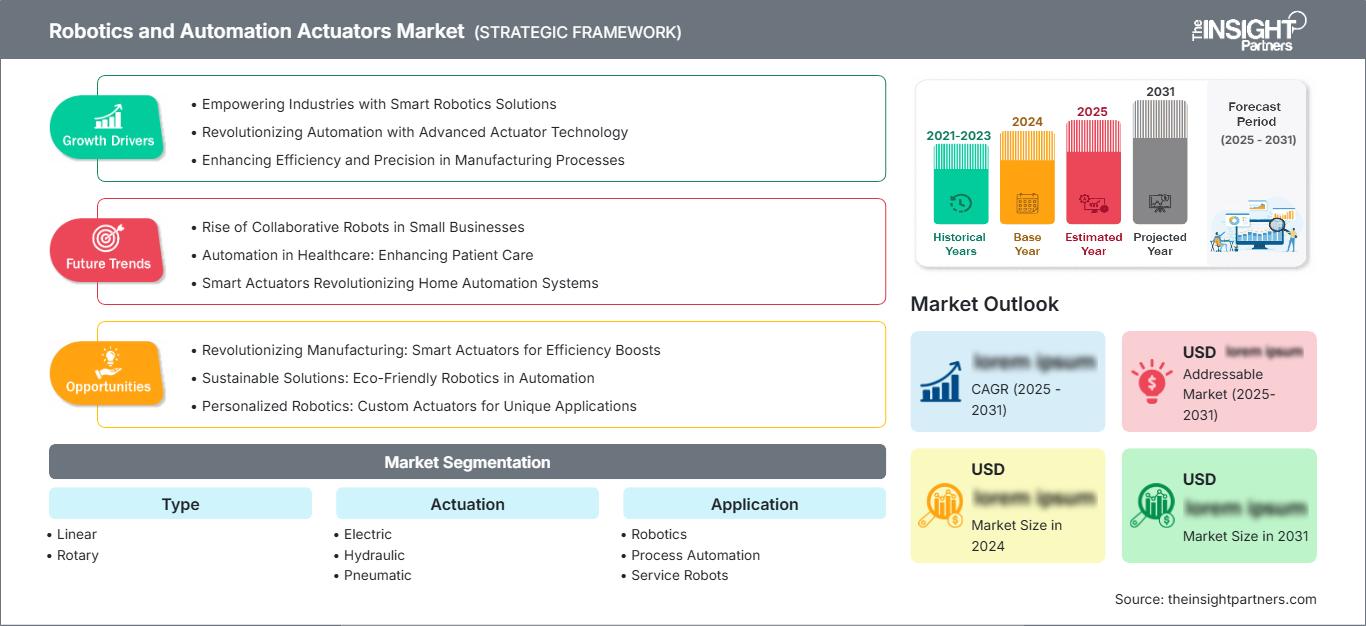
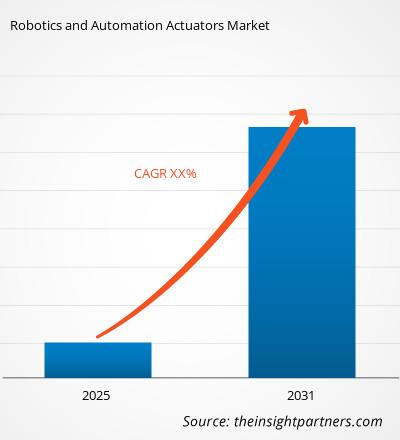
The robotics and automation actuators market was valued at US$ 51.65 Billion in 2025 and is projected to reach US$ 161.35 Billion by 2034, expanding at a CAGR of 13.49% during 2026–2034. Growth reflects the rising deployment of motion systems across industrial robots, automated production lines, mobile machines, and process equipment. Actuators increasingly combine motors, drives, sensors, feedback, and communications to provide precise, programmable motion while supporting flexibility and energy efficiency.
The robotics and automation actuators market size in North America is supported by advanced manufacturing, reshoring, automotive electrification, and flexible automation. The region is expected to expand at a 12.2–13.0% CAGR during 2026–2034, with demand reinforced by electronics production, warehouse automation, defense modernization, and replacement of aging motion equipment.
Robotics and Automation Actuators Market Assessment and Insights
- North America: North America is estimated to hold a 29–31% share in 2025 and grow at a 12.2–13.0% CAGR between 2026–2034, supported by reshoring, industrial modernization, and automation investment.
- US: The US accounts for 82–84% of North America's 2025 market and is projected to grow at a 12.4–13.2% CAGR between 2026–2034, led by advanced manufacturing.
- Europe: Europe is estimated at a 24–26% share in 2025 and is expected to grow at an 11.3–12.1% CAGR between 2026–2034, with Germany, the UK, France, Italy, and Spain leading adoption.
- Asia Pacific: Asia Pacific is estimated at a 32–34% share in 2025 and is forecast to expand at a 14.2–15.0% CAGR between 2026–2034, led by China, Japan, South Korea, India, and Australia.
- Largest Segment: Electric actuation holds a 54–57% market share in 2025 and is projected to grow at a 14.0–14.8% CAGR during 2026–2034, reflecting precision and digital integration.
- High Growth Segment: Service Robots hold a 16–19% market share in 2025 and are projected to grow at a 16.0–17.0% CAGR during 2026–2034, supported by autonomous mobility.
- Key companies analyzed in detail: Curtiss-Wright Corporation; DVG Automation S.p.A.; Macron Dynamics Inc.; MISUMI Group Inc.; Moog Inc.; Rotomation; Ewellix; SMC Corporation; Thomson Industries, Inc.; Tolomatic, Inc.
Source: The Insight Partners' analysis based on proprietary research, government publications, company annual reports, investor presentations, industry databases, and expert interviews.
The sector has shifted from discrete cylinders and motors toward integrated electromechanical packages combining actuation, feedback, drives, and communications. Electric solutions are gaining ground where programmable positioning, cleanliness, and energy management matter, while hydraulic and pneumatic systems remain important for high force, rapid cycling, and established infrastructure. Production design increasingly favors modular actuators that shorten integration and simplify diagnostics.
According to the Robotics and Automation Actuators Market Report, adoption should broaden across Southeast Asia, India, Latin America, and industrializing Middle Eastern economies as factories modernize over the forecast period. Investment in robotics, electrification, and digitally monitored equipment will support demand, while machinery safety, energy-efficiency requirements, and interoperability standards encourage intelligent motion architectures. Aerospace, defense, food processing, and energy projects should sustain specialized demand for rugged high-force systems.
Robotics and Automation Actuators Market Report Scope
| Report Attribute | Details |
|---|---|
| Market size in 2025 | US$ 51.65 Billion |
| Market Size by 2034 | US$ 161.35 Billion |
| Global CAGR (2026 - 2034) | 13.49% |
| Historical Data | 2021-2024 |
| Forecast period | 2026-2034 |
Robotics and Automation Actuators Market Analysis
Demand arises from the need for faster and repeatable motion. The market consists of motors, screws, gears, cylinders, valves, drives, sensors, controls, and software; machine builders, integrators, and distributors complete the supply chain. Manufacturers of the components increasingly offer application-specific assemblies to minimize design work. The electronics and automotive industries use precise electric motion; process applications, on the other hand, depend on pneumatic and hydraulic motion.
Factors affecting supply include semiconductor supply, precision bearings, screw technology (ball and roller), sealing components, machining facilities, and control electronics. Actuator solutions are often integrated, resulting in fewer components and less commissioning time. Modularity enables machine builders to standardize on machine platforms across a range of products.
The Robotics and Automation Actuators Market Forecast suggests that competitive intensity is rising as motion-control specialists, industrial suppliers, and robotics component companies converge on smart actuation. Curtiss-Wright Corporation is noted for its emphasis on high-force electromechanical systems in industry, aerospace, and defense applications; Moog Inc. offers both electromechanical and hydraulic solutions. SMC Corporation has comprehensive electric and pneumatic offerings, but Thomson Industries, Inc. and Tolomatic, Inc. focus on linear motion and electric actuators.
The MISUMI Group Inc. can take advantage of its motion component configurability and engineering distribution services. DVG Automation S.p.A., Macron Dynamics Inc., and Rotomation are all suited to solve specialized automation needs. Ewellix provides motion technologies with higher precision. More money is being spent on motor-integrated motors, controllers, feedback, and software to reduce selection and commissioning time.
● REPORT CUSTOMIZATION
Tailor This Report To Align With Your Specific Business Requirements
This report can be customized to align precisely with your business objectives, scope, and target markets. Customization options include tailored segmentation, geography, competitive analysis, and strategic insights to support informed decision-making.
Customize This Report →WHAT YOU CAN ADJUST
- ● Segmentations
- ● Geography
- ● Competitive Analysis
- ● Language Preferences
Robotics and Automation Actuators Market: Strategic Insights
Regional Insights
North America robotics and automation actuators market
North America is estimated to represent a 29–31% of the robotics and automation actuators market share in 2025 and is projected to grow at a 12.2–13.0% CAGR during 2026–2034. The US drives regional demand, while Canada and Mexico have the benefits of automotive, food processing, logistics and machinery investments. Reshoring and nearshoring lead to the automation of repetitive movements and assembling, leading to more demand for the exact positioning of electric actuators and robotic axes.
Another structural trend is automotive electrification, especially battery assembly, welding, pressing and material handling. Electronics and warehousing drive the need for small linear systems, and aerospace and defense need highly reliable actuation systems. Buyers look at the lifetime energy consumption, diagnostics, maintenance and controller compatibility along with force and speed when selecting components. Retrofit demand provides an opportunity as old robotic workcells get motion components without changing the whole equipment.
U.S. robotics and automation actuators Market
The US represents 82–84% of North America's 2025 robotics and automation actuators market and is expected to grow at a 12.4–13.2% CAGR during 2026–2034. Manufacturing automation, warehouse robotics, defense modernization, and domestic production investment support demand. Curtiss-Wright Corporation, Moog Inc., Thomson Industries, Inc., and Tolomatic, Inc. provide actuator technologies across industrial, aerospace, and mobile applications.
Application trends favor electric linear and rotary systems for programmable motion, while hydraulics remain important where high force and power density outweigh electrification benefits. Automotive battery plants, robotic welding, packaging, semiconductor equipment, and logistics systems are expanding the installed base. Demand is also shifting toward integrated actuators with feedback and embedded controls, allowing machine builders to simplify wiring, commissioning, and maintenance.
Europe robotics and automation actuators Market
Europe represents an estimated 24–26% of the robotics and automation actuators market share in 2025 and is projected to expand at an 11.3–12.1% CAGR during 2026–2034. Germany is the leading market, supported by automotive, machinery, factory automation, and engineering industries. The UK, France, Italy, and Spain provide additional demand through aerospace, food, packaging, energy, and industrial modernization.
The UK is strengthening automation in logistics, food processing, aerospace, and advanced manufacturing. Germany has deep demand from automotive production, machine tools, and robotics, where precise electric actuation supports flexible cells. France benefits from aerospace, nuclear, food, and packaging applications, while Italy has strong machinery, automotive, and packaging clusters. Spain adds demand from automotive, food, renewable-energy equipment, and logistics. Energy efficiency and machine safety increasingly influence actuator selection across the region.
APAC robotics and automation actuators Market
Asia Pacific is estimated to hold a 32–34% share of the robotics and automation actuators market in 2025 and is forecast to grow at a 14.2–15.0% CAGR during 2026–2034, making it the fastest-growing major region. China leads, followed by Japan, South Korea, India, and Australia. Electronics, automotive, semiconductor, and general manufacturing investment underpin demand.
Industrial policies supporting factory modernization reinforce adoption. China benefits from a large automation ecosystem, Japan from advanced robotics, South Korea from electronics and automotive production, and India from expanding manufacturing capacity. Australia contributes through mining, food, logistics, and infrastructure automation. Scalable electric motion and localized service should support new installations and retrofit programs.
Middle East & Africa robotics and automation actuators Market
Middle East and Africa robotics and automation actuators market is projected to grow at a 10.4–11.2% CAGR during 2026–2034. Saudi Arabia is the leading opportunity, followed by the UAE and South Africa. Industrial diversification, logistics infrastructure, energy projects, and new manufacturing facilities are creating selective demand for automated motion systems.
Saudi Arabia and the UAE are investing in industrial and infrastructure projects that can incorporate robotics and process automation. South Africa contributes through automotive, food, mining, and materials processing, while the rest of MEA remains fragmented. Demand favors rugged actuators for harsh environments alongside electric systems for cleaner, digitally monitored facilities. Energy and water projects support specialized process automation requirements.
Segmentation Analysis
Type
The Robotics and Automation Actuators Market Forecast indicates that the Type segment is projected to grow at a 12.8–13.6% CAGR during 2026–2034. Linear and rotary architectures address complementary motion requirements, with selection determined by stroke, torque, load, speed, installation geometry, and control precision. Growing robot complexity supports demand for compact, modular motion components that integrate efficiently into multi-axis equipment.
- Linear: Linear actuators support positioning, lifting, pressing, clamping, and robotic additional axes. Demand favors compact electric designs where programmable stroke, repeatability, cleanliness, and simplified integration are important.
- Rotary: Rotary actuators provide controlled angular motion for joints, valves, indexing, steering, and end-effectors. Their importance increases in articulated robots and equipment requiring synchronized rotational movement.
Actuation
According to the Robotics and Automation Actuators Market, the Actuation segment is expected to expand at a 13.8–14.6% CAGR during 2026–2034. Electric, hydraulic, and pneumatic technologies coexist because application requirements differ. Electrification gains traction where precise control, data connectivity, and energy management are priorities, while established fluid-power architectures remain important in demanding environments.
- Electric: Electric actuation combines precise positioning, programmable motion, and digital connectivity. It is increasingly selected for robotics, packaging, electronics, and flexible machinery where energy efficiency and control integration matter.
- Hydraulic: Hydraulic actuators remain important for high-force applications requiring strong power density and rugged operation. They serve heavy machinery, aerospace, defense, and process equipment where force demands can exceed conventional electromechanical solutions.
- Pneumatic: Pneumatic actuation remains widely used for fast repetitive movements, gripping, clamping, and straightforward machine functions. Existing compressed-air infrastructure and low component complexity sustain adoption across factories.
Application
According to the Robotics and Automation Actuators Market, the Application segment is projected to grow at a 14.2–15.0% CAGR during 2026–2034. Robotics, process automation, and service robots require different combinations of force, precision, speed, duty cycle, and portability. Increasing autonomy is expanding the need for compact actuators with integrated sensing and control.
- Robotics: Robotics applications require coordinated multi-axis motion, repeatability, force control, and increasingly compact components. Actuators are central to manipulators, mobile platforms, collaborative systems, and specialized robotic equipment.
- Process Automation: Process Automation uses actuators for valves, positioning, material handling, dosing, and repetitive machine operations. Reliability, duty cycle, environmental resistance, and compatibility with plant control systems shape purchasing decisions.
- Service Robots: Service Robots require lightweight, efficient, quiet, and controllable motion systems for mobility, manipulation, inspection, healthcare, hospitality, and commercial tasks. Battery efficiency and compact packaging are strategically important.
Industry Vertical
According to the Robotics and Automation Actuators Market, the Industry Vertical segment is projected to grow at a 13.1–13.9% CAGR during 2026–2034. Adoption is broadening because automation investments increasingly target productivity, quality, worker safety, and repeatable motion. Automotive and electronics provide large installed bases, while energy, construction, food, and aerospace add specialized requirements.
- Automotive: Automotive plants use actuators for welding, pressing, assembly, battery production, material handling, and robotic positioning. Electrification increases demand for precise motion in battery and electronic-component manufacturing.
- Electronics: Electronics manufacturing favors compact, accurate actuators for semiconductor handling, assembly, inspection, packaging, and precision positioning. High throughput and small component sizes increase the value of repeatable motion.
- Aerospace and Defense: Aerospace and Defense applications prioritize reliability, force density, environmental tolerance, and qualification. Actuation supports flight systems, platforms, handling equipment, unmanned systems, and specialized robotic mechanisms.
- Chemicals and Materials: Chemicals and Materials applications require robust motion for valves, dosing, conveying, handling, and process equipment. Corrosion resistance, sealing, reliability, and hazardous-environment compatibility influence system selection.
- Engineering and Construction: Engineering and Construction applications use actuators in machinery, positioning systems, lifting equipment, automated fabrication, and material handling. Ruggedness, load capacity, and maintainability are key purchasing factors.
- Energy and Utilities: Energy and Utilities facilities use actuators for valves, turbines, process equipment, grid infrastructure, and inspection systems. Reliability, remote operation, and environmental resilience support adoption.
- Food and Beverages: Food and Beverages applications emphasize hygienic design, clean operation, rapid cycling, and repeatable handling. Electric actuators can reduce fluid contamination concerns in selected mobile and packaging applications.
Opportunity Snapshot
| Application | Revenue Contribution | Trend Tag | Adoption Stage |
| Robotics | High | Multi-Axis Motion | Mature |
| Process Automation | High | Valve Automation | Mature |
| Service Robots | Medium | Mobile Dexterity | Scaling |
Robotics and Automation Actuators Market Growth Drivers and Impact Analysis
Electrification of machine motion
Electrification is affecting the procurement of actuators due to manufacturers' increasing preference for programmable motions, minimal maintenance, and direct interface with digital controls. Electrification allows the system to obtain information regarding the position and force through the use of encoders and controllers. This trend is most relevant where there is the presence of fluid power that incurs energy loss, maintenance, or contaminants. Fluid power is still viable for high-force applications and high cycles. The result is that the shift in terms of practical effects on the marketplace is application-dependent migration towards hybridization. Suppliers who can offer alternatives in electrification in equal measure to the force, ruggedness, and cost of lifecycle can benefit from the retrofitting process.
Growth of flexible robotic production
Factories are reconfiguring their manufacturing process around shortened product lifecycles, increased variety and more flexible automation systems. This means a rising need for actuator technologies that enable position, velocity, force, and stroke to be programmed rather than mechanically adjusted. Applications such as robotic welding, battery assembly, packaging, machine tending, and inspection may be improved through programmable motion. Integrated actuators decrease cabinet space and wiring needs by integrating the motor, encoder and controller. The effects are throughout the chain of value since robot suppliers, system integrators, and machine makers may standardize the motion platform but customize the end-use application using software. Companies that offer technology that is based on common industrial communication standards and rapid configuration will do well.
Expansion of autonomous machines and mobile robotics
Autonomous devices need compact actuators with a good trade-off between torque, mass, power consumption, reaction speed, and durability. Mobile robots, automated guided vehicles, agricultural machines, inspection equipment, and custom-designed service robots have stricter power limitations than stationary industrial machinery. This means that there is a demand for light-weight electrical actuators, efficient power transmission, feedback integration, and robust rotary actuators. Custom hydraulic solutions are still needed for those mobile platforms that have a need for high force density. The effect on the market would be the expansion of the envelope for actuators, as well as the development of products that work on batteries and are designed for intermittent autonomous cycles. As autonomy rises, failure of actuators may interfere with the movement and handling tasks.
Robotics and Automation Actuators Market Future Trends
Integrated actuation will become a standard architecture
Future actuators will feature more integrated design solutions that incorporate motor, transmission, feedback, controller, and communications interfaces into one system. This concept decreases cabling, cabinets, parts matching, and the installation process, and increases the modularity of machines. Intelligence embedded into actuators will help not only monitor the state of a machine but also take local decisions regarding movements. In the case of robotics, it is possible to create an integrated system around the entire mechanism and, therefore, simplify the packaging of multiaxis systems. This will motivate vendors to go beyond the design of individual mechanical components and work on the development of mechatronic modules. However, standardized interfaces are needed since machine builders require interchangeability between different platforms of control.
Actuators will be optimized for physical AI and dexterity
In terms of physical robots, there is going to be an increased demand for actuators that are able not only to perform point-to-point movements but also to move quickly and repeatedly with precision. Actuators with a low backlash, high bandwidth, internal sensors, and good thermal management will be needed by robots working in non-structured environments for performing tasks related to manipulating different objects and reacting to contact. Weight and power consumption will be of equal importance in mobile and humanoid robots since each actuator influences run time and load-carrying capacity. These factors will promote research and development of compact high-torque rotary actuators, efficient linear actuators, and force-sensing actuators.
Robotics and Automation Actuators Market Opportunities
Retrofit programs for legacy automation
The installed base of older production equipment creates an actionable opportunity for actuator suppliers and integrators. Many factories can improve throughput and flexibility without replacing entire machines by upgrading cylinders, motors, drives, or robotic axes with smarter components. Retrofit packages can combine electric actuators, controllers, sensors, communication modules, and engineering services around established mechanical structures. This approach lowers capital intensity and allows manufacturers to prioritize bottleneck operations. Vendors can target packaging lines, machine tools, material handling systems, and robotic cells where maintenance costs or limited programmability constrain productivity. A successful retrofit strategy should emphasize compatibility, downtime reduction, documented performance gains, and lifecycle support. Standardized kits for common machine architectures can reduce engineering time and create repeatable deployment models across regional factory networks.
Actuation platforms for emerging service robotics
The Robotics and Automation Actuators Market Trends highlight service robotics as an investment opportunity because mobility, manipulation, and autonomous interaction require different actuator characteristics from conventional factory robots. Healthcare logistics, commercial cleaning, hospitality, agriculture, inspection, and warehouse support create use cases where compact, quiet, efficient motion is valuable. Suppliers can develop modular actuator platforms that scale across robot designs while maintaining common electronics and software interfaces. Battery-powered operation makes energy efficiency a primary selection criterion, while service environments increase the importance of low noise and safe force behavior. Partnerships with robot developers and system integrators can help actuator manufacturers validate designs before volume production. Early participation can establish reference architectures for new robotic categories, creating opportunities for recurring component demand as specialized robot fleets expand.
Frequently Asked Questions

- Comprehensive Market Sizing and Forecast Analysis
- Detailed Segmentation Analysis
- In-Depth Market Dynamics Assessment
- Regional and Country-Level Insights
- Competitive Landscape and Company Benchmarking
- Strategic Business Intelligence
Recent Reports
Testimonials

The Insight Partners provided valuable market intelligence that supported our global go-to-market strategy. Their team was professional, responsive, and attentive to our feedback, providing thoughtful analysis and helpful methodological clarifications throughout the project.
Junmo Kim Chief Financial Officer (CFO), Enertech Co., Ltd.
The Insight Partners' SCADA System Market report is comprehensive, with valuable insights on current trends and future forecasts. The team was highly professional, responsive, and supportive throughout. We are very satisfied and highly recommend their services.
RAN KEDEM Partner, Reali Technologies LTDs
I requested a report on a very specific software market and the team produced the report in a few days. The information was very relevant and well presented. I then requested some changes and additions to the report. The team was again very responsive and I got the final report in less than a week.
JEAN-HERVE JENN Chairman, Future Analytica
We worked with The Insight Partners for an important market study and forecast. They gave us clear insights into opportunities and risks, which helped shape our plans. Their research was easy to use and based on solid data. It helped us make smart, confident decisions. We highly recommend them.
PIYUSH NAGPAL Sr. Vice President, High Beam Global
The Insight Partners delivered insightful, well-structured market research with strong domain expertise. Their team was professional and responsive throughout. The user-friendly website made accessing industry reports seamless. We highly recommend them for reliable, high-quality research services
YUKIHIKO ADACHI CEO, Deep Blue, LLC.
This is the first time I have purchased a market report from The Insight Partners.While I was unsure at first, I visited their web site and felt more comfortable to take the risk and purchase a market report.I am completely satisfied with the quality of the report and customer service. I had several questions and comments with the initial report, but after a couple of dialogs over email with their analyst I believe I have a report that I can use as input to our strategic planning process.Thank you so much for taking the extra time and making this a positive experience.I will definitely recommend your service to others and you will be my first call when we need further market data.
JOHN SUZUKI President and Chief Executive Officer, Board Director, BK Technologies
I wish to appreciate your support and the professionalism you displayed in the course of attending to my request for information regarding to infectious disease IVD market in Nigeria. I appreciate your patience, your guidance, and the fact that you were willing to offer a discount, which eventually made it possible for us to close a deal. I look forward to engaging The Insight Partners in the future, all thanks to the impression you have created in me as a result of this first encounter.
DR CHIJIOKE ONYIA MANAGING DIRECTOR, PineCrest Healthcare Ltd.Reason to Buy
- Informed Decision-Making
- Understanding Market Dynamics
- Competitive Analysis
- Identifying Emerging Markets
- Customer Insights
- Market Forecasts
- Risk Mitigation
- Boosting Operational Efficiency
- Strategic Planning
- Investment Justification
- Tracking Industry Innovations
- Aligning with Regulatory Trends





 Get Free Sample for