
Service Robots Market Share, Demand & Growth by 2034
Coverage: by Type (Professional Service Robots, Domestic Service Robots, and Others); and Application (Healthcare, Defense, Security, Logistics, Inspection & Maintenance Systems, and Others), and Geography (North America, Europe, Asia Pacific, and South and Central America)
- Status : Data Released
- Report Code : TIPMC00002526
- Category : Electronics and Semiconductor
- No. of Pages : 150
- Available Report Formats :


- Last update date : July 17, 2026


2025 Market Size
US$ 36.93 Bn
Base year value
2034 Forecast
US$ 136.35 Bn
Projected by 2034
CAGR 2026-2034
15.62 %
Growth rate
Addressable Market
US$ 735.96 Bn
(2026-2034)
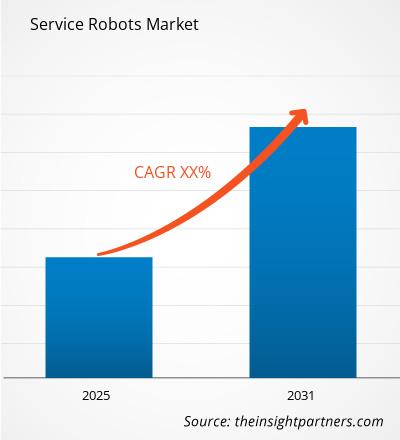
The Service Robots market size is projected to grow from US$ 36.93 Billion in 2025 to US$ 136.35 Billion by 2034, recording a CAGR of 15.62% during 2026–2034. Growth is supported by rising deployment of autonomous systems across healthcare, logistics, defense, security, and inspection environments where labor availability, operational safety, and process accuracy are becoming central procurement criteria.
Across North America, the Service Robots Market size is shaped by warehouse automation, hospital support robotics, defense modernization, and inspection demand in utilities and energy assets. The region is estimated to hold 38–40% share in 2025 and grow at a CAGR of 14–16% through 2034, supported by robot-as-a-service adoption, high labor costs, and mature enterprise technology integration.
Service Robots Market Assessment and Insights
- North America accounted for 38–40% share in 2025 and is growing at a CAGR range of 14–16% during 2026–2034, led by healthcare automation, logistics fulfillment, defense robotics, and inspection programs.
- US represented 78–82% of North America in 2025 and is growing at a CAGR range of 14–16%, supported by defense procurement and hospital automation.
- Europe held 24–26% share in 2025 and is growing at a CAGR range of 13–15% during 2026–2034, with Germany, the UK, France, Italy, and Spain leading adoption.
- Asia Pacific captured 28–30% share in 2025 and is growing at a CAGR range of 17–19% during 2026–2034, driven by China, Japan, South Korea, India, and Australia.
- Largest Segment Professional Service Robots held 67–70% market share in 2025 and is growing at a CAGR range of 15–17% through 2034.
- High Growth Segment Logistics held 25–28% market share in 2025 and is growing at a CAGR range of 18–20% through 2034.
- Key companies analyzed in detail: Northrop Grumman Corporation, KUKA AG, iRobot Corporation, Kongsberg Maritime AS, SZ DJI Technology Co., Ltd., Honda Motor Co., Ltd., Adept Technology, Inc., General Dynamics Mission Systems, Inc., Aethon Inc., GeckoSystems International Corporation.
Source: The Insight Partners' analysis based on proprietary research, government publications, company annual reports, investor presentations, industry databases, and expert interviews.
The technology migration in the Service Robots Market has resulted in these robots shifting from their role as single-use tools to smart and interconnected platforms with simultaneous localization, machine vision, fleet management, and AI route planning. There is also a change in production trends, where companies are integrating modularity of hardware and software in the cloud, along with service agreements, in order to alleviate initial capital requirements. The IFR recorded the sale of nearly 200,000 professional service robots in 2024, out of which 102,900 were used for transportation and logistics.
Future demand will go beyond early automation efficiencies as hospitals, ports, airports, warehouses, utilities, and defense organizations focus on achieving resilience. New geographies are anticipated to embrace the concept of Service Robots by adopting them through rentals, safety initiatives, and infrastructure inspection requirements without necessarily owning them directly. Regulatory issues will become increasingly important for the adoption of autonomous mobility and safety certification, among others.
Service Robots Market Report Scope
| Report Attribute | Details |
|---|---|
| Market size in 2025 | US$ 36.93 Billion |
| Market Size by 2034 | US$ 136.35 Billion |
| Global CAGR (2026 - 2034) | 15.62% |
| Historical Data | 2021-2024 |
| Forecast period | 2026-2034 |
Service Robots Market Analysis
Service robots market growth is driven by measurable productivity gaps in logistics, healthcare, defense, security, and inspection workflows. Aging populations increase hospital support requirements, while e-commerce networks require continuous material movement. IFR data showing 31% growth in robot-as-a-service fleets indicates buyers are shifting toward outcome-based automation when asset ownership is less attractive.
The value chain covers sensors, actuators, navigation software, batteries, edge computing chips, cloud fleet management, integration solutions, and maintenance services. Favorable supply dynamics will be in the hands of suppliers that can offer hardware paired with recurring software sales. The semiconductor situation, localization of key components, and support services continue to matter since hospitals, logistics centers, and defense installations cannot tolerate downtime like consumers.
Service robots market analysis shows a competitive field split between defense primes, industrial automation specialists, consumer robotics brands, and niche autonomous platform providers. Northrop Grumman Corporation and General Dynamics Mission Systems, Inc. emphasize mission reliability, while KUKA AG, Aethon Inc., and Adept Technology, Inc. target industrial, hospital, and logistics workflows.
Investment is moving toward software-defined autonomy, modular payloads, fleet analytics, and domain-specific compliance. iRobot Corporation and Honda Motor Co., Ltd. reinforce domestic and assistive robotics relevance, whereas Kongsberg Maritime AS, SZ DJI Technology Co., Ltd., and GeckoSystems International Corporation strengthen underwater, aerial, and assistive segments. Strategic positioning in the Service Robots Market increasingly depends on ecosystem partnerships rather than standalone machine capability.
● REPORT CUSTOMIZATION
Tailor This Report To Align With Your Specific Business Requirements
This report can be customized to align precisely with your business objectives, scope, and target markets. Customization options include tailored segmentation, geography, competitive analysis, and strategic insights to support informed decision-making.
Customize This Report →WHAT YOU CAN ADJUST
- ● Segmentations
- ● Geography
- ● Competitive Analysis
- ● Language Preferences
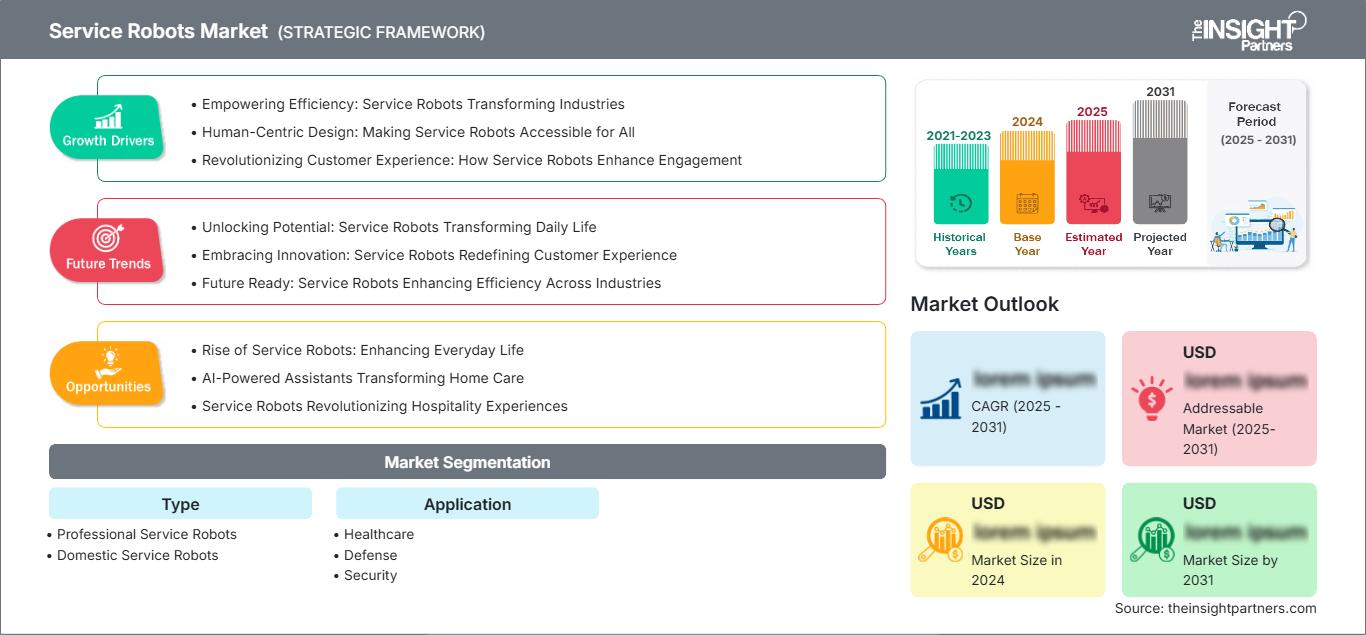
Service Robots Market: Strategic Insights
Regional Insights
North America Service Robots Market
North America accounted for 38–40% share in 2025 and is projected to grow at a CAGR range of 14–16% during 2026–2034. The service robots market share is supported by strong warehouse automation spending, healthcare labor constraints, and defense modernization. Adoption is concentrated in autonomous mobile robots, surgical support, unmanned defense systems, and infrastructure inspection platforms.
The area has well-established cloud infrastructures, systems integration services, and purchasing models that facilitate leasing and robot-as-a-service offerings. In hospitals, delivery and disinfection systems reduce manual labor, while logistic companies have fleet-managed robots for picking, moving, and inventory management. Energy utilities and government agencies are increasingly adopting inspection robots for dangerous and distant assets.
U.S. Service Robots Market
The U.S. represented 78–82% of North America in 2025 and is expected to expand at a CAGR range of 14–16% through 2034. Demand is supported by defense robotics programs, hospital automation, e-commerce fulfillment density, and high wage pressure in repetitive operations. Large domestic technology ecosystems accelerate integration of AI, sensors, and fleet software, strengthening the Service Robots Market in the country.
Company presence is broad across defense, logistics, healthcare, and consumer robotics. Northrop Grumman Corporation and General Dynamics Mission Systems, Inc. support unmanned and mission systems, while iRobot Corporation and Aethon Inc. reinforce domestic and hospital workflows. Application trends favor autonomous delivery, security patrol, warehouse transport, and inspection systems with remote supervision.
Europe Service Robots Market
Europe held 24–26% share in 2025 and is projected to grow at a CAGR range of 13–15% during 2026–2034. Germany drives the region in automation capabilities, engineering knowledge, and modern factories. On its part, the UK promotes the use of technology in health care, logistics, and security through digital government services and private fulfillment operations.
The French, Italians, and Spanish are developing robotic solutions for hospitals, inspections, and warehouses to solve labor shortage issues related to health care and logistics operations. The EU's safety standards will help in the adoption of certified platforms, data management processes, and interoperability of the system. The KUKA AG is a key regional supplier.
APAC Service Robots Market
APAC captured 28–30% share in 2025 and is projected to grow at a CAGR range of 17–19% during 2026–2034. China leads through manufacturing scale, smart logistics investment, and domestic robotics supply chains, while Japan and South Korea bring advanced mechatronics and aging-society use cases. These factors are driving the rapid expansion of the Service Robots Market across the Asia-Pacific region.
India and Australia add momentum through warehouse automation, healthcare access improvement, infrastructure inspection, and mining safety. Policy support for advanced manufacturing, smart cities, and automation localization is accelerating deployment. SZ DJI Technology Co., Ltd. strengthens aerial robotics relevance across inspection, defense-adjacent, and enterprise applications.
Middle East & Africa Service Robots Market
The Middle East & Africa is projected to grow at a CAGR range of 12–14% during 2026–2034. Saudi Arabia and the UAE lead adoption through airport, energy, smart city, security, and logistics investments, while South Africa develops mining, infrastructure inspection, and healthcare support use cases. These developments are contributing to the growth of the Service Robots Market across the region.
Energy infrastructure creates demand for robots that inspect pipelines, offshore systems, ports, and hazardous industrial assets. Public safety and hospitality pilots are expanding, but deployment depends on integrator availability, climate-resilient hardware, and maintenance capability. The rest of MEA adoption remains selective, focused on projects with clear safety or labor-efficiency returns.
Segmentation Analysis
Type
CAGR growth for the type will range between 15–17% from 2026–2034. The scope of service robots by type depends on professional enterprise solutions and domestic automation devices. Professional solutions lead in terms of revenue since there are larger payloads needed by healthcare, defense, logistics, and inspection buyers along with precise navigation. Domestic robots focus on volume sales, with cleaning and assistive home devices taking the lead.
- Professional Service Robots have the highest revenue potential as robots are used for logistical operations, hospitals, military uses, security and inspections where there is a need for uptime.
- Domestic Service Robots have increasing usage at home as cleaning robots, lawnmowers and personal assistants are increasingly affordable, networked and easy to manage using apps and automated docking stations.
Application
The Application Market is projected to exhibit a CAGR of 16–18% between 2026 and 2034. These robots see the most adoption wherever automation can help lower risks, enhance efficiency, or compensate for the shortage of skilled workers. The use of these robots is highly economical in healthcare and logistics operations, while in defense, security, and inspection applications, they are used for jobs that are dangerous, distant, or require promptness.
- Demand for healthcare is fueled by hospital processes of delivering, disinfecting, surgery assistance, rehabilitation, and elder care that benefit from increased reliability, repetition, and decreased workload of the staff.
- Defense systems rely on unmanned ground, aerial, and maritime vehicles utilized for reconnaissance, explosive ordnance disposal, perimeter surveillance, and support in missions involving high risks.
- Security robots are becoming relevant for patrol and surveillance, access control, and incident response in campuses, industries, transportation terminals, and critical infrastructure.
- Logistics continues to be strategically significant due to the use of mobile autonomous robots at warehouses, plants, hospitals, and retail outlets that decrease walking time and enable 24-hour work.
- Inspection & Maintenance Systems help utilities, energy, marine, transportation, and manufacturing infrastructure by decreasing the risk associated with inspection in confined, elevated, underwater, and hazardous conditions.
Opportunity Snapshot
| Application | Revenue Contribution | Trend Tag | Adoption Stage |
| Healthcare | High | Hospital Flow | Scaling |
| Defense | Medium | Mission Autonomy | Scaling |
| Security | Medium | Perimeter Patrol | Emerging |
| Logistics | High | Fleet Routing | Mature |
| Inspection & Maintenance Systems | Medium | Asset Inspection | Scaling |
Service Robots Market Growth Drivers and Impact Analysis
Labor Scarcity and Productivity Pressure in Critical Workflows
The shortage of labor in the economy is causing firms to use robots for tasks that are mundane, dangerous, and critical from the perspective of timely completion. The effect is seen most prominently in hospitals, warehouses, airports, utility organizations, and the military, where any delay causes cost, security, or operational problems. IFR found that professional service robots have been sold to the tune of nearly 200,000 units in 2024, registering a growth of 9%, while transportation and logistics saw the sale of 102,900 units. This justifies the need for robots that assist with the transport of goods, supplies, and materials.
Robot-as-a-Service Models Lower Procurement Barriers
Robot-as-a-Service is altering the purchase pattern by offering alternative purchasing methods from outright capital investment through subscriptions, rental arrangements, and performance-based systems. This is relevant for hospitals, small warehousing operations, retail organizations, and governmental organizations that require automation but do not have budgetary approval issues. According to IFR, the robot-as-a-service fleet increased by 31%, and RaaS for logistics operations expanded at an even faster rate in 2024. The implications of this include wider accessibility to Service Robots, faster pilot-to-production time frames, and revenue stream visibility for the vendor.
Safety, Inspection, and Remote Operations Requirements
Robots have found greater application by companies running industries, energy, defense, and infrastructure due to increased use of robots in areas that are dangerous, expensive, or inefficient for humans to operate. Robots have been used in inspections and maintenance of operations in tight spaces, submarine installations, pipelines, oil rigs, warehouses, and security areas. In the defense and public safety sectors, robots are preferred for their use in reconnaissance missions, handling of explosive ordnance, and border surveillance. These changes will influence vendors in the form of increased orders for durable and sensor-equipped robots.
Service Robots Market Future Trends
Multi-Purpose Autonomous Platforms
Service robots market trends are moving toward platforms that can support multiple payloads, routes, and task profiles instead of single-function machines. Hospitals may use the same base architecture for delivery, linen movement, and waste handling, while industrial sites may combine inspection, mapping, and surveillance. This trend will raise the value of modular hardware, open software interfaces, and fleet orchestration. It will also encourage buyers to compare platform extensibility rather than only initial task fit. Vendors able to certify safety across several use cases will reduce customer switching risk and improve long-term account expansion.
AI-Enabled Fleet Intelligence and Predictive Service
Intelligence in terms of the fleet itself will be a differentiator as the deployment goes from single units up to fleets of robots. The AI will help to optimize the routes, schedule charging, estimate the wear and tear on the components and even prioritize the tasks. This will be highly useful in logistics settings, hospitals and security settings where there is constant variability in the environment because of congestion and the need for urgent response. Predictive maintenance can help decrease downtime and make procurement decisions easier.
Service Robots Market Opportunities
Healthcare Support Automation Beyond Surgical Use
Hospitals and care facilities present a strong opportunity beyond high-cost surgical robotics. Delivery robots, disinfection units, rehabilitation support, laboratory automation, and eldercare assistance address daily operational bottlenecks. WHO-linked concerns around aging populations and health workforce pressure strengthen the case for assistive automation. Investors can target platforms that integrate with hospital information systems, elevators, pharmacy workflows, and infection-control requirements. The opportunity is attractive because hospitals value reliability, traceability, and service continuity, creating recurring revenue potential through maintenance, software, and workflow expansion rather than isolated hardware sales.
Inspection Robotics for Energy and Infrastructure Assets
Energy, utilities, ports, rail, and industrial infrastructure create an actionable opportunity for robots that inspect assets under difficult operating conditions. Operators need safer methods for pipelines, tanks, offshore structures, transmission assets, warehouses, and underwater equipment. The opportunity is strengthened by aging infrastructure, climate exposure, and demand for continuous monitoring. Vendors can differentiate through rugged mobility, sensor fusion, digital twin integration, and certified reporting outputs. Commercial models may combine hardware, analytics, and managed inspection services, allowing customers to link payments to completed inspections, downtime reduction, or compliance documentation.
Recent Developments
- June 2026: Pudu Robotics, a global leader in commercial service robotics, and Shenzhen Culture & Tourism Industry Development Co. Ltd (Abbv. Shenzhen CITD Co. Ltd) have officially signed a strategic cooperation agreement to jointly develop the world's first full-scenario robot-serviced hotel on the West Artificial Island of the Shenzhen-Zhongshan Link, one of the most ambitious infrastructure projects in the Guangdong-Hong Kong-Macao Greater Bay Area in China.
- March 2026: iRobot Corporation, a leader in consumer robots, today introduced Roomba Mini, its smallest Roomba robot ever. With its powerful cleaning system and the flexibility to vacuum or mop, this beautiful little robot tackles everyday messes with ease while gliding under furniture and into hard-to-reach spots that stick vacuum cleaners and standard-size robots can't reach.
- January 2026: iRobot Corporation — completed a court-supervised transaction with Picea, emerging as a stronger Boston-based consumer robotics company and establishing iRobot Safe as an independent U.S. subsidiary focused on data protection and governance. — https://media.irobot.com/press-releases
- October 2025: The total number of service robots sold for professional use reached almost 200,000 units in 2024, marking a 9% increase. Staff shortages are a key driver for companies to use robots designed for trained professionals. At the same time, the growing elderly population is increasing the demand for medical robots. These findings are presented in the World Robotics 2025 Service Robots report by the IFR.
Frequently Asked Questions

- Comprehensive Market Sizing and Forecast Analysis
- Detailed Segmentation Analysis
- In-Depth Market Dynamics Assessment
- Regional and Country-Level Insights
- Competitive Landscape and Company Benchmarking
- Strategic Business Intelligence
Recent Reports
Testimonials

The Insight Partners' SCADA System Market report is comprehensive, with valuable insights on current trends and future forecasts. The team was highly professional, responsive, and supportive throughout. We are very satisfied and highly recommend their services.
RAN KEDEM Partner, Reali Technologies LTDs
I requested a report on a very specific software market and the team produced the report in a few days. The information was very relevant and well presented. I then requested some changes and additions to the report. The team was again very responsive and I got the final report in less than a week.
JEAN-HERVE JENN Chairman, Future Analytica
We worked with The Insight Partners for an important market study and forecast. They gave us clear insights into opportunities and risks, which helped shape our plans. Their research was easy to use and based on solid data. It helped us make smart, confident decisions. We highly recommend them.
PIYUSH NAGPAL Sr. Vice President, High Beam Global
The Insight Partners delivered insightful, well-structured market research with strong domain expertise. Their team was professional and responsive throughout. The user-friendly website made accessing industry reports seamless. We highly recommend them for reliable, high-quality research services
YUKIHIKO ADACHI CEO, Deep Blue, LLC.
This is the first time I have purchased a market report from The Insight Partners.While I was unsure at first, I visited their web site and felt more comfortable to take the risk and purchase a market report.I am completely satisfied with the quality of the report and customer service. I had several questions and comments with the initial report, but after a couple of dialogs over email with their analyst I believe I have a report that I can use as input to our strategic planning process.Thank you so much for taking the extra time and making this a positive experience.I will definitely recommend your service to others and you will be my first call when we need further market data.
JOHN SUZUKI President and Chief Executive Officer, Board Director, BK Technologies
I wish to appreciate your support and the professionalism you displayed in the course of attending to my request for information regarding to infectious disease IVD market in Nigeria. I appreciate your patience, your guidance, and the fact that you were willing to offer a discount, which eventually made it possible for us to close a deal. I look forward to engaging The Insight Partners in the future, all thanks to the impression you have created in me as a result of this first encounter.
DR CHIJIOKE ONYIA MANAGING DIRECTOR, PineCrest Healthcare Ltd.Reason to Buy
- Informed Decision-Making
- Understanding Market Dynamics
- Competitive Analysis
- Identifying Emerging Markets
- Customer Insights
- Market Forecasts
- Risk Mitigation
- Boosting Operational Efficiency
- Strategic Planning
- Investment Justification
- Tracking Industry Innovations
- Aligning with Regulatory Trends





 Get Free Sample for