
Smart Connected Offices Market Size, Trends & Growth by 2034
Smart Connected Offices Market Size and Forecasts (2021 - 2034), Global and Regional Share, Trends, and Growth Opportunity Analysis Report Coverage : By Component (Hardware, Software, Services), Office Type (New Construction, Retrofit)
- Status : Data Released
- Report Code : TIPRE00039629
- Category : Electronics and Semiconductor
- No. of Pages : 150
- Available Report Formats :


- Last update date : August 05, 2026


2025 Market Size
US$ 55.8 Bn
Base year value
2034 Forecast
US$ 152.13 Bn
Projected by 2034
CAGR 2026-2034
11.79 %
Growth rate
Addressable Market
US$ 913.53 Bn
(2026-2034)
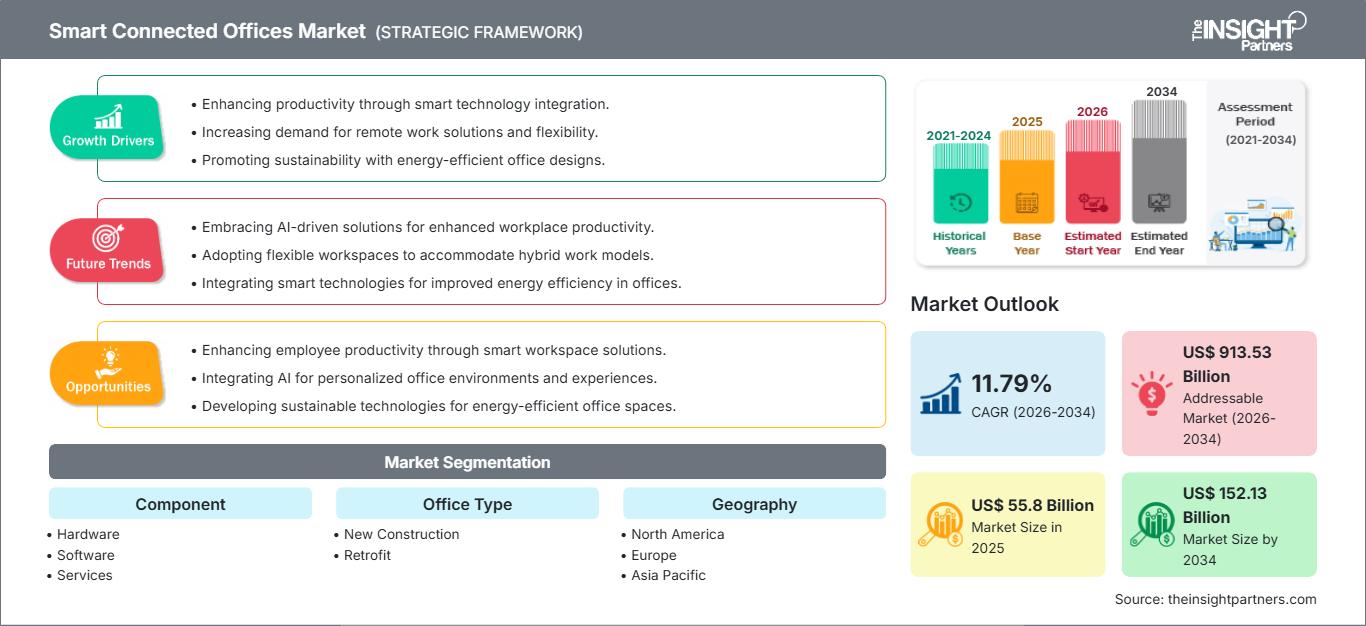
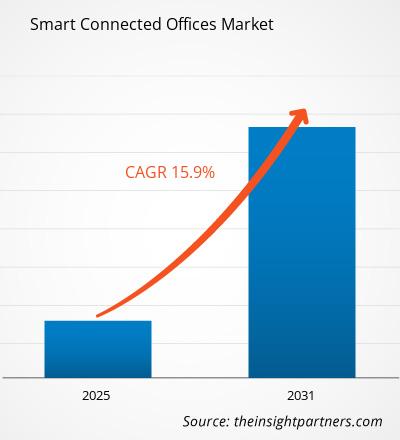
The Smart Connected Offices Market in 2025 was US$ 55.8 billion and is forecast to reach US$ 152.13 billion by 2034, recording a CAGR of 11.79% for 2026–2034. The market has been driven by building controls systems, occupancy analytics, workplace security networks, and energy management solutions which enable businesses to manage their hybrid workplaces efficiently and effectively.
North America will continue to be one of the focus areas for smart connected office adoption as organizations upgrade offices towards hybrid work models and cyber-secured connections. Smart Connected Offices Market size in North America is anticipated to grow at a rate of 10.8–11.6% CAGR on the back of the retrofit requirement from Class A commercial real estate properties and new digital infrastructure in business campuses.
Smart Connected Offices Market Assessment and Insights
- North America accounted for 34–36% share in 2025 and is growing at a CAGR of 10.8–11.6% during 2026–2034, driven by building modernization, workplace analytics, and corporate energy efficiency mandates.
- US represented 72–75% of North America in 2025 and is growing at a CAGR of 10.7–11.5% during 2026–2034, led by enterprise campuses and retrofit activity.
- Europe held 25–27% share in 2025 and is growing at a CAGR of 10.4–11.2% during 2026–2034, with Germany, the UK, France, Italy, and Spain leading compliance-driven adoption.
- Asia Pacific captured 23–25% share in 2025 and is growing at a CAGR of 13.1–14.0% during 2026–2034, supported by China, Japan, South Korea, India, and Australia.
- Largest Segment Hardware held 49–52% market share in 2025 and is growing at a CAGR of 10.2–11.0% during 2026–2034 as sensors, gateways, lighting, and access controls remain foundational.
- High Growth Segment Software held 27–30% market share in 2025 and is growing at a CAGR of 13.6–14.5% during 2026–2034 as analytics, AI, dashboards, and integration layers scale.
- Key companies analyzed in detail: ABB Ltd., Cisco Systems, Inc., Crestron Electronics, Inc., Honeywell International Inc., Johnson Controls International plc, Lutron Electronics Co., Inc., Signify Holding, Schneider Electric SE, Siemens AG, SensorSuite Inc.
Source: The Insight Partners' analysis based on proprietary research, government publications, company annual reports, investor presentations, industry databases, and expert interviews.
Office technologies have advanced from automation to intelligent operation. Initial installations included lighting control, HVAC schedule control, and access control while recent ones involve sensors, office applications, network architecture, and energy software in one operating layer. The production trends are increasingly adopting interoperable devices, cloud-based platform, and service-oriented integration since the owners would require retrofitting without replacing the whole building system and disturbing tenants.
In the forecasted years ahead, investments will be extended from high-end headquarters to regional offices, coworking spaces, healthcare administrative buildings, and educational campuses. The regulatory pressure on the performance of the buildings, the increase in price of energy, and variations in hybrid attendance are increasing the need for systems that can dynamically change comfort, security, and occupancy in the building.
Smart Connected Offices Market Report Scope
| Report Attribute | Details |
|---|---|
| Market size in 2025 | US$ 55.8 Billion |
| Market Size by 2034 | US$ 152.13 Billion |
| Global CAGR (2026 - 2034) | 11.79% |
| Historical Data | 2021-2024 |
| Forecast period | 2026-2034 |
Smart Connected Offices Market Analysis
The demand is growing as users are trying to achieve higher energy efficiency, optimize their space usage, and provide easy access to work places. Smart Connected Offices market growth is supported by hybrid work habits that do not allow for effective work on fixed schedules and force facility managers to use occupancy sensors, lighting controls, air quality monitoring, and connected rooms.
Supply conditions benefit vendors who offer stable devices with flexible software integration capabilities. Availability of semiconductors, cybersecurity certification, and the capabilities of installing contractors affect the timing of the projects implementation. This becomes particularly evident when talking about retrofitted office spaces with different BMS protocols. Customers want solutions that can demonstrate their efficiency on dashboards and with fault detection and predictive maintenance.
The intensity of competition is affected by platform breadth and channel depth. Competitive analysis of Smart Connected Offices Market Report reveals that ABB Ltd., Schneider Electric SE, Siemens AG, Honeywell International Inc., and Johnson Controls International plc offer competitive solutions in terms of building automation platforms, whereas Cisco Systems, Inc. improves secure collaboration and connectivity. Crestron Electronics, Inc., Lutron Electronics Co., Inc., Signify Holding, and SensorSuite Inc. focus on experience, lighting, and occupancy intelligence segments.
Current investment trends show the shift from purely capital investments to recurring software, monitoring, and optimization investments. Solution providers with analytics, compliance reporting capabilities, and ecosystems of partners can protect their margins given customer requirement for tangible results. Effective strategic positioning in the industry becomes increasingly reliant on interoperability, cyber governance, and multi-stage implementation capabilities.
● REPORT CUSTOMIZATION
Tailor This Report To Align With Your Specific Business Requirements
This report can be customized to align precisely with your business objectives, scope, and target markets. Customization options include tailored segmentation, geography, competitive analysis, and strategic insights to support informed decision-making.
Customize This Report →WHAT YOU CAN ADJUST
- ● Segmentations
- ● Geography
- ● Competitive Analysis
- ● Language Preferences
Smart Connected Offices Market: Strategic Insights
Regional Insights
North America Smart Connected Offices Market
North America had a market share of 34-36% in 2025 and is expected to grow at a CAGR of 10.8-11.6% between 2026 and 2034. Adoption drivers include high digitization of corporate real estate, aged office inventory needing retro-fit control, and tenant demand for flexible, secure, and data-enabled workspaces. The Smart Connected Offices Market share is still dominant in the commercial corridors of cities.
Rising energy efficiency regulations and rising prices are driving integration of HVAC systems, lighting, and access control systems. Occupancy sensing is being used to consolidate floor space, peak power consumption, and optimize conference rooms. The vendors benefit from an established installation network, cloud services, and large campuses where platform unification can be performed.
U.S. Smart Connected Offices Market
North America includes the U.S. and represents 72–75% of the market in 2025 and expected to expand at a 10.7–11.5% CAGR between 2026 and 2034. Demand is driven by sectors including technology, finance, healthcare, educational institutions, and governmental agencies needing security, fine-grain access control, and flexible collaboration environments spanning multiple sites.
Company representation is broad, with Cisco Systems, Inc., Honeywell International Inc., Johnson Controls International plc, Lutron Electronics Co., Inc., and Crestron Electronics, Inc. all having well-developed distribution channels. Applications have been found to be coming together on workspace scheduling, air quality monitoring, energy savings, and secure network systems. This allows the facility managers to maximize the effectiveness of the space as an operating measure.
Europe Smart Connected Offices Market
Europe constituted 25% to 27% market share in 2025 and is projected to have 10.4% to 11.2% CAGR between 2026 and 2034. Europe’s lead market includes Germany due to advanced building engineering, automation suppliers, and efficiency regulations, whereas the UK focuses on smart retrofits in London and regional business districts, both of which prefer interoperable systems.
France, Italy, and Spain deploy the technology through office refurbishments, public efficiency initiatives, and smart cities-infrastructure. The demand is driven by offices where building owners need to improve energy grade without disturbing their tenants. Schneider Electric SE, Siemens AG, ABB Ltd., and Signify Holding enjoy established European engineering and sustainable procurement channels.
APAC Smart Connected Offices Market
The market share held by APAC in 2025 was around 23-25%, and it is expected that APAC will have the highest CAGR between 13.1% to 14.0% during 2026-2034.
China leads in terms of construction of commercial buildings and implementation of smart cities, whereas countries like Japan and South Korea focus on automation, safety, and high productivity in office buildings. India and Australia gain pace through technology parks, certification for green buildings, and improvement of corporate real estate.
Middle East & Africa Smart Connected Offices Market
The Middle East & Africa region is predicted to exhibit a CAGR of 11.8%-12.6% from 2026 to 2034. Saudi Arabia accounts for highest regional consumption as projects such as giga-projects, digital government hubs, and luxurious commercial areas have requirement of integrated office controls from design phase.
UAE comes next, as it is into high-performance towers and tenant experience platforms. The rest of MEA and South Africa would be looking for solutions related to security, energy savings, and retrofit phases.
Segmentation Analysis
Component
Component demand is expected to grow at 11.6–12.4% CAGR during 2026–2034. Smart Connected Offices Market scope across components is widening as buyers combine devices, platforms, and services into operational programs rather than one-time installations. Hardware remains essential, software captures rising value, and services help integrate legacy systems, cyber controls, and energy optimization workflows.
- Hardware includes sensors, smart lighting, controllers, gateways, access devices, and room systems that form the physical base of connected offices and enable real-time data capture.
- Software covers analytics, dashboards, workplace apps, BMS integration, and AI optimization tools that convert device data into energy, space, comfort, and security decisions.
- Services include consulting, installation, commissioning, cybersecurity support, maintenance, and managed optimization, making them critical for retrofit projects with complex legacy infrastructure.
Office Type
Office Type is forecast to expand at 11.2–12.0% CAGR during 2026–2034. New construction embeds connectivity into design, electrical planning, and commissioning, while retrofit projects dominate volume because existing offices need better energy performance and flexible space management. Adoption depends on ownership structure, tenant churn, payback visibility, and integration complexity.
- New Construction benefits from specification-stage integration, enabling unified wiring, sensors, controls, cybersecurity architecture, and sustainability reporting from the first occupancy cycle.
- Retrofit demand is driven by aging commercial stock, hybrid work redesign, compliance upgrades, and the need to achieve measurable savings without full building replacement.
Opportunity Snapshot
| Component | Revenue Contribution | Trend Tag | Adoption Stage |
| Hardware | High | Sensor Mesh | Mature |
| Software | High | AI Controls | Scaling |
| Services | Medium | Retrofit Enablement | Scaling |
Smart Connected Offices Market Growth Drivers and Impact Analysis
Hybrid Work Makes Occupancy Intelligence Operationally Essential
Hybrid work has reduced the reliability of fixed office schedules, making occupancy intelligence central to workplace planning. Enterprises need live data on desks, meeting rooms, air quality, lighting zones, and footfall to adjust services and reduce wasted capacity. The impact is practical: facilities teams can consolidate underused floors, automate comfort settings, and justify real estate decisions with evidence. This driver also supports tenant retention because employees increasingly expect offices to be responsive, safe, and easy to use.
Energy Codes and Cost Pressure Accelerate Smart Retrofits
Building energy rules and rising electricity prices are making automation a financial and compliance priority. Connected HVAC, lighting, and plug-load controls allow offices to reduce peak demand, detect equipment faults, and document performance improvements. Retrofit adoption is especially important because most 2034 office stock already exists today. Owners that cannot rebuild assets can still improve efficiency through sensors, controllers, software, and continuous commissioning, protecting lease competitiveness while lowering operating expenses.
Cyber-Secure Networks Enable Connected Workplace Scale
As offices connect operational technology with enterprise IT, cybersecurity becomes a purchasing requirement rather than an afterthought. Smart lighting, access control, room systems, and environmental sensors all create data flows that must be authenticated, monitored, and segmented. Secure network architecture allows organizations to scale deployments across campuses without exposing critical systems. This strengthens demand for vendors that combine workplace automation with identity management, encrypted communications, device governance, and lifecycle support.
Smart Connected Offices Market Future Trends
AI-Native Building Operations
Smart Connected Offices Market trends are moving toward AI-native operations where systems recommend actions, prioritize faults, and automate adjustments based on occupancy, weather, tariffs, and equipment health. Instead of dashboards that only report conditions, future platforms will guide maintenance crews, tune HVAC sequences, and forecast space demand. This shift will increase software differentiation and make data quality, model governance, and explainability important procurement criteria for large enterprises.
Grid-Interactive Office Buildings
Office buildings will increasingly participate in grid flexibility programs as electrification raises peak loads. Connected systems can pre-cool spaces, shift equipment schedules, coordinate batteries, and reduce demand during high-price periods while maintaining occupant comfort. This trend will favor offices with integrated energy management, submetering, and automation-ready electrical infrastructure. Landlords may use grid participation revenues and lower demand charges to improve the business case for smart upgrades.
Smart Connected Offices Market Opportunities
Managed Optimization Services for Multi-Site Enterprises
Multi-site enterprises need consistent office performance but often manage buildings with different ages, systems, and service providers. Vendors can capture value by offering managed optimization services that monitor energy, comfort, access, and space utilization across portfolios. The opportunity lies in recurring revenue, benchmark reporting, and continuous improvement contracts. Providers that combine integration expertise with analytics can help customers prioritize capital spending and achieve faster payback without requiring simultaneous full-site upgrades.
Retrofit Packages for Mid-Market Commercial Buildings
Mid-market offices represent a large but underpenetrated opportunity because owners need practical upgrades with clear payback and limited disruption. Packaged retrofit offers can bundle wireless sensors, lighting controls, gateway integration, dashboards, and commissioning services into modular phases. This approach lowers adoption risk and allows landlords to improve tenant comfort, energy performance, and reporting capability over time. Channel partners that simplify financing and installation will be well positioned.
Recent Developments
- June 2025: Honeywell announced the launch of Honeywell Connected Solutions, an AI-powered platform that integrates critical building software and technologies into a single interface to help enable more efficient operations. The platform's early adopters – Verizon Communications Inc. and Vanderbilt University – have already begun using the solution in their buildings. With Connected Solutions, which is built on Honeywell Forge, building operators can manage Honeywell software, systems and devices through one integrated interface. When a building or campus is fully connected, users gain comprehensive data and real-time visibility into how critical systems are operating alongside actionable insights on how to troubleshoot challenges that may arise.
- April 2025: Johnson Controls released a new commissioned study conducted by Forrester Consulting quantifying the Total Economic Impact and benefits of its OpenBlue platform. In the study, Forrester found that a model organization representing a composite of interviewed customers from multiple industries deploying OpenBlue, including FM:Systems solutions, could achieve up to a 155% return on investment (ROI) over three years.
- May 2025: At Boston’s iconic Fenway Park, Johnson Controls welcomed building owners, engineers and facility leaders for the 2025 Smart Building Symposium: Technology for Tomorrow’s Buildings. With sweeping views of the park and a jam-packed agenda, the event gave attendees a deep dive into how innovation in building automation is reshaping how they operate, maintain and modernize the built environment. Advanced tools such as fault detection, energy dashboards and Connected Controls Services provide increased insight and control, helping owners stay ahead of maintenance issues. The session also highlighted the importance of cybersecurity in modern building automation systems (BAS), emphasizing zero-trust models, data privacy and simplifying compliance for IT teams. Security isn’t just a feature, it’s foundational to future-ready building automation.
Frequently Asked Questions

- Comprehensive Market Sizing and Forecast Analysis
- Detailed Segmentation Analysis
- In-Depth Market Dynamics Assessment
- Regional and Country-Level Insights
- Competitive Landscape and Company Benchmarking
- Strategic Business Intelligence
Recent Reports
Testimonials

The Insight Partners' SCADA System Market report is comprehensive, with valuable insights on current trends and future forecasts. The team was highly professional, responsive, and supportive throughout. We are very satisfied and highly recommend their services.
RAN KEDEM Partner, Reali Technologies LTDs
I requested a report on a very specific software market and the team produced the report in a few days. The information was very relevant and well presented. I then requested some changes and additions to the report. The team was again very responsive and I got the final report in less than a week.
JEAN-HERVE JENN Chairman, Future Analytica
We worked with The Insight Partners for an important market study and forecast. They gave us clear insights into opportunities and risks, which helped shape our plans. Their research was easy to use and based on solid data. It helped us make smart, confident decisions. We highly recommend them.
PIYUSH NAGPAL Sr. Vice President, High Beam Global
The Insight Partners delivered insightful, well-structured market research with strong domain expertise. Their team was professional and responsive throughout. The user-friendly website made accessing industry reports seamless. We highly recommend them for reliable, high-quality research services
YUKIHIKO ADACHI CEO, Deep Blue, LLC.
This is the first time I have purchased a market report from The Insight Partners.While I was unsure at first, I visited their web site and felt more comfortable to take the risk and purchase a market report.I am completely satisfied with the quality of the report and customer service. I had several questions and comments with the initial report, but after a couple of dialogs over email with their analyst I believe I have a report that I can use as input to our strategic planning process.Thank you so much for taking the extra time and making this a positive experience.I will definitely recommend your service to others and you will be my first call when we need further market data.
JOHN SUZUKI President and Chief Executive Officer, Board Director, BK Technologies
I wish to appreciate your support and the professionalism you displayed in the course of attending to my request for information regarding to infectious disease IVD market in Nigeria. I appreciate your patience, your guidance, and the fact that you were willing to offer a discount, which eventually made it possible for us to close a deal. I look forward to engaging The Insight Partners in the future, all thanks to the impression you have created in me as a result of this first encounter.
DR CHIJIOKE ONYIA MANAGING DIRECTOR, PineCrest Healthcare Ltd.Reason to Buy
- Informed Decision-Making
- Understanding Market Dynamics
- Competitive Analysis
- Identifying Emerging Markets
- Customer Insights
- Market Forecasts
- Risk Mitigation
- Boosting Operational Efficiency
- Strategic Planning
- Investment Justification
- Tracking Industry Innovations
- Aligning with Regulatory Trends





 Get Free Sample for