
Smart Water Softeners Market Size, Growth & Demand by 2034
Coverage: By Connectivity (Bluetooth, Wifi, Others); Type (Wall mounted, Floor); End-user (Commercial, Residential) , and Geography (North America, Europe, Asia Pacific, and South and Central America)
- Status : Data Released
- Report Code : TIPRE00019797
- Category : Electronics and Semiconductor
- No. of Pages : 150
- Available Report Formats :


- Last update date : September 07, 2026


2025 Market Size
US$ 824.22 Mn
Base year value
2034 Forecast
US$ 2,556. Mn
Projected by 2034
CAGR 2026-2034
13.40 %
Growth rate
Addressable Market
US$ 14,655.50 Mn
(2026-2034)
The Smart Water Softeners Market size was valued at US$ 824.22 Million in 2025 and is projected to reach US$ 2,556. Million by 2034, registering a CAGR of 13.40% during 2026–2034. The market reflects the convergence of conventional ion-exchange treatment with connected controls, automated regeneration, water-use monitoring, and remote alerts. Rising attention to household water quality and resource efficiency is accelerating the transition from timer-based equipment toward digitally managed softening systems.
North America remains a structurally important Smart Water Softeners Market, supported by widespread hard-water exposure, established dealer and installer networks, and high smart-home penetration. The regional outlook indicates a CAGR of approximately 12.5–14.0% through 2034. Replacement demand, premium retrofit installations, and integration with leak detection and whole-home water management are strengthening the addressable opportunity across residential and light-commercial applications.
Smart Water Softeners Market Assessment and Insights
- North America: North America is expected to retain a leading position, supported by established treatment infrastructure and connected-home adoption, with a 34–38% Smart Water Softeners Market share in 2025 and a 12.5–14.0% CAGR between 2026–2034.
- US: The US represents the dominant North American market, benefiting from hard-water exposure and mature installation channels, with a 76–80% share of North America in 2025 and a 12.8–14.2% CAGR between 2026–2034.
- Europe: Europe is supported by water-efficiency priorities and established treatment demand, particularly in Germany, the UK, France, Italy, and Spain, with a 24–28% share in 2025 and a 12.0–13.5% CAGR between 2026–2034.
- Asia Pacific: Asia Pacific is positioned for rapid adoption as urban households and commercial properties invest in automated treatment, led by China, Japan, India, South Korea, and Australia, with a 21–25% share in 2025 and a 14.0–15.5% CAGR between 2026–2034.
- Largest Segment: Floor systems represent the largest segment, supported by higher-capacity installations and replacement demand, holding a 55–60% market share in 2025 and expanding at a 12.0–13.5% CAGR from 2026–2034.
- High Growth Segment: Wi-Fi connectivity is the high-growth segment as cloud monitoring and app control broaden, representing a 50–55% market share in 2025 and a 14.5–16.0% CAGR from 2026–2034.
- Key companies analyzed in detail: Advanced Water Treatment Inc.; BWT Holding GmbH; Drop; EcoWater Systems LLC; General Electric Company; HART Water Ltd.; Pentair plc; US Water Systems, Inc.; Water-Right, Inc.; A. O. Smith Corporation; Culligan International Company.
Source: The Insight Partners' analysis based on proprietary research, government publications, company annual reports, investor presentations, industry databases, and expert interviews.
The Smart Water Softeners Market have changed from mechanical-controlled softeners into systems integrating hardness management, on-demand regeneration, diagnostic, and mobile notifications. Manufacturers are now adding valves, meters, sensors, and cloud connections to traditional resin-based water treatment. Such technological advancements are impacting manufacturing processes with hardware reliability becoming paramount as well as software, connectivity components, cyber security, and remote servicing becoming critical factors determining product differentiation.
Moving forward, growth in the Smart Water Softeners Market is forecasted to extend beyond well-known North American and European markets into urban Asia Pacific and some chosen Middle Eastern countries. Capital expenditures will be made in favor of water-saving regeneration, connected monitoring, installer empowerment, and comprehensive home water treatment solutions. Attention to the issues of water savings and brine management will play into such systems that can optimize regeneration cycles and minimize water and salt waste.
Smart Water Softeners Market Report Scope
| Report Attribute | Details |
|---|---|
| Market size in 2025 | US$ 824.22 Million |
| Market Size by 2034 | US$ 2,556. Million |
| Global CAGR (2026 - 2034) | 13.40% |
| Historical Data | 2021-2024 |
| Forecast period | 2026-2034 |
Smart Water Softeners Market Analysis
The demand will be driven by hard water effects on plumbing, appliances, fixtures, and home maintenance, along with increased consumer interest in automated water management. The ecosystem consists of resin and media providers, valves and sensors producers, electronic suppliers, software platforms, installers, dealers, and post-sale services companies. The supply trends become more favorable towards providers who are able to deliver reliable hardware treatment with connectivity and service infrastructure.
Along the value chain in the Smart Water Softeners Market, the importance of installation and servicing continues existing, as regeneration parameters, hardness calibration, and maintenance impact the performance. Households provide mass market demand, whereas commercial properties present opportunities to deliver high-capacity systems and servicing. In the USA, the water-treatment penetration has widened significantly, as the Water Quality Association found out that 54% of American households utilized water-treatment products in 2025.
Competition in the Smart Water Softeners Market will increasingly be defined by the capacity to link treatment effectiveness with information. General Electric Company has focused on app-enabled flow monitoring, leaks detection, remote shut-off, and low-salt alarms, while Pentair plc, EcoWater Systems LLC, BWT Holding GmbH, and Culligan International Company compete with existing treatment line-up and services. A. O. Smith Corporation and US Water Systems, Inc. offer diversity in residential and professional markets, while specialized firms such as Advanced Water Treatment Inc., Drop, HART Water Ltd., and Water-Right, Inc. improve their positioning through specialization.
Smart Water Softeners Market trends have moved from hardware expansion to smart valves, predictive analytics, need-based regeneration, and channel partnerships. Positioning differentials will increasingly depend on the economic aspects of total cost of ownership, which include the amount of salt used, amount of water used, maintenance, ease of installation, and troubleshooting remotely. Existing dealer networks give an opportunity for faster implementation of smart systems as a part of replacement programs, while technology-oriented newcomers can compete through user-friendly systems and retrofitting possibilities.
● REPORT CUSTOMIZATION
Tailor This Report To Align With Your Specific Business Requirements
This report can be customized to align precisely with your business objectives, scope, and target markets. Customization options include tailored segmentation, geography, competitive analysis, and strategic insights to support informed decision-making.
Customize This Report →WHAT YOU CAN ADJUST
- ● Segmentations
- ● Geography
- ● Competitive Analysis
- ● Language Preferences
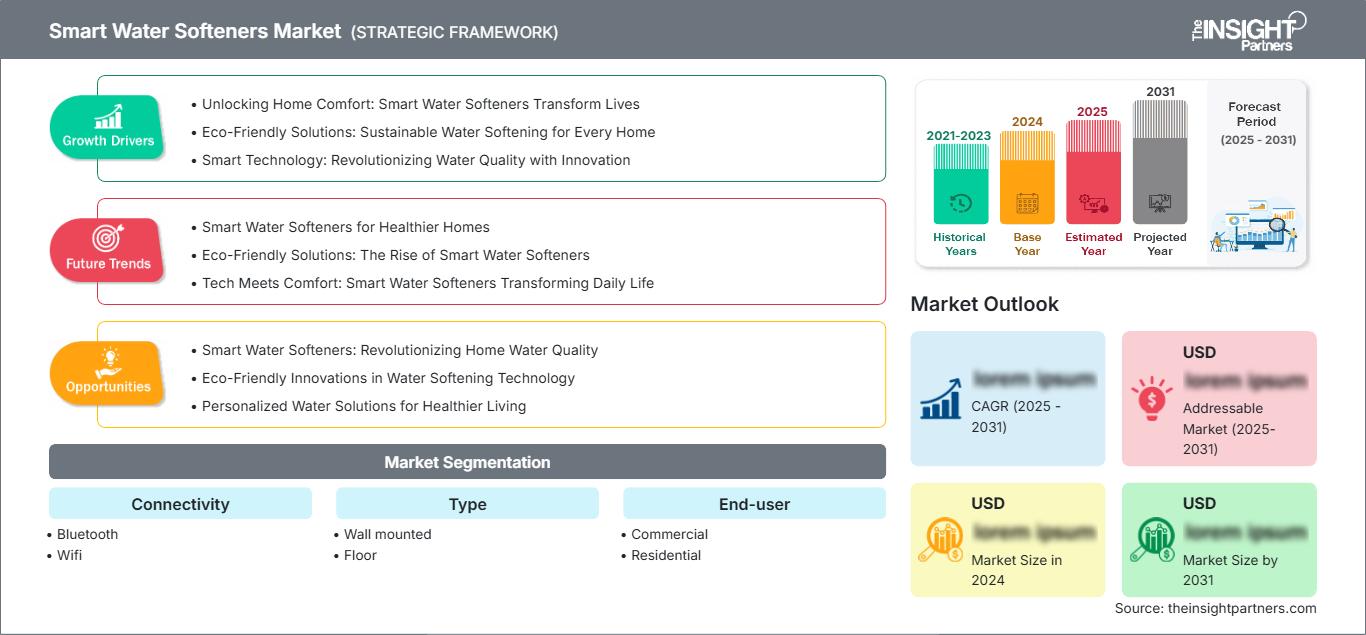
Smart Water Softeners Market: Strategic Insights
Regional Insights
North America Smart Water Softeners Market
North America is projected to hold a 34–38% share in 2025, supported by mature water-treatment infrastructure, extensive hard-water exposure, and established professional installation channels. The region is expected to expand at a 12.5–14.0% CAGR from 2026–2034. Residential replacement demand is reinforced by growing interest in connected home systems, while commercial users increasingly value monitoring capabilities that reduce manual inspection and unplanned service requirements.
According to the Smart Water Softeners Market forecast, the regional ecosystem is enhanced by good supplier and dealer networks, especially in the US and Canada. Smart control technology is now being marketed alongside filter technology, leak detectors, and whole home water management systems. Legislation pertaining to water efficiency and brine discharge also creates an environment that fosters more efficient operations for manufacturers, and they will work on enhancing the intelligence in their regeneration and monitoring technologies.
U.S. Smart Water Softeners Market
The U.S. accounts for 76–80% of North America's 2025 market, reflecting the country's established softener installed base and widespread hard-water exposure. It is expected to grow at a 12.8–14.2% CAGR from 2026–2034. According to the Water Quality Association, 54% of American households have employed at least one water treatment product in 2025. Moreover, the sales of whole house systems and water softeners have increased by 16%.
The company is operating in different segments such as appliances, water treatment products, and speciality channel. The General Electric Company has introduced its smart water treatment products by introducing app-based monitoring and remote shut-off facility. The applications are getting concentrated in premium residential installations, new constructions, and light commercial buildings due to the utility of the above-mentioned facilities.
Europe Smart Water Softeners Market
Europe is estimated at a 24–28% share in 2025 and is expected to expand at a 12.0–13.5% CAGR from 2026–2034. The reasons for Germany being an important reference market include treatment practices and requirements of water treatment in industries. The UK also stands out due to continued demand, enabled by hard water in large population areas, and domestic treatment channel. Thus, Germany and the UK will continue to be considered important reference markets for connected residential appliances.
Other potential areas of development include the markets of France, Italy, and Spain, where growth will be possible due to residential replacements, hospitality, and water efficiency. In France, there is already some treatment demand for hard water, while in Italy and Spain – opportunities related to water management at home and in businesses. In Europe, such companies as BWT Holding GmbH and others specializing in treatment will take advantage of existing channel relationships.
APAC Smart Water Softeners Market
The Smart Water Softeners Market report shows that APAC is estimated to represent a 21–25% share in 2025 and is projected to grow at a 14.0–15.5% CAGR from 2026–2034, making it one of the fastest-expanding regions. China leads regional scale, while Japan, South Korea, India, and Australia offer distinct residential and commercial opportunities. Urbanization and rising awareness of water quality are expanding the addressable customer base.
Industrial water requirements, smart-home adoption, and government attention to water efficiency support investment. India presents particularly strong potential as organized distribution and connected-home demand expand; South India represented 32.0% of India's broader water-softener market in 2025, reflecting significant hardness-related demand.
Middle East & Africa Smart Water Softeners Market
Middle East & Africa is expected to grow at a 10.5–12.5% CAGR from 2026–2034, supported by water scarcity, desalination-linked infrastructure, hospitality development, and premium residential construction. Saudi Arabia and the UAE represent leading Gulf opportunities, while South Africa provides an important sub-Saharan market with established water-treatment requirements and distribution capabilities.
Regional demand in the Smart Water Softeners Market is increasingly connected to infrastructure efficiency rather than appliance replacement alone. Hotels, commercial facilities, and residential developments can benefit from monitoring that helps control water consumption and maintenance. Saudi Arabia is positioned as the leading regional market, while the UAE offers strong premium-property applications. Energy-intensive water infrastructure also increases the strategic value of efficient regeneration and digitally managed treatment cycles.
Segmentation Analysis
Connectivity
Connectivity is projected to expand at a 14.0–16.0% CAGR from 2026–2034 as users increasingly expect remote monitoring, alerts, and automated operating controls. Wi-Fi-enabled systems provide broader integration with cloud platforms and smart-home ecosystems, while Bluetooth supports direct local control. The segment's strategic importance is increasing because connectivity transforms softeners from standalone appliances into monitored water-management assets.
- Bluetooth: Bluetooth systems offer direct device-to-phone communication and can simplify commissioning, diagnostics, and localized monitoring. Their lower dependence on cloud infrastructure makes them useful where users prioritize straightforward control, privacy, or limited connectivity requirements.
- Wifi: Wifi systems provide broader remote access, cloud connectivity, alerts, usage monitoring, and integration with smart-home platforms. Their ability to support continuous oversight makes them increasingly important for premium residential and professional service models.
Type
Type is expected to register a 12.0–13.5% CAGR from 2026–2034. Floor-mounted systems remain the principal configuration because they accommodate larger capacities and conventional installation layouts, particularly in dedicated utility areas. Wall-mounted products address space-constrained applications and can benefit from compact housing requirements. Manufacturers are balancing capacity, footprint, installation flexibility, and access for maintenance when designing new connected models.
- Wall mounted: Wall mounted systems address properties where floor space is constrained and compact equipment is preferred. Their strategic value is strongest in urban apartments, retrofit projects, and installations requiring efficient use of utility-room or service-wall space.
- Floor: Floor systems retain broad market acceptance because conventional residential and commercial installations often provide dedicated equipment areas. Their capacity and service accessibility make them particularly suitable for higher-throughput applications and replacement of established softening equipment.
End-user
End-user demand is projected to rise at a 13.0–15.0% CAGR from 2026–2034, with residential adoption providing scale and commercial properties supporting higher-value installations. Connected features can reduce manual checks and support proactive service, making them relevant to both homeowners and facility operators. Demand is increasingly influenced by total lifecycle economics rather than purchase price alone, especially where water and salt efficiency can reduce operating costs.
- Commercial: Commercial users include hospitality, healthcare, offices, and other properties requiring consistent water quality. Their demand emphasizes capacity, reliability, service responsiveness, and operational monitoring, creating opportunities for connected systems that support maintenance planning and resource control.
- Residential: Residential users remain central to market expansion because connected softeners address everyday hard-water concerns while adding convenience through alerts, usage information, and remote control. Smart-home integration can strengthen adoption among premium and digitally engaged households.
Opportunity Snapshot
| End Users | Revenue Contribution (High/Medium/Low) | Trend Tag (MAX 2 words) | Adoption Stage (Emerging/Scaling/Mature) |
|---|---|---|---|
| Commercial | Medium | Facility Monitoring | Scaling |
| Residential | High | Smart Homes | Scaling |
Smart Water Softeners Market Growth Drivers and Impact Analysis
Hard-water damage and whole-home treatment adoption
The presence of minerals in water provides a continual economic justification for filtration due to the formation of scale that may impact pipes, water heater, appliances, cleaning ability, and maintenance schedules. This value proposition goes beyond water quality as intelligent softeners can be sold as devices for the protection of the property. In the US, 85% of households have hard water, making a significant opportunity for the substitution and upgrade of this device. Smart controls enhance the value proposition as they allow consumers to control the flow and detect any unusual water use as well as provide servicing reminders. As people start to control several interconnected devices through their mobile phone, intelligent softeners with the same interface can get more recognition at the moment of substitution.
Water-efficiency requirements favor demand-based regeneration
Water scarcity and higher importance in resource management are affecting how the treatment system is being analyzed. Traditional timed regeneration doesn’t need to account for exact consumption in the household, while demand regeneration systems do take consumption into consideration. There is, therefore, an engineering motive to develop the technology related to sensors, control methods, and valves. As a result, manufacturers consider efficiency to be an integral component of their development process instead of an additional one. It will also allow smart monitoring to generate information that could help identify issues in consumption or operation of the system. In the long run, these technologies might start to affect decision-making of business customers managing facilities that use much water, and have to maintain predictability of operating costs.
Integration of water treatment with connected property management
The boundaries between individual water-treatment appliances and broader property-management systems are narrowing. Smart valves, leak detection, remote shutoff, usage analytics, and mobile notifications allow a softener to participate in a wider risk-management architecture. This integration increases the potential value of connected equipment because a single sensor event can trigger an action beyond regeneration or salt management. GE Appliances' connected softener, for example, combines water-flow monitoring, leak detection, remote shutoff, and smartphone alerts. As similar functionality becomes more familiar, buyers may increasingly compare systems based on interoperability, data visibility, and service responsiveness. Suppliers that can integrate treatment equipment with existing smart-home or professional monitoring ecosystems can therefore strengthen their strategic position without relying solely on hardware differentiation.
Smart Water Softeners Market Future Trends
Predictive treatment management and software-led differentiation
Predictive management is likely to become a defining direction as connected softeners accumulate operating data from flow, regeneration, salt levels, and system diagnostics. Rather than merely reporting on the occurrence of certain conditions, future platforms will be able to detect patterns that are associated with abnormal consumption, inefficient regeneration, or the need for servicing. That opens up possibilities for creating ongoing software and maintenance business models for the equipment already installed. The change in direction will mean a shift in priorities when it comes to developing products, as there will be more of an emphasis placed on robust firmware, data infrastructure, cybersecurity, and updates. With the use of connected water treatment becoming a feature of smart property systems, companies may seek to stand out by means of their algorithmics and service processes instead of valve hardware alone.
Modular whole-home water platforms
The future architectural design of products would entail the integration of functionalities such as softening, filtration, leak prevention, monitoring, and other management functions in a coherent architecture. The modular approach of product architecture could help with easy installation of the system, and at the same time customers could choose to include functionalities based on their property needs and budget. Product architecture can also lead to the formation of more sustained relationships between manufacturers, dealers, and end-users, as consumables, maintenance, software and other components would be incorporated into a coherent lifecycle process. For builders and professionals in installation, modules would simplify the configuration process in different installations. For end-users, a single interface for managing water treatment systems would make things easy.
Smart Water Softeners Market Opportunities
Connected retrofit programs through professional installer networks
A significant opportunity lies in converting the installed base of conventional softeners through structured retrofit programs. Dealers and plumbing professionals already possess customer relationships, installation expertise, and maintenance records that can support targeted upgrades. Rather than requiring complete replacement in every case, manufacturers can develop compatible control modules, valves, sensors, or packaged systems that introduce monitoring capabilities during routine service events. This approach can reduce customer acquisition costs while creating a predictable path from conventional equipment to connected treatment. Suppliers can support adoption through installer training, standardized commissioning procedures, financing options, and service subscriptions. The opportunity is particularly attractive in mature markets where replacement demand is steady and customers increasingly expect connected functionality from household equipment. A retrofit strategy can therefore expand smart adoption without depending exclusively on new-home construction.
Commercial water-management partnerships
Commercial properties offer an opportunity to position smart softeners as components of broader facility-efficiency programs. Hotels, healthcare facilities, multi-family housing, food-service operations, and offices can benefit from centralized monitoring because equipment performance affects maintenance schedules, guest experience, and plumbing reliability. Suppliers can pursue partnerships with facility managers, property developers, water-service companies, and building-management integrators to establish standardized treatment specifications across portfolios. Data generated by connected equipment can also support service contracts based on equipment condition rather than fixed inspection intervals. For investors and manufacturers, this model creates potential recurring revenue from maintenance, consumables, software, and replacement equipment. Commercial deployment can additionally generate operational datasets that improve product engineering and predictive-service algorithms, strengthening the economics of connected platforms as adoption expands.
Recent Developments
- July 2026: American Home Water & Air today announced the introduction of The Governor, a new smart water softener designed to combine water treatment functionality with integrated leak detection capabilities. The launch marks an expansion of the company’s residential water treatment offerings and reflects a growing focus on solutions that address both water quality and household water management.
- July 2026: ANGEL Group has launched two new water treatment solutions in Thailand: the ANGEL Whole-House Mini Water Softener and the ANGEL Faucet Water Purifier. Developed to address common local water issues such as hard water and impurities, the products provide Thai households with convenient, efficient, and reliable water solutions. Both are available separately through HomePro and supported by installation and after-sales services from ANGEL's local trusted partner, Mazuma. The system combines ANGEL's dual enhanced softening system with a proprietary flat water distribution structure, achieving up to 99.8% softening efficiency while reducing salt and water consumption. A patented Smart Control Valve automatically optimizes regeneration based on household water usage, while high-performance DuPont resin delivers stable, long-lasting performance. By reducing hard water minerals, the system helps keep skin and hair softer, protects household appliances from scale buildup, and improves overall comfort in daily life.
- February 2025: GE Appliances Air & Water Solutions announced the launch of its new GE Profile Professional Smart Valve Water Softener. This all-in-one solution is designed for plumbing professionals to assist homeowners with better quality water by addressing the challenge of hard water, which impacts 85% of U.S. homes according to the U.S. Geological Survey.
Frequently Asked Questions

- Comprehensive Market Sizing and Forecast Analysis
- Detailed Segmentation Analysis
- In-Depth Market Dynamics Assessment
- Regional and Country-Level Insights
- Competitive Landscape and Company Benchmarking
- Strategic Business Intelligence
Recent Reports
Testimonials

The Insight Partners' SCADA System Market report is comprehensive, with valuable insights on current trends and future forecasts. The team was highly professional, responsive, and supportive throughout. We are very satisfied and highly recommend their services.
RAN KEDEM Partner, Reali Technologies LTDs
I requested a report on a very specific software market and the team produced the report in a few days. The information was very relevant and well presented. I then requested some changes and additions to the report. The team was again very responsive and I got the final report in less than a week.
JEAN-HERVE JENN Chairman, Future Analytica
We worked with The Insight Partners for an important market study and forecast. They gave us clear insights into opportunities and risks, which helped shape our plans. Their research was easy to use and based on solid data. It helped us make smart, confident decisions. We highly recommend them.
PIYUSH NAGPAL Sr. Vice President, High Beam Global
The Insight Partners delivered insightful, well-structured market research with strong domain expertise. Their team was professional and responsive throughout. The user-friendly website made accessing industry reports seamless. We highly recommend them for reliable, high-quality research services
YUKIHIKO ADACHI CEO, Deep Blue, LLC.
This is the first time I have purchased a market report from The Insight Partners.While I was unsure at first, I visited their web site and felt more comfortable to take the risk and purchase a market report.I am completely satisfied with the quality of the report and customer service. I had several questions and comments with the initial report, but after a couple of dialogs over email with their analyst I believe I have a report that I can use as input to our strategic planning process.Thank you so much for taking the extra time and making this a positive experience.I will definitely recommend your service to others and you will be my first call when we need further market data.
JOHN SUZUKI President and Chief Executive Officer, Board Director, BK Technologies
I wish to appreciate your support and the professionalism you displayed in the course of attending to my request for information regarding to infectious disease IVD market in Nigeria. I appreciate your patience, your guidance, and the fact that you were willing to offer a discount, which eventually made it possible for us to close a deal. I look forward to engaging The Insight Partners in the future, all thanks to the impression you have created in me as a result of this first encounter.
DR CHIJIOKE ONYIA MANAGING DIRECTOR, PineCrest Healthcare Ltd.Reason to Buy
- Informed Decision-Making
- Understanding Market Dynamics
- Competitive Analysis
- Identifying Emerging Markets
- Customer Insights
- Market Forecasts
- Risk Mitigation
- Boosting Operational Efficiency
- Strategic Planning
- Investment Justification
- Tracking Industry Innovations
- Aligning with Regulatory Trends





 Get Free Sample for