
Streaming Devices Market Growth, Share & Trends by 2034
Coverage: By Device Type (Streaming Box/Stick, Smart TV, Game Console); Resolution Type (4K UHD, 1080p, 720p); Application (Gaming, Streaming audio/video, E-Learning) , and Geography (North America, Europe, Asia Pacific, and South and Central America)
- Status : Data Released
- Report Code : TIPRE00010782
- Category : Electronics and Semiconductor
- No. of Pages : 150
- Available Report Formats :


- Last update date : November 02, 2026


2025 Market Size
US$ 18.79 Bn
Base year value
2034 Forecast
US$ 43.93 Bn
Projected by 2034
CAGR 2026-2034
11.20 %
Growth rate
Addressable Market
US$ 298.46 Bn
(2026-2034)
The Streaming Devices Market generated an estimated global market size of US$ 18.79 Billion in 2025 and is projected to reach US$ 43.93 Billion by 2034, expanding at a CAGR of 11.20% from 2026 to 2034. The market encompasses dedicated streaming hardware, connected smart televisions, and game consoles that enable digital video, audio, gaming, and learning experiences through internet-connected displays and home entertainment systems.
The Streaming Devices Market size in North America is supported by high household connectivity, established paid streaming penetration, and frequent replacement of connected entertainment hardware. The region is expected to expand at a modeled CAGR of ~9% through 2034, with demand increasingly shifting toward integrated smart TV platforms, higher-resolution displays, advertising-supported streaming interfaces, and devices that combine entertainment with gaming and smart-home functionality.
Streaming Devices Market Assessment and Insights
Regional Outlook
- North America: ~36% of the global market in 2025 | ~9% CAGR through 2034. Market position: North America remains the largest regional market, supported by mature broadband infrastructure, high connected-TV penetration, established streaming ecosystems, and recurring replacement demand for smart televisions and dedicated streaming players.
- US: ~82% of North American market revenue in 2025 | ~9% CAGR through 2034. Market position: The US represents the principal demand center within North America, supported by extensive streaming adoption, strong platform competition, and broad use of smart TVs, streaming sticks, game consoles, and premium connected-TV services.
- Europe: ~27% of the global market in 2025 | ~9% CAGR through 2034. Market position: Europe is a mature connected-entertainment market where replacement cycles and migration toward internet-based television support demand. Germany, the UK, France, Italy, and Spain are major markets, with the UK representing the leading country in Europe.
- Asia Pacific: ~29% of the global market in 2025 | ~11% CAGR through 2034. Market position: Asia Pacific is the fastest-growing major region, supported by expanding broadband access, rising smart-TV ownership, local streaming services, and increasing availability of competitively priced 4K devices. China is the leading country in Asia Pacific.
Segment Outlook
- Smart TV: ~58% Share in 2025 | ~9% CAGR through 2034. Market position: Smart TVs lead because streaming functionality is increasingly integrated directly into television operating systems, reducing the need for separate hardware while combining content discovery, applications, advertising, gaming, and smart-home functions.
- Application: ~46% Share in 2025 | ~11% CAGR through 2034. Market position: Application is the high-growth main segment as streaming devices increasingly support multiple use cases beyond conventional video, including cloud gaming, music and podcasts, remote learning, and interactive digital content.
Competitive Coverage
Amazon.com, Inc., Apple Inc., Azulle, Google LLC, LG Electronics Inc., Microsoft Corporation, NVIDIA Corporation, Roku, Inc., Samsung Electronics Co., Ltd., Sony Corporation
Methodology
The Insight Partners follows Data Collection & Secondary Research, Primary Research, Data Analysis, and Data Triangulation & Final Review to validate market estimates and insights.
Source: The Insight Partners' analysis based on proprietary research, government publications, company annual reports, investor presentations, industry databases, and expert interviews.
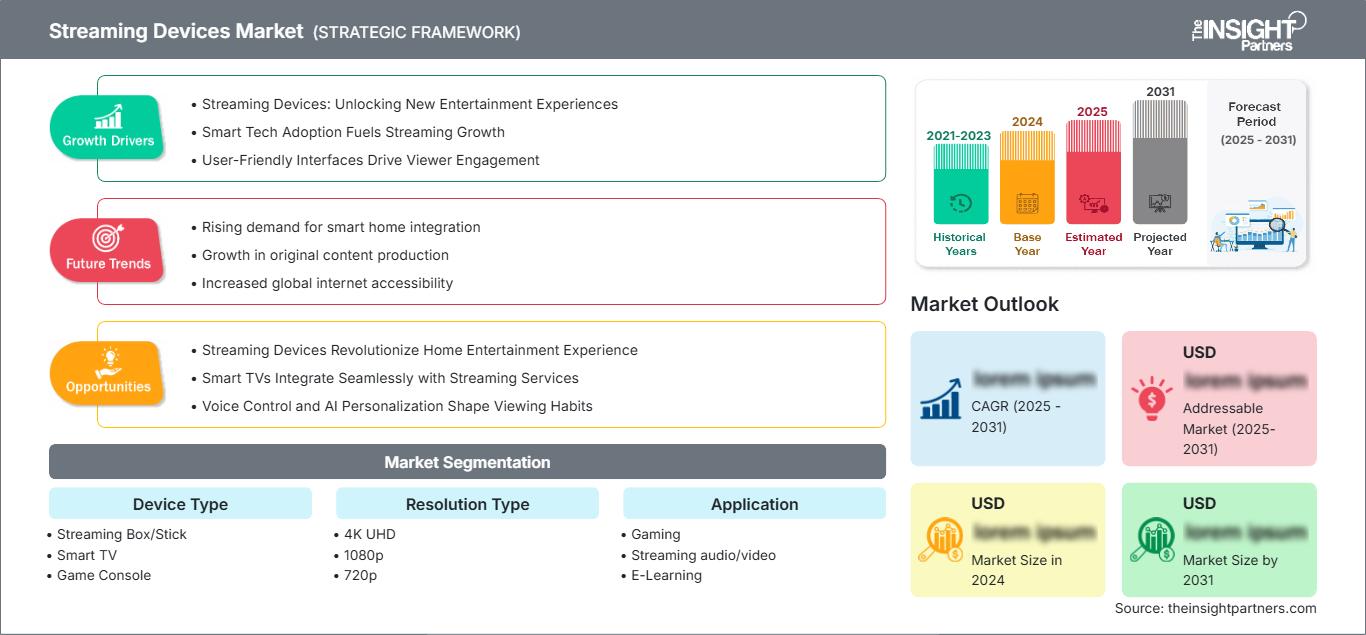
In the Streaming Devices Market, the focus has shifted from simple media players intended to provide internet videos to an ecosystem that provides entertainment services connected to one another. While the early generation of devices provided users with application access and HD content playback, the latest versions of such devices integrate features like 4K HDR, voice commands, discovery, gaming, smart home, and advertising-supported content. Furthermore, smart TVs have integrated the functionalities provided by sticks and boxes that are external, whereas the game consoles have become multipurpose entertainment systems. In this way, competition among the device manufacturers involves hardware, software, application ecosystem, partnerships, advertising, and user engagement.
In the future, development in the market would involve the integration of television, gaming, audio, education, and connected-home services. New markets available in the region of Asia Pacific and some economies in the Middle East could help in providing opportunities for adoption of smart TV and deployment of affordable streaming sticks. There would be investments made in the development of software that could help in improving search, recommendations, personalization, and monetization of content. Digital advertising, privacy, accessibility, platform competition, low cost of components, and wide availability of 4K content are also important.
Streaming Devices Market Report Scope
| Report Attribute | Details |
|---|---|
| Market size in 2025 | US$ 18.79 Billion |
| Market Size by 2034 | US$ 43.93 Billion |
| Global CAGR (2026 - 2034) | 11.20% |
| Historical Data | 2021-2024 |
| Forecast period | 2026-2034 |
Streaming Devices Market Analysis
Demand is driven by the move from linear television to on-demand and internet-enabled forms of entertainment, along with consumer preference for having access to all services in one place. Enhanced display quality, voice control, personalized recommendation, cloud gaming, and free television enabled through advertisements have made the connected screen more functionally valuable. The Streaming Devices Market thus sees demand coming not just from new connectivity but also from replacement demand, with consumers updating their old TVs with new technology or adding streaming sticks to increase the longevity of their display devices.
The ecosystem includes semiconductor makers, display makers, operating systems vendors, device makers, application developers, content service providers, advertisers, broadband providers, retailers, and consumers. The supply strategy has moved towards focusing on system-on-chip efficiency, WiFi performance, memory size, operating system performance, and the integration of content services. The smart TV makers derive their value proposition from hardware and software integration, while streaming stick providers create value with hardware integration. This has created a value chain that feeds on itself.
Strategic Competitions in the Streaming Devices Market Report are shifting towards platform ecosystems and away from mere hardware configurations. Amazon.com, Inc. uses its Fire TV hardware, Alexa, and overall content ecosystem, while Roku, Inc. focuses on its operating system, streaming players, smart-TV licensing, and advertising platform. Google LLC has its Google TV integrated with search engines, recommendations, smart-home features, and Android ecosystem. Apple Inc. has positioned Apple TV around premium hardware, services, and the Apple device ecosystem.
Samsung Electronics Co., Ltd. and LG Electronics Inc. compete through their established bases of smart TVs and their own television platforms, whereas Sony Corporation has its premium television hardware with connected entertainment and gaming options. Microsoft Corporation extends the gaming experience to connected screens through its cloud-based Xbox services, and NVIDIA Corporation has focused on performance-oriented consumers through SHIELD TV and cloud gaming. Azulle is specialized in streaming and compact computing applications.
● REPORT CUSTOMIZATION
Tailor This Report To Align With Your Specific Business Requirements
This report can be customized to align precisely with your business objectives, scope, and target markets. Customization options include tailored segmentation, geography, competitive analysis, and strategic insights to support informed decision-making.
Customize This Report →WHAT YOU CAN ADJUST
- ● Segmentations
- ● Geography
- ● Competitive Analysis
- ● Language Preferences
Streaming Devices Market: Strategic Insights
Regional Insights
North America Streaming Devices Market
North America represents the largest regional market, with a modeled ~9% CAGR through 2034. The region benefits from mature broadband networks, extensive streaming service availability, established connected-TV ownership, and high consumer familiarity with dedicated streaming hardware. Replacement demand is also important because users frequently upgrade devices to obtain faster interfaces, better wireless connectivity, higher resolution, or access to newer applications.
The largest share of regional demand comes from the US market, whereas Canada helps add value through the adoption of streaming and high connectivity of households. The rivalry between platforms continues to be strong within smart TVs, streaming sticks, boxes, and game consoles. More integration of services that are supported by ads offers another source of value due to the ability to monetize viewer activity rather than hardware sales. This is why growth will be driven not by adoption, but by replacements and other factors.
U.S. Streaming Devices Market
North America accounts for ~82% of revenues in the United States by 2025, and is predicted to grow at a projected ~9% CAGR through 2034. This is driven by high penetration levels of connected entertainment, highly competitive market landscape with platforms including Roku, Amazon, Apple, Samsung, Google, LG, etc., and presence of multiple streaming services. Smart TVs are increasingly being used as the entry point to watch videos, and dedicated players are useful in situations where users need particular operating systems or cost-effective solutions.
Moreover, streaming is not limited to videos alone. Other uses such as cloud gaming, music, podcasts, sports, ad-supported free channels, and educational purposes provide further motivation to use connected entertainment devices. Companies including Roku, Inc., Amazon.com, Inc., Apple Inc., Google LLC, Samsung Electronics Co., Ltd., LG Electronics Inc., Microsoft Corporation, NVIDIA Corporation, and Sony Corporation have their share of involvement in this ecosystem either via hardware, operating systems, applications, services, or gaming platforms.
Europe Streaming Devices Market
Europe comprised ~27% of the Streaming Devices Market Share in 2025 and is expected to grow at a CAGR of ~9% through 2034. Europe possesses both the advantage of well-developed television ownership along with rapidly growing internet-based TV distribution, resulting in a replacement-driven demand environment. The UK ranks as the top country in Europe due to high streaming adoption rates and presence of well-established connected-TV ecosystem. Germany ranks as another significant market on the basis of the size of its household population and growing adoption of connected TV technology.
France derives its strength from broad availability of broadband connectivity and demand for subscription and on-demand video. Italy and Spain enjoy the support of rising streaming consumption and upgrading from traditional television to connected television technologies. 4K television, integrated application stores, voice interfaces, and free-ad-supported content drive regional demand. The presence of terrestrial, satellite, cable, IPTV, and streaming delivery options also offers multiple upgrade paths. Hence, manufacturers will have to tailor their interfaces, language offerings, content arrangements, and business models according to each specific national market.
APAC Streaming Devices Market
Asia Pacific accounts for ~29% of the global market in 2025 and is expected to grow at a modeled ~11% CAGR through 2034, making it the fastest-growing major region. China is the leading country in Asia Pacific, supported by a large consumer-electronics manufacturing base, extensive domestic content ecosystems, and substantial demand for connected displays.
Japan and South Korea combine advanced consumer-electronics industries with high-quality home entertainment requirements, while India offers significant incremental adoption potential because of expanding broadband availability, affordable smart televisions, and localized streaming services. Australia has a mature connected-TV ecosystem and strong streaming usage. Across the region, local manufacturing, lower device prices, mobile-first consumer behavior, and integration of regional applications support demand. Increasing deployment of 4K televisions and affordable streaming sticks should further broaden access beyond premium households.
Middle East & Africa Streaming Devices Market
The Middle East & Africa region is expected to expand at a modeled ~10% CAGR through 2034. Saudi Arabia and the UAE represent important markets in the Middle East because of high purchasing power, digitally oriented consumers, extensive entertainment investment, and rapid development of modern residential and hospitality infrastructure. South Africa provides an important sub-Saharan demand center supported by established broadband and digital entertainment adoption.
The wider region offers longer-term potential as internet connectivity improves and affordable smart TVs become more widely available. Streaming hardware can provide an accessible route to digital entertainment where legacy television infrastructure is fragmented. Energy-efficient televisions, compact streaming sticks, local-language content, and regional application support can strengthen adoption. Hospitality, residential development, and entertainment investments also create institutional demand for connected screens, particularly where operators seek centralized access to digital content and interactive services.
Segmentation Analysis
Device Type
The Device Type segment is expected to expand at a modeled ~9% CAGR from 2026 to 2034. Smart TVs represent the largest device category because streaming capabilities are increasingly embedded directly into television operating systems. Streaming boxes and sticks remain important where consumers want to upgrade legacy televisions, change operating platforms, or obtain lower-cost access to connected services. Game consoles contribute through multifunctional entertainment and cloud-gaming capabilities.
- Streaming Box/Stick: Streaming boxes and sticks remain strategically important because they can convert conventional televisions into connected displays without requiring full television replacement. Demand is supported by affordable hardware, simple installation, portability, platform-specific interfaces, and access to expanding application and content libraries.
- Smart TV: Smart TVs hold the strongest position because connectivity is increasingly included as a standard television feature. Integrated operating systems simplify content discovery, application access, advertising, gaming, and smart-home control, making the category central to long-term platform competition.
- Game Console: Game consoles serve as multifunctional entertainment hubs that combine gaming with video and audio streaming. Their strategic importance is increasing as cloud gaming and cross-device services allow users to access broader content libraries without relying exclusively on dedicated gaming hardware.
Resolution Type
The Resolution Type segment is projected to grow at a modeled ~10% CAGR through 2034. Demand is shifting toward higher-resolution content as 4K televisions become more accessible and streaming services expand premium picture-quality offerings. Resolution is increasingly connected with HDR, larger screen sizes, image processing, and premium viewing experiences rather than operating as an isolated hardware specification.
- 4K UHD: 4K UHD is positioned as the mainstream premium resolution for connected home entertainment. Its adoption is supported by falling display costs, broader availability of compatible content, larger television sizes, improved image processing, and consumer preference for sharper visuals across movies, sports, gaming, and educational video.
- 1080p: 1080p remains relevant in entry and mid-tier applications, particularly where consumers prioritize affordability or use smaller displays. The category continues to support cost-sensitive replacement purchases and streaming upgrades where 4K capability is not a primary purchasing criterion.
- 720p: 720p occupies a more limited position and is primarily relevant in older displays, low-cost applications, and markets where affordability remains the principal consideration. Its strategic role is increasingly linked to extending the life of legacy television hardware through inexpensive connected devices.
Application
The Application segment in the Streaming Devices Market is expected to expand at a modeled ~11% CAGR through 2034, making it the high-growth main segment. Streaming video remains the core use case, but gaming, music, podcasts, and digital learning are broadening the value proposition of connected screens. Platform providers increasingly design interfaces to support multiple content formats within one ecosystem.
- Gaming: Gaming is gaining strategic importance as cloud gaming enables compatible televisions and streaming devices to function as access points for game libraries. The convergence of streaming hardware, controllers, cloud infrastructure, and subscription services can reduce dependence on dedicated gaming hardware for selected use cases.
- Streaming audio/video: Streaming audio/video remains the principal application because consumers increasingly expect on-demand access to movies, television, live events, music, podcasts, and other digital media. Platform integration, recommendation engines, advertising-supported services, and subscription aggregation reinforce its central role.
- E-Learning: E-Learning provides an expanding secondary use case as connected televisions become larger interactive screens for educational videos, tutorials, language learning, demonstrations, and family-oriented educational content. Voice search and AI-assisted discovery can make television-based learning more accessible to households.
Opportunity Snapshot
| Application | Revenue Contribution | Trend Tag | Adoption Stage |
| Gaming | Medium | Cloud Gaming | Scaling |
| Streaming audio/video | High | Multi-Service Streaming | Mature |
| E-Learning | Low | Large-Screen Learning | Emerging |
Streaming Devices Market Growth Drivers and Impact Analysis
Expansion of Connected-TV and Platform-Based Entertainment
The transition from channel-based television toward application-driven entertainment is strengthening demand for connected screens and supporting hardware. Consumers increasingly expect a single interface to aggregate subscription services, free channels, live programming, music, and personalized recommendations. This changes the economics of the device category because hardware becomes the entry point into recurring software and service engagement. Manufacturers can therefore differentiate through operating-system functionality, content discovery, advertising interfaces, voice control, and cross-device integration rather than relying only on processor speed or industrial design. The impact is particularly significant for smart TVs, where connectivity is increasingly embedded at the point of purchase. Dedicated streaming sticks and boxes continue to benefit from households seeking an affordable upgrade path for older displays.
Falling Hardware Costs and Broader 4K Accessibility
Declining component costs and increased manufacturing scale are improving access to connected television products across developed and emerging markets. More affordable system-on-chip solutions, wireless connectivity, memory, and display technologies allow manufacturers to add streaming functionality without proportionally increasing retail prices. At the same time, 4K displays are moving beyond premium television categories, creating greater compatibility between streaming hardware and higher-resolution content. This mechanism supports both new household adoption and replacement demand. In emerging economies, inexpensive streaming sticks can extend the useful life of existing televisions, while in mature markets consumers can replace older connected products with faster interfaces and improved picture quality. The resulting upgrade cycle expands the addressable installed base for platform providers.
Convergence of Streaming, Gaming, and Smart-Home Functions
Connected screens are increasingly becoming multifunctional control points rather than devices used solely for watching television. Cloud gaming enables selected smart TVs and streaming hardware to access games without a dedicated console, while smart-home integrations allow users to control cameras, lighting, thermostats, and other devices from the television interface. This convergence increases the functional value of connected hardware and creates opportunities for technology companies to integrate entertainment, commerce, advertising, and home automation. It also increases competitive intensity because companies from gaming, consumer electronics, cloud services, and digital advertising increasingly overlap. For consumers, multifunctionality can reduce the need for separate devices, while vendors gain additional opportunities to monetize engagement through applications, subscriptions, advertising, and ecosystem services.
Streaming Devices Market Future Trends
AI-Driven Content Discovery and Personalized Television Interfaces
Artificial intelligence in the Streaming Devices Market Trends is expected to become a more visible component of television interfaces through conversational search, personalized recommendations, automatic content summaries, and adaptive home screens. Instead of navigating individual applications separately, users may increasingly describe the type of content they want and receive recommendations across multiple services. AI can also support household-specific profiles, content discovery for children, accessibility functions, and contextual recommendations based on viewing patterns. The strategic implication is that operating systems and interface providers may gain greater influence over content discovery than individual applications. Device manufacturers that integrate AI at the system level can differentiate otherwise similar hardware, while service providers will need stronger metadata, recommendation, and interoperability capabilities to remain discoverable within aggregated television environments.
Television as a Unified Digital Entertainment and Commerce Hub
The next stage of connected television development is likely to broaden the role of the screen from passive entertainment toward a unified digital environment. Streaming interfaces can combine live channels, on-demand video, gaming, music, social features, smart-home controls, and selected commerce experiences. Free ad-supported services can increase the amount of content available without direct subscription payments, while targeted advertising provides platform operators with an alternative monetization stream. Large-screen short-form video, interactive advertising, and connected shopping experiences could further increase engagement. The development of these capabilities will depend on privacy standards, consumer acceptance, platform interoperability, and network performance. Vendors with established operating systems and large installed bases are positioned to benefit from these ecosystem effects.
Streaming Devices Market Opportunities
Affordable Connected-TV Upgrades in Emerging Markets
Emerging markets provide an opportunity to expand the installed base through affordable streaming sticks, entry-level smart TVs, and localized software experiences. Many households can gain connected functionality without immediately replacing an otherwise functional television, creating a practical route to first-time streaming adoption. Vendors can strengthen this opportunity through local-language interfaces, regional payment methods, locally relevant content aggregation, and partnerships with broadband operators. India and Southeast Asian markets are particularly relevant because a combination of expanding connectivity, large consumer populations, competitive electronics manufacturing, and growing digital entertainment consumption supports scalable distribution. Retail bundles combining broadband, streaming subscriptions, and hardware can further reduce adoption barriers while providing platform providers with recurring customer relationships.
Integrated Gaming and Entertainment Ecosystems
Gaming provides an opportunity to increase the value of connected screens by extending their use beyond conventional streaming. Cloud gaming can allow compatible televisions and streaming devices to access game libraries through subscription services, reducing the hardware requirements for selected gaming experiences. Device manufacturers can capitalize by supporting low-latency connectivity, controller compatibility, gaming interfaces, and cloud-service integration. Partnerships among television manufacturers, cloud providers, game publishers, and platform operators can create differentiated bundles. The Streaming Devices Market Forecast opportunity is also relevant to households that already own smart TVs but do not want to purchase a separate console. As gaming and video become more closely integrated, the television operating system can become a common distribution layer for multiple forms of digital entertainment.
Recent Developments
- May 2026: Amazon.com, Inc. launched the all-new Fire TV Stick HD in India, positioning it as a faster and more portable HD streaming device. The product provides full-HD streaming with Wi-Fi 6 and was introduced at ₹4,999. Amazon stated that the new device delivers more than 30% faster average performance than the previous generation, reinforcing its focus on affordable streaming upgrades.
- April 2026: Google LLC announced new Google TV capabilities designed to make the television a more personalized and interactive screen. The updates include AI-enabled image and video creation, Google Photos features, dynamic slideshows, and an upcoming personalized short-video area featuring YouTube Shorts. The development expands the role of Google TV beyond conventional content discovery.
- November 2025: LG Electronics Inc. expanded LG Channels with a new identity, refined user interface, and advanced personalization. The company stated that LG Channels had expanded to 33 countries and offered more than 4,000 channels through the LG Smart TV ecosystem. The development illustrates the increasing importance of integrated FAST services and personalized content discovery within smart-TV platforms.
Frequently Asked Questions

- Comprehensive Market Sizing and Forecast Analysis
- Detailed Segmentation Analysis
- In-Depth Market Dynamics Assessment
- Regional and Country-Level Insights
- Competitive Landscape and Company Benchmarking
- Strategic Business Intelligence
Recent Reports
Testimonials

The Insight Partners provided valuable market intelligence that supported our global go-to-market strategy. Their team was professional, responsive, and attentive to our feedback, providing thoughtful analysis and helpful methodological clarifications throughout the project.
Junmo Kim Chief Financial Officer (CFO), Enertech Co., Ltd.
The Insight Partners' SCADA System Market report is comprehensive, with valuable insights on current trends and future forecasts. The team was highly professional, responsive, and supportive throughout. We are very satisfied and highly recommend their services.
RAN KEDEM Partner, Reali Technologies LTDs
I requested a report on a very specific software market and the team produced the report in a few days. The information was very relevant and well presented. I then requested some changes and additions to the report. The team was again very responsive and I got the final report in less than a week.
JEAN-HERVE JENN Chairman, Future Analytica
We worked with The Insight Partners for an important market study and forecast. They gave us clear insights into opportunities and risks, which helped shape our plans. Their research was easy to use and based on solid data. It helped us make smart, confident decisions. We highly recommend them.
PIYUSH NAGPAL Sr. Vice President, High Beam Global
The Insight Partners delivered insightful, well-structured market research with strong domain expertise. Their team was professional and responsive throughout. The user-friendly website made accessing industry reports seamless. We highly recommend them for reliable, high-quality research services
YUKIHIKO ADACHI CEO, Deep Blue, LLC.
This is the first time I have purchased a market report from The Insight Partners.While I was unsure at first, I visited their web site and felt more comfortable to take the risk and purchase a market report.I am completely satisfied with the quality of the report and customer service. I had several questions and comments with the initial report, but after a couple of dialogs over email with their analyst I believe I have a report that I can use as input to our strategic planning process.Thank you so much for taking the extra time and making this a positive experience.I will definitely recommend your service to others and you will be my first call when we need further market data.
JOHN SUZUKI President and Chief Executive Officer, Board Director, BK Technologies
I wish to appreciate your support and the professionalism you displayed in the course of attending to my request for information regarding to infectious disease IVD market in Nigeria. I appreciate your patience, your guidance, and the fact that you were willing to offer a discount, which eventually made it possible for us to close a deal. I look forward to engaging The Insight Partners in the future, all thanks to the impression you have created in me as a result of this first encounter.
DR CHIJIOKE ONYIA MANAGING DIRECTOR, PineCrest Healthcare Ltd.Reason to Buy
- Informed Decision-Making
- Understanding Market Dynamics
- Competitive Analysis
- Identifying Emerging Markets
- Customer Insights
- Market Forecasts
- Risk Mitigation
- Boosting Operational Efficiency
- Strategic Planning
- Investment Justification
- Tracking Industry Innovations
- Aligning with Regulatory Trends





 Get Free Sample for