
Supply Chain Security Market Size, Share & Demand by 2034
Supply Chain Security Market Size and Forecasts (2021 - 2034), Global and Regional Share, Trends, and Growth Opportunity Analysis Report Coverage : By Component (Hardware, Software, Services), Security Type (Data Locality and Protection, Data Visibility and Governance, Others), Organization Size (SMEs, Large Enterprises), Application (Healthcare & Pharmaceuticals, FMCG, Chemicals, Retail and Ecommerce, Others)
- Status : Data Released
- Report Code : TIPRE00039642
- Category : Technology, Media and Telecommunications
- No. of Pages : 150
- Available Report Formats :


- Last update date : August 06, 2026


2025 Market Size
US$ 2.91 Bn
Base year value
2034 Forecast
US$ 8.14 Bn
Projected by 2034
CAGR 2026-2034
12.12 %
Growth rate
Addressable Market
US$ 48.45 Bn
(2026-2034)
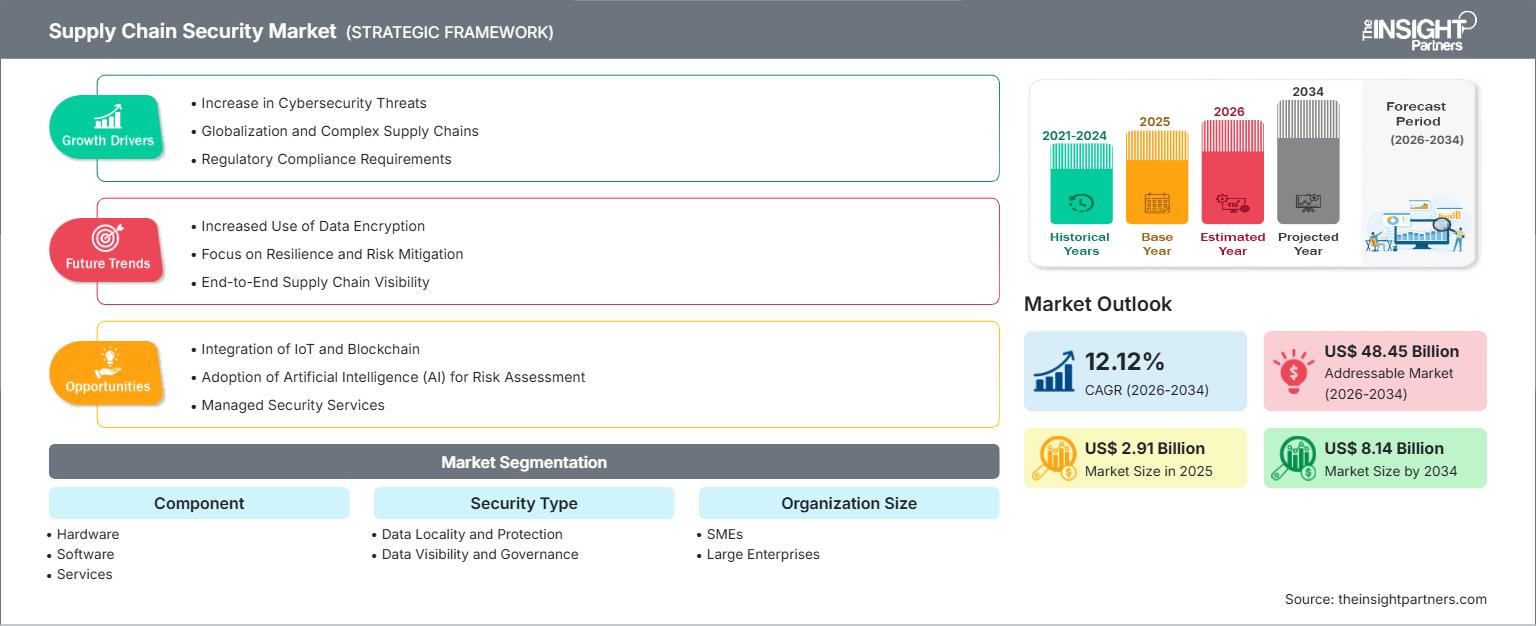
The supply chain security market was valued at US$ 2.91 Billion in 2025 and is projected to reach US$ 8.14 Billion by 2034, registering a CAGR of 12.12% during 2026–2034. The market continues to gain momentum as organizations strengthen end-to-end visibility, improve product traceability, and protect logistics networks against cyberattacks, counterfeiting, cargo theft, and regulatory non-compliance across increasingly interconnected global supply chains.
Across North America, investments in resilient logistics infrastructure, industrial digitalization, and cybersecurity frameworks continue to accelerate enterprise adoption. The supply chain security market size is expanding steadily as manufacturers, retailers, and healthcare organizations integrate cloud-based monitoring platforms, IoT-enabled tracking devices, and AI-powered risk analytics. The region is expected to grow at a CAGR ranging between 11.5% and 12.8% through 2034, supported by stricter compliance requirements and higher spending on supply chain resilience.
Supply Chain Security Market Assessment and Insights
- North America: Accounted for 34–38% share in 2025 and is anticipated to grow at a CAGR of 11.5–12.8% during 2026–2034. Enterprise cybersecurity investments, digital logistics transformation, and government initiatives promoting resilient critical infrastructure continue to strengthen regional demand.
- US: Represented 72–76% of the North American market in 2025 and is projected to expand at a CAGR of 11.7–12.9% during 2026–2034, driven by rapid cloud adoption, pharmaceutical traceability regulations, and advanced warehouse automation.
- Europe: Held 27–31% share in 2025 and is expected to record a CAGR of 10.8–12.0% during 2026–2034. Germany, the UK, and France remain major contributors owing to stringent product traceability regulations and industrial digitalization.
- Asia Pacific: Captured 24–28% share in 2025 and is forecast to grow at a CAGR of 13.5–14.8% during 2026–2034. China, Japan, India, and South Korea are leading investments in connected manufacturing and intelligent logistics.
- Largest Segment: Software accounted for 42–46% market share in 2025 and is anticipated to register a CAGR of 12.4–13.2% during 2026–2034, supported by increasing deployment of cloud-native visibility and analytics platforms.
- High Growth Segment: Healthcare & Pharmaceuticals represented 18–22% market share in 2025 and is projected to expand at a CAGR of 14.5–15.8% during 2026–2034, reflecting growing regulatory emphasis on cold-chain integrity and pharmaceutical serialization.
- Key companies analyzed in detail: International Business Machines Corporation (IBM), Emerson Electric Co., Oracle Corporation, NXP Semiconductors N.V., Testo SE & Co. KGaA, ORBCOMM Inc., Sensitech Inc., ELPRO-BUCHS AG, Rotronic AG, Monnit Corporation.
Source: The Insight Partners' analysis based on proprietary research, government publications, company annual reports, investor presentations, industry databases, and expert interviews.
SMEs are a great source of potential due to the fact that budget constraints and lack of awareness have been a hindrance in terms of tool adoption in comparison to larger firms. Reduced cost and complexity of cloud-based platforms make it possible for vendors to target this market through tiered scalable solutions that address the specific needs of the SME market, which has low budgets and is not aware of governance. Managed service providers offering governance solutions through IT services are an effective channel of distribution for the scattered SME market that does not have any compliance staff internally. As cross-border commerce continues to expand, organizations are expected to allocate larger technology budgets toward predictive risk management, automated compliance, and real-time supply chain intelligence, according to the Supply Chain Security Market report.
Supply Chain Security Market Report Scope
| Report Attribute | Details |
|---|---|
| Market size in 2025 | US$ 2.91 Billion |
| Market Size by 2034 | US$ 8.14 Billion |
| Global CAGR (2026 - 2034) | 12.12% |
| Historical Data | 2021-2024 |
| Forecast period | 2026-2034 |
Supply Chain Security Market Analysis
Growing geopolitical uncertainty, increasing cyber threats, and expanding global trade networks continue to strengthen the supply chain security market growth trajectory. Organizations are increasingly recognizing supply chain resilience as a strategic business priority rather than a compliance obligation. The digital transformation in sectors such as manufacturing, healthcare, retailing, and chemicals is driving the development of advanced monitoring systems that enable real-time asset visibility, predictive risk assessment, and incident automation response. Compliance with rules such as pharmaceutical serialization, food traceability, and critical infrastructure protection is also driving the adoption of advanced security solutions.
At the ecosystem level, the collaboration among the various stakeholders, such as technology providers, semiconductor firms, cloud infrastructure providers, logistics providers, and industrial automation solution providers, is helping to develop an integrated solution set. Internet of Things sensors help in gathering environmental data and locational data, whereas artificial intelligence-driven platforms help in assessing operational risks and cybersecurity threats. There is also an increasing use of blockchain technologies in order to ensure secure transactional records. Convergence of IT and OT has helped enterprises enhance their supply chain resilience without affecting efficiency.
A comprehensive supply chain security market analysis indicates that competitive differentiation increasingly depends on integrated digital platforms rather than standalone hardware solutions. Leading providers continue to extend the software functionalities through AI, cloud-native, and predictive analytics solutions in addition to enhancing the compatibility with enterprise resource planning, warehouse management, and transportation management systems. Acquisitions and technology alliances are playing a pivotal role in enhancing the visibility of logistics processes in increasingly distributed network environments.
Leading providers such as International Business Machines Corporation (IBM), Oracle Corporation, Emerson Electric Co., ORBCOMM Inc., NXP Semiconductors N.V., Sensitech Inc., ELPRO-BUCHS AG, Testo SE & Co. KGaA, Rotronic AG, and Monnit Corporation continue to invest in intelligent sensing technologies, industrial Internet of Things connectivity, analytics, and cloud security infrastructure. These providers are enhancing their competitive positions through extending subscription-based software services, incorporating cybersecurity features into logistics solutions, and delivering scalable solutions for regulatory compliance, cold chain monitoring, product authentication, and enterprise visibility.
● REPORT CUSTOMIZATION
Tailor This Report To Align With Your Specific Business Requirements
This report can be customized to align precisely with your business objectives, scope, and target markets. Customization options include tailored segmentation, geography, competitive analysis, and strategic insights to support informed decision-making.
Customize This Report →WHAT YOU CAN ADJUST
- ● Segmentations
- ● Geography
- ● Competitive Analysis
- ● Language Preferences
Supply Chain Security Market: Strategic Insights
Regional Insights
North America Supply Chain Security Market
North America accounted for 34–38% of the supply chain security market share in 2025 and is expected to register a CAGR of 11.5–12.8% during 2026–2034. The area already has an established digital ecosystem, a high level of cloud implementation, as well as consistent investment in the development of cybersecurity solutions. The existence of strict regulations on tracking pharmaceuticals, food safety, and critical infrastructure encourages companies to implement monitoring and risk management systems. Increasing investments in industrial Internet of Things, artificial intelligence-driven analysis, and logistics are driving implementation even more.
Smart warehouses, autonomous logistics technologies, and predictive monitoring of the supply chain are continuously developed in the United States and Canada. Companies from the healthcare, retail, chemicals, and FMCG sectors increasingly pay attention to real-time visibility to avoid operational disruption and ensure compliance. Vendors of technology solutions are also establishing cooperation with logistics companies to integrate environmental and cybersecurity monitoring and analytics into their business processes.
U.S. Supply Chain Security Market
The United States represented 72–76% of the North American Supply Chain Security Market in 2025 and is projected to expand at a CAGR of 11.7–12.9% through 2034. The country benefits from a highly developed technology ecosystem, strong enterprise software adoption, and increasing investments in resilient supply chain infrastructure. Rising cybersecurity threats targeting logistics operations have accelerated the deployment of AI-powered monitoring, cloud-based visibility platforms, and connected asset management systems across multiple industries, supporting the Supply Chain Security Market forecast.
Major manufacturers, pharma firms, retailers, and logistics service providers are continuing to incorporate digital security solutions into transportation and warehousing processes. The involvement of leading technology companies like International Business Machines Corporation, Oracle Corporation, Emerson Electric Co., ORBCOMM Inc., and Monnit Corporation ensures continuous innovation in products. Demand for predictive analytics, cold chain tracking, and compliance solutions is driving innovation and reinforcing the position of leadership in technology adoption in the region.
Europe Supply Chain Security Market
Europe held 27–31% market share in 2025 and is anticipated to grow at a CAGR of 10.8–12.0% during 2026–2034, reflecting key Supply Chain Security Market trends. Germany remains the leading regional market owing to its advanced manufacturing base, Industry 4.0 adoption, and strong automotive and industrial sectors. Enterprises continue investing in secure digital supply chains to comply with evolving cybersecurity and sustainability regulations while improving operational resilience across cross-border trade.
The United Kingdom is still making efforts to expand its investments into logistics management and cybersecurity in the cloud in various industries such as retail, healthcare, and transport industry. There is an increase in connected warehouse technology, smart asset tracking, and product authentication being used in France, Italy, and Spain. ESG reporting, digital product passports, and traceability are also being invested in by European companies.
APAC Supply Chain Security Market
Asia Pacific accounted for 24–28% share in the Supply Chain Security Market in 2025 and is expected to record the fastest regional expansion with a CAGR of 13.5–14.8% during 2026–2034. China leads regional adoption through rapid industrial automation, while Japan and South Korea continue advancing smart manufacturing and connected logistics initiatives.
Growing investments in digital supply chain infrastructure, cybersecurity, and real-time visibility technologies are further supporting market growth across the region.
India and Australia are increasingly investing in digital trade infrastructure, pharmaceutical traceability, and intelligent transportation systems. Government support for manufacturing modernization, expanding e-commerce networks, and growing deployment of industrial IoT technologies are expected to sustain regional demand throughout the forecast period.
Middle East & Africa Supply Chain Security Market
The Middle East & Africa Supply Chain Security Market is projected to witness a CAGR of 10.2–11.3% during 2026–2034, supported by expanding logistics infrastructure, industrial diversification, and digital transformation initiatives. Saudi Arabia and the UAE continue investing in smart ports, automated warehouses, and integrated logistics ecosystems to strengthen international trade competitiveness.
South Africa remains an important regional logistics hub with increasing adoption of asset monitoring and transportation security technologies. Infrastructure modernization, expanding energy investments, and greater emphasis on resilient cross-border supply chains are expected to encourage broader deployment of intelligent monitoring platforms across the Rest of MEA.
Segmentation Analysis
Component
The Component segment defines the technological foundation of the market and represents an essential element of the supply chain security market scope. The segment is projected to grow at a CAGR of 12.0–12.8% during 2026–2034, supported by increasing enterprise investments in integrated hardware, software, and managed services that enhance operational visibility, cybersecurity, compliance, and risk management across complex logistics ecosystems.
- Hardware: Hardware includes IoT sensors, RFID devices, gateways, GPS trackers, and environmental monitoring equipment that enable continuous shipment visibility, condition monitoring, and secure asset tracking throughout transportation and warehousing operations.
- Software: Software platforms deliver centralized monitoring, AI-driven analytics, predictive risk assessment, automated compliance management, and enterprise-wide visibility by integrating logistics, warehouse, transportation, and cybersecurity data into unified operational dashboards.
- Services: Professional and managed services support implementation, integration, consulting, maintenance, cybersecurity assessments, employee training, and continuous optimization, enabling organizations to maximize long-term performance from deployed security technologies.
Security Type
The Security Type segment in the Supply Chain Security Market is expected to expand at a CAGR of 12.4–13.3% during 2026–2034 as organizations prioritize secure information exchange, regulatory compliance, and operational transparency. Increasing digital collaboration among suppliers, logistics providers, manufacturers, and distributors is accelerating investments in comprehensive governance frameworks and advanced data protection capabilities.
- Data Locality and Protection: Organizations deploy encryption, secure storage, identity management, and localized data governance solutions to protect sensitive operational information while satisfying industry regulations and national data sovereignty requirements.
- Data Visibility and Governance: These solutions improve end-to-end transparency through centralized monitoring, audit trails, supplier collaboration, policy enforcement, and analytics that support proactive risk management and informed operational decision-making.
Organization Size
The Organization Size segment in the Supply Chain Security Market is forecast to grow at a CAGR of 11.8–12.6% during 2026–2034. Digital transformation initiatives, cloud-based deployment models, and subscription pricing continue making advanced security technologies increasingly accessible to organizations of varying operational scale while improving flexibility, scalability, and implementation efficiency.
- SMEs: Small and medium-sized enterprises increasingly adopt cloud-based security platforms that provide scalable visibility, regulatory compliance, cybersecurity monitoring, and affordable implementation without requiring extensive internal IT infrastructure.
- Large Enterprises: Large enterprises invest in highly integrated security ecosystems combining predictive analytics, industrial IoT, AI, blockchain, and enterprise software to manage global supplier networks and complex logistics operations efficiently.
Application
The Application segment in the Supply Chain Security Market is projected to register a CAGR of 12.8–13.7% during 2026–2034, reflecting growing demand for industry-specific security solutions. Expanding regulatory oversight, increasing cyber threats, and rising expectations for operational transparency continue driving adoption across diverse industrial environments with complex logistics requirements.
- Healthcare & Pharmaceuticals: Organizations prioritize cold-chain integrity, pharmaceutical serialization, product authentication, and regulatory compliance using connected monitoring technologies that improve patient safety while minimizing spoilage and counterfeit risks.
- FMCG: Consumer goods manufacturers deploy intelligent tracking, warehouse monitoring, and inventory visibility solutions to improve distribution efficiency, reduce losses, and enhance product availability across expanding retail networks.
- Chemicals: Chemical manufacturers implement environmental monitoring, hazardous material tracking, secure transportation management, and regulatory reporting systems to improve operational safety and reduce compliance risks.
- Retail and Ecommerce: Retailers integrate real-time shipment visibility, predictive delivery monitoring, and fraud prevention technologies to improve customer satisfaction, optimize fulfillment operations, and protect high-value merchandise throughout distribution.
Opportunity Snapshot
| Application | Revenue Contribution | Trend Tag | Adoption Stage |
|---|---|---|---|
| Healthcare & Pharmaceuticals | High | Cold Chain | Mature |
| FMCG | High | Smart Logistics | Scaling |
| Chemicals | Medium | Hazard Tracking | Scaling |
| Retail and Ecommerce | High | Last-Mile | Mature |
Supply Chain Security Market Growth Drivers and Impact Analysis
Expansion of Digital Supply Chain Ecosystems
The ongoing process of digitalizing manufacturing, warehousing, transport, and procurement activities is contributing to an increased need for intelligent logistics security systems. Companies are leveraging the power of cloud computing, artificial intelligence, IoT sensors, and advanced analytics to attain continuous operational visibility of their activities involving suppliers and logistics service providers. Through the creation of digital ecosystems, companies can identify weaknesses and disruptions, conduct automated compliance reporting, and make better decisions even before any disruption occurs. Meanwhile, governments are also promoting secure digital infrastructure through cybersecurity and industrial modernization policies. As organizations become increasingly reliant on interconnected operational technology solutions, investments in integrated monitoring, cyber resiliency, and intelligent logistics security will continue to be a key factor for future growth.
Increasing Regulatory Focus on Product Traceability
Regulatory authorities around the globe have continued to increase demands for compliance in the areas of drug serialization, food safety, dangerous materials transport, and electronic records management. These regulatory pressures motivate companies to invest in systems that can efficiently track their goods and document all their processes along the line of manufacturing, transport, storage, and delivery of products to their destinations. Advanced technologies such as sensor integration, blockchain-based tracing, and automation of the documentation process minimize operational risks while increasing transparency in a complex network of suppliers.
Growing Cybersecurity Risks Across Logistics Networks
There is an increasing tendency of supply chain systems to become increasingly susceptible to ransomware attacks, data thefts, counterfeits, cargo thefts, and third-party cyber attacks. This calls for organizations to bolster their cybersecurity measures with the help of zero-trust architecture, AI-based threat detection, secure cloud systems, and continuous monitoring of all connected devices. The amalgamation of cybersecurity with operational technologies helps detect anomalies sooner, while reducing interference in production and logistics operations. With the increasing interconnectedness of the supplier ecosystems, companies will be required to make investment decisions that integrate physical and cybersecurity.
Supply Chain Security Market Future Trends
AI-Driven Predictive Risk Intelligence
AI is projected to be the core of future security solutions for supply chains because businesses will switch from reactive monitoring of potential risks to predictive management of such risks. AI-driven technologies are able to process huge amounts of operational, environmental, vendor, and transportation data in order to foresee possible risks and prevent disruption. The usage of machine learning algorithms becomes more and more common for the integration with IoT systems, enterprise systems, and logistics platforms. Autonomous decision-making tools will be the key component of future implementations as they will help organizations to manage risks and resources efficiently. The growing availability of real-time data streams will make businesses use adaptive intelligent security frameworks.
Blockchain-Based Supply Chain Transparency
Blockchain technology is set to be adopted widely by firms looking for increased product verification, transaction security, and transparency among suppliers. Blockchain systems can allow for a tamper-proof recording process that can be shared by different parties. This can facilitate traceability in sectors like pharmaceuticals, chemicals, food, and retail industries. In future supply chain security applications, blockchain technology is set to be integrated with the Internet of Things (IoT) sensors and cloud computing platforms to generate accurate and verifiable digital logs of product tracking, environmental conditions, and other regulatory compliance processes.
Supply Chain Security Market Opportunities
Expansion of Secure Cold Chain Monitoring Solutions
The growing requirement for temperature-sensitive logistics presents significant opportunities for technology providers developing advanced monitoring solutions. Pharmaceutical products, vaccines, biologics, specialty chemicals, and certain food categories require continuous environmental control throughout transportation and storage. Organizations are increasingly adopting connected sensors, cloud platforms, and automated alert systems to maintain product integrity and meet regulatory requirements. The increasing complexity of global distribution networks creates opportunities for vendors offering integrated cold chain visibility, predictive analytics, and compliance management capabilities. Companies investing in scalable monitoring platforms can address rising demand from healthcare, biotechnology, and food industries while supporting improved operational efficiency and reduced product losses throughout international supply networks.
Integration of Cybersecurity with Industrial IoT Platforms
The convergence of cybersecurity and industrial IoT creates new opportunities for companies developing secure connected infrastructure solutions. Manufacturing plants, warehouses, ports, and logistics networks increasingly rely on connected devices that generate valuable operational data while introducing additional security challenges. Technology providers can capture emerging demand by delivering solutions that combine device authentication, encrypted communication, threat monitoring, and operational analytics. As organizations expand smart manufacturing and automated logistics initiatives, integrated cybersecurity capabilities will become essential for protecting connected ecosystems. The development of interoperable platforms that support multiple industries and enterprise environments is expected to create additional investment opportunities across hardware, software, and managed service providers.
Frequently Asked Questions

- Comprehensive Market Sizing and Forecast Analysis
- Detailed Segmentation Analysis
- In-Depth Market Dynamics Assessment
- Regional and Country-Level Insights
- Competitive Landscape and Company Benchmarking
- Strategic Business Intelligence
Recent Reports
Testimonials

The Insight Partners' SCADA System Market report is comprehensive, with valuable insights on current trends and future forecasts. The team was highly professional, responsive, and supportive throughout. We are very satisfied and highly recommend their services.
RAN KEDEM Partner, Reali Technologies LTDs
I requested a report on a very specific software market and the team produced the report in a few days. The information was very relevant and well presented. I then requested some changes and additions to the report. The team was again very responsive and I got the final report in less than a week.
JEAN-HERVE JENN Chairman, Future Analytica
We worked with The Insight Partners for an important market study and forecast. They gave us clear insights into opportunities and risks, which helped shape our plans. Their research was easy to use and based on solid data. It helped us make smart, confident decisions. We highly recommend them.
PIYUSH NAGPAL Sr. Vice President, High Beam Global
The Insight Partners delivered insightful, well-structured market research with strong domain expertise. Their team was professional and responsive throughout. The user-friendly website made accessing industry reports seamless. We highly recommend them for reliable, high-quality research services
YUKIHIKO ADACHI CEO, Deep Blue, LLC.
This is the first time I have purchased a market report from The Insight Partners.While I was unsure at first, I visited their web site and felt more comfortable to take the risk and purchase a market report.I am completely satisfied with the quality of the report and customer service. I had several questions and comments with the initial report, but after a couple of dialogs over email with their analyst I believe I have a report that I can use as input to our strategic planning process.Thank you so much for taking the extra time and making this a positive experience.I will definitely recommend your service to others and you will be my first call when we need further market data.
JOHN SUZUKI President and Chief Executive Officer, Board Director, BK Technologies
I wish to appreciate your support and the professionalism you displayed in the course of attending to my request for information regarding to infectious disease IVD market in Nigeria. I appreciate your patience, your guidance, and the fact that you were willing to offer a discount, which eventually made it possible for us to close a deal. I look forward to engaging The Insight Partners in the future, all thanks to the impression you have created in me as a result of this first encounter.
DR CHIJIOKE ONYIA MANAGING DIRECTOR, PineCrest Healthcare Ltd.Reason to Buy
- Informed Decision-Making
- Understanding Market Dynamics
- Competitive Analysis
- Identifying Emerging Markets
- Customer Insights
- Market Forecasts
- Risk Mitigation
- Boosting Operational Efficiency
- Strategic Planning
- Investment Justification
- Tracking Industry Innovations
- Aligning with Regulatory Trends





 Get Free Sample for