
Threat Intelligence Security Market Share, Demand & Growth by 2034
Threat Intelligence Security Market Size and Forecasts (2021 - 2034), Global and Regional Share, Trends, and Growth Opportunity Analysis Report Coverage : By Deployment (Cloud, On-premise), Service (Managed Services, Professional Services), Enterprise Type (SMEs, Large scale Enterprises)
- Status : Data Released
- Report Code : TIPRE00039654
- Category : Technology, Media and Telecommunications
- No. of Pages : 150
- Available Report Formats :


- Last update date : August 06, 2026


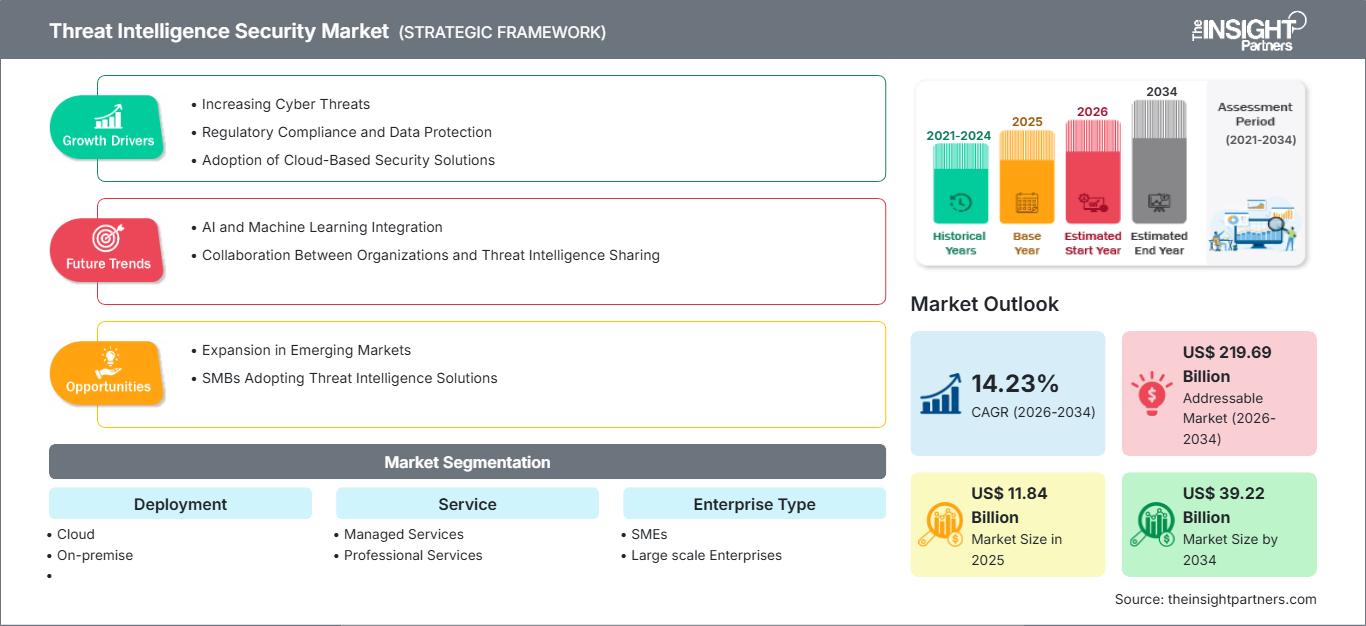
2025 Market Size
US$ 11.84 Bn
Base year value
2034 Forecast
US$ 39.22 Bn
Projected by 2034
CAGR 2026-2034
14.23 %
Growth rate
Addressable Market
US$ 219.69 Bn
(2026-2034)
The Threat intelligence security market was valued at US$ 11.84 Billion in 2025 and is projected to reach US$ 39.22 Billion by 2034, expanding at a CAGR of 14.23% during 2026–2034. Growing cybercrime sophistication, wider attack surfaces across cloud environments, and increasing adoption of intelligence-led security operations are supporting demand. Organizations are prioritizing real-time threat visibility, threat hunting, and automated response capabilities to strengthen cybersecurity resilience across critical infrastructure and enterprise networks.
Across North America, sustained cybersecurity spending, strong regulatory oversight, and broad deployment of security operations centers continue to stimulate adoption. The threat intelligence security market size in the region is supported by extensive cloud migration, increasing ransomware incidents, and rising investments in AI-enabled cyber defense. Regional growth is expected to remain robust, with an estimated CAGR between 13.5% and 15.0% through the forecast period, led by the U.S. and Canada.
Threat Intelligence Security Market Assessment and Insights
- North America: Strong enterprise cybersecurity spending and mature security operations capabilities support leadership. Share in 2025 is estimated at 37–39%, with CAGR between 13.5–15.0% during 2026–2034.
- US: High concentration of cybersecurity vendors, federal cyber initiatives, and cloud adoption. Share of North America in 2025 is estimated at 82–84%, with CAGR between 13.8–15.2% during 2026–2034.
- Europe: Strong adoption across the UK, Germany, and France supported by data protection regulations. Share in 2025 is estimated at 26–28%, growing at a CAGR of 13.0–14.5% during 2026–2034.
- Asia Pacific: China, Japan, India, South Korea, and Australia are expanding cyber defense investments. Share in 2025 is estimated at 24–26%, with CAGR between 15.5–17.0% during 2026–2034.
- Largest Segment: Cloud deployment remains dominant with a 56–60% market share in 2025 and CAGR between 15.0–16.0% driven by scalable intelligence integration across distributed digital environments.
- High Growth Segment: Managed Services account for approximately 36–40% share in 2025 and are expected to expand at a CAGR between 15.8–17.2% due to cybersecurity talent shortages.
- Key companies analyzed in detail: Anomali, Inc.; Datto Holding Corp.; F-Secure Corporation; Farsight Security, Inc.; Fortinet, Inc.; Intel 471, Inc.; International Business Machines Corporation; Juniper Networks, Inc.; KKR & Co. Inc.; LogRhythm, Inc.
Source: The Insight Partners' analysis based on proprietary research, government publications, company annual reports, investor presentations, industry databases, and expert interviews.
Cybersecurity priorities have been transformed globally through digital transformation programs, multi-cloud implementations, and the rise of the remote workforce. Security professionals now need intelligence sources, attack surface monitoring, and analytics that can detect new threat groups. The increasing use of artificial intelligence in security operations is also driving a change in production and delivery methods to enable quick correlation of indicators, automation of investigations, and improved incident response orchestration. As organizations process increasing amounts of telemetry information, intelligence platforms will become key tools for cyber risk management and operational resilience practices.
Future growth will be driven by increasing cybersecurity budgets in emerging countries, critical infrastructure protection laws, and wider use of intelligence exchange platforms. Government bodies, banks, healthcare organizations, and energy companies will make growing investments in predictive threat analytics. The rising number of public-private partnerships and global cybersecurity projects will also boost deployment potential in emerging regions.
Threat Intelligence Security Market Report Scope
| Report Attribute | Details |
|---|---|
| Market size in 2025 | US$ 11.84 Billion |
| Market Size by 2034 | US$ 39.22 Billion |
| Global CAGR (2026 - 2034) | 14.23% |
| Historical Data | 2021-2024 |
| Forecast period | 2026-2034 |
Threat Intelligence Security Market Analysis
The threat intelligence security market growth trajectory is supported by the accelerating frequency of ransomware, phishing, supply-chain attacks, and state-sponsored cyber campaigns. The ecosystem comprises various players such as data providers, intelligence platforms, MSSPs, cloud infrastructure providers, and incident response experts, thereby forming an integrated value chain aimed at enhancing the cyber readiness of enterprises. The demand for such solutions has been increasing among enterprises belonging to industries such as financial services, healthcare, manufacturing, and governmental bodies, where any form of operational disruption could lead to high costs.
Cloud-based deployment is driving the adoption of this market by simplifying the infrastructure setup and ensuring intelligence distribution in real time across multiple geographical locations. As cyber attacks become more automated in nature, enterprises are now focusing on intelligence-driven cybersecurity that could deliver quick results.
The threat intelligence security market analysis indicates a competitive landscape characterized by platform expansion, AI integration, and strategic partnerships. International Business Machines Corporation, Fortinet, Inc., and Anomali, Inc. remain committed to advanced analytics, machine learning, and large-scale threat intelligence networks in their attempts to enhance product differentiation. Vendors have become more interested in contextual intelligence and automation, which increases the efficiency of analysts’ work and decreases the time for actions.
In particular, strategic investments are being made in such segments as managed detection, threat hunting, cloud security intelligence, and cyber analytics. Among the companies that have been making such investments, there are Intel 471, Inc., LogRhythm, Inc., Juniper Networks, Inc., and F-Secure Corporation. Positioning becomes increasingly dependent on the quality of intelligence, integration capability, cloud-readiness, and enterprise operations environment support.
● REPORT CUSTOMIZATION
Tailor This Report To Align With Your Specific Business Requirements
This report can be customized to align precisely with your business objectives, scope, and target markets. Customization options include tailored segmentation, geography, competitive analysis, and strategic insights to support informed decision-making.
Customize This Report →WHAT YOU CAN ADJUST
- ● Segmentations
- ● Geography
- ● Competitive Analysis
- ● Language Preferences
Threat Intelligence Security Market: Strategic Insights
Regional Insights
North America Threat Intelligence Security Market
North America accounted for an estimated 37–39% threat intelligence security market share in 2025 and remains the largest regional market. Strong cybersecurity spending, extensive cloud infrastructure deployment, and advanced security operations capabilities continue to support demand. The region is expected to register a CAGR of 13.5–15.0% between 2026 and 2034. Increasing ransomware incidents targeting healthcare, government, and financial institutions are encouraging organizations to strengthen intelligence-led defense frameworks.
Regulatory requirements, cyber insurance standards, and public-sector cybersecurity initiatives further stimulate adoption. Large enterprises increasingly integrate intelligence platforms with XDR, SIEM, and SOAR systems to improve incident response efficiency. Canada is also expanding cyber resilience investments, particularly within critical infrastructure and public services, contributing to sustained regional expansion.
U.S. Threat Intelligence Security Market
The United States represented approximately 82–84% of North American threat intelligence security market revenue in 2025 and is projected to expand at a CAGR of 13.8–15.2% through 2034. High cybersecurity expenditure, substantial cloud investments, and significant concentration of technology companies contribute to market leadership. Increasing federal focus on cyber resilience and intelligence sharing is promoting wider deployment across public and private sectors.
Major participants, including International Business Machines Corporation, Fortinet, Inc., Anomali, Inc., and LogRhythm, Inc., maintain substantial commercial activities within the country. Demand is expanding across government agencies, defense organizations, healthcare systems, and financial institutions. Integration of AI-enabled threat detection, behavioral analytics, and automated investigation workflows is supporting long-term growth prospects.
Europe Threat Intelligence Security Market
Europe held an estimated 26–28% share of the threat intelligence security market in 2025 and is anticipated to record a CAGR of 13.0–14.5% during the forecast period. There is an availability of good governance frameworks on cybersecurity and a growing need for active threat monitoring. Germany is still leading the way in the country market because of the digitalization of industry and enterprise cybersecurity investments.
The UK keeps showing good demand through financial services, cyber programs in the nation, and cloud transformation. Intelligence platforms are being adopted by organizations to tackle the issues of ransomware and supply chain threats as well as achieving regulatory compliance and operational resiliency.
There is considerable adoption in Germany owing to the adoption of Industry 4.0, manufacturing digitalization, and critical infrastructure protection programs. France, Italy, and Spain are investing more in cyber resilience, intelligence sharing, and digital transformation in the public sector.
APAC Threat Intelligence Security Market
Asia Pacific accounted for approximately 24–26% of global revenue in 2025 and is expected to register the highest regional CAGR of 15.5–17.0%. China, Japan, India, South Korea, and Australia continue to strengthen cybersecurity investment amid rapid digitalization and increasing cyber risk exposure.
Government-backed cybersecurity programs, growth in cloud adoption, and expanding digital infrastructure are supporting market expansion. China remains the leading country market, while India demonstrates particularly strong growth potential due to expanding enterprise digitization, fintech development, and cybersecurity modernization initiatives.
Middle East & Africa Threat Intelligence Security Market
The Middle East & Africa market is developing steadily with increasing investments in cyber resilience for critical infrastructure, energy facilities, and government networks. The region is expected to achieve a CAGR of 14.0–15.5% between 2026 and 2034.
Saudi Arabia and the UAE remain key adoption centers due to smart city investments, digital government initiatives, and expanding cybersecurity frameworks. South Africa leads activity in Sub-Saharan Africa, while broader regional demand is supported by the modernization of utilities, telecommunications, and financial services infrastructure.
Segmentation Analysis
Deployment
The deployment segment is projected to expand at a CAGR of 14.8–16.0% during 2026–2034. The threat intelligence security market scope continues to broaden as organizations seek flexible deployment architectures capable of supporting distributed security operations. Cloud adoption remains strong due to scalability, rapid updates, and lower infrastructure management requirements, while on-premise deployments retain relevance among highly regulated organizations.
- Cloud: Largest deployment model, enabling centralized intelligence aggregation, rapid scalability, and easier integration with modern security ecosystems. Strong adoption is observed among enterprises pursuing cloud-first digital transformation strategies.
- On-premise: Maintains importance in sectors managing highly sensitive information, offering greater control over infrastructure, data governance, and regulatory compliance requirements.
Service
The service segment is anticipated to grow at a CAGR of 15.2–16.8% through the forecast period. Increasing cybersecurity complexity and shortages of skilled analysts are encouraging organizations to rely on specialized service providers. Service offerings play a critical role in operationalizing intelligence, improving visibility, and strengthening incident response capabilities.
- Managed Services: Organizations leverage managed security specialists for continuous monitoring, intelligence contextualization, and 24/7 operational support, helping reduce internal resource constraints.
- Professional Services: Demand is driven by deployment, advisory, training, and optimization activities that support the successful implementation of intelligence-driven cybersecurity programs.
Enterprise Type
The enterprise type segment is expected to register a CAGR of 13.8–15.1% from 2026 to 2034. Expanding cyber threats affect organizations of all sizes, creating a broad demand for intelligence solutions. Adoption patterns differ according to budget, security maturity, and operational complexity.
- SMEs: Small and medium enterprises increasingly adopt subscription-based solutions and managed services to improve security visibility while maintaining cost efficiency and operational simplicity.
- Large scale Enterprises: Large organizations invest heavily in advanced intelligence platforms, integrating cyber threat intelligence with broader security operations, risk management, and compliance initiatives.
Opportunity Snapshot
| Enterprise Type | Revenue Contribution | Trend Tag | Adoption Stage |
| SMEs | Medium | MSSP Demand | Scaling |
| Large scale Enterprises | High | AI Defense | Mature |
Threat Intelligence Security Market Growth Drivers and Impact Analysis
Escalating sophistication of cyberattacks
In today’s world, many cyber-criminal gangs make use of automation, artificial intelligence, and a multiple-stage attack. It has become more vulnerable for organizations to be attacked by ransomware, credential attacks, supply chain attacks, and advanced persistent threats. The signature-based protection system is not efficient enough to detect the changing tactics, so it has become imperative for organizations to adopt an intelligence-driven detection system. Threat Intelligence Platforms assist organizations in detecting the indicators of compromise, correlating the attack patterns, and enhancing the mitigation process. As digital assets grow in cloud/hybrid environments, it is necessary for the organization to monitor and have knowledge about the threats.
Expansion of cloud and hybrid computing environments
Adoption of clouds will continue changing enterprise technology architectures, which increases the attack surface and visibility problems. Organizations need intelligent systems that are able to monitor distributed users, applications, and workloads across different environments. The use of intelligence tools helps security personnel identify any suspicious activities, prioritize vulnerabilities, and respond to threats. The combination of cloud security, identity management, and security operations technology will make their operations more efficient and manageable. With the increasing digitization by enterprises and the migration of critical processes to cloud-based infrastructures, the need for intelligent systems will be a strong driver of growth.
Regulatory focus on cyber resilience
The need for more robust cyber governance and cyber incident reporting regulations is gaining popularity among governments and regulatory agencies. Critical infrastructure providers, healthcare organizations, banks, and governmental organizations are under increasing pressure to demonstrate their capacity for cyber risk management and resiliency. Threat intelligence solutions can help companies comply with such regulations through their ability to provide continual monitoring, situational awareness, and incident response. In addition, increased cooperation between governmental and commercial entities promotes intelligence exchange and defensive strategies. Enterprises will be required to invest more in intelligence technologies and services due to changing regulatory requirements around the world.
Threat Intelligence Security Market Future Trends
AI-enabled predictive intelligence platforms
The threat intelligence security market trends increasingly point toward predictive analytics supported by artificial intelligence and machine learning. Future platforms are expected to move beyond threat detection toward anticipatory risk modeling. Vendors are investing in technologies capable of identifying attacker behaviors, forecasting attack patterns, and generating automated recommendations for mitigation. Improved contextualization of threat data, combined with autonomous investigation workflows, may significantly reduce analyst workloads. These developments are expected to enhance operational efficiency and support proactive cybersecurity strategies across enterprise environments.
Convergence of intelligence with security operations
Market participants are increasingly integrating intelligence capabilities directly into security operations workflows. SIEM, XDR, SOAR, and exposure management platforms are expected to become more intelligence-centric, reducing silos between detection and response processes. Unified platforms can improve investigative speed by correlating external intelligence with internal telemetry. As cybersecurity teams seek automation and operational simplification, integrated intelligence architectures are likely to become a defining feature of future security ecosystems.
Threat Intelligence Security Market Opportunities
Expansion across emerging digital economies
Rapid digitalization across developing economies creates substantial investment opportunities. Governments and enterprises are expanding cloud infrastructure, online services, and digital payment ecosystems, increasing cybersecurity requirements. Security vendors can benefit from the growing demand for affordable intelligence platforms, managed services, and localized threat monitoring solutions. Continued improvements in regulatory frameworks and national cybersecurity strategies are expected to support long-term commercialization opportunities. Businesses pursuing regional expansion can strengthen market access through channel partnerships, cloud alliances, and industry-specific cybersecurity offerings.
Managed intelligence services acceleration
The latest threat intelligence security market Forecasts suggest increasing demand for outsourced expertise as organizations struggle to recruit qualified cybersecurity professionals. Managed intelligence services offer continuous monitoring, rapid threat assessment, and operational support without requiring substantial internal resources. Vendors capable of combining intelligence feeds, analytics, and managed response services can capture expanding opportunities among mid-sized and large organizations. Investment in automation, AI-driven workflows, and sector-specific intelligence offerings may further improve service value and customer retention prospects.
Frequently Asked Questions

- Comprehensive Market Sizing and Forecast Analysis
- Detailed Segmentation Analysis
- In-Depth Market Dynamics Assessment
- Regional and Country-Level Insights
- Competitive Landscape and Company Benchmarking
- Strategic Business Intelligence
Recent Reports
Testimonials

The Insight Partners' SCADA System Market report is comprehensive, with valuable insights on current trends and future forecasts. The team was highly professional, responsive, and supportive throughout. We are very satisfied and highly recommend their services.
RAN KEDEM Partner, Reali Technologies LTDs
I requested a report on a very specific software market and the team produced the report in a few days. The information was very relevant and well presented. I then requested some changes and additions to the report. The team was again very responsive and I got the final report in less than a week.
JEAN-HERVE JENN Chairman, Future Analytica
We worked with The Insight Partners for an important market study and forecast. They gave us clear insights into opportunities and risks, which helped shape our plans. Their research was easy to use and based on solid data. It helped us make smart, confident decisions. We highly recommend them.
PIYUSH NAGPAL Sr. Vice President, High Beam Global
The Insight Partners delivered insightful, well-structured market research with strong domain expertise. Their team was professional and responsive throughout. The user-friendly website made accessing industry reports seamless. We highly recommend them for reliable, high-quality research services
YUKIHIKO ADACHI CEO, Deep Blue, LLC.
This is the first time I have purchased a market report from The Insight Partners.While I was unsure at first, I visited their web site and felt more comfortable to take the risk and purchase a market report.I am completely satisfied with the quality of the report and customer service. I had several questions and comments with the initial report, but after a couple of dialogs over email with their analyst I believe I have a report that I can use as input to our strategic planning process.Thank you so much for taking the extra time and making this a positive experience.I will definitely recommend your service to others and you will be my first call when we need further market data.
JOHN SUZUKI President and Chief Executive Officer, Board Director, BK Technologies
I wish to appreciate your support and the professionalism you displayed in the course of attending to my request for information regarding to infectious disease IVD market in Nigeria. I appreciate your patience, your guidance, and the fact that you were willing to offer a discount, which eventually made it possible for us to close a deal. I look forward to engaging The Insight Partners in the future, all thanks to the impression you have created in me as a result of this first encounter.
DR CHIJIOKE ONYIA MANAGING DIRECTOR, PineCrest Healthcare Ltd.Reason to Buy
- Informed Decision-Making
- Understanding Market Dynamics
- Competitive Analysis
- Identifying Emerging Markets
- Customer Insights
- Market Forecasts
- Risk Mitigation
- Boosting Operational Efficiency
- Strategic Planning
- Investment Justification
- Tracking Industry Innovations
- Aligning with Regulatory Trends





 Get Free Sample for