
Vector Database Market Growth, Demand & Size by 2034
Vector Database Market Size and Forecasts (2021–2034), Global and Regional Share, Trends, and Growth Opportunity Analysis Report Coverage : By Offering (Solutions and Services), Technology (NLP, Computer Vision, and Recommendation Systems), Vertical (Media & Entertainment, IT & ITeS, Healthcare & Life Sciences)
- Status : Data Released
- Report Code : TIPRE00039667
- Category : Technology, Media and Telecommunications
- No. of Pages : 150
- Available Report Formats :


- Last update date : August 05, 2026


2025 Market Size
US$ 2.59 Bn
Base year value
2034 Forecast
US$ 14.09 Bn
Projected by 2034
CAGR 2026-2034
20.71 %
Growth rate
Addressable Market
US$ 67.04 Bn
(2026-2034)
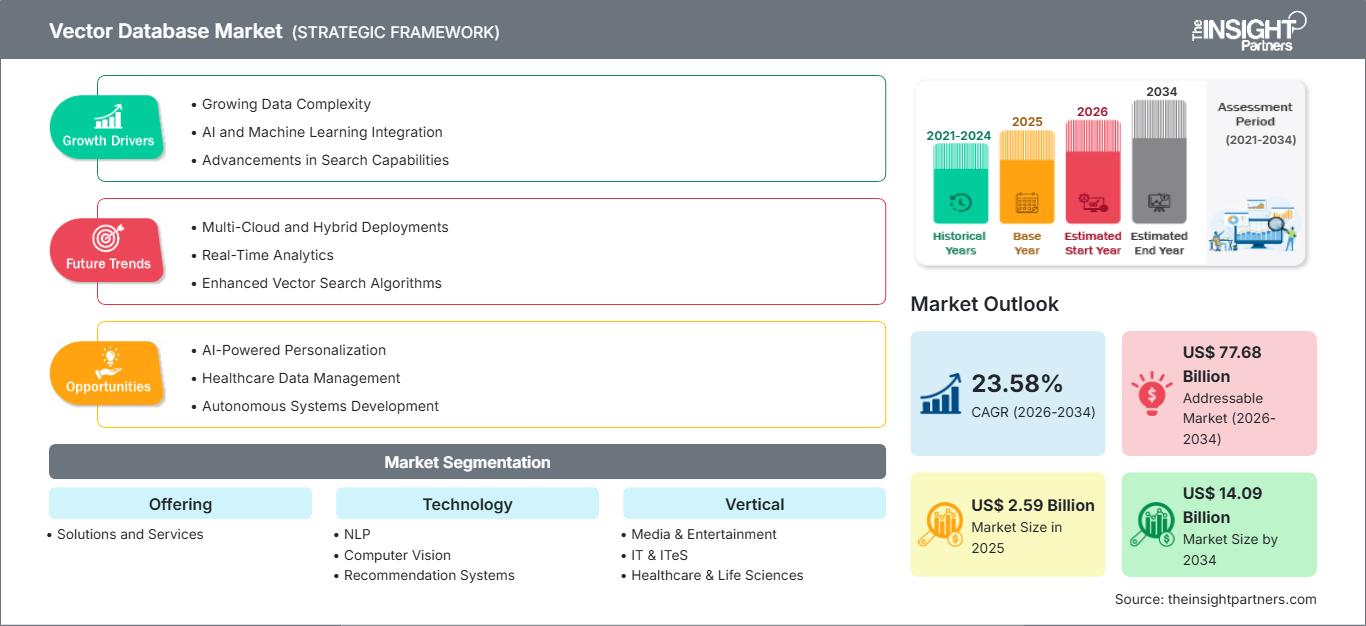
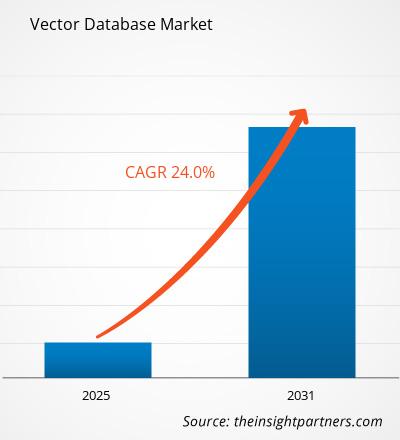
The Vector Database market was valued at US$ 2.59 billion in 2025 and is expected to reach US$ 14.09 billion by 2034; it is estimated to record a CAGR of 20.71% during 2026-2034.
Vector Database Market Assessment and Insights
- North America: Held an estimated 34–38% share in 2025 and is projected to grow at a CAGR of 22–24% between 2026 and 2034, underpinned by dense hyperscale presence and enterprise AI budgets.
- US: Accounts for the majority of regional revenue, growing at a CAGR of 22–25% between 2026 and 2034, propelled by generative AI pilots scaling into production environments.
- Europe: Commanded roughly 22–26% share in 2025, expanding at a CAGR of 21–23% between 2026 and 2034, led by Germany, the UK, and France amid strengthening data sovereignty frameworks.
- Asia Pacific: Captured nearly 20–24% share in 2025 and is set to grow fastest at a CAGR of 25–27% between 2026 and 2034, led by China, Japan, and India through digital infrastructure expansion.
- Largest Segment: Solutions held an estimated 62–66% share in 2025, growing at a CAGR of 22–24% between 2026 and 2034, reflecting sustained platform licensing and deployment demand.
- High Growth Segment: Recommendation Systems is projected to grow at a CAGR of 25–28% between 2026 and 2034, driven by personalization needs across commerce and media platforms.
- Key companies analyzed in detail: Microsoft Corporation, Elastic N.V., Alibaba Cloud, MongoDB Inc., SingleStore Inc., Zilliz Inc., Pinecone Systems Inc., Milvus, Weaviate B.V., Clarifai Inc.
Source: The Insight Partners' analysis based on proprietary research, government publications, company annual reports, investor presentations, industry databases, and expert interviews.
The market has witnessed a significant shift as enterprises progressively move from relational and keyword-based search architectures toward embedding-driven retrieval, transforming how unstructured text, image, and audio data are indexed and accessed. Early deployments centered on recommendation engines and semantic search, while recent innovation cycles have introduced retrieval-augmented generation (RAG) pipelines that combine large language models with high-dimensional vector indexes. Current market dynamics emphasize approximate nearest-neighbor (ANN) algorithms, hybrid search capabilities, and scalable indexing across billions of embeddings, driving vendors to re-architect storage and query layers to support concurrent, low-latency workloads at enterprise scale, thereby increasing the Vector Database Market share across AI-powered applications and data-intensive environments.
In the future, cloud computing will see adoption expanding outside of North America and Western Europe to Southeast Asia, the Gulf, and Latin America, where there is growing investment in cloud infrastructure. With regulatory scrutiny increasing around data residency and AI governance, vendors are now offering regional deployment services. There is continued strong capital infusion into vector database companies, indicating ongoing innovation around indexing and multi-modal search capabilities in the next ten years.
Vector Database Market Report Scope
| Report Attribute | Details |
|---|---|
| Market size in 2025 | US$ 2.59 Billion |
| Market Size by 2034 | US$ 14.09 Billion |
| Global CAGR (2026 - 2034) | 20.71% |
| Historical Data | 2021-2024 |
| Forecast period | 2026-2034 |
Vector Database Market Analysis
The vector database market growth is fundamentally linked to the proliferation of generative AI applications requiring efficient similarity search across billions of high-dimensional embeddings. Firms within finance, healthcare, and e-commerce sectors are adopting vector search technology within customer support, fraud detection, and content discovery processes by swapping out outdated keyword search indexes with advanced semantic search layers, which lead to significant improvements in accuracy and speed of query execution.
The landscape consists of vector-native suppliers, hyperscalers incorporating vector search functionality into their current database offerings, and open-source initiatives providing versatile implementation options. On the supply side, there is a clear trend toward vendors who provide managed horizontal scaling solutions, since organizations now value simplicity over complexity when implementing search functionality alongside existing data and ML infrastructures.
Competitive intensity has increased as Microsoft and Alibaba Cloud embed vector search directly into flagship cloud platforms, while MongoDB and Elastic extend established database and search products with native vector indexing. This vector database market analysis highlights specialized entrants, including Pinecone, Zilliz, Weaviate, and Milvus, differentiating through performance benchmarks and open-source community adoption.
Investments continue to be made in specialized vendors, with SingleStore and Clarifai augmenting their platforms to cater to enterprise workloads of structured and unstructured data. Positioning is becoming more reliant on the effectiveness of hybrid search, the integration of large language models, and predictable pricing based on the size of embeddings, setting the course for 2034.
● REPORT CUSTOMIZATION
Tailor This Report To Align With Your Specific Business Requirements
This report can be customized to align precisely with your business objectives, scope, and target markets. Customization options include tailored segmentation, geography, competitive analysis, and strategic insights to support informed decision-making.
Customize This Report →WHAT YOU CAN ADJUST
- ● Segmentations
- ● Geography
- ● Competitive Analysis
- ● Language Preferences
Vector Database Market: Strategic Insights
Regional Insights
North America Vector Database Market
North America held an estimated 34–38% share of the global Vector Database Market in 2025, supported by concentrated hyperscale cloud infrastructure, mature enterprise AI budgets, and a dense vendor presence spanning both established technology firms and specialized startups headquartered across the region.
The region is projected to expand at a CAGR of 22–24% between 2026 and 2034, driven by continued enterprise investment in retrieval-augmented generation, expanding cloud-native deployment models, and growing integration of vector search within financial services, healthcare diagnostics, and retail personalization platforms across the United States and Canada. Increasing adoption of generative AI applications and enterprise knowledge management solutions is further supporting demand for scalable vector data infrastructure across the region.
U.S. Vector Database Market
The United States represents the dominant share of North American revenue, estimated at 85–88% of the regional total in 2025, reflecting concentrated enterprise adoption, extensive hyperscale infrastructure, and a dense base of specialized vendors headquartered domestically across major technology corridors.
Growth is projected at a CAGR of 22–25% between 2026 and 2034, propelled by expanding generative AI production deployments across enterprise software, healthcare analytics, and financial services. Strong investment in retrieval-augmented generation (RAG), semantic search, and AI-powered knowledge management platforms is further accelerating demand. Company presence remains robust, with Microsoft, MongoDB, Pinecone, and Clarifai maintaining significant domestic engineering and go-to-market operations that continue to support innovation and enterprise adoption within the market.
Europe Vector Database Market
Europe accounted for an estimated 22–26% share of the global market in 2025, with adoption shaped by data sovereignty regulations and enterprise modernization initiatives spanning banking, manufacturing, and public sector digitalization programs across the continent.
Germany led regional adoption, contributing an estimated 26–29% share within Europe in 2025, supported by strong manufacturing digitalization and enterprise software investment. The UK followed closely, driven by financial services innovation and AI research clusters concentrated around London. France, Italy, and Spain collectively contributed a growing share, reflecting expanding public cloud adoption and national AI strategies. The region is projected to grow at a CAGR of 21–23% between 2026 and 2034, supported by increasing deployment of generative AI applications, retrieval-augmented generation (RAG) frameworks, and enterprise knowledge management solutions, with Germany expected to remain the leading national market throughout the forecast period.
APAC Vector Database Market
Asia Pacific held an estimated 20–24% share of the global market in 2025 and is projected to expand at the fastest regional CAGR of 25–27% between 2026 and 2034, led by China through large-scale cloud infrastructure investment and government-backed AI initiatives.
Japan and South Korea provided consistent demand from businesses associated with manufacturing and telecoms technology upgrades, whereas India turned out to be one of the fastest-growing providers thanks to the growing use of IT services and the implementation of generative AI at companies. Australia offered additional demand due to digitalization and cloud transformation efforts in its finance sector. Growing spending on AI infrastructure, machine learning usage, and RAG solutions is supposed to fuel the market development even more, with China remaining the market leader in the region.
Middle East & Africa Vector Database Market
The Middle East and Africa market is projected to expand at a CAGR of 20–22% between 2026 and 2034, with Saudi Arabia and the UAE leading adoption through national digital transformation programs, sovereign AI investment funds, and expanding hyperscale data center infrastructure that supports enterprise cloud migration and AI-driven workloads.
South Africa provides consistent demand by virtue of digitalization in financial services and increasing use of advanced data analytics platforms, while the Rest of MEA represents a nascent stage of adoption in conjunction with telecommunications advancements and digitalization initiatives undertaken by the government. Further growth in the market can be expected as a result of rising investments made in artificial intelligence, cloud computing, and enterprise data management, and the country that will continue to dominate the national landscape is Saudi Arabia.
Segmentation Analysis
Offering
Offering is estimated to grow at a CAGR of 22–24% between 2026 and 2034, reflecting the vector database market scope extending across both platform licensing and implementation services. Solutions dominate current revenue given sustained enterprise deployment, while services demand rises as organizations require integration expertise, migration support, and ongoing performance optimization for production-scale retrieval systems.
- Solutions: Core platform offerings remain the primary revenue contributor, favored for embedded indexing capabilities, scalability, and direct integration with enterprise machine learning pipelines and applications.
- Services: Implementation and consulting services support enterprises navigating migration, performance tuning, and integration with existing data infrastructure and AI development workflows.
Technology
Technology segmentation is projected to expand at a CAGR of 23–25% between 2026 and 2034, with Recommendation Systems emerging as the fastest-growing category. Natural language processing applications remain foundational, while computer vision use cases expand steadily across media, retail, and healthcare imaging workflows requiring high-dimensional similarity search capabilities.
- NLP: Semantic search, chatbots, and document retrieval use cases are powered by natural language processing applications and continue to be a core use case in enterprise knowledge management implementations.
- Computer Vision: Similarity search using images and videos is utilized in content moderation, visual search, and diagnostic imaging use cases in both retail and healthcare settings.
- Recommendation Systems: Personalized recommendation systems take advantage of vector similarity in product/content/media recommendations and constitute the fastest-growing field of technology application.
Vertical
Vertical adoption is estimated to grow at a CAGR of 22–24% between 2026 and 2034, with Healthcare & Life Sciences representing the fastest-adopting vertical as diagnostic imaging and genomic data retrieval scale. Media & Entertainment and IT & ITeS verticals continue driving steady enterprise deployment volumes across content platforms and technology services.
- Media & Entertainment: Platforms used in content recommendation and rights management use vector search technology to discover personal recommendations for their customers in streaming and publishing solutions.
- IT & ITeS: Providers of IT services incorporate vector databases into their enterprise software solutions, thus implementing search, analytics, and AI-based customer platforms.
- Healthcare & Life Sciences: Diagnosis, genomics, and clinical documentation searches benefit greatly from using vector similarity search to find relevant information quickly and accurately.
Opportunity Snapshot
| Industry Vertical | Revenue Contribution | Trend Tag | Adoption Stage |
| Media & Entertainment | Medium | Content Discovery | Scaling |
| IT & ITeS | High | Enterprise Search | Mature |
| Healthcare & Life Sciences | Medium | Diagnostic Retrieval | Emerging |
Vector Database Market Growth Drivers and Impact Analysis
Generative AI Integration Across Enterprise Applications
In the market, enterprise adoption of large language model applications has created substantial demand for retrieval-augmented generation (RAG) architectures that depend on efficient vector similarity search. Businesses that make use of customer support automation, knowledge assistants, and document summarization tools need indexing technology that can manage billions of vectors with low query latency. This has created the need for cloud service providers and specialty companies to build capacity in indexing, improve approximate nearest neighbor searching, and create hybrid searches that incorporate keyword and semantic similarity. The outcome is that there is a significant increase in the addressable enterprise market for these systems, as vector searches have gone from experimental use in artificial intelligence research labs to being adopted in production applications.
Expansion of Unstructured Data Volumes
In the Vector Database Market, enterprises are generating growing volumes of unstructured data, including documents, images, audio, and sensor logs, that traditional relational databases struggle to index effectively for similarity-based retrieval. This growth has driven enterprises into storage solutions that use embeddings, which are capable of capturing various kinds of data in high-dimensional vector form. Sectors such as the media, healthcare imaging, and industrial monitoring now use vector indexing as a way of gaining relevance from the unstructured databases that existed before. With the increasing generation of data from connected devices and digital channels, there is an increasing demand for retrieval solutions, which makes it necessary to invest in vector databases.
Cloud-Native Infrastructure Modernization
In the Vector Database Market, enterprises migrating legacy on-premises systems toward cloud-native architectures are increasingly embedding vector search capabilities within modernized data stacks. This transition helps companies combine their workloads for search, analytics, and machine learning on the scalable infrastructure without having to run individual systems. Hyperscale clouds have driven the transformation by building support for vector indexing right into their database offerings, making it easier for companies to use. With modernization efforts being undertaken by banks, manufacturers, and even the public sector, the requirement for cloud-native vector indexing keeps increasing, especially for companies focused on scalability, managed services, and lower costs.
Vector Database Market Future Trends
Convergence of Vector and Traditional Database Architectures
Emerging vector database market trends point toward deepening convergence between vector-native platforms and established relational or document database systems. Vendors are increasingly embedding vector indexing directly into existing database engines rather than positioning standalone specialized products. This convergence simplifies enterprise architecture by reducing the number of systems required to support hybrid structured and unstructured data workloads. Over the coming years, expect established database providers to expand native vector capabilities further, while specialized vendors differentiate through performance benchmarks, multi-modal support, and deeper integration with large language model orchestration frameworks used across enterprise AI development pipelines.
Multi-Modal Retrieval Becomes Standard Practice
Enterprise search systems are steadily moving away from embeddings that are only based on text towards multi-modal systems that can index text, images, audio, and video data simultaneously through vector spaces. Such a transition would allow for much more complex use cases, including content moderation, medical image correlation, and cross-modal searching capabilities. With growing support for multi-modal embeddings in foundation models, vector database vendors need to adapt their databases to handle different types of data efficiently. Such changes are expected to impact competition in this space, favoring those with better multi-modal indexing capabilities.
Vector Database Market Opportunities
Vertical-Specific Retrieval Platforms
Substantial opportunity exists for vendors developing vertical-specific vector database configurations tailored to regulatory and workflow requirements within healthcare, financial services, and legal sectors. Current vector database market forecasts suggest accelerating demand for compliance-ready deployments supporting data residency, audit logging, and domain-specific embedding models. Vendors investing in pre-configured healthcare diagnostic retrieval or financial document search solutions can capture premium enterprise contracts requiring specialized security and compliance certifications. This opportunity favors providers combining core vector indexing capabilities with domain expertise, positioning them advantageously against generalized platforms lacking sector-specific configuration options across regulated enterprise environments globally.
Emerging Market Infrastructure Investment
There is an important chance to increase the use of vector databases in emerging economies located in Southeast Asia, Latin America, and the Gulf region, where there is increasing investment in cloud infrastructure, along with the development of AI strategies by governments in these countries. By creating partnerships in regional data centers and by deploying their services within these regions, vendors can take advantage of early mover benefits since companies within these regions are just beginning to deploy their own AI projects. With increasing emphasis on sovereignty of infrastructure in government-supported digital transformation programs within these regions, vendors can profit from the increased use of vector search that is compliant with these regulations.
Frequently Asked Questions

- Comprehensive Market Sizing and Forecast Analysis
- Detailed Segmentation Analysis
- In-Depth Market Dynamics Assessment
- Regional and Country-Level Insights
- Competitive Landscape and Company Benchmarking
- Strategic Business Intelligence
Recent Reports
Testimonials

The Insight Partners' SCADA System Market report is comprehensive, with valuable insights on current trends and future forecasts. The team was highly professional, responsive, and supportive throughout. We are very satisfied and highly recommend their services.
RAN KEDEM Partner, Reali Technologies LTDs
I requested a report on a very specific software market and the team produced the report in a few days. The information was very relevant and well presented. I then requested some changes and additions to the report. The team was again very responsive and I got the final report in less than a week.
JEAN-HERVE JENN Chairman, Future Analytica
We worked with The Insight Partners for an important market study and forecast. They gave us clear insights into opportunities and risks, which helped shape our plans. Their research was easy to use and based on solid data. It helped us make smart, confident decisions. We highly recommend them.
PIYUSH NAGPAL Sr. Vice President, High Beam Global
The Insight Partners delivered insightful, well-structured market research with strong domain expertise. Their team was professional and responsive throughout. The user-friendly website made accessing industry reports seamless. We highly recommend them for reliable, high-quality research services
YUKIHIKO ADACHI CEO, Deep Blue, LLC.
This is the first time I have purchased a market report from The Insight Partners.While I was unsure at first, I visited their web site and felt more comfortable to take the risk and purchase a market report.I am completely satisfied with the quality of the report and customer service. I had several questions and comments with the initial report, but after a couple of dialogs over email with their analyst I believe I have a report that I can use as input to our strategic planning process.Thank you so much for taking the extra time and making this a positive experience.I will definitely recommend your service to others and you will be my first call when we need further market data.
JOHN SUZUKI President and Chief Executive Officer, Board Director, BK Technologies
I wish to appreciate your support and the professionalism you displayed in the course of attending to my request for information regarding to infectious disease IVD market in Nigeria. I appreciate your patience, your guidance, and the fact that you were willing to offer a discount, which eventually made it possible for us to close a deal. I look forward to engaging The Insight Partners in the future, all thanks to the impression you have created in me as a result of this first encounter.
DR CHIJIOKE ONYIA MANAGING DIRECTOR, PineCrest Healthcare Ltd.Reason to Buy
- Informed Decision-Making
- Understanding Market Dynamics
- Competitive Analysis
- Identifying Emerging Markets
- Customer Insights
- Market Forecasts
- Risk Mitigation
- Boosting Operational Efficiency
- Strategic Planning
- Investment Justification
- Tracking Industry Innovations
- Aligning with Regulatory Trends





 Get Free Sample for