
Water Heater Component Market Growth, Share & Trends by 2034
Coverage: by Component (Heat Exchanger, Thermostat and Controls, Pipes and Tubes, Valves, Others); Sales Channel (Direct Sales, In direct Sales); Installation (OEMs, Aftermarket) , and Geography (North America, Europe, Asia Pacific, and South and Central America)
- Status : Data Released
- Report Code : TIPRE00005714
- Category : Manufacturing and Construction
- No. of Pages : 150
- Available Report Formats :


- Last update date : September 28, 2026


2025 Market Size
US$ 16.04 Bn
Base year value
2034 Forecast
US$ 22.25 Bn
Projected by 2034
CAGR 2026-2034
3.7 %
Growth rate
Addressable Market
US$ 173.88 Bn
(2026-2034)
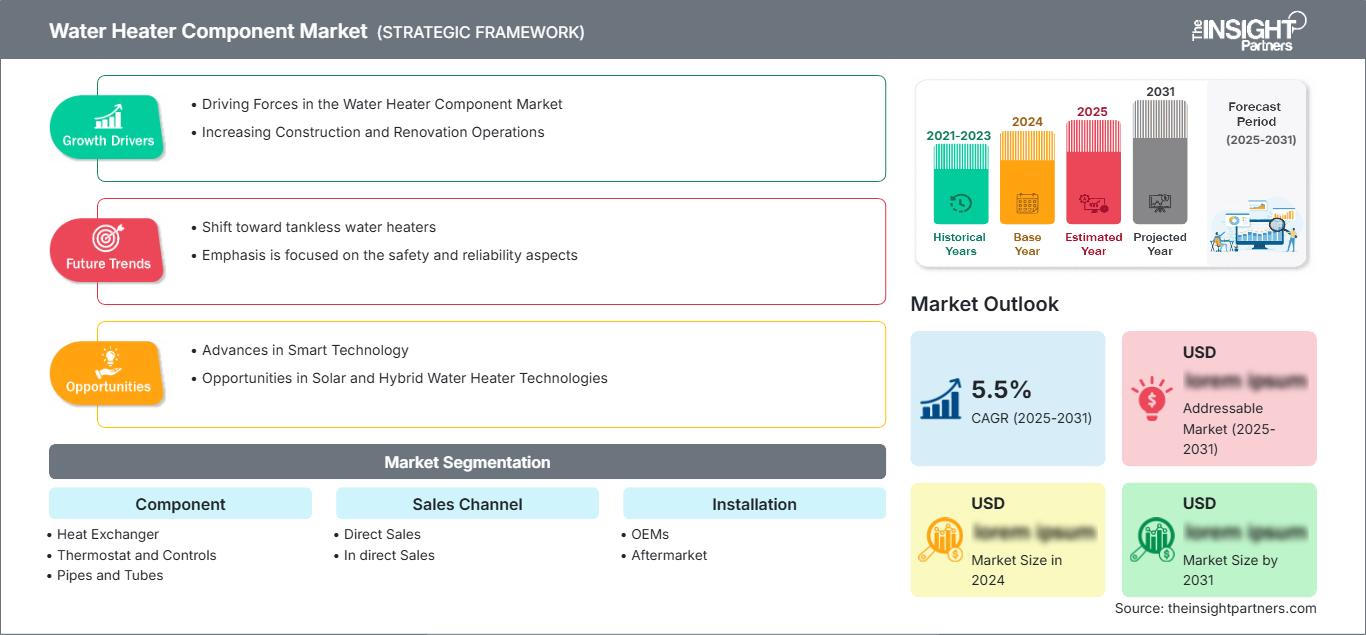
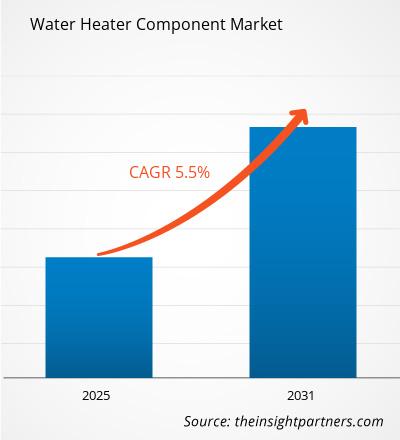
The global Water Heater Component market was valued at US$ 16.04 billion in 2025 and is expected to reach US$ 22.25 billion by 2034; it is estimated to record a CAGR of 3.7% during 2026-2034.
Water Heater Component Market Assessment and Insights
- North America: The region is estimated to account for 20–23% share in 2025 and grow at a 3.7–4.3% CAGR between 2026–2034, supported by replacement cycles, commercial refurbishment, efficiency upgrades, and established distribution networks.
- US: The US represents approximately 84–88% of North American demand in 2025 and is expected to grow at a 3.6–4.2% CAGR during 2026–2034, led by replacement and retrofit activity.
- Europe: Europe is estimated at 19–22% share in 2025 and is projected to grow at a 3.4–4.0% CAGR between 2026–2034, with Germany, the UK, France, Italy, and Spain benefiting from efficiency regulation and refurbishment.
- Asia Pacific: Asia Pacific is estimated to hold 34–38% share in 2025 and expand at a 4.7–5.3% CAGR during 2026–2034, led by China, India, Japan, South Korea, and Australia amid urbanization and appliance modernization.
- Largest Segment: Heat Exchanger is estimated to hold a 28–32% market share in 2025 and grow at a 4.5–5.2% CAGR during 2026–2034, reflecting its central role in efficient heat transfer.
- High Growth Segment: Thermostat and Controls is estimated to represent a 17–21% share in 2025 and grow at a 5.0–5.8% CAGR during 2026–2034 as digital regulation and connected operation expand.
- Key companies analyzed in detail: Ariston Thermo S.p.A.; Bajaj Electricals Limited; Bosch Industriekessel GmbH; Bradford White Corporation; Bradley Corporation; BSH Hausgeräte GmbH; Siemens AG; Eccotemp.com; HTP Comfort Solutions LLC; Rinnai America Corporation; Venus Home Appliances Pvt. Ltd.; A. O. Smith Corporation; Rheem Manufacturing Company.
Source: The Insight Partners' analysis based on proprietary research, government publications, company annual reports, investor presentations, industry databases, and expert interviews.
The water heater component market is evolving from conventional replacement parts toward engineered assemblies designed around higher efficiency, tighter temperature control, improved corrosion resistance, and easier servicing. Heat exchangers, valves, thermostats, sensors, and piping systems are becoming more often chosen as interconnected sub-systems than individual components. Thus, development in the area will focus on compatibility, efficiency, ease of installation and durability of electric, gas, tankless, hybrid and heat pump models.
In terms of future developments, resources are likely to be devoted to components that can be integrated into electrified systems, electronics and heat transfer, and modularity for replacement. The developing ecodesign policy in Europe will increase emphasis on efficiency and the availability of spare parts. In Asia Pacific, urban housing expansion and appliance upgrading provide a broader volume base, while manufacturers increasingly localize sourcing to manage logistics, material costs, and lead-time exposure, according to the Water Heater Component Market report.
Water Heater Component Market Report Scope
| Report Attribute | Details |
|---|---|
| Market size in 2025 | US$ 16.04 Billion |
| Market Size by 2034 | US$ 22.25 Billion |
| Global CAGR (2026 - 2034) | 3.7% |
| Historical Data | 2021-2024 |
| Forecast period | 2026-2034 |
Water Heater Component Market Analysis
Demand is anchored by the replacement of installed heaters, new residential construction, commercial refurbishment, and upgrades toward more efficient equipment. The water heater component market growth increasingly depends on the component intensity of newer systems, because advanced heaters require sophisticated controls, improved heat exchangers, electronically managed valves, and application-specific piping. The ecosystem includes producers of component parts, producers of heaters, distributors, installers, plumbing contractors, and post-market services providers.
Supply issues are impacted by copper, steel, aluminum, plastics, electronics, and machined components. The manufacturers have been caught between the cost fluctuation in materials and the requirements of consistency and accuracy. Original equipment manufacturer buying is based on standardized components, which make the assembly process easier, while the aftermarket business depends on interchangeable, easy access and servicing capability.
Competitive positioning combines manufacturing scale with application engineering and distribution reach. Companies such as A. O. Smith Corporation, Ariston Thermo S.p.A., Bradford White Corporation, Bosch Industriekessel GmbH, Rinnai America Corporation, and Rheem Manufacturing Company compete through product integration, engineering capabilities, channel relationships, and technology development. Bajaj Electricals Limited, BSH Hausgeräte GmbH, Siemens AG, Bradley Corporation, Eccotemp.com, HTP Comfort Solutions LLC, and Venus Home Appliances Pvt. Ltd. add regional and specialist capabilities, shaping the competitive landscape outlined in the Water Heater Component Market forecast.
Money is being invested in areas like control technologies, heat pump-ready systems, commercial heating technology platforms, digital servicing, and logistics resiliency. The investments made by A.O. Smith for product development by 2025 and the expansion by Rinnai into the North American market highlight this focus on technology and production capabilities. Acquisition of valves, flow, controls or water management capabilities can enhance supplier ecosystem strength.
● REPORT CUSTOMIZATION
Tailor This Report To Align With Your Specific Business Requirements
This report can be customized to align precisely with your business objectives, scope, and target markets. Customization options include tailored segmentation, geography, competitive analysis, and strategic insights to support informed decision-making.
Customize This Report →WHAT YOU CAN ADJUST
- ● Segmentations
- ● Geography
- ● Competitive Analysis
- ● Language Preferences
Water Heater Component Market: Strategic Insights
Regional Insights
North America Water Heater Component Market
North America is estimated to hold a 20–23% share of the global water heater component market in 2025 and is projected to expand at a 3.7–4.3% CAGR during 2026–2034. America continues to be the main source of demand, backed by a large installed base, replacement demand, commercial remanufacturing and contractor-based distribution. Canada and Mexico play their roles in contributing to demand through residential, hotel and infrastructure uses.
The demand for components is increasingly dictated by energy efficiency regulations and technological changes. Specifications from the US Department of Energy continue to dictate the design of the heaters as well as compliance plans, while the upcoming commercial regulations in 2026 encourage re-evaluation of component design architecture. This creates a conducive environment for heat transfer parts, electronic controls, valves and piping that are more energy efficient and reliable.
U.S. Water Heater Component Market
The U.S. represents approximately 84–88% of North American component demand in 2025 and is projected to grow at a 3.6–4.2% CAGR through 2034. The water heater component market benefits from a mature replacement ecosystem involving manufacturers, wholesalers, plumbing contractors, retailers, and service companies. Commercial usage contributes to extra demand from hotels, health care centers, multi-family buildings, restaurants, and institutional buildings.
The companies involved are not only general manufacturers but also specialists. These include the A. O. Smith Corporation, Bradford White Corporation, Rinnai America Corporation, Rheem Manufacturing Company, and HTP Comfort Solutions LLC. Trends in commercial heaters include the use of electronics, heat pumps, tankless heaters, valves, and easy-to-service components. Cost of running the heaters over their lifetime, regulations, ease of installation, and availability of replacement parts determine demand.
Europe Water Heater Component Market
Europe is estimated to account for 19–22% of the water heater component market share in 2025 and is expected to expand at a 3.4–4.0% CAGR during 2026–2034. The focus on the energy performance, product information, repairability, and energy-efficient heating is increasing the requirements of high-quality components. The country of Germany is among the key countries due to renovation and energy-efficient investments.
The UK keeps stressing building efficiency and replacement-driven upgrading, which leads to the need for components suitable for modern heating solutions. Germany has good conditions for a retrofit industry that promotes energy-efficient and electric-driven equipment. France and Italy have benefits due to replacement, modernization of heating, and appliance manufacturing. Spain gets support from housing constructions, tourist infrastructure, and efficient water heating systems.
APAC Water Heater Component Market
APAC is estimated to hold a 34–38% share of the water heater component market in 2025 and is projected to register a 4.7–5.3% CAGR through 2034. China serves as the largest market, with India, Japan, South Korea, and Australia adding more demand. The factors that include urbanization, household appliance penetration, replacement cycles, and industrial development contribute to the use of components.
China derives advantage from the scale and depth of manufacturing, whereas India leverages growth in residential use along with efficiency. Reliability and mature replacement demand define Japan’s strength, and advanced appliance technology, along with compact systems, characterizes South Korea. In the case of Australia, there are energy performance standards. Technology improvements that favor efficient water heating add more significance to thermostats, heat exchangers, valves, and controls.
Middle East & Africa Water Heater Component Market
The Middle East and Africa water heater component market demand is expected to expand at a 4.0–4.8% CAGR during 2026–2034. The key opportunities for Saudi Arabia and the UAE include construction, hospitality, commercial infrastructure, and replacement. The key contributions from South Africa come from residential and commercial renovations. Other regions provide long-term opportunities in connection with infrastructure development and electrification.
Energy management becomes especially relevant in hot climates where water heating is still an ongoing load for the electricity supply. New buildings, hotels, hospitals, and residential projects need reliable heaters along with functional components. Suppliers that can offer durable material, valves, controls, and efficient heat exchange systems would be able to cope with the challenging conditions.
Segmentation Analysis
Component
The Component segment is expected to expand at a 3.9–4.8% CAGR during 2026–2034. Demand is increasingly determined by efficiency, reliability, thermal management, digital control, and compatibility with multiple heater architectures. Heat exchangers remain fundamental, while thermostats, valves, pipes, and tubes evolve to support tighter performance requirements and simplified servicing, reflecting key Water Heater Component Market trends.
- Heat Exchanger: This component maintains a strong market position because efficient heat transfer directly affects system performance. Demand is supported by tankless, condensing, hybrid, and heat-pump configurations requiring optimized thermal exchange.
- Thermostat and Controls: Increasing electronic regulation and connected functionality are expanding the strategic importance of controls. Manufacturers prioritize precise temperature management, diagnostics, safety functions, and compatibility with smart-home systems.
- Pipes and Tubes: Demand follows heater installations, replacement activity, and system redesigns. Material selection increasingly considers corrosion resistance, pressure performance, thermal conditions, installation time, and compatibility with modern plumbing configurations.
- Valves: Valves remain critical for safety, flow management, temperature regulation, isolation, and maintenance. Advanced systems increasingly require precise flow and pressure management, creating opportunities for engineered and electronically assisted valve solutions.
Sales Channel
The Sales Channel segment is projected to grow at a 3.8–4.6% CAGR through 2034. Direct relationships remain important for OEM-scale procurement, specification control, and customized components, while indirect distribution provides reach across fragmented installer and aftermarket networks. Digital ordering is also improving product discovery and replenishment.
- Direct Sales: Direct sales support large OEM programs and institutional buyers requiring consistent specifications, volume availability, engineering coordination, and supply agreements. The channel is strategically important for integrated component development.
- In direct Sales: Indirect sales provide broad access to distributors, contractors, retailers, and service technicians. Availability, fast delivery, product compatibility, and replacement convenience remain major purchasing considerations.
Installation
The Installation segment is expected to register a 4.0–4.9% CAGR during 2026–2034. OEM installation remains important for new equipment production, while aftermarket activity benefits from the large installed base and recurring replacement requirements. Component suppliers increasingly design products to reduce installation complexity and service time.
- OEMs: OEM demand is driven by production volumes, platform redesigns, efficiency requirements, and integration of advanced components. Suppliers with engineering support and scalable manufacturing can secure longer-term platform relationships.
- Aftermarket: Aftermarket demand is supported by replacement cycles, component wear, maintenance, and retrofit activity. Interchangeability, stocking depth, installer familiarity, and fast availability are particularly important purchasing factors.
Opportunity Snapshot
| Installation | Revenue Contribution | Trend Tag | Adoption Stage |
| OEMs | High | Platform Integration | Mature |
| Aftermarket | High | Retrofit Parts | Mature |
Water Heater Component Market Growth Drivers and Impact Analysis
Energy-Efficiency Requirements Are Raising Component Specifications
The changing efficiency regulations are moving the purchasing criteria from mere replacement to quantifiable thermal and control efficiencies. According to the International Energy Agency, over 130 nations had at least one energy efficiency regulation by 2025, hence making the need for components that assist in meeting the efficiency targets paramount. The heat exchangers will be required to be efficient in transferring the heat, the controls must be able to run within narrow specifications and valves should allow safe flow management. This makes the technical specifications of individual components higher and in turn, makes their replacement values go up even if there are no high unit growths. As far as the suppliers are concerned, efficiency regulations present them with the chance to gain a competitive advantage in terms of materials, electronic controls, testing and reliability.
Replacement Cycles Create Resilient Aftermarket Demand
A stock of residential and commercial water heaters guarantees demand for components irrespective of the manufacturing of new systems. Older heaters will need to have their thermostats, valves, tubing, heat exchangers, and controllers replaced due to factors such as corrosion, scaling, leaks, and electrical failures. Such a replacement cycle acts as insurance in case there is a slowdown in construction, since maintenance cannot be put off endlessly where hot water heaters are concerned. Manufacturers whose products have wide-ranging compatibility will be able to meet the demand regardless of the generation of the heaters, while distributors benefit from the regularity of the demand for the products. The aftermarket favors components that save technicians' effort with standardized connections and ease of troubleshooting. With electronic water heaters becoming more common, there is an increased demand for replacement components that have both compatibility and electronics.
Urban Construction and Commercial Refurbishment Expand Component Demand
Development in urban housing, multifamily units, hospitality, healthcare infrastructure, and commercial buildings enlarges the market of water heating components. New buildings need to have systems with the perfect balance between installation size, performance efficiency, reliability, and low costs, which encourages the use of compact heat exchangers, electronic valve control, energy-efficient pipings, and programmable controllers. Commercial properties also need reliable hot water distribution systems that will accommodate the varied demand patterns, making the components suited for higher-duty cycles more important. This has particular importance for the Asia Pacific and Middle Eastern regions, as the development in these regions increases the installations of these components. For the mature markets of North America and Europe, building refitting serves as an alternate demand stream for the component manufacturers.
Water Heater Component Market Future Trends
Integration of Smart Controls With Component-Level Diagnostics
In future iterations of product development, the connection of thermostats, sensors, valves, and control boards in diagnostic units is expected to become more widespread. Controls would not just regulate the temperature but also monitor operational parameters, detect issues, and notify about maintenance needs. Such an approach can help reduce unnecessary maintenance while enhancing the safety of equipment and its availability. Sensors can be integrated by suppliers of components right into valves and thermal devices, which allows heater manufacturers to simplify their design. Remote configuration and firmware updates of controls could be made possible through connectivity in more expensive commercial installations. The emergence of the trend entails the transition from advantages based only on mechanical characteristics of controls to those associated with their software features, cybersecurity, interoperability, and data accuracy.
Heat-Pump Compatibility Will Reshape Component Engineering
Heat-pump water heating will influence component design by placing greater emphasis on low-temperature heat transfer, refrigerant-side integration, airflow management, condensate handling, and sophisticated electronic controls. Unlike conventional resistance or gas systems, heat-pump architectures depend on coordinated operation between thermal, electrical, and control subsystems. This creates opportunities for suppliers to redesign heat exchangers, sensors, valves, piping interfaces, and controllers around system-level efficiency. Component durability will also become more important because longer operating cycles can expose weaknesses that are less significant in conventional equipment. As manufacturers expand heat-pump portfolios, suppliers with testing capabilities and cross-platform engineering expertise can participate earlier in product development. The trend should gradually increase the value of specialized components while encouraging greater collaboration between appliance manufacturers, electronics suppliers, thermal engineers, and plumbing-system specialists.
Water Heater Component Market Opportunities
Localized Supply Chains for Critical Components
Component suppliers can expand by establishing regional production or strategic sourcing for heat exchangers, valves, controls, and precision tubing. Localization can reduce transportation exposure, shorten replenishment cycles, and improve responsiveness to regional heater specifications. The opportunity is particularly relevant in markets where appliance manufacturing is expanding but imported components remain vulnerable to logistics disruption or currency volatility. Suppliers can combine regional assembly with centralized engineering to preserve economies of scale while adapting products to local codes and customer requirements. Strategic partnerships with OEMs can provide visibility into upcoming platforms and allow component manufacturers to design products before production begins. Investments in automated forming, brazing, machining, electronic assembly, and quality testing can further strengthen cost competitiveness. Companies that build flexible regional capacity should be better positioned to serve both OEM production and aftermarket requirements.
Integrated Component Platforms for Commercial Systems
Commercial water heating creates an opportunity for suppliers to offer integrated component packages rather than individual parts. Hotels, hospitals, educational institutions, and multifamily properties often require reliable systems with precise temperature control, high flow capability, and simplified maintenance. Bundled assemblies combining valves, controls, heat-transfer components, sensors, and connection hardware can reduce installation complexity and improve system compatibility. Suppliers can strengthen margins by providing engineering support, commissioning assistance, replacement planning, and digital monitoring alongside physical components. This model also creates closer relationships with commercial OEMs and contractors, increasing recurring aftermarket opportunities. Product platforms should be designed around modularity so that individual parts can be replaced without redesigning an entire system. Such an approach can improve lifecycle economics while supporting efficient modernization of older commercial water-heating installations.
Frequently Asked Questions

- Comprehensive Market Sizing and Forecast Analysis
- Detailed Segmentation Analysis
- In-Depth Market Dynamics Assessment
- Regional and Country-Level Insights
- Competitive Landscape and Company Benchmarking
- Strategic Business Intelligence
Recent Reports
Testimonials

The Insight Partners' SCADA System Market report is comprehensive, with valuable insights on current trends and future forecasts. The team was highly professional, responsive, and supportive throughout. We are very satisfied and highly recommend their services.
RAN KEDEM Partner, Reali Technologies LTDs
I requested a report on a very specific software market and the team produced the report in a few days. The information was very relevant and well presented. I then requested some changes and additions to the report. The team was again very responsive and I got the final report in less than a week.
JEAN-HERVE JENN Chairman, Future Analytica
We worked with The Insight Partners for an important market study and forecast. They gave us clear insights into opportunities and risks, which helped shape our plans. Their research was easy to use and based on solid data. It helped us make smart, confident decisions. We highly recommend them.
PIYUSH NAGPAL Sr. Vice President, High Beam Global
The Insight Partners delivered insightful, well-structured market research with strong domain expertise. Their team was professional and responsive throughout. The user-friendly website made accessing industry reports seamless. We highly recommend them for reliable, high-quality research services
YUKIHIKO ADACHI CEO, Deep Blue, LLC.
This is the first time I have purchased a market report from The Insight Partners.While I was unsure at first, I visited their web site and felt more comfortable to take the risk and purchase a market report.I am completely satisfied with the quality of the report and customer service. I had several questions and comments with the initial report, but after a couple of dialogs over email with their analyst I believe I have a report that I can use as input to our strategic planning process.Thank you so much for taking the extra time and making this a positive experience.I will definitely recommend your service to others and you will be my first call when we need further market data.
JOHN SUZUKI President and Chief Executive Officer, Board Director, BK Technologies
I wish to appreciate your support and the professionalism you displayed in the course of attending to my request for information regarding to infectious disease IVD market in Nigeria. I appreciate your patience, your guidance, and the fact that you were willing to offer a discount, which eventually made it possible for us to close a deal. I look forward to engaging The Insight Partners in the future, all thanks to the impression you have created in me as a result of this first encounter.
DR CHIJIOKE ONYIA MANAGING DIRECTOR, PineCrest Healthcare Ltd.Reason to Buy
- Informed Decision-Making
- Understanding Market Dynamics
- Competitive Analysis
- Identifying Emerging Markets
- Customer Insights
- Market Forecasts
- Risk Mitigation
- Boosting Operational Efficiency
- Strategic Planning
- Investment Justification
- Tracking Industry Innovations
- Aligning with Regulatory Trends





 Get Free Sample for