
Wireless Power Bank Market Growth, Size & Forecast by 2034
Coverage: By Capacity (Below 8000 mAh, 8000 - 10000 mAh, Above 10000 mAh); Distribution Channel (Online, Offline); Application (Smartphones, Tablets, Wearable Devices, Others), and Geography (North America, Europe, Asia Pacific, and South and Central America)
- Status : Data Released
- Report Code : TIPRE00013819
- Category : Electronics and Semiconductor
- No. of Pages : 150
- Available Report Formats :


- Last update date : September 28, 2026


2025 Market Size
US$ 6.24 Bn
Base year value
2034 Forecast
US$ 9.59 Bn
Projected by 2034
CAGR 2026-2034
4.89 %
Growth rate
Addressable Market
US$ 71.84 Bn
(2026-2034)
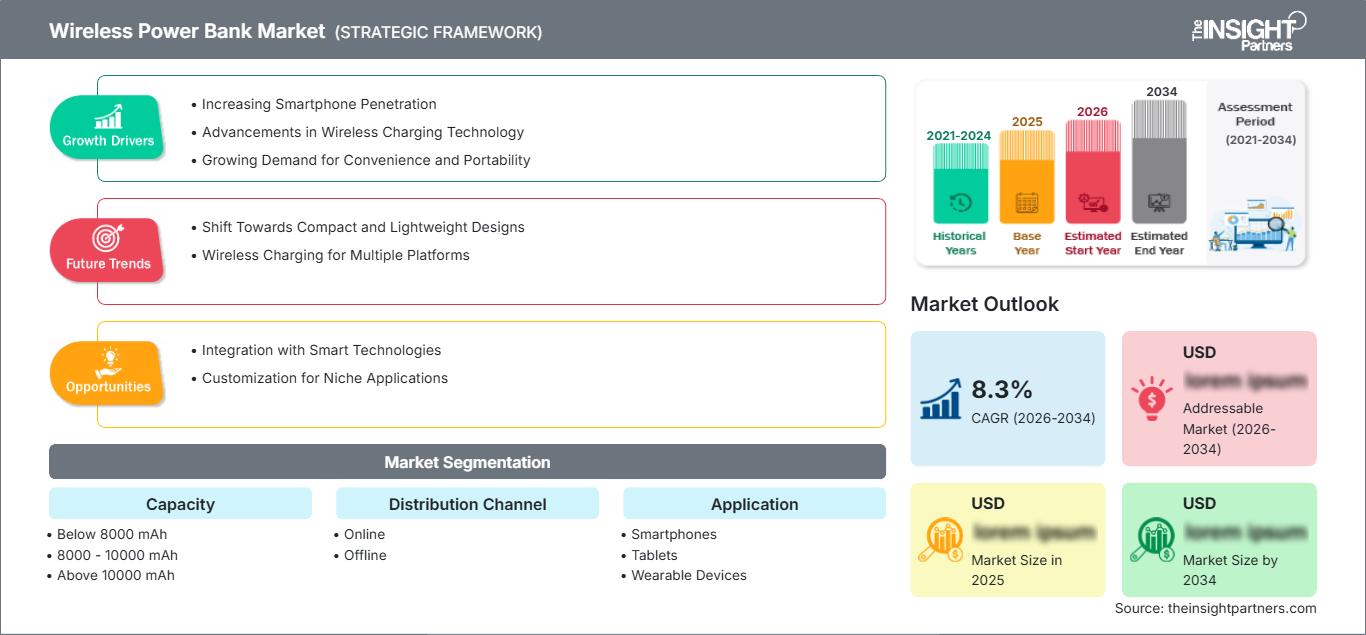
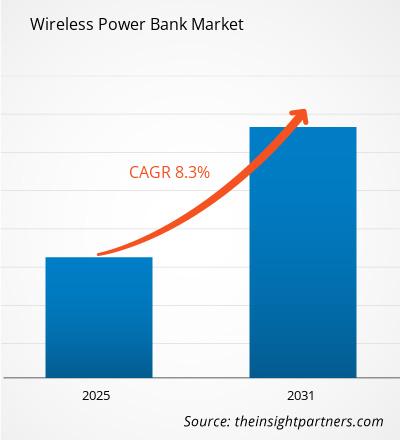
The wireless power bank market was valued at US$ 6.24 Billion in 2025 and is projected to reach US$ 9.59 Billion by 2034, expanding at a CAGR of 4.89% during 2026–2034. The market reflects increasing consumer preference for cable-free charging, broader smartphone compatibility with wireless charging standards, and continued product development around compact designs, magnetic alignment, faster charging, and multi-device functionality.
Across North America, the wireless power bank market size is supported by premium smartphone ownership, frequent travel, and strong adoption of magnetic charging accessories. The regional market is estimated to expand at 3.7–4.2% CAGR from 2026–2034, with replacement demand and Qi2-enabled product availability strengthening consumer acceptance. Established retail ecosystems and high online accessory penetration further support premium product positioning.
Wireless Power Bank Market Assessment and Insights
- North America held an estimated 24–26% wireless power bank market share in 2025 and is expected to grow at a 3.7–4.2% CAGR between 2026–2034, supported by premium smartphone penetration, established wireless charging ecosystems, travel use, and strong accessory replacement demand.
- US represented approximately 72–76% of North American revenue in 2025 and is projected to grow at a 3.8–4.3% CAGR during 2026–2034, driven by high smartphone replacement and online accessory purchasing.
- Europe accounted for approximately 21–23% share in 2025 and is projected to expand at a 4.1–4.6% CAGR during 2026–2034. Germany, the UK, France, Italy, and Spain remain important markets as consumers increasingly favor compact, certified charging accessories.
- Asia Pacific represented approximately 38–41% share in 2025 and is expected to expand at a 5.2–5.7% CAGR during 2026–2034, led by China, Japan, South Korea, and India, where electronics manufacturing, smartphone adoption, and online retail reinforce demand.
- Largest Segment: The 8000–10000 mAh capacity segment held an estimated 34–38% market share in 2025 and is projected to grow at a 4.8–5.3% CAGR during 2026–2034, balancing portability with practical charging capacity.
- High Growth Segment: Wearable Devices represented approximately 12–15% share in 2025 and is expected to grow at a 5.8–6.4% CAGR during 2026–2034, supported by expanding smartwatch and wireless-earbud ecosystems.
- Key companies analyzed in detail: ALLDOCK AUSTRALASIA PTY LTD, AUKEY Technology Co., Ltd., Intex Technologies (India) Limited, Kenu, Otter Products, LLC, Samsung Electronics Co., Ltd., Seasky Industry Co., Ltd., Shenzhen Ugood Technology Co., Ltd., Xiaomi Corporation, and ZAGG Inc.
Source: The Insight Partners' analysis based on proprietary research, government publications, company annual reports, investor presentations, industry databases, and expert interviews.
Wireless power bank product development is now shifting from inductive charging to more advanced technologies, which include magnetic alignment, higher wireless output, thinner cases, thermal management, and stands/cables. The technology Qi2 is especially significant since magnetic alignment helps improve the positioning of the coils. In addition, manufacturers integrate the wireless output with USB-C power delivery, allowing users to choose between wireless convenience and faster wired charging, depending on their needs.
Going forward, the growth in the wireless power bank market is expected to be based more on quality products than on battery capacity alone. Certifications, aviation-safe design, thermal management, use of recycled materials, and ecosystem support can affect purchasing decisions. The development of emerging markets in India and Southeast Asia can provide additional volume potential for manufacturers, while developed markets favor high-end designs and accessories with efficient wireless charging capabilities for different device types.
Wireless Power Bank Market Report Scope
| Report Attribute | Details |
|---|---|
| Market size in 2025 | US$ 6.24 Billion |
| Market Size by 2034 | US$ 9.59 Billion |
| Global CAGR (2026 - 2034) | 4.89% |
| Historical Data | 2021-2024 |
| Forecast period | 2026-2034 |
Wireless Power Bank Market Analysis
The development of wireless power banks will be influenced by trends that are driving the shift to a portable device ecosystem involving smartphones, tablets, smartwatches, earphones, and various other connected electronic gadgets whose charging needs are constantly changing during the day. This ecosystem includes lithium-ion battery makers, charging-enabled electronics producers, certifying organizations, component manufacturers, brands, online stores, distributors, and specialty retailers. High demand can be expected in cases where convenience will compensate for the inefficiency of wireless charging.
Supply factors include the magnetic charging standards, semiconductor supply, battery cell cost, thermal management issues, and the need for compliance with certification standards. Chinese contract manufacturers and others in Asian manufacturing centers will maintain a wide array of offerings, while well-known brands will leverage their capabilities in terms of industrial design, firmware, safety features, guarantees, and distribution channels.
Competitive positioning in the wireless power bank market analysis becomes more reliant on the ability to integrate capacity, charging speed, portability, certification, and ecosystem compatibility. Samsung Electronics Co., Ltd. relies on device-platform integration, while Xiaomi Corporation uses widespread availability along with value-driven specifications. ZAGG Inc. relies on the mophie portfolio, focusing on high-end portable charging with a travel-oriented approach.
The wireless power bank market report reveals that the ALLDOCK AUSTRALASIA PTY LTD, AUKEY Technology Co., Ltd., Kenu, Otter Products, LLC, Seasky Industry Co., Ltd., Shenzhen Ugood Technology Co., Ltd., and Intex Technologies (India) Limited cover specialist, regional, and value segments. Competitive intensity will be high due to the relatively low barriers for manufacturing; however, premium positioning will require higher validation, better thermal engineering, warranty guarantees, and higher credibility in retail. As a result, investment trends become more oriented towards form factor differentiation, certified magnetic systems, and multi-device operation.
● REPORT CUSTOMIZATION
Tailor This Report To Align With Your Specific Business Requirements
This report can be customized to align precisely with your business objectives, scope, and target markets. Customization options include tailored segmentation, geography, competitive analysis, and strategic insights to support informed decision-making.
Customize This Report →WHAT YOU CAN ADJUST
- ● Segmentations
- ● Geography
- ● Competitive Analysis
- ● Language Preferences
Wireless Power Bank Market: Strategic Insights
Regional Insights
North America wireless power bank market
North America accounted for an estimated 24–26% share in 2025 and is projected to register a 3.7–4.2% CAGR through 2034. The United States leads in regional consumption due to high disposable income levels, high adoption of smartphones, business travel, and an extensive infrastructure for e-commerce. Canada adds value to this market due to the similarity in mobile devices usage despite having a smaller addressable market.
Selection of products is now increasingly being driven by the magnetism capability, size, portability at airports, and rapid USB-C output. There is an increase in Qi2 certified products as magnetic charging becomes common with consumers. The region has a good representation of top accessory brands. Recurring sales opportunities are available due to replacement and travel demands.
U.S. wireless power bank market
According to the wireless power bank market forecast, the U.S. represented approximately 72–76% of North American revenue in 2025 and is expected to expand at a 3.8–4.3% CAGR. High rates of smart phone usage, premium device adoption, and online purchase of accessories ensure continued demand. There is also a wide distribution network that exists across major electronics retailers, market places, telecommunications providers, and stores that belong to the brands themselves.
The demand for application stays focused on smartphones but tablets and wearable devices are becoming more significant. Competition comes not only from global players and online sellers but also from traditional accessory makers such as Samsung Electronics Co., Ltd. and ZAGG Inc. The customers pay much attention to the strength of the magnets, wireless outputs, USB-C capabilities, size, heat behavior, and warranties, not just capacity anymore.
Europe wireless power bank market
Europe held an estimated 21–23% share in 2025 and is projected to grow at a 4.1–4.6% CAGR through 2034, with Germany representing a leading national market. Together, the United Kingdom, Germany, France, Italy, and Spain offer a wide market demand, thanks to premium mobile phones, traveling, e-commerce, and the rising popularity of durable electronic accessories.
The United Kingdom still has great potential as a premium accessory market, as online shopping and the popularity of iPhones make the magnetic charging products attractive. Germany gains from the high awareness of consumers about product safety, product quality, and sustainability. France has demonstrated its demand for both premium mobile accessories and accessories for urban travelers. Italy and Spain can also contribute to the growth of the market.
APAC wireless power bank market
APAC represented approximately 38–41% share in 2025 and is forecast to expand at a 5.2–5.7% CAGR, making it the leading regional market. The Chinese market continues to remain the largest national market, while India stands to experience substantial growth as ownership of smartphones, e-commerce activities, and electronics distribution within its borders increase.
The Japanese and South Korean markets offer premium wireless charging due to their advanced consumer electronics industry, and the Australian market provides its contribution through travel and mobile device accessories. The clustering of production within China ensures quick refreshing of products and low prices.
Middle East & Africa wireless power bank market
Middle East and Africa demand is expected to expand at a 4.3–4.8% CAGR through 2034, supported by smartphone adoption, travel activity, urbanization, and expanding organized electronics retail. Saudi Arabia and the UAE lead premium demand, while South Africa represents an important sub-Saharan market for branded accessories.
UAE gains from tourism and business visitors as well as buying of high-end consumer electronic devices, whereas Saudi Arabia sees increasing digital consumption along with increased infrastructure for shopping. South Africa reveals the need for mobile chargers, whereby movement and access to power affect the decision to buy. The rest of MEA region is more concerned about pricing, and reliable mid-range products can be targeted there.
Segmentation Analysis
Capacity
The Capacity segment is expected to register a 4.7–5.1% CAGR during 2026–2034. Capacity selection reflects a trade-off between portability and charging endurance. Mid-capacity products remain particularly relevant because consumers increasingly want enough stored energy for a full day without carrying heavier units. Product design, battery density, wireless efficiency, and airline portability therefore influence competitive differentiation.
- Below 8000 mAh products emphasize lightweight portability and rapid emergency top-ups. Demand is strongest among urban consumers who prioritize pocket-friendly designs, short charging sessions, and lower carrying weight over maximum stored energy.
- 8000 - 10000 mAh products balance practical capacity and portability, making them suitable for daily commuting, travel, and smartphone-intensive usage. Their broad compatibility supports strong retail visibility across premium and mainstream channels.
- Above 10000 mAh products appeal to users requiring extended power availability or multi-device charging. Their strategic value increases where tablets, multiple smartphones, or longer travel periods create higher energy requirements.
Distribution Channel
The Distribution Channel segment is projected to expand at a 4.9–5.3% CAGR during 2026–2034 as consumers increasingly compare technical specifications, compatibility, ratings, and prices digitally. Online channels benefit from extensive assortment and direct brand visibility, while physical stores remain important for consumers seeking immediate availability and product verification.
- Online channels provide broad product variety and enable detailed comparisons of capacity, charging standards, dimensions, compatibility, and warranty conditions. Marketplace visibility also allows emerging brands to reach consumers without extensive physical distribution.
- Offline channels remain strategically important for electronics retailers, telecom stores, airports, and specialty outlets. Immediate purchase availability and physical inspection support adoption among consumers who prioritize established brands and trusted retail environments.
Application
The Application segment is projected to grow at a 5.1–5.6% CAGR during 2026–2034. The wireless power bank market scope is expanding as charging requirements extend beyond smartphones into tablets and wearable electronics. Magnetic alignment and multi-output architectures are enabling suppliers to position portable batteries as broader personal-device power solutions rather than single-device accessories.
- Smartphones remain the principal application because they combine high ownership with frequent charging requirements. Magnetic attachment, fast wireless output, and USB-C fallback enhance convenience during navigation, streaming, commuting, and travel.
- Tablets create demand for larger capacities and higher power delivery because their batteries are substantially larger than those of smartphones. Products serving this category increasingly emphasize higher stored energy and versatile wired output.
- Wearable Devices are gaining strategic importance as smartwatch and earbud ecosystems expand. Smaller magnetic accessories, compact charging surfaces, and multi-device capability can make portable power products more useful for consumers carrying several connected devices.
Opportunity Snapshot
| Application | Revenue Contribution (High/Medium/Low) | Trend Tag | Adoption Stage |
| Smartphones | High | Magnetic Charging | Mature |
| Tablets | Medium | High-Power Output | Scaling |
| Wearable Devices | Medium | Multi-Device | Scaling |
Wireless Power Bank Market Growth Drivers and Impact Analysis
Expansion of Magnetic Wireless Charging Ecosystems
Shift to Magnetic Wireless Charging is Transforming the Value Equation for Portable Batteries. While regular wireless charging systems need consumers to place their smartphones at a certain spot over a charging coil, magnetic systems keep the alignment even when the process is in progress and the device is being actively used. Certification with Qi2 will improve interoperability and allow manufacturers to have a unified technical basis. In turn, such an innovation may make customers more willing to purchase devices that feature stable magnetic connection. Commercial applications extend further than just power banks since charging cases, stands, wires, and other accessories that fit multiple devices are likely to form complete systems. Manufacturers who produce batteries with powerful magnets, temperature control, efficient coils, and small cells may compete based on this feature without having to offer high capacity only.
Increasing Multi-Device Ownership and Mobile Usage
More consumers are using several mobile phones together, making portable charging needs more complicated. A smartphone would be used along with wireless earphones, smartwatch, a tablet, or second phone especially while traveling or working. This practice makes it easy to have demand for items that are able to charge wirelessly and at the same time, through cables. The commercialization becomes possible if suppliers can design small-sized items with enough battery and intelligent power distribution. Multiple device usage also alters buying considerations, as consumers would analyze the availability of connectors, charging priority, stability of the output, and convenience. Items that charge more than one device can prove more useful than single-purpose items even if their capacity is the same. Suppliers can facilitate this process by arranging power banks with smartphones, wearables, travel items, and cables together.
Growth of Portable Electronics and Travel-Centric Consumption
Mobile work, tourism, commuting, and outdoor activity increase the importance of dependable personal power. Portable electronics are used across airports, hotels, public transport, campuses, and flexible workplaces where wall outlets may not be conveniently accessible. Wireless charging adds convenience by reducing dependence on cable availability, while integrated kickstands and compact designs allow users to continue viewing content during charging. Travel requirements also encourage manufacturers to manage weight, battery energy ratings, safety documentation, and airline-carry considerations carefully. The impact differs by geography, with mature markets supporting premium travel products and emerging economies emphasizing affordable capacity and reliability. Brands can capture this opportunity through products designed around specific use cases rather than generic battery specifications, such as slim commuter models, higher-capacity travel units, or multi-device solutions for business travelers and frequent flyers.
Wireless Power Bank Market Future Trends
Qi2.2 and Higher-Power Magnetic Charging
The next phase of the wireless power bank market trends is likely to center on higher wireless output without sacrificing thermal stability or portability. Qi2.2 and 25W-class products are raising consumer expectations beyond the original 15W magnetic profile. Future designs are likely to combine improved coil efficiency, better heat dissipation, more precise power management, and stronger device authentication. The result should be a gradual narrowing of the convenience gap between wireless and wired charging. Product developers may also use higher-output systems to support tablets and larger mobile devices more effectively, although thermal constraints and battery size will remain important. Premium products could increasingly include displays showing remaining energy, charging status, temperature, and output allocation. As the technology matures, certification and interoperability are expected to become stronger purchasing signals, particularly for consumers who want predictable performance across several generations of compatible smartphones and accessories.
Integrated Personal Power Hubs
Future portable batteries are likely to evolve toward compact personal power hubs rather than simple energy-storage accessories. Multi-device charging, built-in cables, digital displays, kickstands, magnetic attachment, and wearable charging surfaces can increasingly be combined within one enclosure. This convergence addresses the practical problem of carrying separate accessories for smartphones, tablets, watches, and earbuds. Product architecture will therefore become more important as manufacturers balance battery capacity against weight, heat, structural durability, and travel requirements. Software-enabled monitoring could also become more common, allowing users to observe charging cycles, battery health, temperature, and power distribution. Sustainability may influence design through recycled plastics, longer-life cells, replaceable components, and more transparent battery information. Such developments can shift competition toward total ownership value, with reliability, serviceability, compatibility, and ecosystem integration becoming more important than headline capacity alone.
Wireless Power Bank Market Opportunities
Premium Certified Product Platforms
A significant investment opportunity lies in developing certified product platforms that can serve multiple smartphone generations and accessory ecosystems. Rather than competing primarily on battery capacity, manufacturers can build differentiated portfolios around magnetic compatibility, higher wireless output, thermal safeguards, USB-C power delivery, and durable materials. Certification can reduce consumer uncertainty and provide retailers with stronger product qualification criteria. Premium platforms also create opportunities for recurring model updates as wireless standards evolve, allowing companies to refresh internal charging modules while preserving recognizable industrial design. Partnerships with smartphone manufacturers, telecom operators, electronics retailers, and travel-focused distributors can further increase market reach. Suppliers with strong engineering capabilities can extend these platforms into multi-device products, creating higher-value bundles. This approach may be especially attractive in North America, Western Europe, Japan, South Korea, and other markets where consumers show stronger willingness to pay for validated performance.
Localized Mid-Market Expansion in Emerging Economies
Emerging economies offer opportunities for manufacturers that can adapt wireless charging products to local purchasing power and distribution structures. India, Southeast Asia, Latin America, and selected Middle Eastern markets combine expanding smartphone ownership with increasing online retail participation. Instead of transferring premium-market specifications unchanged, suppliers can develop locally relevant products emphasizing dependable battery capacity, affordable pricing, durable construction, and broad USB-C compatibility. Regional distributors and marketplace partnerships can reduce customer-acquisition costs while improving availability beyond major metropolitan areas. Local assembly or sourcing can also support shorter replenishment cycles and potentially improve cost competitiveness. Brands should nevertheless maintain rigorous battery safety and certification practices because product reliability is essential for long-term channel relationships. A tiered portfolio spanning entry-level wireless models, mainstream magnetic units, and premium multi-device products could capture consumers as purchasing power and awareness of wireless standards increase.
Frequently Asked Questions

- Comprehensive Market Sizing and Forecast Analysis
- Detailed Segmentation Analysis
- In-Depth Market Dynamics Assessment
- Regional and Country-Level Insights
- Competitive Landscape and Company Benchmarking
- Strategic Business Intelligence
Recent Reports
Testimonials

The Insight Partners provided valuable market intelligence that supported our global go-to-market strategy. Their team was professional, responsive, and attentive to our feedback, providing thoughtful analysis and helpful methodological clarifications throughout the project.
Junmo Kim Chief Financial Officer (CFO), Enertech Co., Ltd.
The Insight Partners' SCADA System Market report is comprehensive, with valuable insights on current trends and future forecasts. The team was highly professional, responsive, and supportive throughout. We are very satisfied and highly recommend their services.
RAN KEDEM Partner, Reali Technologies LTDs
I requested a report on a very specific software market and the team produced the report in a few days. The information was very relevant and well presented. I then requested some changes and additions to the report. The team was again very responsive and I got the final report in less than a week.
JEAN-HERVE JENN Chairman, Future Analytica
We worked with The Insight Partners for an important market study and forecast. They gave us clear insights into opportunities and risks, which helped shape our plans. Their research was easy to use and based on solid data. It helped us make smart, confident decisions. We highly recommend them.
PIYUSH NAGPAL Sr. Vice President, High Beam Global
The Insight Partners delivered insightful, well-structured market research with strong domain expertise. Their team was professional and responsive throughout. The user-friendly website made accessing industry reports seamless. We highly recommend them for reliable, high-quality research services
YUKIHIKO ADACHI CEO, Deep Blue, LLC.
This is the first time I have purchased a market report from The Insight Partners.While I was unsure at first, I visited their web site and felt more comfortable to take the risk and purchase a market report.I am completely satisfied with the quality of the report and customer service. I had several questions and comments with the initial report, but after a couple of dialogs over email with their analyst I believe I have a report that I can use as input to our strategic planning process.Thank you so much for taking the extra time and making this a positive experience.I will definitely recommend your service to others and you will be my first call when we need further market data.
JOHN SUZUKI President and Chief Executive Officer, Board Director, BK Technologies
I wish to appreciate your support and the professionalism you displayed in the course of attending to my request for information regarding to infectious disease IVD market in Nigeria. I appreciate your patience, your guidance, and the fact that you were willing to offer a discount, which eventually made it possible for us to close a deal. I look forward to engaging The Insight Partners in the future, all thanks to the impression you have created in me as a result of this first encounter.
DR CHIJIOKE ONYIA MANAGING DIRECTOR, PineCrest Healthcare Ltd.Reason to Buy
- Informed Decision-Making
- Understanding Market Dynamics
- Competitive Analysis
- Identifying Emerging Markets
- Customer Insights
- Market Forecasts
- Risk Mitigation
- Boosting Operational Efficiency
- Strategic Planning
- Investment Justification
- Tracking Industry Innovations
- Aligning with Regulatory Trends





 Get Free Sample for