
Wireless Presenter Market Share, Growth & Demand by 2034
Coverage: By Types (Infrared, Radio Frequency); Application (Commercial Use, School, Hospital, Other) , and Geography (North America, Europe, Asia Pacific, and South and Central America)
- Status : Data Released
- Report Code : TIPRE00018436
- Category : Electronics and Semiconductor
- No. of Pages : 150
- Available Report Formats :


- Last update date : September 28, 2026


2025 Market Size
US$ 571.02 Mn
Base year value
2034 Forecast
US$ 1,434.15 Mn
Projected by 2034
CAGR 2026-2034
10.77 %
Growth rate
Addressable Market
US$ 8,872.45 Mn
(2026-2034)
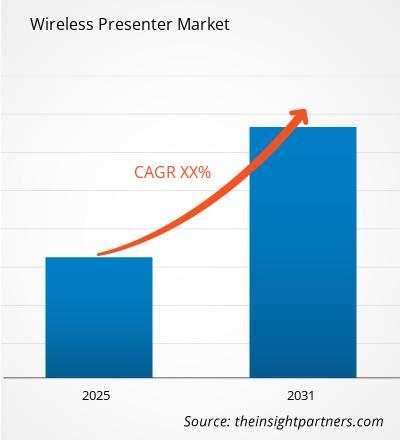
The wireless presenter market is valued at US$ 571.02 Million in 2025 and is projected to reach US$ 1,434.15 Million by 2034, registering a CAGR of 10.77% during 2026–2034. Expansion is supported by continued demand for portable presentation-control devices across business, education, and healthcare settings, alongside product upgrades involving wireless connectivity, ergonomic controls, rechargeable power systems, and integrated pointing capabilities.
North America is expected to remain a structurally important market, with the wireless presenter market size supported by established corporate presentation practices, widespread digital learning infrastructure, and high adoption of wireless peripherals. The region is estimated to expand at a CAGR of 9.4–10.2% through 2034 as enterprises modernize meeting environments and educational institutions increasingly deploy technology-enabled classrooms.
Wireless Presenter Market Assessment and Insights
- North America is expected to account for 34–38% wireless presenter market share in 2025 and grow at a CAGR of 9.4–10.2% between 2026–2034, supported by corporate technology spending and mature education infrastructure.
- US is projected to represent 75–80% of North America's 2025 market and expand at a CAGR of 9.6–10.4% during 2026–2034, led by enterprise and education deployments.
- Europe is estimated to hold 27–31% share in 2025 and grow at a CAGR of 9.8–10.6% between 2026–2034, with Germany, the UK, France, Italy, and Spain supporting demand through digital workplace and classroom modernization.
- Asia Pacific is estimated at 23–27% share in 2025 and is projected to grow at a CAGR of 12.0–13.0% during 2026–2034, led by China, Japan, South Korea, and India.
- Largest Segment is expected to be Radio Frequency, with a 62–66% market share in 2025 and a CAGR of 10.9–11.6% between 2026–2034, reflecting reliable plug-and-play connectivity.
- High Growth Segment is expected to be School application, with an 18–22% market share in 2025 and a CAGR of 12.2–13.0% between 2026–2034, driven by technology-enabled teaching environments.
- Key companies analyzed in detail: Canon Inc., Gembird Software Ltd., Koninklijke Philips N.V., Logitech International S.A., Newmen Technology Corporation, Promate Technologies Ltd., Satechi, Shanghai Norwii Technology Co., Ltd., Targus International LLC, and Trust International B.V.
Source: The Insight Partners' analysis based on proprietary research, government publications, company annual reports, investor presentations, industry databases, and expert interviews.
Whereas presentation-control technology had progressed from infrared-based clicker-style remotes to radio frequency-based alternatives with longer operational range, better reception, laser or digital pointing, and software compatibility, design trends have moved toward smaller form factors, intuitive buttons, rechargeable batteries, and multi-functionality. The resulting increased use cases have now moved from the traditional business meeting room to include learning institutions such as classrooms, training facilities, medical presentation environments, seminars, and collaborative hybrid settings.
As the forecast period progresses, wireless presenter manufacturers can be expected to focus on the following trends: dual connectivity capabilities, USB-C chargers, software compatibility, and pointing that continues to work even in virtual environments. Growth from emerging countries in the Asia Pacific region and the Middle East can be expected to drive the demand for the product as digital presentation facilities are set up in businesses, educational establishments, and governmental organizations.
Wireless Presenter Market Report Scope
| Report Attribute | Details |
|---|---|
| Market size in 2025 | US$ 571.02 Million |
| Market Size by 2034 | US$ 1,434.15 Million |
| Global CAGR (2026 - 2034) | 10.77% |
| Historical Data | 2021-2024 |
| Forecast period | 2026-2034 |
Wireless Presenter Market Analysis
The demand will depend upon the need for free movement of the user in order to control the slides, media and the visual pointing without going back to the computer. Hence, the growth in the wireless presenter will be driven by modernization of meeting rooms, digitization of classrooms, professional training, and communications related to events. The supply chain consists of semiconductor component providers, radio-component providers, device manufacturers, software providers, distributors, resellers and institutions.
The supply side is biased in favor of peripheral device manufacturers with wide distribution networks, whereas the specialist brands compete through pricing, compactness, functions of the stylus and application. The RF devices are especially appealing as they offer simple receiving operations without depending on the configuration of host device via Bluetooth technology. On the other hand, the devices with Bluetooth capability are gaining significance as well.
The forecast for the wireless presenter market also shows that there is a fragmented nature of competition among such players as Logitech International S.A., Canon Inc., Targus International LLC, and Koninklijke Philips N.V. based on their branding and periphery portfolio. Satechi and Promate Technologies Ltd. provide multifunctional and modern connectivity capabilities, while Shanghai Norwii Technology Co., Ltd., Gembird Software Ltd., Newmen Technology Corporation, and Trust International B.V. target cost-conscious consumers and regional markets.
Positioning is now becoming more dependent on the ability to combine affordability and functionality. Logitech International S.A. provides both traditional laser presenters and advanced digital pointing technology, while Targus International LLC focuses on plug and play RF technology. Satechi is now moving toward Bluetooth and USB-C enabled presentation control technology, while Promate Technologies Ltd. offers presentation controls combined with a stylus.
● REPORT CUSTOMIZATION
Tailor This Report To Align With Your Specific Business Requirements
This report can be customized to align precisely with your business objectives, scope, and target markets. Customization options include tailored segmentation, geography, competitive analysis, and strategic insights to support informed decision-making.
Customize This Report →WHAT YOU CAN ADJUST
- ● Segmentations
- ● Geography
- ● Competitive Analysis
- ● Language Preferences
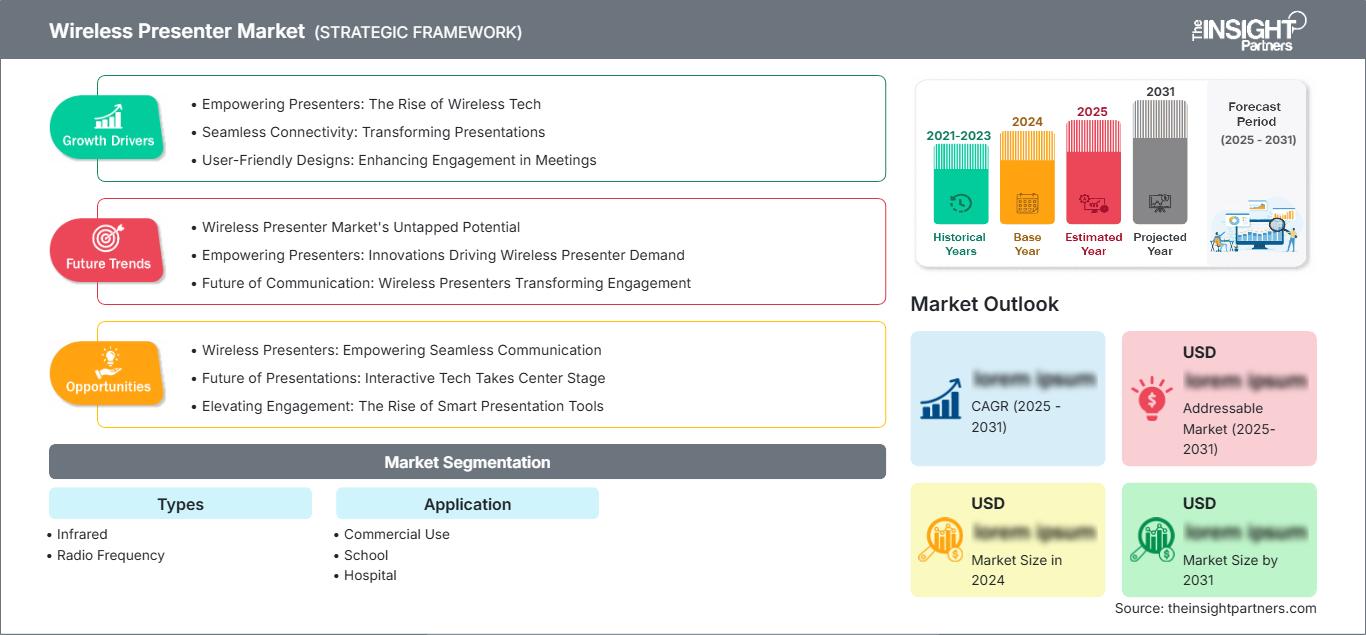
Wireless Presenter Market: Strategic Insights
Regional Insights
North America Wireless Presenter Market
North America is estimated to hold 34–38% of the global wireless presenter market in 2025 and is projected to expand at a CAGR of 9.4–10.2% through 2034. US is considered as the main regional center for demand since professional presentations, training, education, and government communications often use digital displays and peripheral control devices. In addition, Canada is contributing through technology renewal at the institutional level.
Increasingly, enterprise purchasing decisions are based on mixed meeting approaches, whereas educational institutions have continued to incorporate interactive displays, projectors, and collaboration software. The compatibility with PowerPoint, Keynote, Google Slides, and conference software will enable replacement opportunities. Well-known manufacturers, including Logitech International S.A. and Targus International LLC, will be favored by wide distribution, whereas niche manufacturers will thrive through cost and functionality.
U.S. Wireless Presenter Market Market
The U.S. is estimated to represent 75–80% of North America's 2025 wireless presenter market and is expected to grow at a CAGR of 9.6–10.4% through 2034. Strong enterprise technology budgets, extensive higher-education infrastructure, professional training activity, and large-scale conference usage support recurring demand. Corporate applications remain important because presenters provide simple control across meeting rooms and external event venues.
From the wireless presenter market report, it is evident that trends in terms of applications have expanded into areas other than the traditional navigation of slides. The inclusion of digital pointers, cursor control, media presentation capabilities, and even Bluetooth capability makes such presenters more useful for hybrid presentations. Established companies that have presence in their products include Logitech International S.A., Canon Inc., and Targus International LLC, while Satechi and Promate Technologies Ltd. cater to users who desire multiple functions.
Europe Wireless Presenter Market Market
Europe is estimated to account for 27–31% of global demand in 2025 and is expected to grow at a CAGR of 9.8–10.6% through 2034. The UK benefits from extensive corporate and university presentation activity. Germany combines strong industrial training requirements with mature enterprise technology procurement, while France is supported by government, education, and business digitization. Italy and Spain contribute through corporate events, schools, universities, and professional training. Germany is expected to remain the leading European country because of its industrial base and institutional technology spending.
APAC Wireless Presenter Market Market
APAC is estimated at 23–27% share in 2025 and is projected to grow at a CAGR of 12.0–13.0% through 2034. China remains the leading market, supported by manufacturing capacity and large institutional demand. Japan and South Korea benefit from advanced workplace technology, while India gains from education digitization, corporate training, and expanding technology adoption. Australia contributes through mature business and education infrastructure. Public investment in digital classrooms and enterprise modernization should reinforce regional adoption.
Middle East & Africa Wireless Presenter Market Market
Middle East and Africa is projected to expand at a CAGR of 8.5–9.5% through 2034. Saudi Arabia and the UAE are expected to lead regional demand as economic diversification programs increase investments in corporate facilities, education, conferences, and smart infrastructure. South Africa provides an important institutional market, while the rest of MEA offers longer-term potential through improving connectivity and technology procurement.
Segmentation Analysis
Types
The Types segment is divided between Infrared and Radio Frequency technologies. Radio Frequency is expected to maintain the stronger position, supported by longer operating distances and simple receiver-based connectivity, while infrared remains relevant for basic, cost-sensitive presentation environments. The overall Types segment is expected to expand at a CAGR of 10.6–11.3% during 2026–2034.
- Infrared: Infrared presenters remain relevant where straightforward line-of-sight operation, low device complexity, and economical procurement are priorities. Demand is concentrated in basic presentation environments requiring conventional slide navigation.
- Radio Frequency: Radio Frequency presenters command stronger adoption where users require freedom of movement, stable connections, and operation across larger rooms. Their plug-and-play receiver architecture supports corporate and educational procurement.
Application
The Application segment covers Commercial Use, School, and Hospital environments. Commercial Use represents the broadest installed base because businesses conduct frequent presentations, training programs, meetings, and conferences. School applications are positioned for faster expansion as digital classrooms increase demand for accessible presentation-control tools. The Application segment is expected to grow at a CAGR of 10.7–11.5% during 2026–2034.
- Commercial Use: Commercial users prioritize dependable slide control, portability, and compatibility with common presentation platforms. Demand spans corporate meetings, sales presentations, training programs, conferences, and consulting engagements.
- School: Schools increasingly require simple wireless controls for interactive lessons, lectures, demonstrations, and multimedia instruction. Affordable devices with intuitive controls are strategically important where multiple classrooms require standardized peripherals.
- Hospital: Hospitals use presenters in clinical education, staff training, conferences, and administrative meetings. Demand favors compact devices that support reliable control in presentation rooms without introducing complicated installation requirements.
Opportunity Snapshot
| Application | Revenue Contribution | Trend Tag | Adoption Stage |
| Commercial Use | High | Hybrid Meetings | Mature |
| School | Medium | Digital Classrooms | Scaling |
| Hospital | Low | Clinical Training | Emerging |
Wireless Presenter Market Growth Drivers and Impact Analysis
Expansion of Digital and Hybrid Presentation Environments
The continued use of digital displays across offices, classrooms, training centers, and event venues is broadening the addressable application base for presentation peripherals. Hybrid work has also increased the importance of controlling content while remaining physically separated from a computer or display. This creates demand for devices that combine slide navigation with cursor, multimedia, and pointing functions. In education, wireless control can allow teachers to move around classrooms while maintaining command over lesson content. In commercial environments, presenters support more dynamic meeting formats and reduce dependence on fixed podium controls. The resulting replacement cycle benefits manufacturers capable of delivering reliable connectivity, broad software compatibility, ergonomic designs, and manageable total ownership costs.
Shift Toward Multifunctional and Dual-Connectivity Devices
Product differentiation is increasingly moving beyond basic next-slide and previous-slide functions. Buyers are showing greater value sensitivity toward devices that combine presentation control, digital pointing, cursor operation, multimedia navigation, and compatibility with multiple host platforms. Dual connectivity can address organizations using mixed device fleets, particularly where Windows, macOS, tablets, and conference-room systems coexist. Rechargeable batteries and USB-C charging further reduce dependence on disposable batteries and simplify equipment management. Multifunctional designs also allow manufacturers to address users who require presentation control alongside classroom annotation or media navigation. This evolution supports premium positioning while creating opportunities for suppliers to compete through software-enabled features, customization, and cross-platform functionality rather than relying solely on hardware specifications.
Institutional Digitization and Standardized Peripheral Procurement
Education, healthcare, and public-sector organizations increasingly standardize digital equipment across multiple rooms and departments. Such procurement programs can create repeatable demand for presentation peripherals when devices meet interoperability, durability, security, and ease-of-use requirements. Schools may purchase multiple units for classrooms, while hospitals can deploy presenters across training and conference facilities. Corporate groups with distributed offices can similarly standardize presentation accessories to simplify support and replacement. The impact is particularly relevant for manufacturers offering dependable product availability, consistent operating procedures, and compatibility across widely used presentation platforms. Distributors and resellers can benefit by packaging presenters with displays, docking equipment, conference-room accessories, or classroom technology. Standardization therefore shifts purchasing from individual accessories toward broader equipment-management decisions.
Wireless Presenter Market Future Trends
Software-Enhanced Digital Pointing
The wireless presenter market trends are moving toward digital pointing systems that can highlight, magnify, or interact with content without depending exclusively on a physical laser beam. This approach is particularly relevant for hybrid presentations, where audiences may view shared screens remotely and a physical laser may not be visible. Future products are likely to integrate pointer customization, presentation timers, cursor functions, and application-specific controls into companion software. Manufacturers may increasingly differentiate through software ecosystems that provide configuration, firmware management, battery monitoring, and user profiles. Such capabilities can extend product utility beyond the presentation itself and improve integration with modern collaboration platforms. As displays shift toward interactive panels and screen-sharing environments, digital pointing should become an increasingly important design consideration for premium presentation devices.
USB-C and Multi-Device Compatibility
Future product development is likely to emphasize seamless compatibility across laptops, tablets, smartphones, and conference-room systems. USB-C adoption is reducing the relevance of older connector standards, while Bluetooth provides an alternative where users want to avoid dedicated receivers. Presenters that support multiple connection methods can serve organizations with heterogeneous device fleets and reduce compatibility concerns during meetings or classroom sessions. Rechargeable batteries combined with USB-C charging can also simplify device management and reduce consumable requirements. Manufacturers may increasingly package connectivity as part of the user experience rather than treating it as a technical specification. The competitive advantage will therefore favor products that establish connections quickly, maintain stable operation, and support widely used presentation applications without extensive configuration.
Wireless Presenter Market Opportunities
Growth in Education Technology Procurement
Education provides an attractive opportunity for suppliers capable of developing cost-effective presentation devices with intuitive controls and strong compatibility. Schools and universities increasingly use interactive displays, projectors, digital learning platforms, and multimedia content, creating a requirement for teachers to control material while remaining engaged with students. Vendors can target institutional procurement through durable designs, standardized models, rechargeable power, and simplified device management. Bundling presenters with classroom displays, collaboration equipment, or teacher technology kits could improve procurement efficiency. Emerging markets may offer additional potential as governments and education providers expand digital-learning infrastructure. Manufacturers should also consider accessibility, tactile differentiation, and simple controls because these characteristics can improve usability across different classroom environments. Long-term supply agreements could create recurring replacement demand.
Premium Hybrid-Work and Conference Applications
Premium commercial applications create opportunities for devices positioned around presentation quality, software integration, and hybrid audience engagement rather than basic slide navigation. Corporate users may value digital pointers, programmable controls, vibration alerts, multimedia commands, and dual connectivity when presentations involve multiple screens or remote participants. Suppliers can differentiate through enterprise support, centralized configuration, warranty services, and compatibility validation across collaboration platforms. Conference organizers and professional training providers represent another addressable customer group because presenters are frequently used across changing venues and equipment configurations. Strategic partnerships with meeting-room integrators and workplace technology distributors could strengthen market access. A premium strategy is most viable where the product demonstrably reduces presentation friction, supports varied devices, and improves presenter mobility without requiring complicated setup.
Frequently Asked Questions

- Comprehensive Market Sizing and Forecast Analysis
- Detailed Segmentation Analysis
- In-Depth Market Dynamics Assessment
- Regional and Country-Level Insights
- Competitive Landscape and Company Benchmarking
- Strategic Business Intelligence
Recent Reports
Testimonials

The Insight Partners provided valuable market intelligence that supported our global go-to-market strategy. Their team was professional, responsive, and attentive to our feedback, providing thoughtful analysis and helpful methodological clarifications throughout the project.
Junmo Kim Chief Financial Officer (CFO), Enertech Co., Ltd.
The Insight Partners' SCADA System Market report is comprehensive, with valuable insights on current trends and future forecasts. The team was highly professional, responsive, and supportive throughout. We are very satisfied and highly recommend their services.
RAN KEDEM Partner, Reali Technologies LTDs
I requested a report on a very specific software market and the team produced the report in a few days. The information was very relevant and well presented. I then requested some changes and additions to the report. The team was again very responsive and I got the final report in less than a week.
JEAN-HERVE JENN Chairman, Future Analytica
We worked with The Insight Partners for an important market study and forecast. They gave us clear insights into opportunities and risks, which helped shape our plans. Their research was easy to use and based on solid data. It helped us make smart, confident decisions. We highly recommend them.
PIYUSH NAGPAL Sr. Vice President, High Beam Global
The Insight Partners delivered insightful, well-structured market research with strong domain expertise. Their team was professional and responsive throughout. The user-friendly website made accessing industry reports seamless. We highly recommend them for reliable, high-quality research services
YUKIHIKO ADACHI CEO, Deep Blue, LLC.
This is the first time I have purchased a market report from The Insight Partners.While I was unsure at first, I visited their web site and felt more comfortable to take the risk and purchase a market report.I am completely satisfied with the quality of the report and customer service. I had several questions and comments with the initial report, but after a couple of dialogs over email with their analyst I believe I have a report that I can use as input to our strategic planning process.Thank you so much for taking the extra time and making this a positive experience.I will definitely recommend your service to others and you will be my first call when we need further market data.
JOHN SUZUKI President and Chief Executive Officer, Board Director, BK Technologies
I wish to appreciate your support and the professionalism you displayed in the course of attending to my request for information regarding to infectious disease IVD market in Nigeria. I appreciate your patience, your guidance, and the fact that you were willing to offer a discount, which eventually made it possible for us to close a deal. I look forward to engaging The Insight Partners in the future, all thanks to the impression you have created in me as a result of this first encounter.
DR CHIJIOKE ONYIA MANAGING DIRECTOR, PineCrest Healthcare Ltd.Reason to Buy
- Informed Decision-Making
- Understanding Market Dynamics
- Competitive Analysis
- Identifying Emerging Markets
- Customer Insights
- Market Forecasts
- Risk Mitigation
- Boosting Operational Efficiency
- Strategic Planning
- Investment Justification
- Tracking Industry Innovations
- Aligning with Regulatory Trends





 Get Free Sample for