
Yaw System Market Trends, Size & Growth by 2034
Coverage: By Type (Active Yaw Systems, Passive Yaw Systems); Application (Wind Energy, Gear Motors, Water Conservancy Project, Others) , and Geography (North America, Europe, Asia Pacific, and South and Central America)
- Status : Data Released
- Report Code : TIPRE00021471
- Category : Manufacturing and Construction
- No. of Pages : 150
- Available Report Formats :


- Last update date : September 28, 2026


2025 Market Size
US$ 1.37 Bn
Base year value
2034 Forecast
US$ 3.55 Bn
Projected by 2034
CAGR 2026-2034
11.20 %
Growth rate
Addressable Market
US$ 21.76 Bn
(2026-2034)
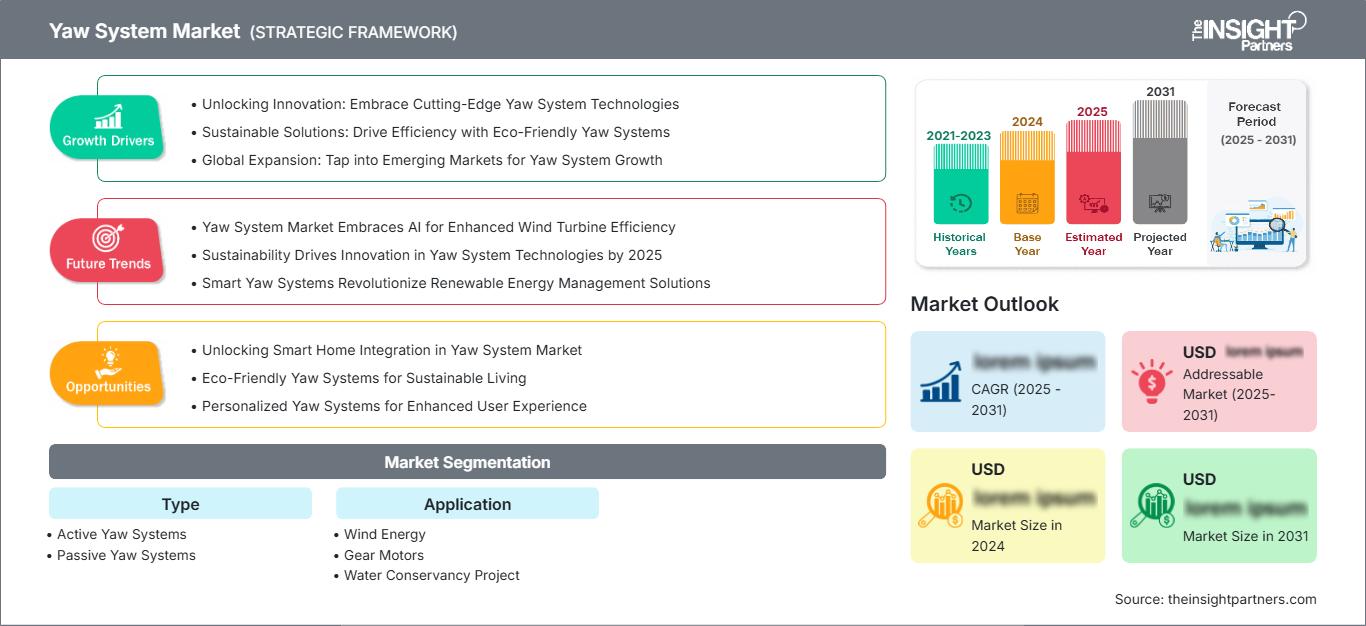
The yaw system market is expanding as wind turbine developers prioritize precise nacelle orientation, drivetrain protection, and higher operating availability across onshore and offshore installations. The market is valued at US$ 1.37 Billion in 2025 and is projected to reach US$ 3.55 Billion by 2034, registering a CAGR of 11.20% from 2026 to 2034. Increasing turbine ratings, greater deployment in variable wind regimes, and stronger emphasis on lifecycle efficiency are supporting demand for integrated yaw-control technologies.
North America is expected to remain a strategically important market, with a modeled CAGR of 9–11% during 2026–2034, supported by repowering programs, utility-scale wind additions, and demand for dependable turbine-control components. The regional yaw system market size is also benefiting from domestic supply-chain localization, replacement demand, and engineering upgrades for aging wind assets.
Yaw System Market Assessment and Insights
- North America: The region is modeled to represent 24–28% yaw system market share in 2025, with the market growing at a 9–11% CAGR between 2026–2034 as repowering, grid modernization, and turbine reliability investments strengthen component demand.
- US: The US is estimated to account for 68–72% of North American 2025 demand, expanding at a 9–11% CAGR between 2026–2034, supported by utility-scale wind refurbishment and new capacity.
- Europe: Europe is modeled at 29–33% share in 2025, growing at a 10–12% CAGR between 2026–2034. Germany, the UK, Spain, France, and Italy remain important due to offshore deployment, repowering, and established turbine manufacturing ecosystems.
- Asia Pacific: Asia Pacific is estimated at 34–38% share in 2025, with a 12–14% CAGR between 2026–2034. China, India, Japan, and South Korea provide the strongest structural demand through manufacturing scale and renewable-energy investment.
- Largest Segment: Wind Energy is modeled as the largest application, with 78–82% market share in 2025 and a 10–12% CAGR from 2026–2034, reflecting its direct linkage to turbine installations.
- High Growth Segment: Active Yaw Systems are estimated at 62–66% market share in 2025, advancing at 12–14% CAGR from 2026–2034 as automated orientation becomes more important for larger turbines.
- Key companies analyzed in detail: Bonfiglioli S.P.A., Eaton Corporation plc, Hydratech Industries Wind Power, Kor-Pak Corporation, NGC Gears, Seaglet Co., Ltd., Siemens AG, Svendborg Brakes ApS, SIBRE Siegerland Bremsen GmbH, ZOLLERN GmbH & Co. KG, Grede Holdings LLC, and Altra Industrial Motion Corp.
Source: The Insight Partners' analysis based on proprietary research, government publications, company annual reports, investor presentations, industry databases, and expert interviews.
Yaw system market growth in terms of engineering will become driven by larger rotor diameter, higher nacelle loads, and turbine operating characteristics. Mechanical gears, motors, brakes, controllers, sensors, and the software that controls all of those items are becoming designed and manufactured together rather than separately. All of that means more torque density, more thermal efficiency, more accurate positioning, proper sealing, and more condition monitoring are needed. This trend creates an advantage for suppliers who have integrated engineering capability when it comes to customized turbine and lifecycle needs.
During the forecast period, funding for the yaw system market will be moving towards more offshore-focused product lines, monitoring solutions, modular replacement systems, and manufacturing capability closer to new wind projects. Government support of renewable electricity generation, localization of procurement process, and the need for carbon neutral grids can increase the addressable installation base. On top of that, yaw system selection is likely to be based on lifecycle costs rather than initial acquisition costs.
Yaw System Market Report Scope
| Report Attribute | Details |
|---|---|
| Market size in 2025 | US$ 1.37 Billion |
| Market Size by 2034 | US$ 3.55 Billion |
| Global CAGR (2026 - 2034) | 11.20% |
| Historical Data | 2021-2024 |
| Forecast period | 2026-2034 |
Yaw System Market Analysis
Demand is strongly tied to the installation of turbines since each traditional horizontal-axis turbine needs regulated orientation of its nacelle to align aerodynamically with the varying wind direction. This means that the market expansion of the yaw system industry will depend on the number of new installations, replacement cycles, and upgrades of existing systems. Value chains in the yaw system industry include motors, gearboxes, brakes, bearings, controllers, sensors, power electronics, engineering integrators, turbine OEMs, and servicing firms.
Supply chains are affected by the availability of steel, machining, bearings, electrical parts, and drives industries. The suppliers are increasingly adopting modular geartrain designs and standard interface design to save on engineering time without sacrificing torque customizability. Increasing sizes of offshore turbines increase the need for corrosion resistance, load capacity, and maintainability. These factors lead to an ecosystem favoring vendors with integrated mechanical transmission, electrical actuation, braking, and monitoring capabilities without OEM limitations.
Engineering competency, customization, installed base, and service have become increasingly important in competing in the yaw system market forecast. Bonfiglioli S.P.A. offers gearboxes used in conjunction with motors and inverters, while Siemens AG is involved in wind equipment and turbine controls. Svendborg Brakes ApS, SIBRE Siegerland Bremsen GmbH, Hydratech Industries Wind Power, and Eaton Corporation plc add competition to the marketplace through their capabilities in braking, hydraulics, electricity, and controls.
Strategy in terms of investments is also becoming application-oriented. ZOLLERN GmbH & Co. KG and NGC Gears are focused on precision transmissions, whereas Kor-Pak Corporation, Grede Holdings LLC, and Altra Industrial Motion Corp. complement this with mechanical and braking abilities. Seaglet Co., Ltd. is adding competition through its special abilities, while Svendborg Brakes ApS and SIBRE Siegerland Bremsen GmbH benefit from experience in braking systems that can handle large loads. Yaw System Market Report thus examines competition through breadth of products offered, integration ability, geography, and applicability.
● REPORT CUSTOMIZATION
Tailor This Report To Align With Your Specific Business Requirements
This report can be customized to align precisely with your business objectives, scope, and target markets. Customization options include tailored segmentation, geography, competitive analysis, and strategic insights to support informed decision-making.
Customize This Report →WHAT YOU CAN ADJUST
- ● Segmentations
- ● Geography
- ● Competitive Analysis
- ● Language Preferences
Yaw System Market: Strategic Insights
Regional Insights
North America yaw system market
North America is modeled to hold 24–28% share in 2025, with a 9–11% CAGR through 2034. The US represents most regional demand, while Canada makes its contribution through further wind expansion and equipment renewal. Repowering is especially significant because older turbines need drivetrain, brake, control system, and orientation system upgrades. Project developers pay increasing attention to downtime minimization because it can significantly influence project economics. Domestic manufacturing programs and local sourcing demands may push suppliers to organize their inventories and technical support services close to wind power plants. Thus, the market includes both original equipment demand and growing aftermarket opportunities in mature projects.
Growing importance of project economics favoring equipment capable of coping with the effects of variable weather conditions and frequent adjustments along with long operating periods opens another business opportunity for component manufacturers. Offshore projects also add one more dimension because marine environment makes it necessary to implement even better measures of protecting against corrosion and improve reliability of components. Suppliers having established relations with turbine producers, engineering companies, and independent service companies can supply replacement parts along with new equipment. Canada will remain a smaller but important player in this market.
U.S. yaw system market Market
The US represents approximately 68–72% of North American 2025 demand, with a modeled 9–11% CAGR through 2034. Installed capacity, repowering, and part replacement facilitate sustained demand. The demands of applications are becoming increasingly concerned about ease of maintenance, controls integration, and reliability during varying operating conditions.
There are global industrial players and component manufacturers among the supplier base domestically. Turbine operators have started looking at their braking systems, drives, and positioning components altogether as compatibility among components is an aspect that plays a role in maintenance planning. New installations continue to play an important role; however, retrofits could be a sustainable procurement cycle where turbines reach mid-life. Offshore installations could create a niche segment where equipment requirements get more stringent.
Europe yaw system market Market
Europe is modeled at 29–33% share in 2025, expanding at a 10–12% CAGR, with Germany positioned as a leading market. Wind energy, offshore development, turbine manufacturing expertise, repowering, and the presence of component suppliers are some of the strengths of the region. Germany and the UK both have considerable engineering depth, while Spain, France, Italy, and others cater to onshore replacement needs. In Europe, purchasing is now taking into consideration durability, energy efficiency, maintenance periods, and turbine specifications. All of these help create more high-quality systems than just quantity-based competition.
It is still quite significant for Germany, since it is well-equipped for manufacturing gearboxes, brakes, motors, and industrial components. The UK offers a good opportunity that is offshore-oriented where corrosion and remote maintenance are important criteria in purchasing. Spain and France offer established wind infrastructure combined with investment in renewable energy, while Italy offers specific manufacturing abilities in industry. It is also worth noting that both Italy and Spain offer an opportunity for component suppliers that can serve regional turbine and drivetrain ecosystems.
APAC yaw system market Market
APAC is modeled at 34–38% share in 2025 and a 12–14% CAGR, led by China. China has manufacturing capabilities at scale, while Japan and South Korea offer advanced engineering capabilities. India provides growing onshore demand, while Australia brings its demand via renewable utility scale projects.
The demand in the region comes from domestic manufacturing, renewable purchase, and modernization of the existing portfolio. China still represents the main volume hub, while India becomes more and more relevant for equipment production and maintenance onshore. Japan and South Korea bring technology-oriented demand, especially where reliability and compactness of the equipment matter.
Middle East & Africa yaw system market Market
Middle East and Africa demand is modeled to grow at a 9–11% CAGR, with Saudi Arabia and the UAE leading emerging procurement activity. South Africa offers the regional proven track record for wind power, while others depend on projects. Energy diversification and investments in infrastructure offer more opportunities.
Saudi Arabia and the UAE have built renewable energy pipelines, which could generate demand for reliable turbine parts and services. South Africa is the regional platform that offers replacement and maintenance chances in the existing wind framework. Other projects in the region are more influenced by financing, grid readiness, localization demands, and logistics. Companies with capacity to offer reliable equipment, services, and replacements stand to benefit.
Segmentation Analysis
Type
Type segmentation distinguishes Active Yaw Systems and Passive Yaw Systems according to how turbine orientation is controlled. Active architectures are expected to retain technological leadership because larger turbines require coordinated electromechanical control, accurate positioning, and automated response. The yaw system market scope consequently remains strongly linked to active-control adoption.
- Active Yaw Systems: These systems use powered actuation, control logic, and braking to adjust nacelle orientation. Their integration with sensors and digital controls makes them strategically important for larger turbines requiring precise wind tracking and automated operational management.
- Passive Yaw Systems: Passive architectures rely more heavily on aerodynamic or mechanical response mechanisms. They remain relevant where simplicity, lower system complexity, and application-specific operating requirements outweigh the benefits of sophisticated powered control.
The main Type segment, Active Yaw Systems, is modeled to register a 12–14% CAGR from 2026–2034, supported by increasing turbine scale, automation, and requirements for precise nacelle positioning. Integration with digital controllers and condition-monitoring functions can further improve maintenance planning.
Application
Application segmentation covers Wind Energy, Gear Motors, and Water Conservancy Project applications. Wind Energy remains the dominant use case because yaw equipment is integral to turbine nacelle orientation. Gear-motor applications provide a broader industrial pathway, while water-conservancy installations create specialized demand where controlled mechanical movement is required.
- Wind Energy: This application represents the principal demand center, supported by new turbine installations, repowering, offshore projects, and replacement requirements. Suppliers prioritize high torque, reliability, corrosion resistance, and compatibility with turbine control architectures.
- Gear Motors: Gear-motor applications create opportunities where controlled rotary movement, load handling, and compact transmission assemblies are required. Their strategic relevance extends the addressable customer base beyond dedicated turbine projects.
- Water Conservancy Project: These installations require durable mechanical actuation under demanding environmental conditions. Procurement typically emphasizes long service life, load capacity, maintenance accessibility, and dependable movement control.
The main Application segment, Wind Energy, is modeled to grow at a 10–12% CAGR from 2026–2034, reflecting its close relationship with global wind deployment and the replacement cycle of installed turbines.
Opportunity Snapshot
Market Opportunity Snapshot
| Application | Revenue Contribution (High/Medium/Low) | Trend Tag | Adoption Stage |
|---|---|---|---|
| Wind Energy | High | Offshore Wind | Scaling |
| Gear Motors | Medium | Precision Drives | Scaling |
| Water Conservancy Project | Low | Hydraulic Control | Emerging |
Yaw System Market Growth Drivers and Impact Analysis
Increasing turbine size raises torque and reliability requirements
Larger turbine rotors increase the mechanical loads transferred through the nacelle orientation mechanism, making torque capacity, bearing performance, braking precision, and structural rigidity more important. As turbine developers pursue higher output from individual machines, suppliers must engineer components capable of handling greater loads without disproportionate increases in weight or maintenance complexity. This trend favors high-torque planetary gearboxes, improved seals, stronger materials, and better thermal management. It also encourages co-engineering between turbine OEMs and component manufacturers earlier in the design cycle. For suppliers, the commercial impact extends beyond initial equipment sales because higher-value components can generate additional service, refurbishment, and replacement opportunities. The effect is particularly pronounced in offshore installations, where component access is expensive and equipment reliability directly influences maintenance economics.
Repowering creates recurring demand for upgraded orientation equipment
Repowering is creating an important replacement pathway because many operating wind farms contain turbines designed around earlier generations of control, braking, and drivetrain technology. Rather than replacing complete wind farms immediately, operators can selectively upgrade components to extend useful operating life and improve availability. Yaw equipment is well suited to this approach because drives, brakes, motors, sensors, and controllers can often be engineered around existing turbine interfaces. The commercial impact is a broader aftermarket opportunity that is less dependent on annual new-build installations. Suppliers that maintain documentation, dimensional compatibility data, retrofit kits, and field-service capabilities can reduce engineering barriers for operators. Repowering also encourages demand for digitally enabled components capable of supplying operating-condition information, helping maintenance teams identify wear and intervene before mechanical degradation results in extended turbine downtime.
Digital monitoring is improving lifecycle management
Condition monitoring is increasingly being incorporated into industrial drive and turbine-control architectures, changing how operators evaluate yaw equipment. Sensors can support measurement of torque, vibration, temperature, braking behavior, and mechanical condition, creating data that can be used to schedule inspections more efficiently. The resulting value proposition is not simply improved monitoring but better coordination of maintenance resources, spare-parts inventories, and turbine availability. Suppliers that combine mechanical equipment with sensing and control capabilities can differentiate their products from conventional standalone drives. Digital integration also creates opportunities for predictive-maintenance services, remote diagnostics, and performance benchmarking across turbine fleets. As wind farms become more geographically distributed and offshore assets become more expensive to access, the economic value of identifying abnormal behavior before failure increases, supporting wider adoption of connected yaw equipment.
Yaw System Market Future Trends
Sensor-rich yaw architectures will become more standardized
The yaw system market trends are likely to move toward sensor-rich architectures in which mechanical components, drives, brakes, and controllers exchange operational data continuously. Instead of treating monitoring as an optional service layer, manufacturers are expected to embed sensing capability into standard product configurations. Torque, vibration, temperature, position, and brake-condition information can support automated diagnostics and more precise maintenance scheduling. Standardized communication interfaces should make integration easier across turbine platforms, reducing the engineering burden associated with fleet-wide monitoring. Over time, data from multiple turbines can also improve component selection and maintenance intervals by revealing recurring failure patterns. This trend will particularly benefit offshore operators, where remote access and vessel logistics make preventive intervention economically attractive. Suppliers with interoperable hardware and software architectures are therefore likely to gain strategic importance.
Modular platforms will support multi-turbine product families
Future product development is expected to emphasize modular yaw platforms that can be adapted across several turbine ratings without requiring entirely new mechanical architectures. Modular gear stages, motor interfaces, braking packages, and electronic controls can shorten engineering cycles while allowing manufacturers to configure products for different torque and environmental requirements. This approach can improve manufacturing efficiency and simplify spare-parts management for operators with mixed turbine fleets. Offshore equipment may increasingly use modular corrosion-protection and sealing packages, while onshore systems can prioritize compactness and ease of replacement. Standardized interfaces could also make retrofit projects easier by reducing the need for extensive nacelle modifications. As turbine OEMs seek shorter development timelines and suppliers face pressure to control inventory complexity, configurable platforms are likely to become an important competitive differentiator across global markets.
Yaw System Market Opportunities
Localized service networks can capture aftermarket value
A significant opportunity exists in building localized service networks around established wind installations, particularly in markets with large installed fleets and growing repowering activity. Suppliers can combine regional inventories with inspection, refurbishment, commissioning, and emergency-replacement services to reduce turbine downtime. This model is particularly valuable for operators that cannot justify holding extensive inventories for every component. Local technical teams can also collect field-performance data, supporting future product improvements and strengthening customer relationships. In emerging wind markets, establishing service capabilities early can create long-term advantages as projects transition from warranty periods into independent maintenance contracts. Companies with flexible engineering capabilities can further tailor replacement packages to different turbine platforms. The opportunity therefore extends beyond component sales toward recurring aftermarket revenue, technical support, refurbishment, and lifecycle optimization.
Integrated drive and brake packages can simplify procurement
Another opportunity lies in integrated equipment packages combining drives, motors, brakes, sensors, and controls under coordinated engineering responsibility. Turbine manufacturers and operators can benefit from fewer interface points, clearer accountability, and potentially shorter commissioning cycles. Suppliers can differentiate through application-specific packages designed around turbine torque, environmental exposure, operating cycles, and service requirements. Integration may also improve system diagnostics because component data can be interpreted through a common control architecture. For offshore projects, consolidated procurement can reduce installation complexity and simplify spare-parts planning. For onshore repowering, modular integrated packages could accelerate replacement by reducing adaptation work around existing interfaces. Vendors that can combine mechanical engineering with electrical controls and service support may therefore secure higher-value contracts while improving their position in technically demanding turbine platforms.
Frequently Asked Questions

- Comprehensive Market Sizing and Forecast Analysis
- Detailed Segmentation Analysis
- In-Depth Market Dynamics Assessment
- Regional and Country-Level Insights
- Competitive Landscape and Company Benchmarking
- Strategic Business Intelligence
Recent Reports
Testimonials

The Insight Partners provided valuable market intelligence that supported our global go-to-market strategy. Their team was professional, responsive, and attentive to our feedback, providing thoughtful analysis and helpful methodological clarifications throughout the project.
Junmo Kim Chief Financial Officer (CFO), Enertech Co., Ltd.
The Insight Partners' SCADA System Market report is comprehensive, with valuable insights on current trends and future forecasts. The team was highly professional, responsive, and supportive throughout. We are very satisfied and highly recommend their services.
RAN KEDEM Partner, Reali Technologies LTDs
I requested a report on a very specific software market and the team produced the report in a few days. The information was very relevant and well presented. I then requested some changes and additions to the report. The team was again very responsive and I got the final report in less than a week.
JEAN-HERVE JENN Chairman, Future Analytica
We worked with The Insight Partners for an important market study and forecast. They gave us clear insights into opportunities and risks, which helped shape our plans. Their research was easy to use and based on solid data. It helped us make smart, confident decisions. We highly recommend them.
PIYUSH NAGPAL Sr. Vice President, High Beam Global
The Insight Partners delivered insightful, well-structured market research with strong domain expertise. Their team was professional and responsive throughout. The user-friendly website made accessing industry reports seamless. We highly recommend them for reliable, high-quality research services
YUKIHIKO ADACHI CEO, Deep Blue, LLC.
This is the first time I have purchased a market report from The Insight Partners.While I was unsure at first, I visited their web site and felt more comfortable to take the risk and purchase a market report.I am completely satisfied with the quality of the report and customer service. I had several questions and comments with the initial report, but after a couple of dialogs over email with their analyst I believe I have a report that I can use as input to our strategic planning process.Thank you so much for taking the extra time and making this a positive experience.I will definitely recommend your service to others and you will be my first call when we need further market data.
JOHN SUZUKI President and Chief Executive Officer, Board Director, BK Technologies
I wish to appreciate your support and the professionalism you displayed in the course of attending to my request for information regarding to infectious disease IVD market in Nigeria. I appreciate your patience, your guidance, and the fact that you were willing to offer a discount, which eventually made it possible for us to close a deal. I look forward to engaging The Insight Partners in the future, all thanks to the impression you have created in me as a result of this first encounter.
DR CHIJIOKE ONYIA MANAGING DIRECTOR, PineCrest Healthcare Ltd.Reason to Buy
- Informed Decision-Making
- Understanding Market Dynamics
- Competitive Analysis
- Identifying Emerging Markets
- Customer Insights
- Market Forecasts
- Risk Mitigation
- Boosting Operational Efficiency
- Strategic Planning
- Investment Justification
- Tracking Industry Innovations
- Aligning with Regulatory Trends





 Get Free Sample for