
Antiparasitic Market Share, Demand & Growth by 2034
Coverage: By Drug Class (Anthelmintics, Antiprotozoals, Others); Disease Indication (Giardiasis, Trichuriasis, Filariasis, Neurocysticercosis, Hydatid disease, Pinworm disease, Cysticercosis, Ascariasis, Others); Distribution Channel (Hospital pharmacies, Retail pharmacies, Online pharmacies, Others) , and Geography (North America, Europe, Asia Pacific, and South and Central America)
- Status : Data Released
- Report Code : TIPRE00018094
- Category : Life Sciences
- No. of Pages : 150
- Available Report Formats :


- Last update date : August 24, 2026


2025 Market Size
US$ 26.22 Bn
Base year value
2034 Forecast
US$ 46.91 Bn
Projected by 2034
CAGR 2026-2034
6.68 %
Growth rate
Addressable Market
US$ 330.62 Bn
(2026-2034)
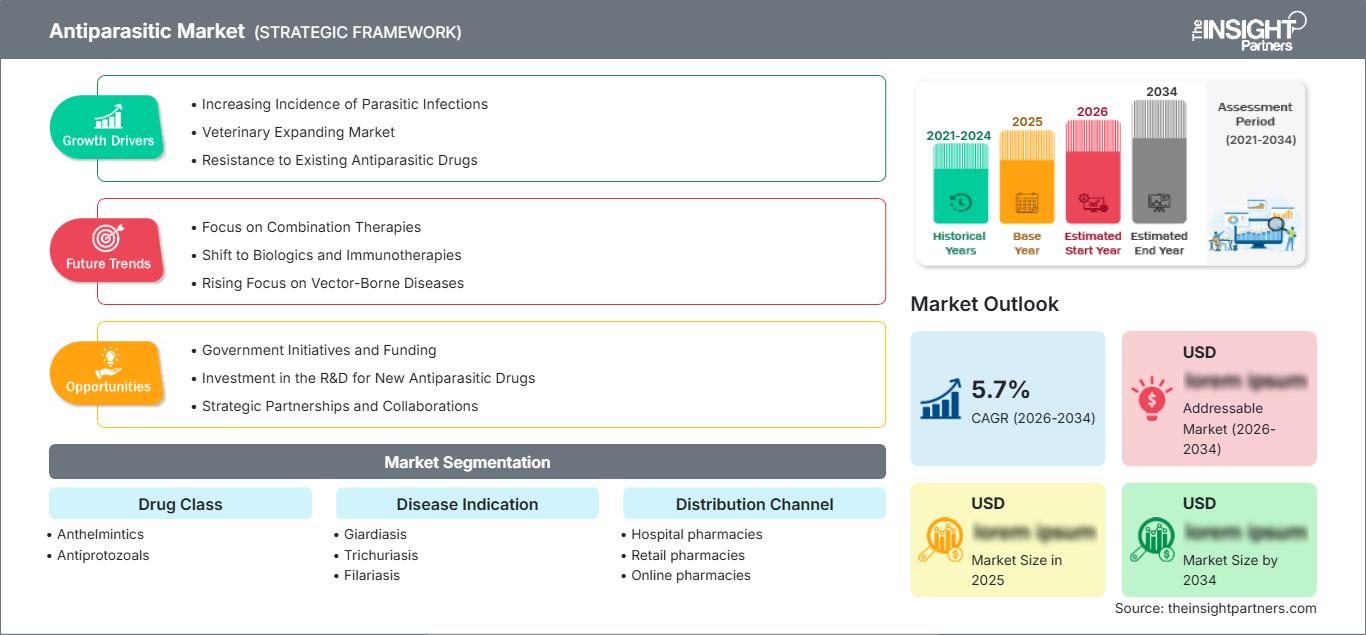
The antiparasitic market is expected to grow consistently driven by the expansion of prevention, diagnosis, and treatment initiatives for parasitic and re-emerging diseases. The market size is estimated at US$ 26.22 Billion in 2025 and is forecasted to rise up to US$ 46.91 Billion by 2034, showing a CAGR of 6.68% over 2026-2034, driven by persistent prevalence, treatment programs by governmental health agencies, greater access to essential drugs and investments in new treatments of neglected infections.
Within North America, the antiparasitic market size will be underpinned by the existing structure for prescription drugs, infections contracted by travelers, veterinary human disease surveillance, and focus on imported parasitic diseases. Modeling suggests a CAGR of 4.8-5.6% over 2026-2034 driven by consistent treatment needs, improved diagnosis and availability of branded and generic drugs.
Antiparasitic Market Assessment and Insights
- North America: North America is expected to account for a 17–20% antiparasitic market share in 2025, with a CAGR of 4.8–5.6% between 2026–2034. Established healthcare systems and diagnosis of imported infections support predictable pharmaceutical demand.
- US: The US represents approximately 78–82% of North America's 2025 market, with a CAGR of 4.7–5.5% during 2026–2034, supported by specialist prescribing and generic availability.
- Europe: Europe is estimated at a 23–26% share in 2025 and a CAGR of 5.2–6.0% through 2034. Germany, France, the UK, Italy, and Spain provide the region's principal demand base.
- Asia Pacific: Asia Pacific holds an estimated 31–35% share in 2025 and is projected to grow at 7.0–7.8%. China, India, Japan, South Korea, and Australia combine high disease exposure with expanding pharmaceutical access.
- Largest Segment: Anthelmintics represent the largest segment, with a modeled 2025 market share of 68–72% and a CAGR of 6.2–6.8% through 2034.
- High Growth Segment: Antiprotozoals represent the high-growth segment, with a modeled 2025 share of 28–32% and a CAGR of 7.2–8.0%, supported by persistent protozoal disease burden.
- Key companies analyzed in detail: Ipca Laboratories Ltd., Zydus Lifesciences Limited, Merck KGaA, Pfizer Inc., GlaxoSmithKline plc, Cipla Limited, Ranbaxy Laboratories Limited, Novartis AG, Alvizia Health Care, and Eisai Co., Ltd.
Source: The Insight Partners' analysis based on proprietary research, government publications, company annual reports, investor presentations, industry databases, and expert interviews.
The antiparasitic market has developed from conventional treatments to specialized formulations with enhanced coverage of disease and access schemes. Traditional anthelmintic generics continue to play an important role, whereas antiprotozoals have developed further into specialized disease-specific treatments. Dynamics of production include large-scale public purchases, donations by pharmaceutical companies, availability of active pharmaceutical ingredients, and regional production facilities. Based on statistics from WHO, soil-transmitted helminthiasis affects about 1.5 billion individuals, which emphasizes the structural need for regular treatments and prevention programs.
According to the antiparasitic market report, in the future, the geography of demand is predicted to increase as endemic countries develop their treatment programs and improve drug distribution. Development in regulation in the form of support for essential medicines, manufacturing of generics locally, and public-private partnerships would enhance stability of supply chain. There are also more investments being made in treatments with better tolerability, reduced duration of treatments, ability to be administered to children, and effectiveness against resistant strains of parasites.
Antiparasitic Market Report Scope
| Report Attribute | Details |
|---|---|
| Market size in 2025 | US$ 26.22 Billion |
| Market Size by 2034 | US$ 46.91 Billion |
| Global CAGR (2026 - 2034) | 6.68% |
| Historical Data | 2021-2024 |
| Forecast period | 2026-2034 |
Antiparasitic Market Analysis
Antiparasitic market expansion can be mainly attributed to the persistent existence of helminth and protozoa infections in tropical and subtropical populations. According to WHO, in 2023 there were 1.495 billion people in need of interventions due to neglected tropical diseases and only 867.1 million people treated for at least one type of NTD. Market ecosystem consists of API producers, formulation companies, public procurement organizations, hospitals, pharmacies, community programs and international health organizations. The antiparasitics' supply is fragmented among multinationals and generic regional producers and involves different pricing models.
There are considerable differences in demand patterns depending on particular disease. Anthelmintics have benefits associated with mass preventive treatments, while antiprotozoals depend more on diagnosis and prescription for a particular disease. Public procurement generates high order volumes but creates significant pressure in terms of pricing and production costs. Moreover, according to WHO logistics challenges such as delays in medication requests, difficulties in customs procedures, inadequate stocks management and last mile delivery are among factors that should be considered.
Competitive positioning within the antiparasitic industry involves a combination of branded drugs, established generics, donations, and specialty R&D initiatives. Relevance for cost-conscious pharmaceuticals lies in companies such as Ipca Laboratories, Zydus Lifesciences, Cipla, and Ranbaxy Laboratories; however, larger global health capabilities lie with companies such as Pfizer, GlaxoSmithKline, Merck KGaA, and Novartis. Novartis continues to make important research and development investments into neglected diseases, including the development of treatment solutions for leishmaniasis and cryptosporidiosis.
Strategic investment is increasingly moving towards differentiated therapy, access initiatives, and medicines that can fill gaps in the treatment landscape rather than just increasing the volume. Firms that have the capability of developing both API and formulations can be more flexible in their procurement management, while the multinational firms will benefit from their regulatory expertise and international health partnerships.
● REPORT CUSTOMIZATION
Tailor This Report To Align With Your Specific Business Requirements
This report can be customized to align precisely with your business objectives, scope, and target markets. Customization options include tailored segmentation, geography, competitive analysis, and strategic insights to support informed decision-making.
Customize This Report →WHAT YOU CAN ADJUST
- ● Segmentations
- ● Geography
- ● Competitive Analysis
- ● Language Preferences
Antiparasitic Market: Strategic Insights
Regional Insights
North America antiparasitic market
North America is estimated to hold a 17–20% share in 2025 and is expected to expand at a 4.8–5.6% CAGR through 2034. The region is characterized by mature pharmaceutical distribution, strong diagnostic capacity, and comparatively high treatment access. Demand is concentrated around prescription management of intestinal parasites, protozoal infections, travel-associated diseases, and infections affecting immunocompromised populations.
USA is the leading market for the region, whereas Canada is a secondary and more stable market. Specialization in the treatment of infectious diseases, travel medicine, hospital pharmacy procurement and generic substitution are key consumption factors. Regulations also ensure quality and traceability of the products. As such, growth will be moderate in nature and not driven by volumes; however, there will be an expansion in value.
U.S. antiparasitic Market
The US constitutes an estimated 78%-82% share of North America’s 2025 market and will register a 4.7%-5.5% CAGR up to 2034. The demand is bolstered by treatments in hospitals, out-patient prescribing, travel medicines, and diagnosis of infections contracted within and outside the country. International drug manufacturers such as Pfizer, Merck KGaA, Novartis, and others will be involved either directly or indirectly.
The pattern of use varies from that of endemic countries because there is no emphasis on preventive mass treatments. On the other hand, prescriptions may largely be associated with actual infection, prior exposure to the parasite, clinical manifestation, and specialist opinion. The retail and hospital pharmacies will still be significant marketing channels, but generics will limit price escalation.
Europe antiparasitic Market
Europe is expected to be 23-26% share in 2025 and is projected to grow at CAGR of 5.2-6.0%. Germany is the largest country, owing to its well-developed pharmaceutical market and healthcare system. UK, France, Italy and Spain account for additional demand due to hospital care, primary care, travel medicine and treatment of imported infections.
UK has a good surveillance system for infectious diseases, with good access to hospital treatments, whereas Germany has a developed pharmaceutical industry along with healthcare sector. France, Italy and Spain have domestic treatment needs in addition to travel and imported infections. Growth in the region continues to be modest as the prevalence of disease in Europe is lower as compared to endemic areas, but migration, international travel, diagnostics, and antimicrobial stewardship continue to generate the demand for effective antiparasitic drugs.
APAC antiparasitic Market
APAC is estimated at 31–35% of 2025 revenue and is projected to grow at 7.0–7.8% through 2034. China is the leading market, followed by India, Japan, South Korea, and Australia. Large populations, endemic infections, public-health initiatives, and improving pharmaceutical access support demand.
China and India provide the strongest volume opportunity because of population scale and persistent parasitic disease exposure. Japan, South Korea, and Australia contribute higher-value prescription demand and travel-related treatment. National disease-control programs, sanitation improvements, local pharmaceutical manufacturing, and expanding healthcare coverage should support market development, although pricing remains sensitive in mass-treatment settings.
Middle East & Africa antiparasitic Market
MEA will witness a growth rate of around 6.5-7.3% through 2034, with Saudi Arabia and UAE as leading countries in terms of healthcare in the Gulf region, while South Africa leads in the southern African region. Public procurement, hospital infrastructure, and imports of infection management drive the consumption in the region.
Saudi Arabia has advantages such as strong healthcare infrastructure and international tourism, while the UAE has an advantageous private healthcare system. South Africa has a well-established pharmaceutical distribution network along with infectious disease needs. RoMEA depends more on international health programs, local procurement, and funded treatment. Energy income in Gulf economies can facilitate healthcare investments, whereas the infrastructure challenges continue to impact the availability of medicines in other economies.
Segmentation Analysis
Drug Class
Drug Class remains the principal basis for evaluating treatment demand, with anthelmintics accounting for the largest commercial pool. The segment is expected to expand at a 6.2–6.8% CAGR during 2026–2034. Antiprotozoals provide a complementary growth engine because diagnosis, resistance concerns, and disease-specific treatment protocols create opportunities for differentiated medicines.
- Anthelmintics: Anthelmintics maintain the strongest position because albendazole, mebendazole, and related medicines support large-scale treatment programs for intestinal worms and several helminthic diseases. Their strategic importance is reinforced by high-volume procurement.
- Antiprotozoals: Antiprotozoals serve diseases requiring more targeted diagnosis and therapeutic selection. Demand is influenced by giardiasis and other protozoal infections, treatment complexity, resistance considerations, and specialist prescribing.
Disease Indication
Disease Indication is expected to expand at a 6.4–7.1% CAGR during 2026–2034. Commercial performance varies by epidemiology, treatment frequency, diagnosis, and public-health priorities. Conditions with established preventive-treatment protocols can generate recurring volumes, whereas less common diseases depend more heavily on specialist diagnosis and access.
- Giardiasis: Giardiasis creates recurring outpatient demand, particularly where contaminated water and food exposure remain concerns. Treatment is generally prescription-led, making diagnostic recognition and primary-care access important commercial determinants.
- Trichuriasis: Trichuriasis is closely associated with soil-transmitted helminth programs. Its strategic importance arises from school-age treatment campaigns and integration with broader deworming activities in endemic communities.
- Filariasis: Filariasis represents a major public-health application for preventive chemotherapy. Procurement is strongly influenced by national elimination programs, donor support, treatment coverage, and coordinated community distribution.
- Neurocysticercosis: Neurocysticercosis requires more specialized clinical management and therefore generates comparatively diagnosis-intensive demand. Treatment decisions often involve specialist assessment, imaging, and consideration of disease severity.
- Hydatid disease: Hydatid disease creates specialist treatment demand because clinical management can involve prolonged pharmacotherapy alongside surgery or interventional procedures. Endemicity and diagnostic capacity influence access.
- Pinworm disease: Pinworm disease generates recurring retail and primary-care demand because household transmission can lead to repeated treatment and management of exposed family members.
- Cysticercosis: Cysticercosis demand depends on diagnostic confirmation and clinical severity. Its commercial importance is concentrated in endemic regions and specialist infectious-disease settings.
- Ascariasis: Ascariasis remains a major volume indication because it affects large populations and is incorporated into preventive deworming programs. Affordable oral formulations remain strategically important for broad treatment coverage.
Distribution Channel
Distribution Channel is projected to grow at a 5.8–6.6% CAGR during 2026–2034. Channel performance depends on whether treatment is individually prescribed or delivered through public-health campaigns. Hospital channels support complex infections, while retail channels dominate routine outpatient treatment in many countries.
- Hospital pharmacies: Hospital pharmacies are strategically important for severe, complicated, or diagnostically uncertain infections requiring physician supervision, inpatient treatment, or specialist monitoring.
- Retail pharmacies: Retail pharmacies provide broad access to established antiparasitic medicines, particularly in countries with strong generic penetration and outpatient treatment practices.
- Online pharmacies: Online pharmacies are expanding medicine accessibility where digital prescription systems and e-commerce regulation permit. Their relevance is strongest for routine outpatient therapies and repeat purchases.
Opportunity Snapshot
| Segment Name | Revenue Contribution (High/Medium/Low) | Trend Tag | Adoption Stage |
|---|---|---|---|
| Hospital pharmacies | High | Specialist Care | Mature |
| Retail pharmacies | High | Generic Access | Mature |
| Online pharmacies | Medium | Digital Dispensing | Scaling |
Antiparasitic Market Growth Drivers and Impact Analysis
Persistent endemic disease burden sustains recurring treatment requirements
Parasitic infections remain deeply linked to sanitation, water quality, climate, housing conditions, and socioeconomic status. WHO estimates that soil-transmitted helminth infections affect approximately 1.5 billion people globally, demonstrating why treatment demand remains structurally relevant despite progress in prevention. In 2024, more than 883 million children required preventive chemotherapy for soil-transmitted helminthiases, while approximately 506.6 million received treatment. This treatment gap creates continued procurement requirements across endemic countries. For manufacturers, the impact is strongest in high-volume oral formulations, where production efficiency and reliable supply are essential. Public-health programs can therefore generate recurring demand even when individual medicine prices remain constrained, supporting stable volume-based opportunities for producers with scalable manufacturing capabilities.
Expansion of preventive chemotherapy and integrated disease programs
Preventive chemotherapy increasingly forms part of integrated national health programs rather than isolated disease campaigns. WHO guidance supports periodic administration of medicines for several neglected tropical diseases, including lymphatic filariasis and soil-transmitted helminthiases. Integrated delivery can reduce operational costs and increase treatment reach by combining medicines and community activities. This creates a meaningful commercial effect because procurement can become more predictable when national programs adopt multi-year treatment schedules. Manufacturers capable of supplying standardized, shelf-stable formulations at competitive prices are better positioned for these tenders. However, funding interruptions can rapidly affect volumes. WHO reported that funding reductions in 2025 delayed 47 NTD campaigns that would have helped protect 143 million people, illustrating the direct connection between program financing, medicine distribution, and market realization.
Improving diagnosis expands treatment beyond mass-treatment programs
Greater diagnostic availability is shifting some demand from population-wide prevention toward patient-specific treatment. Molecular, antigen-based, imaging, and laboratory methods can improve identification of parasitic infections that previously remained undiagnosed or were treated empirically. This particularly benefits disease indications such as neurocysticercosis, hydatid disease, and persistent protozoal infections, where clinical differentiation affects therapeutic selection. Commercially, better diagnosis expands the addressable treated population while supporting specialist products with stronger clinical positioning. Pharmaceutical companies can benefit by pairing medicines with diagnostic education, clinical guidelines, and treatment pathways rather than relying exclusively on broad procurement programs. The impact is likely to be most pronounced in middle-income markets where diagnostic infrastructure is improving faster than treatment access.
Antiparasitic Market Future Trends
Shift toward shorter and more patient-friendly treatment regimens
The antiparasitic market trends indicate that future product development is likely to emphasize shorter treatment courses, improved tolerability, pediatric suitability, and simplified dosing. These characteristics can improve adherence and reduce operational complexity in community programs. Single-dose or reduced-frequency regimens are particularly valuable where healthcare workers must treat large populations within limited campaign windows. Formulation innovation may also address taste, swallowability, dose flexibility, and stability in challenging distribution environments. For commercial decision-makers, the opportunity is not limited to premium pricing. A more convenient formulation can reduce administration costs and improve treatment completion, strengthening its value in procurement evaluations. Companies developing differentiated products should therefore assess total treatment economics, including healthcare-worker time and follow-up requirements, rather than evaluating medicines solely on unit acquisition price.
Data-driven targeting of parasitic disease interventions
Disease surveillance is expected to become increasingly granular as governments combine epidemiological, demographic, mobility, and environmental information. Such data can help identify persistent transmission clusters, prioritize treatment campaigns, and reduce unnecessary medicine distribution as elimination progresses. Pharmaceutical suppliers can use these changes to improve demand planning and anticipate shifts between preventive and case-based procurement. Digital inventory systems can further reduce stockouts and improve synchronization between central warehouses, regional distributors, and healthcare facilities. The resulting market structure should become more responsive to localized disease patterns. Suppliers that combine reliable manufacturing with forecasting capabilities, flexible packaging, and rapid replenishment may gain advantages as procurement becomes increasingly evidence-based and geographically targeted.
Antiparasitic Market Opportunities
Localized manufacturing and regional supply resilience
Manufacturers have an opportunity to establish or expand regional production of high-volume antiparasitic medicines in Asia, Africa, and Latin America. Local manufacturing can shorten supply chains, reduce exposure to international freight disruption, and improve responsiveness to government tenders. The opportunity is particularly relevant for established generic products where manufacturing technology is mature and demand is primarily volume-driven. Partnerships with national pharmaceutical companies can provide regulatory knowledge and distribution access without requiring full-scale greenfield investment. Investors should prioritize markets with recurring public procurement, established API availability, and improving pharmaceutical regulation. Contract manufacturing and technology-transfer models may offer lower-risk entry than independent manufacturing facilities, while regional packaging operations can provide additional flexibility for public-sector tenders and differentiated dosage requirements.
Digital procurement and targeted treatment expansion
Digital procurement platforms create opportunities to connect manufacturers more directly with hospitals, pharmacies, distributors, and public-health programs. Better visibility into orders and inventory can reduce shortages while allowing suppliers to identify regional demand patterns earlier. The antiparasitic market Forecasts should therefore consider not only epidemiological growth but also changes in procurement architecture and channel digitization. Companies can develop differentiated commercial strategies by combining hospital contracts with retail and online distribution, particularly for routine outpatient therapies. Investment in serialization, inventory analytics, demand forecasting, and electronic tender management can improve working-capital efficiency. For pharmaceutical companies, the strongest opportunity lies in using digital infrastructure to increase availability and reduce distribution inefficiencies rather than treating online sales as a standalone growth channel.
Recent Developments
- December 2025: Novartis AG reported that it had invested US$490 million in research and development for malaria and neglected tropical diseases since 2021 and renewed its commitment with at least US$250 million for 2026–2030. The company highlighted a pipeline spanning malaria, dengue, leishmaniasis, Chagas disease, and cryptosporidiosis.
- July 2025: Novartis AG updated its clinical development activities for antiparasitic and neglected-disease research, with LXE408 continuing as a candidate for leishmaniasis and Chagas disease while EDI048 was identified for cryptosporidiosis. The company reported that its NTD and malaria portfolio had expanded through partnerships and internal discovery programs.
- June 2025: World Health Organization and pharmaceutical partners reported significant disruption to NTD treatment campaigns following reductions in external development assistance. WHO stated that 47 campaigns were delayed, potentially affecting 143 million people, while medicine shortages and logistics constraints created additional risks for treatment continuity in endemic countries.
Frequently Asked Questions

- Comprehensive Market Sizing and Forecast Analysis
- Detailed Segmentation Analysis
- In-Depth Market Dynamics Assessment
- Regional and Country-Level Insights
- Competitive Landscape and Company Benchmarking
- Strategic Business Intelligence
Recent Reports
Testimonials

The Insight Partners' SCADA System Market report is comprehensive, with valuable insights on current trends and future forecasts. The team was highly professional, responsive, and supportive throughout. We are very satisfied and highly recommend their services.
RAN KEDEM Partner, Reali Technologies LTDs
I requested a report on a very specific software market and the team produced the report in a few days. The information was very relevant and well presented. I then requested some changes and additions to the report. The team was again very responsive and I got the final report in less than a week.
JEAN-HERVE JENN Chairman, Future Analytica
We worked with The Insight Partners for an important market study and forecast. They gave us clear insights into opportunities and risks, which helped shape our plans. Their research was easy to use and based on solid data. It helped us make smart, confident decisions. We highly recommend them.
PIYUSH NAGPAL Sr. Vice President, High Beam Global
The Insight Partners delivered insightful, well-structured market research with strong domain expertise. Their team was professional and responsive throughout. The user-friendly website made accessing industry reports seamless. We highly recommend them for reliable, high-quality research services
YUKIHIKO ADACHI CEO, Deep Blue, LLC.
This is the first time I have purchased a market report from The Insight Partners.While I was unsure at first, I visited their web site and felt more comfortable to take the risk and purchase a market report.I am completely satisfied with the quality of the report and customer service. I had several questions and comments with the initial report, but after a couple of dialogs over email with their analyst I believe I have a report that I can use as input to our strategic planning process.Thank you so much for taking the extra time and making this a positive experience.I will definitely recommend your service to others and you will be my first call when we need further market data.
JOHN SUZUKI President and Chief Executive Officer, Board Director, BK Technologies
I wish to appreciate your support and the professionalism you displayed in the course of attending to my request for information regarding to infectious disease IVD market in Nigeria. I appreciate your patience, your guidance, and the fact that you were willing to offer a discount, which eventually made it possible for us to close a deal. I look forward to engaging The Insight Partners in the future, all thanks to the impression you have created in me as a result of this first encounter.
DR CHIJIOKE ONYIA MANAGING DIRECTOR, PineCrest Healthcare Ltd.Reason to Buy
- Informed Decision-Making
- Understanding Market Dynamics
- Competitive Analysis
- Identifying Emerging Markets
- Customer Insights
- Market Forecasts
- Risk Mitigation
- Boosting Operational Efficiency
- Strategic Planning
- Investment Justification
- Tracking Industry Innovations
- Aligning with Regulatory Trends





 Get Free Sample for