
Automotive Camera Market Key Companies and SWOT Analysis by 2034
Coverage: By Application (Park Assist and ADAS), Type (Mono Camera, Surround View Camera, and Rear View Camera), Vehicle Type (Passenger Cars and Commercial Vehicle), Level of Autonomy (L1, L2, L3, and Others) and Geography
- Status : Data Released
- Report Code : TIPRE00004119
- Category : Automotive and Transportation
- No. of Pages : 150
- Available Report Formats :


- Last update date : August 27, 2026


2025 Market Size
US$ 13.60 Bn
Base year value
2034 Forecast
US$ 62.11 Bn
Projected by 2034
CAGR 2026-2034
18.4 %
Growth rate
Addressable Market
US$ 312.65 Bn
(2026-2034)
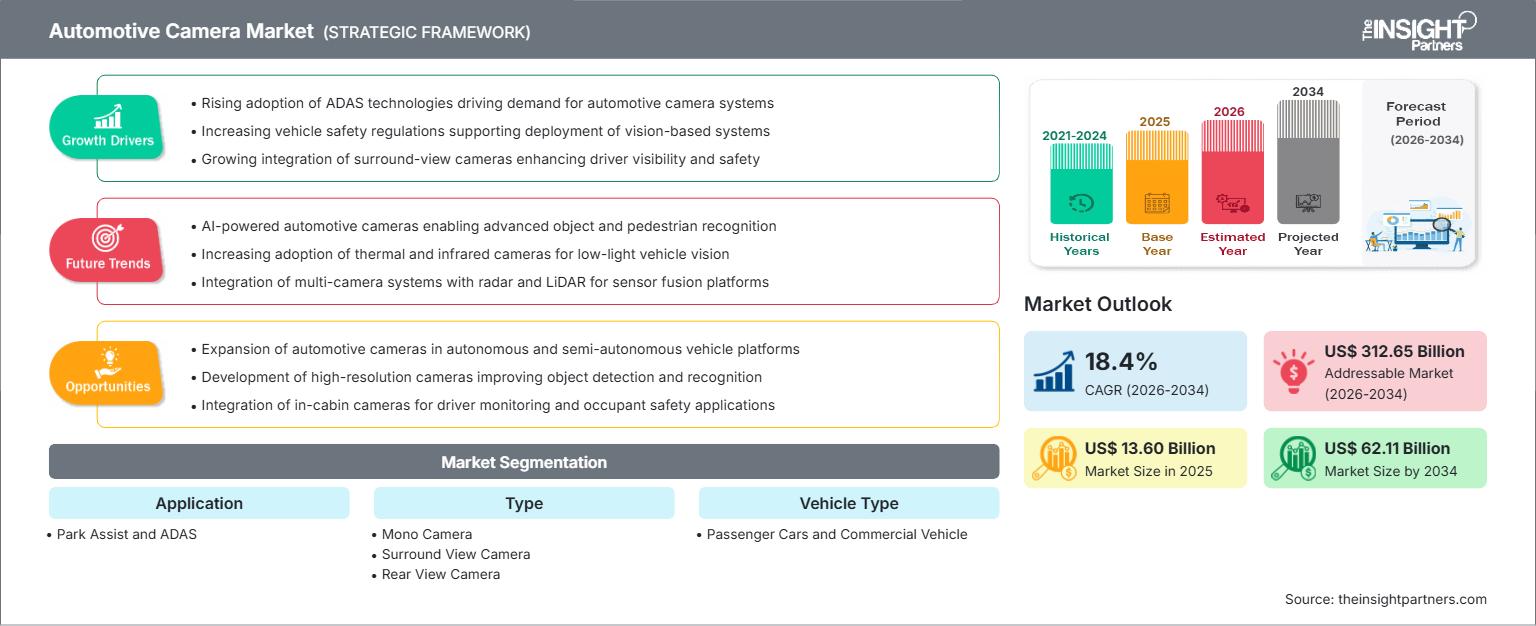
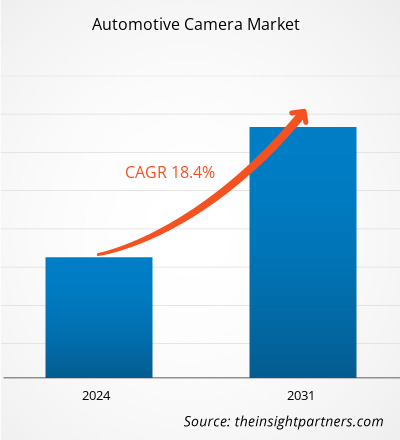
The automotive camera market is projected to grow from US$ 13.60 Billion in 2025 to US$ 62.11 Billion by 2034, registering a CAGR of 18.4% during 2026–2034. Demand is being shaped by the rapid integration of vision-based safety systems, higher camera count per vehicle, and the shift from basic parking support toward advanced driver assistance functions across passenger cars and commercial vehicles.
North America is expected to remain a structurally important revenue contributor, with estimated growth supported by federal safety expectations, OEM investments in Level 2 assistance, and rising consumer preference for camera-enabled parking and highway support. The automotive camera market size in the region is influenced by premium vehicle penetration, commercial fleet safety upgrades, and expanding software-defined vehicle programs.
Automotive Camera Market Assessment and Insights
- North America: The region is estimated to account for 27–30% share in 2025 and grow at a CAGR of 17–19% during 2026–2034, led by ADAS standardization, fleet safety upgrades, and stronger demand for multi-camera perception systems.
- US: The US is estimated to represent 72–76% of North America in 2025 and grow at a CAGR of 17–18.5%, supported by OEM safety packages and commercial vehicle camera adoption.
- Europe: Europe is estimated to hold 30–34% share in 2025 and grow at a CAGR of 16–18%, with Germany, France, the UK, Italy, and Spain benefiting from EU safety mandates and premium vehicle production.
- Asia Pacific: APAC is estimated to hold 31–35% share in 2025 and grow at a CAGR of 19–21%, supported by China, Japan, South Korea, and India, where vehicle production scale and ADAS localization are expanding rapidly.
- Largest Segment: Park Assist is estimated to hold 48–52% market share in 2025 and grow at a CAGR of 15–17%, reflecting widespread rear view and surround view camera deployment.
- High Growth Segment: ADAS is estimated to hold 48–52% market share in 2025 and grow at a CAGR of 20–22%, supported by regulatory pressure and Level 2 feature adoption.
- Key companies analyzed in detail: Aptiv PLC, Autoliv Inc., Continental AG, Teledyne FLIR LLC, Gentex Corporation, Magna International Inc., Robert Bosch GmbH, Valeo SE, Mobileye Global Inc., and Stonkam Co., Ltd.
Source: The Insight Partners' analysis based on proprietary research, government publications, company annual reports, investor presentations, industry databases, and expert interviews.
Vehicle vision has evolved from single-purpose reversing cameras into networked perception systems that support parking, lane guidance, pedestrian detection, blind spot monitoring, and driver assistance. The automotive camera market growth is tied to higher sensor resolution, improved low-light performance, and centralized processing architectures that allow automakers to combine exterior and in-cabin vision data within broader ADAS platforms.
Looking forward, the demand is forecasted to grow due to safety regulation implementation within new geographic areas, and localizing of camera modules by international OEMs to support vehicle programs with cost concerns. The market trends towards investment into AI-powered perception, surround view, and upgradable camera platforms.
Automotive Camera Market Report Scope
| Report Attribute | Details |
|---|---|
| Market size in 2025 | US$ 13.60 Billion |
| Market Size by 2034 | US$ 62.11 Billion |
| Global CAGR (2026 - 2034) | 18.4% |
| Historical Data | 2021-2024 |
| Forecast period | 2026-2034 |
Automotive Camera Market Analysis
Demand drivers are increasingly linked to safety ratings, regulatory compliance, and consumer expectations for convenience features. The automotive camera market analysis shows that cameras are becoming essential inputs for ADAS, parking assist, lane support, and driver monitoring. With the incorporation of safety systems into mass-market cars and premium vehicles, there has been a steady increase in the installation of front-, surround-, rear-, and interior-view cameras by car manufacturers. There has been a rising trend in the need for high-resolution camera systems as manufacturers seek to prevent accidents and integrate automation in their automobiles.
The supply environment has also changed as the integration of camera modules now requires greater coordination between lens suppliers, image sensors, Tier 1 companies, and software engineers. The increase in the complexity of cameras has brought an increasing need for image processing and calibration. There has been an increased focus on improving the quality, reliability, and compatibility of cameras in the midst of costs related to large-scale adoption.
The positioning of competitiveness is based on scalable camera platforms, perception software, and OEM program successes. Among the companies that are giving preference to the integration of ADAS architecture that includes cameras, radar, ultrasonic sensors, and AI perception systems are Aptiv PLC, Continental AG, Magna International Inc., Robert Bosch GmbH, Valeo SE, and Mobileye Global Inc. The capability of offering scalable solutions is one of the key advantages in winning contracts from big automobile companies.
According to the Automotive Camera Market Report, Gentex Corporation, Autoliv Inc., Teledyne FLIR LLC, and Stonkam Co., Ltd. address specialized visibility, safety, and commercial vehicle use cases. Companies are increasingly investing in thermal imaging, driver monitoring technology, and enhanced vision systems to differentiate their product portfolios. As autonomous driving development progresses and regulatory requirements become more stringent, market participants are expected to focus on innovation, software capabilities, and strategic partnerships to strengthen their competitive positions and capture emerging opportunities in the global market.
● REPORT CUSTOMIZATION
Tailor This Report To Align With Your Specific Business Requirements
This report can be customized to align precisely with your business objectives, scope, and target markets. Customization options include tailored segmentation, geography, competitive analysis, and strategic insights to support informed decision-making.
Customize This Report →WHAT YOU CAN ADJUST
- ● Segmentations
- ● Geography
- ● Competitive Analysis
- ● Language Preferences
Automotive Camera Market: Strategic Insights
Regional Insights
North America automotive camera market
North America is estimated to account for 27–30% automotive camera market share in 2025 and grow at a CAGR of 17–19% during 2026–2034. Growth is supported by high safety feature penetration, rising adoption of Level 2 assistance, and increasing demand for multi-camera parking and highway support systems.
The region benefits from strong OEM technology roadmaps and fleet safety upgrades. Camera-based ADAS is moving from premium vehicles into mass-market trims, while commercial vehicle operators are adopting rear, side, and driver-monitoring cameras to reduce accident risk and improve compliance readiness.
U.S. automotive camera market Market
The US is estimated to represent 72–76% of North America in 2025 and grow at a CAGR of 17–18.5% during 2026–2034. The country’s position is supported by high passenger vehicle technology content, strong pickup and SUV sales, and commercial fleet adoption of camera-enabled safety systems.
Supplier activity is concentrated around ADAS software, camera modules, and integrated perception systems. OEMs are using cameras for parking, lane support, driver awareness, and highway assistance, while safety expectations and insurance cost pressures encourage broader deployment across both personal and fleet vehicles.
Europe automotive camera market Market
Europe is estimated to hold 30–34% share in 2025 and grow at a CAGR of 16–18% during 2026–2034. Germany remains the leading country due to premium vehicle production, advanced supplier networks, and fast adoption of safety electronics, while France, the UK, Italy, and Spain support volume expansion.
EU safety regulation is a major structural driver, as mandatory driver assistance functions influence vehicle architecture beyond Europe. Camera systems are being integrated for autonomous emergency braking, intelligent speed assistance, driver attention monitoring, and parking visibility, creating sustained demand for robust, regulation-ready imaging platforms.
APAC automotive camera market Market
APAC is estimated to account for 31–35% share in 2025 and grow at a CAGR of 19–21% during 2026–2034. China is expected to lead regional demand, followed by Japan, South Korea, India, and Australia, supported by high vehicle production and localized ADAS programs.
Growth is reinforced by electric vehicle platforms, compact camera module manufacturing, and rising consumer acceptance of parking assist and highway safety functions. Regional suppliers are also improving cost competitiveness, helping OEMs integrate camera-based safety features into mid-range vehicle models.
Middle East & Africa automotive camera market Market
The Middle East & Africa is expected to grow at a CAGR of 14–16% during 2026–2034. Saudi Arabia and the UAE lead adoption through premium vehicles, smart mobility investments, and safety-focused infrastructure programs, while South Africa contributes demand from commercial fleets and aftermarket safety upgrades.
Adoption in the regional market is relatively smaller compared to the developed markets, although it is growing due to the increasing need for greater visibility, driver monitoring and parking assistance. It is also due to the growth in logistics, road safety, and the adoption of vehicles with ADAS systems.
Segmentation Analysis
Application
Application is expected to grow at a CAGR of 18–20% during 2026–2034. The automotive camera market scope across applications is defined by the transition from visibility support to active decision assistance, with park assist generating strong current demand and ADAS driving higher future value through safety regulation and automation pathways.
- Park Assist: Park assist remains widely adopted because rear-view and surround-view cameras improve low-speed maneuvering, reduce blind spots, and support consumer demand for easier parking in dense urban environments.
- ADAS: ADAS applications are expanding as cameras provide lane, object, pedestrian, and traffic sign inputs, making vision systems central to scalable safety packages and higher autonomy preparation.
Type
Type is expected to grow at a CAGR of 17–19% during 2026–2034. Mono cameras remain important for cost-effective forward sensing, while surround view and rear view cameras gain traction as OEMs increase camera count per vehicle and integrate multiple viewing angles into centralized safety systems.
- Mono Camera: Mono cameras are valued for compact packaging, cost efficiency, and suitability for lane detection and object recognition when paired with advanced image processing software.
- Surround View Camera: Surround view cameras support 360-degree visibility, improving parking, obstacle detection, and premium driver assistance experiences across passenger cars and higher-end commercial vehicles.
- Rear View Camera: Rear view cameras remain a foundational safety feature, supported by regulatory requirements, consumer familiarity, and integration with parking alerts and infotainment displays.
Vehicle Type
Vehicle Type is expected to grow at a CAGR of 18–20% during 2026–2034. Passenger cars dominate adoption due to high production volume and consumer safety expectations, while commercial vehicles increasingly use cameras for rear visibility, blind spot reduction, driver monitoring, and fleet risk management.
- Passenger Cars: Passenger cars generate broad demand as OEMs standardize parking cameras and introduce ADAS packages across mid-range and premium trims.
- Commercial Vehicle: Commercial vehicles rely on cameras for reversing, side visibility, driver awareness, and fleet safety, especially in logistics, construction, mining, and urban delivery operations.
Level of Autonomy
Level of Autonomy is expected to grow at a CAGR of 19–21% during 2026–2034. L1 and L2 systems currently represent high-volume deployment, while L3 programs create future demand for more redundant perception, higher-resolution cameras, and tighter integration between vision, radar, compute, and driver monitoring.
- L1: L1 systems use cameras for basic assistance, such as lane warning or parking support, making them important for entry-level safety adoption.
- L2: L2 systems require stronger perception inputs for lane centering, adaptive support, and supervised automation, increasing camera value per vehicle.
- L3: L3 systems create demand for higher sensing redundancy, precise environmental interpretation, and robust driver handover monitoring in defined operating conditions.
Opportunity Snapshot
| Application | Revenue Contribution | Trend Tag | Adoption Stage |
| Park Assist | High | 360 Parking | Mature |
| ADAS | High | Vision Safety | Scaling |
Automotive Camera Market Growth Drivers and Impact Analysis
Safety regulation and ADAS standardization
Regulatory pressure can be considered as one of the key factors contributing to camera growth. The introduction of European General Safety Regulations, the need to comply with driver monitoring, and regulations on the safety of heavy-duty vehicles are making OEMs regard cameras as standard safety equipment instead of optional devices. This will contribute to the continued demand for front, rear, surround, and in-cabin cameras. With vehicle platforms being developed with regulatory compliance in mind, the use of cameras will affect the architectural design.
Rising camera count per vehicle
The auto industry is installing additional cameras per car to enable surround view, blind spot visualization, driver monitoring, lane assist, and autonomous parking. This trend presents an opportunity to earn more money even as the growth rate in unit car production remains moderate. Multi-camera demands more bandwidth, improved thermal management, and sophisticated electronic control modules. This means that there will be opportunities for the entire supply chain from component manufacturers to semiconductors, software companies, and Tier 1 system integrators.
Growth of software-defined vehicle platforms
Software-defined vehicles are changing camera procurement from component sourcing to platform-level integration. Cameras now feed perception algorithms, over-the-air feature updates, driver assistance functions, and interior monitoring systems. OEMs seek hardware that can support future software capabilities without redesigning the full vehicle electrical architecture. This creates demand for higher-resolution sensors, AI-ready processing, and standardized interfaces. Suppliers that combine hardware reliability with software capability are positioned to capture stronger margins and longer program lifecycles in the automotive camera market.
Automotive Camera Market Future Trends
AI-enabled 360-degree perception
Automotive camera market trends point toward integrated 360-degree perception systems that combine multiple exterior cameras with radar, mapping, and AI-based scene interpretation. These platforms will enable hands-on and hands-free guided driving, automatic parking, and enhanced slow-speed protection. With the increasing use of centralized computing, sensor data will be combined in real time to build better models of the environment. Such an approach is more favorable for those suppliers who can offer synchronized hardware, perception software, and lifecycle support.
Expansion of in-cabin vision systems
Adoption of in-cabin cameras is predicted to increase with driver-monitoring, child detection, occupant-sensing, and customized safety features gaining importance. Rules and requirements are shifting from exterior to interior visibility, making it vital to detect the state of the driver and the cabin. This presents opportunities for RGB-IR sensors, secure processing of the images, and incorporation with restraint systems, entertainment systems, and ADAS controls. Companies addressing accuracy, pricing, data protection, and miniaturization will determine the future direction of vehicle vision solutions.
Automotive Camera Market Opportunities
Localized camera platforms for high-volume vehicles
Automotive camera market Forecasts indicate a strong opportunity in cost-optimized camera platforms for high-volume passenger cars. OEMs in Asia Pacific, North America, and Europe need systems that meet safety requirements while preserving affordability. Suppliers can capture growth by offering modular camera designs, standardized connectors, localized production, and software that scales across trims. This approach reduces integration complexity and supports faster deployment of park assist, lane support, and surround view functions in mass-market vehicle programs.
Commercial fleet visibility and monitoring upgrades
The commercial fleet is an interesting prospect because the technology addresses the problems of reversing accidents, blind spots, driver fatigue, visibility in the cargo space, and risk management from the perspective of insurance companies. It appears that logistics, construction, mining, school, and city delivery fleets are starting to consider using this kind of technology as a valuable investment in safety measures. Suppliers can stand out by providing durable equipment, good performance at night, simple installation, internet connectivity, and analytical dashboard tools.
Frequently Asked Questions

- Comprehensive Market Sizing and Forecast Analysis
- Detailed Segmentation Analysis
- In-Depth Market Dynamics Assessment
- Regional and Country-Level Insights
- Competitive Landscape and Company Benchmarking
- Strategic Business Intelligence
Recent Reports
Testimonials

The Insight Partners' SCADA System Market report is comprehensive, with valuable insights on current trends and future forecasts. The team was highly professional, responsive, and supportive throughout. We are very satisfied and highly recommend their services.
RAN KEDEM Partner, Reali Technologies LTDs
I requested a report on a very specific software market and the team produced the report in a few days. The information was very relevant and well presented. I then requested some changes and additions to the report. The team was again very responsive and I got the final report in less than a week.
JEAN-HERVE JENN Chairman, Future Analytica
We worked with The Insight Partners for an important market study and forecast. They gave us clear insights into opportunities and risks, which helped shape our plans. Their research was easy to use and based on solid data. It helped us make smart, confident decisions. We highly recommend them.
PIYUSH NAGPAL Sr. Vice President, High Beam Global
The Insight Partners delivered insightful, well-structured market research with strong domain expertise. Their team was professional and responsive throughout. The user-friendly website made accessing industry reports seamless. We highly recommend them for reliable, high-quality research services
YUKIHIKO ADACHI CEO, Deep Blue, LLC.
This is the first time I have purchased a market report from The Insight Partners.While I was unsure at first, I visited their web site and felt more comfortable to take the risk and purchase a market report.I am completely satisfied with the quality of the report and customer service. I had several questions and comments with the initial report, but after a couple of dialogs over email with their analyst I believe I have a report that I can use as input to our strategic planning process.Thank you so much for taking the extra time and making this a positive experience.I will definitely recommend your service to others and you will be my first call when we need further market data.
JOHN SUZUKI President and Chief Executive Officer, Board Director, BK Technologies
I wish to appreciate your support and the professionalism you displayed in the course of attending to my request for information regarding to infectious disease IVD market in Nigeria. I appreciate your patience, your guidance, and the fact that you were willing to offer a discount, which eventually made it possible for us to close a deal. I look forward to engaging The Insight Partners in the future, all thanks to the impression you have created in me as a result of this first encounter.
DR CHIJIOKE ONYIA MANAGING DIRECTOR, PineCrest Healthcare Ltd.Reason to Buy
- Informed Decision-Making
- Understanding Market Dynamics
- Competitive Analysis
- Identifying Emerging Markets
- Customer Insights
- Market Forecasts
- Risk Mitigation
- Boosting Operational Efficiency
- Strategic Planning
- Investment Justification
- Tracking Industry Innovations
- Aligning with Regulatory Trends





 Get Free Sample for