
Automotive Hose Market Trends, Size & Forecast by 2034
Coverage: by Type (Nylon Automotive Hose, Tygon Automotive Hose, and Neoprene Automotive Hose); Vehicle Type (Passenger Cars, Heavy Commercial Vehicles, and Light Commercial Vehicles); Application (Turbocharger, Cooling/heating, Fuel Delivery, Braking, Steering), and Geography (North America, Europe, Asia Pacific, and South and Central America)
- Status : Data Released
- Report Code : TIPAT00002484
- Category : Automotive and Transportation
- No. of Pages : 150
- Available Report Formats :


- Last update date : August 06, 2026


2025 Market Size
US$ 2.91 Bn
Base year value
2034 Forecast
US$ 4.96 Bn
Projected by 2034
CAGR 2026-2034
6.11 %
Growth rate
Addressable Market
US$ 35.64 Bn
(2026-2034)
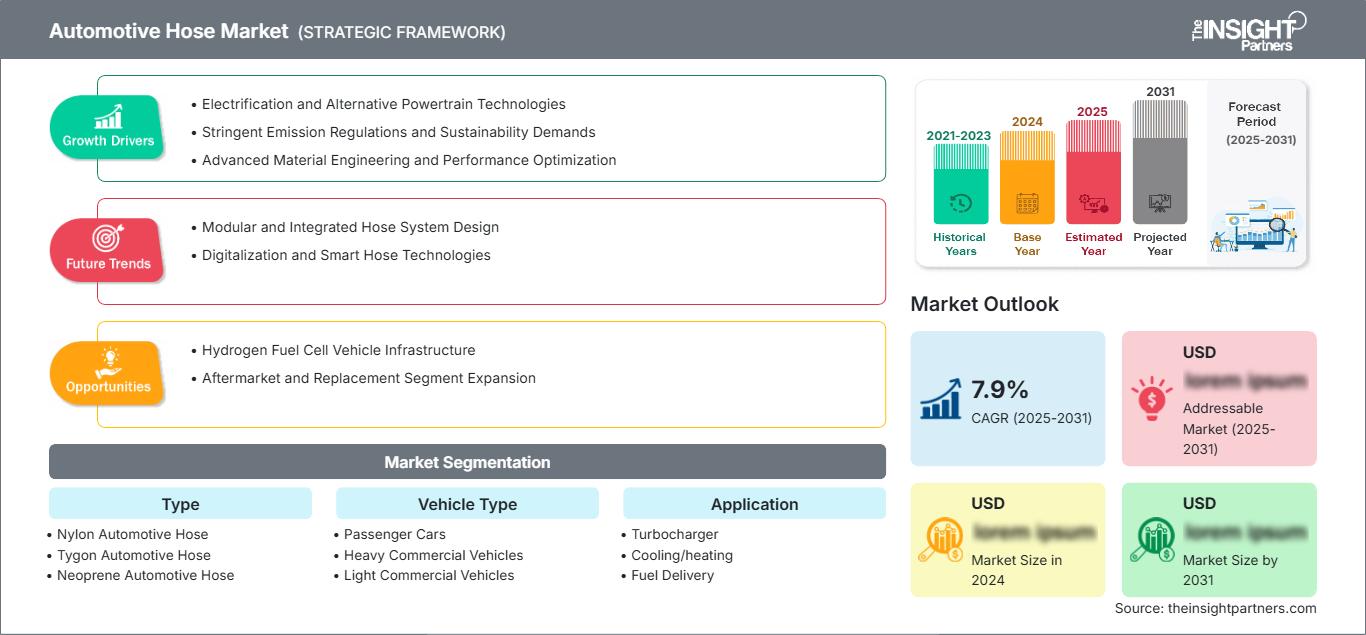
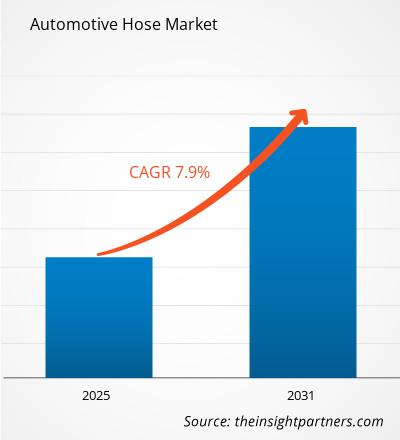
The Automotive Hose Market is projected to grow from US$ 2.91 Billion in 2025 to US$ 4.96 Billion by 2034, registering a CAGR of 6.11% during 2026–2034. Demand is supported by higher vehicle production, increasing thermal management needs, tighter emission requirements, and the expansion of fluid transfer systems across internal combustion, hybrid, and electric vehicle platforms.
North America remains a specification-driven region where Automotive Hose Market size is supported by pickup trucks, SUVs, commercial fleets, and growing electric vehicle thermal systems. The region is estimated to hold 22–25% share in 2025 and expand at a 5.5–6.0% CAGR during 2026–2034, helped by cooling circuit upgrades, braking system replacement, and supplier localization.
Automotive Hose Market Assessment and Insights
- North America: Held an estimated 22–25% share in 2025 and is projected to grow at a 5.5–6.0% CAGR during 2026–2034, supported by vehicle parc, EV cooling loops, and fleet replacement.
- US: Represented 78–82% of North America demand in 2025 and is expected to grow at a 5.6–6.1% CAGR during 2026–2034, led by trucks, SUVs, and aftermarket service.
- Europe accounted for 24–27% share in 2025 and is forecast to grow at a 5.2–5.8% CAGR, with Germany, the UK, France, Italy, and Spain supporting advanced hose adoption.
- Asia Pacific: Represented 39–43% share in 2025 and is projected to grow at a 6.6–7.2% CAGR during 2026–2034, led by China, Japan, South Korea, India, and Australia.
- Largest Segment: Cooling/heating held 34–38% market share in 2025 and is projected to grow at a 6.2–6.8% CAGR because thermal control remains essential across powertrains.
- High Growth Segment: Turbocharger held 12–15% share in 2025 and is projected to grow at a 7.1–7.8% CAGR as downsized engines and hybrid platforms increase heat loads.
- Key companies analyzed in detail: Continental AG; Parker Hannifin Corporation; DuPont de Nemours, Inc.; Manuli Hydraulics India Pvt. Ltd.; Gates Corporation; Toyoda Gosei Co., Ltd.; Sumitomo Riko Company Limited; Codan Rubber Danmark A/S; Hutchinson SA; Tianjin Pengling Group Co., Ltd.
Source: The Insight Partners' analysis based on proprietary research, government publications, company annual reports, investor presentations, industry databases, and expert interviews.
Automotive hose design has advanced from basic rubber conduits toward multilayer, reinforced, chemically resistant, and heat-tolerant assemblies. The Automotive Hose Market growth is linked to tighter packaging, higher operating temperatures, emission control systems, and electric vehicle battery cooling. Suppliers are improving elastomer compounds, nylon structures, and quick-connect assemblies to support pressure stability, routing flexibility, and longer service life.
Future demand will be shaped by electrification, regional production networks, and aftermarket replacement cycles. Asia Pacific will remain the largest volume base, while Europe and North America emphasize validated materials, fuel vapor control, and high-temperature durability. Investment will favor suppliers that combine material science, forming precision, low-permeation designs, and OEM-approved testing capabilities.
Automotive Hose Market Report Scope
| Report Attribute | Details |
|---|---|
| Market size in 2025 | US$ 2.91 Billion |
| Market Size by 2034 | US$ 4.96 Billion |
| Global CAGR (2026 - 2034) | 6.11% |
| Historical Data | 2021-2024 |
| Forecast period | 2026-2034 |
Automotive Hose Market Analysis
Fluid transfer reliability remains central to Automotive Hose Market growth as vehicles use more complex cooling, fuel, braking, steering, and turbocharger circuits. Hoses must withstand pressure pulses, coolant chemistry, fuel blends, vibration, and thermal cycling while fitting compact engine bays and battery platforms.
The value chain includes polymer producers, reinforcement yarn suppliers, compounders, extrusion specialists, fitting manufacturers, Tier 1 assemblers, OEM engineering teams, and aftermarket distributors. Supply dynamics are influenced by rubber, nylon, and specialty polymer costs, qualification lead times, and regional inventory coverage for replacement products.
The Automotive Hose Market analysis shows a competitive landscape led by material capability and system validation. Continental AG, Gates Corporation, Parker Hannifin Corporation, Toyoda Gosei Co., Ltd., Sumitomo Riko Company Limited, Hutchinson SA, Codan Rubber Danmark A/S, Manuli Hydraulics India Pvt. Ltd., DuPont de Nemours, Inc., and Tianjin Pengling Group Co., Ltd. compete through hose compounds, application engineering, and global supply.
Investment trends are shifting toward EV thermal management hoses, low-permeation fuel lines, modular assemblies, and automated extrusion quality control. Strategic positioning favors suppliers with regional production, broad application coverage, and experience across passenger car and commercial vehicle platforms.
● REPORT CUSTOMIZATION
Tailor This Report To Align With Your Specific Business Requirements
This report can be customized to align precisely with your business objectives, scope, and target markets. Customization options include tailored segmentation, geography, competitive analysis, and strategic insights to support informed decision-making.
Customize This Report →WHAT YOU CAN ADJUST
- ● Segmentations
- ● Geography
- ● Competitive Analysis
- ● Language Preferences
Automotive Hose Market: Strategic Insights
Regional Insights
North America Automotive Hose Market
North America accounted for an estimated 22–25% Automotive Hose Market share in 2025 and is forecast to grow at a 5.5–6.0% CAGR during 2026–2034. Demand is concentrated in the US and Mexico, where light trucks, SUVs, commercial fleets, and EV programs require coolant, brake, fuel, steering, and turbocharger hoses.
Regional demand benefits from high vehicle parc, repair activity, and OEM localization. EV battery thermal systems increase coolant hose complexity, while fleet operators replace hoses to reduce downtime. Mexico strengthens supply through assembly exports, and Canada adds steady service demand across passenger and commercial vehicles.
U.S. Automotive Hose Market
The US represented 78–82% of North American demand in 2025 and is projected to grow at a 5.6–6.1% CAGR through 2034. Large pickup, SUV, and delivery fleet volumes support replacement demand, while EV programs increase need for battery cooling and thermal control hoses.
Continental AG, Gates Corporation, Parker Hannifin Corporation, DuPont de Nemours, Inc., and Hutchinson SA support the country through OEM programs, material technologies, distribution, or aftermarket channels. Application trends favor durable coolant hoses, fuel lines with lower permeation, and braking hoses designed for longer service intervals.
Europe Automotive Hose Market
Europe held an estimated 24–27% share in 2025 and is expected to grow at a 5.2–5.8% CAGR during 2026–2034. Germany leads regional demand through premium vehicle platforms, turbocharged engines, and strict material validation. The UK supports replacement and performance-oriented hose applications.
France, Italy, and Spain contribute through passenger car production, light commercial vehicle assembly, and component exports. European programs emphasize low-permeation fuel delivery, compact cooling circuits, and compliance with emission and safety requirements. Continental AG, Hutchinson SA, Parker Hannifin Corporation, and Gates Corporation support advanced hose engineering in the region.
APAC Automotive Hose Market
APAC represented 39–43% share in 2025 and is projected to grow at a 6.6–7.2% CAGR through 2034. China leads due to vehicle production scale and EV battery cooling demand, while Japan and South Korea contribute precision rubber and polymer engineering.
India expands through two-wheeler, passenger car, and light commercial vehicle production, while Australia adds aftermarket demand. Regional supplier localization, government-backed EV programs, and export manufacturing support rising hose volumes across cooling/heating, braking, fuel delivery, steering, and turbocharger applications.
Middle East & Africa Automotive Hose Market
The Middle East & Africa market is expected to grow at a 4.7–5.3% CAGR during 2026–2034. Saudi Arabia and the UAE lead demand through SUV imports, fleet service, and harsh-climate operating conditions, while South Africa supports assembly and replacement channels.
High ambient temperatures increase stress on coolant, fuel, and steering hoses. Rest of MEA demand is linked to commercial fleets, used vehicles, and replacement parts distribution. Growth improves as distributors prioritize heat-resistant hoses and broader aftermarket coverage.
Segmentation Analysis
Type
Type is projected to grow at a 5.9–6.5% CAGR during 2026–2034. The Automotive Hose Market scope by type reflects differences in chemical resistance, flexibility, temperature range, and cost. Nylon, Tygon, and neoprene hoses serve distinct needs across fuel delivery, cooling/heating, braking, steering, and turbocharger systems.
- Nylon Automotive Hose is valued for low weight, dimensional stability, and resistance to fuels and chemicals, making it important in fuel delivery, vapor lines, and compact routing applications.
- Tygon Automotive Hose supports visibility, flexibility, and controlled fluid compatibility in selected automotive systems where transparent or specialty tubing can improve inspection, service, and assembly accuracy.
- Neoprene Automotive Hose remains relevant for durability, oil resistance, weathering performance, and vibration tolerance in applications exposed to heat, engine fluids, and repeated mechanical stress.
Vehicle Type
Vehicle Type is expected to grow at a 6.0–6.6% CAGR during 2026–2034. Passenger cars generate the largest volume, while heavy and light commercial vehicles require hoses with stronger durability, longer service intervals, and resistance to vibration, pressure, and heat.
- Passenger Cars generate the largest demand because high production volumes, hybridization, EV thermal systems, and compact engine bays increase the number and complexity of hose assemblies.
- Heavy Commercial Vehicles require robust hoses for braking, steering, cooling, and turbocharger circuits because long duty cycles, high loads, and fleet uptime needs increase performance expectations.
- Light Commercial Vehicles support steady demand through urban delivery, service fleets, and logistics growth, with replacement cycles focused on coolant, brake, fuel, and steering hose reliability.
Application
Application is forecast to grow at a 6.1–6.7% CAGR during 2026–2034. Cooling/heating leads demand because every powertrain requires thermal control, while turbocharger and braking applications are gaining strategic importance as engines become more heat-dense and safety systems require consistent hydraulic performance.
- Turbocharger hoses manage pressurized air, coolant, or oil routing near high-temperature components, supporting downsized engines, improved power density, and durability in compact engine layouts.
- Cooling/heating hoses carry coolant through engines, batteries, radiators, heaters, and thermal modules, making them central to reliability, cabin comfort, and EV battery temperature stability.
- Fuel Delivery hoses require low permeation, chemical resistance, and stable performance with gasoline, diesel, ethanol blends, and hybrid architectures where emissions compliance remains critical.
- Braking hoses transmit hydraulic pressure under demanding safety conditions, requiring burst strength, flexibility, abrasion resistance, and reliable performance across temperature and vibration cycles.
- Steering hoses support hydraulic steering systems and selected commercial platforms, where pressure resistance, leak prevention, and service durability remain important despite electrification trends.
Opportunity Snapshot
| Application | Revenue Contribution | Trend Tag | Adoption Stage |
| Turbocharger | Medium | Boost Cooling | Scaling |
| Cooling/Heating | High | Battery Thermal | Scaling |
| Fuel Delivery | Medium | Low Permeation | Mature |
| Braking | High | Safety Hydraulics | Mature |
| Steering | Medium | Fleet Service | Mature |
Automotive Hose Market Growth Drivers and Impact Analysis
EV Thermal Systems Increase Hose Content
Electric and hybrid vehicles require more sophisticated coolant routing to control battery packs, inverters, motors, charging systems, heat pumps, and cabin climate systems. This results in greater hose length, connections, and materials performance demands than for conventional cooling systems. Manufacturers have to deal with issues such as coolant compatibility, low extractables, pressure retention, and flexibility during repeated heating. The effect will be felt more acutely in consumer vehicles and small commercial EVs, due to the economies of scale that transform proven hose assembly designs into repeatable buying processes.
Emission Rules Drive Low-Permeation Fuel Hoses
Fuel delivery systems face stricter evaporative emission expectations, especially in regions tightening vehicle environmental standards. The hoses need to minimize the loss of vapors even with the ethanol blends, diesel treatments, fluctuating pressures, and engine compartment heat. Nylon-based, multilayer and specialized elastomer hose technologies are key for automakers to meet their emission requirements without having to change the whole fuel system. This business opportunity can be seen in the OEM procurement, after-market sales, and hybrid cars, which have combustion engines. The suppliers who validate the materials, along with consistent extrusion, will get programs that focus on compliance and durability.
Aftermarket Replacement Supports Resilient Demand
Automotive hoses degrade through heat, pressure, coolant chemistry, fuel exposure, vibration, and age. Since vehicle fleets are expected to stay longer, the need for replacement increases in repair facilities, distribution centers, and fleet maintenance programs. Leakage of coolant hoses, deterioration of brake hoses, failure of steering hoses, and fuel line deterioration lead to repetitive purchasing that is not so much influenced by the production of new cars. This motive becomes essential in North America, Europe, India, the Middle East, and Africa, where older cars and high-mileage fleets need replacement in order to avoid failures and warranty claims.
Automotive Hose Market Future Trends
Integrated Thermal Hose Assemblies
Automotive Hose Market trends point toward pre-assembled thermal circuits that combine hoses, fittings, valves, sensors, and quick connectors for faster vehicle assembly. Electric vehicles (EVs) platforms will contribute to this transition due to the need for consistent hose routing and proven leakage performance in battery cooling systems. Component suppliers will increasingly provide modular components, and no longer will hoses be provided in loose form. This is beneficial to firms that have the technology for extruding hoses, hose connector design, testing, and systems engineering.
Advanced Polymers for Harsh Fluids
Future hose specifications will rely more on nylon, fluoropolymer layers, thermoplastic elastomers, and advanced rubber compounds to handle biofuels, coolants, refrigerants, and high-temperature air paths. This material would help decrease permeation, increase aging resistance, and facilitate lighter routing as compared to traditional rubber hose assemblies. The best applications for this material would include fuel delivery, turbocharger, and battery cooling systems, where harsh chemical exposure and temperature cycling occur. Suppliers who get their material approved and process it repeatedly would have an edge.
Automotive Hose Market Opportunities
Battery Cooling Platforms
Automotive Hose Market Forecasts show a strong opportunity in EV battery cooling platforms as automakers target faster charging, higher range, and longer battery life. The hoses will need to provide a consistent flow of the coolant fluid, a good seal, and compatibility with the thermal fluids for many years of usage. The suppliers may capitalize on providing modular coolant lines for easy assembly and support for different sizes of battery packs. It is important to invest in leak tests, connectors, and heat-resistant materials.
Localized Aftermarket Distribution
Aftermarket growth offers a practical opportunity for hose suppliers with broad catalogs, fitment data, and regional stocking. Replacement purchasers require accurate fit hoses for applications like cooling systems, fuels, brakes, steering systems, and turbochargers, often having limited time periods to perform the job. Businesses can enhance their margins through catering to independent workshops, fleet managers, and e-commerce websites with application-based kits. This is particularly true in areas where there are older vehicles and tough climatic conditions.
Frequently Asked Questions

- Comprehensive Market Sizing and Forecast Analysis
- Detailed Segmentation Analysis
- In-Depth Market Dynamics Assessment
- Regional and Country-Level Insights
- Competitive Landscape and Company Benchmarking
- Strategic Business Intelligence
Recent Reports
Testimonials

The Insight Partners' SCADA System Market report is comprehensive, with valuable insights on current trends and future forecasts. The team was highly professional, responsive, and supportive throughout. We are very satisfied and highly recommend their services.
RAN KEDEM Partner, Reali Technologies LTDs
I requested a report on a very specific software market and the team produced the report in a few days. The information was very relevant and well presented. I then requested some changes and additions to the report. The team was again very responsive and I got the final report in less than a week.
JEAN-HERVE JENN Chairman, Future Analytica
We worked with The Insight Partners for an important market study and forecast. They gave us clear insights into opportunities and risks, which helped shape our plans. Their research was easy to use and based on solid data. It helped us make smart, confident decisions. We highly recommend them.
PIYUSH NAGPAL Sr. Vice President, High Beam Global
The Insight Partners delivered insightful, well-structured market research with strong domain expertise. Their team was professional and responsive throughout. The user-friendly website made accessing industry reports seamless. We highly recommend them for reliable, high-quality research services
YUKIHIKO ADACHI CEO, Deep Blue, LLC.
This is the first time I have purchased a market report from The Insight Partners.While I was unsure at first, I visited their web site and felt more comfortable to take the risk and purchase a market report.I am completely satisfied with the quality of the report and customer service. I had several questions and comments with the initial report, but after a couple of dialogs over email with their analyst I believe I have a report that I can use as input to our strategic planning process.Thank you so much for taking the extra time and making this a positive experience.I will definitely recommend your service to others and you will be my first call when we need further market data.
JOHN SUZUKI President and Chief Executive Officer, Board Director, BK Technologies
I wish to appreciate your support and the professionalism you displayed in the course of attending to my request for information regarding to infectious disease IVD market in Nigeria. I appreciate your patience, your guidance, and the fact that you were willing to offer a discount, which eventually made it possible for us to close a deal. I look forward to engaging The Insight Partners in the future, all thanks to the impression you have created in me as a result of this first encounter.
DR CHIJIOKE ONYIA MANAGING DIRECTOR, PineCrest Healthcare Ltd.Reason to Buy
- Informed Decision-Making
- Understanding Market Dynamics
- Competitive Analysis
- Identifying Emerging Markets
- Customer Insights
- Market Forecasts
- Risk Mitigation
- Boosting Operational Efficiency
- Strategic Planning
- Investment Justification
- Tracking Industry Innovations
- Aligning with Regulatory Trends





 Get Free Sample for