
LED Displays Market Share, Growth & Demand by 2034
Coverage: by Type (Edge-Lit LED, Full Array LED, RGB LED); Application (Indoor Displays, Outdoor Displays); End user (Media and Advertising, Retail, Sports, Events and Festivals, Consumer Electronics); and Geography (North America, Europe, Asia Pacific, and South and Central America)
- Status : Data Released
- Report Code : TIPTE100000360
- Category : Electronics and Semiconductor
- No. of Pages : 150
- Available Report Formats :


- Last update date : October 26, 2026


2025 Market Size
US$ 19.28 Bn
Base year value
2034 Forecast
US$ 32.23 Bn
Projected by 2034
CAGR 2026-2034
5.88 %
Growth rate
Addressable Market
US$ 233.42 Bn
(2026-2034)
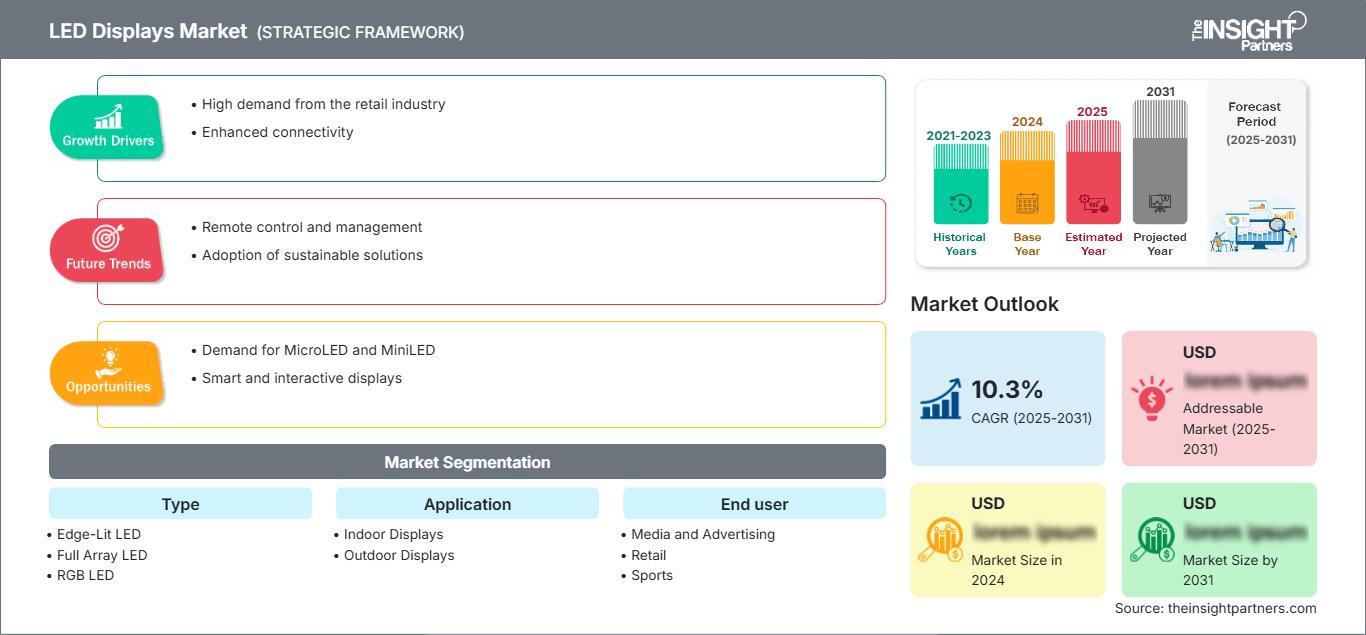
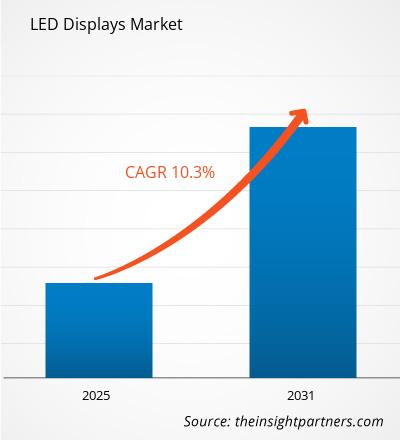
The LED Displays Market was valued at US$ 19.28 Billion in 2025 and is projected to reach US$ 32.23 Billion by 2034, expanding at a CAGR of 5.88% from 2026 to 2034. The market encompasses display architectures and deployment formats serving commercial, entertainment, retail, advertising, sports, events, and consumer applications. Its outlook is shaped by continuing migration toward high-resolution, energy-efficient, modular, and increasingly intelligent visual communication systems across indoor and outdoor environments.
North America presents a structurally attractive LED Displays Market size outlook, supported by digital out-of-home advertising, sports venue modernization, corporate visualization, and premium commercial installations. The regional market is expected to expand at approximately 6.2–7.0% CAGR through 2034. Replacement of legacy signage, demand for fine-pitch displays, and investment in immersive experiences provide a relatively resilient demand base, while supply-chain diversification is increasingly influencing procurement decisions.
LED Displays Market Assessment and Insights
- North America: North America represented an estimated 27–30% LED Displays Market share in 2025 and is expected to grow at a CAGR of 6.2–7.0% between 2026–2034, supported by sports, advertising, retail, and enterprise modernization.
- US: The US accounted for an estimated 75–80% of North American demand in 2025 and is projected to grow at a CAGR of 6.3–7.1% during 2026–2034.
- Europe: Europe held approximately 20–23% share in 2025 and is expected to register a 5.5–6.3% CAGR through 2034, with Germany, the UK, France, Italy, and Spain supporting commercial and public-display deployments.
- Asia Pacific: Asia Pacific represented approximately 40–48% share in 2025 and is projected to expand at a CAGR of 6.5–7.4%, led by China, Japan, South Korea, and India amid manufacturing and infrastructure investment.
- Largest Segment: Outdoor Displays held an estimated 55–60% market share in 2025 and is projected to expand at a CAGR of 6.1–6.8% during 2026–2034.
- High Growth Segment: RGB LED represented approximately 30–35% share in 2025 and is expected to grow at a CAGR of 7.0–7.8% through 2034, supported by premium visual applications.
- Key companies analyzed in detail: Barco NV, Cree, Inc., Delta Electronics, Inc., LG Electronics Inc., Nichia Corporation, ams-OSRAM AG, Panasonic Holdings Corporation, Samsung Electronics Co., Ltd., Sony Corporation, Vanguard LED Display.
Source: The Insight Partners' analysis based on proprietary research, government publications, company annual reports, investor presentations, industry databases, and expert interviews.
Evolution in the LED Displays Market has been taking place from traditional high-brightness displays to modular direct-view setups, small pixel pitch, enhanced color tuning and processing. Advances in manufacturing technology through chip packaging, surface mount, chip on board assemblies and calibration of modules have led to better installation capabilities and display uniformity. Simultaneously, manufacturers are trying to improve the thermal performance, power consumption, panel weight and maintainability in order to reduce total cost of ownership.
In the course of forecast period, LED Displays Market is expected to benefit from the rising deployment of such displays in the new urban areas, luxury retail stores, transport facilities, entertainment locations and professional visualization purposes. Investments in local manufacturing and components' sourcing will continue to grow along with buyers' focus on reliability of deliveries and geopolitical safety of supply chains. Energy efficiency regulations can additionally promote LED displays with efficient drivers and adaptive brightness control.
LED Displays Market Report Scope
| Report Attribute | Details |
|---|---|
| Market size in 2025 | US$ 19.28 Billion |
| Market Size by 2034 | US$ 32.23 Billion |
| Global CAGR (2026 - 2034) | 5.88% |
| Historical Data | 2021-2024 |
| Forecast period | 2026-2034 |
LED Displays Market Analysis
LED Displays Market growth is driven by demands of advertisers for dynamic content, retailers for better storefront experience, sports organizers for better visibility among spectators, and enterprises for large format visualization. The demand tends to grow for modular display solutions which can be adapted to non-standard layouts and reworked without changing the whole system. The supply chain includes suppliers of LED chips and packaging, suppliers of driver ICs, module manufacturers, cabinet assembly companies, processors, distributors, integrators, installers, and content management companies.
While supply dynamics are still affected by components’ availability, production focus, transportation costs, and qualification needs, Asia continues to be critical for upstream production, and North American and European end users tend to give more preference to other options and local presence. The fine pitch products receive more engineering efforts due to the impact of calibration, thermal uniformity, reliability, and installation precision on their performance.
LED Displays Market Report demonstrates competition to be based on integration of technology, applications, serviceability, and diversification. Barco NV is successful in professional visualization applications, while LG Electronics Inc., Samsung Electronics Co., Ltd., and Sony Corporation serve premium commercial and immersive display applications. Delta Electronics, Inc. and ams-OSRAM AG benefit from their expertise in electronics and LED technologies, while Nichia Corporation has significance in LED components development.
Moreover, investments into micro-LED, fine-pitch solutions, manufacturing processes, and energy management are part of competitive strategy as well. It becomes a common practice among companies to integrate hardware with software, installation, monitoring, and other services in order to strengthen customer relations. Panasonic Holdings Corporation, Cree, Inc., and Vanguard LED Display address their own niches in the ecosystem, while large players have more opportunities for distribution and manufacturing. Premiumization, robust supply chain, applications specialization, and installation ease are the focus of such a strategy.
● REPORT CUSTOMIZATION
Tailor This Report To Align With Your Specific Business Requirements
This report can be customized to align precisely with your business objectives, scope, and target markets. Customization options include tailored segmentation, geography, competitive analysis, and strategic insights to support informed decision-making.
Customize This Report →WHAT YOU CAN ADJUST
- ● Segmentations
- ● Geography
- ● Competitive Analysis
- ● Language Preferences
LED Displays Market: Strategic Insights
Regional Insights
North America LED Displays Market
North America accounted for an estimated 27–30% share of the LED Displays Market in 2025 and is projected to grow at a CAGR of 6.2–7.0% from 2026 to 2034. Strengths include the presence of advanced digital-out-of-home infrastructure, stadium refurbishment, modernization of retail spaces, corporate visualization, and investments in entertainment infrastructure. Fine-pitch LED solutions become relevant in cases where viewers will be at short distances and require image quality.
The regional environment is characterized by advanced integration services, experienced advertisers, and large purchasers of technologies. Diversification of the supply chain becomes especially important owing to the necessity of manufacturers and distributors to look for a replacement to concentrated manufacturing. Also, new areas of application of LED displays emerge at transport terminals, hotels, educational institutions, and in virtual production. Reliability, calibration, monitoring services, and cost-effective life cycle become essential.
U.S. LED Displays Market
The U.S. represented approximately 75–80% of North American LED Displays Market demand in 2025 and is expected to expand at a CAGR of 6.3–7.1% through 2034. Diversified demand in the form of sports, retail, entertainment, advertising, corporate installations, and virtual production is seen in this sector. Technology vendors and solution providers ensure widespread availability of premium display technologies.
Application trends are evolving in the direction of increased pixel density, immersion, and networking. Digital out-of-home advertising still needs digital billboards, while stadiums and entertainment installations need high refresh rate, bright solutions. Corporate customers are looking at LED screens as a replacement to traditional projection and tiling. LG Electronics Inc., Samsung Electronics Co., Ltd., Sony Corporation, Barco NV, among others, make for a strong competitive landscape.
Europe LED Displays Market
Europe held approximately 20–23% of the LED Displays Market in 2025 and is expected to grow at a CAGR of 5.5–6.3% through 2034. Leadership in regional industrial and business application is held by Germany, while the UK, France, Italy, and Spain participate in the market through their applications in advertising, sports, retail, transport, and other sectors. Efficiency and performance throughout life cycle become more important when it comes to procurement.
Digital out of home advertising, entertainment, and upgrades in the retail industry remain relevant in the UK, where serviceability and content versatility are priorities for buyers. Germany is interested in manufacturing, trade shows, business visualization, and professional applications. France, Italy, and Spain have requirements in areas of tourism, hospitality, retail, sports, and public sectors. Across Europe, environmental and energy management applications make efficient displays a priority, and premium applications demand fine pitch displays with high color accuracy.
APAC LED Displays Market
APAC represented approximately 40–48% of the LED Displays Market in 2025 and is projected to grow at a CAGR of 6.5–7.4% through 2034. Nevertheless, China will continue dominating because of economies of scale in manufacturing and deployments in the country. The emphasis of Japan and South Korea is on quality technologies whereas India and Australia have fast-growing opportunities for businesses.
There are several factors that contribute to the deployment in particular regions: industrial capacity, urbanization, smart-infrastructure projects, digitalization in retail and major events. India became more important in recent years due to infrastructure investment and digital advertising whereas China maintains its influence on the economics of modules and components. Nevertheless, Japan and South Korea will continue being technology-oriented regions whereas Australia emphasizes outdoor advertising, sport, retail and infrastructure.
Middle East & Africa LED Displays Market
Middle East & Africa is expected to grow at a CAGR of 7.0–8.0% through 2034, with Saudi Arabia representing a leading demand center. Premium retail, hospitality, events, and smart city implementations are seen in UAE, especially in Dubai and Abu Dhabi, whereas South Africa drives demand in advertising and sports segments.
Development of energy infrastructure and urban cities affects the procurement of LED in the region. Saudi Arabia’s development program is geared towards entertainment, tourism and venues constructions which generate demands for large outdoor and indoor displays. UAE is well-placed due to its premium business environments and international events. South Africa has a relatively advanced advertising market, whereas the rest of MEA markets depend on projects.
Segmentation Analysis
Type
Type segmentation comprises Edge-Lit LED, Full Array LED, and RGB LED architectures. The segment is projected to expand at a CAGR of 6.0–6.8% from 2026–2034. Technology selection depends on brightness, contrast, viewing distance, installation geometry, energy consumption, and application-specific image requirements. Premium deployments increasingly favor architectures capable of precise color control and seamless large-format integration.
- Edge-Lit LED: Edge-Lit LED remains relevant where slim form factors, efficient illumination, and controlled installation depth are priorities. Its application base includes commercial environments requiring practical visual presentation and comparatively compact display construction.
- Full Array LED: Full Array LED supports applications requiring stronger brightness uniformity and controlled illumination across larger surfaces. Its architecture remains strategically relevant for installations where consistent visual performance and broad viewing conditions influence purchasing decisions.
- RGB LED: RGB LED provides independent red, green, and blue light generation, enabling strong color reproduction and dynamic visual effects. It is particularly important for advertising, entertainment, sports, premium retail, and immersive installations.
Application
Application segmentation includes Indoor Displays and Outdoor Displays. The segment is projected to grow at a CAGR of 6.1–6.9% during 2026–2034. Application requirements differ materially because indoor deployments prioritize pixel density, close viewing, and aesthetics, while outdoor systems require brightness, weather resistance, thermal management, and durability under variable operating conditions.
- Indoor Displays: Indoor Displays address retail, corporate, hospitality, control-room, entertainment, and premium residential environments. Demand increasingly favors fine-pitch modules, seamless surfaces, accurate color reproduction, simplified installation, and integration with centralized content and monitoring platforms.
- Outdoor Displays: Outdoor Displays serve billboards, stadiums, transportation locations, public spaces, and large commercial façades. Their strategic value derives from high visibility, long operating hours, weather resistance, scalable cabinet construction, and the ability to deliver dynamic content over extended distances.
End user
End user segmentation covers Media and Advertising, Retail, Sports, Events and Festivals, and Consumer Electronics. The segment is expected to expand at a CAGR of 5.7–6.5% through 2034. Purchasing priorities increasingly reflect measurable audience engagement, operational flexibility, content refresh requirements, and total cost of ownership.
- Media and Advertising: Media and Advertising remains a core deployment base because digital signage enables flexible campaigns, scheduled content, and rapid creative changes. Outdoor networks particularly value brightness, reliability, remote management, and scalable installation economics.
- Retail: Retail buyers use LED systems to strengthen storefront visibility, merchandising, promotional communication, and experiential environments. Adoption increasingly depends on compact installation, visual quality, centralized content control, and compatibility with evolving omnichannel strategies.
- Sports: Sports venues require high-brightness, high-refresh-rate, and robust displays for scoreboards, perimeter advertising, ribbons, and fan engagement. Procurement increasingly evaluates viewing consistency, camera compatibility, durability, and service response.
- Events and Festivals: Events and Festivals favor modular systems that can be transported, rapidly assembled, reconfigured, and reused. Demand is shaped by rental economics, setup speed, weather tolerance, visual impact, and compatibility with live production workflows.
- Consumer Electronics: Consumer Electronics applications increasingly emphasize premium image quality, large formats, fine pixel structures, and immersive viewing. Product development is influenced by manufacturing yields, component economics, power efficiency, and the commercial viability of emerging display architectures.
Opportunity Snapshot
| End Users | Revenue Contribution (High/Medium/Low) | Trend Tag (MAX 2 words) | Adoption Stage (Emerging/Scaling/Mature) |
| Media and Advertising | High | Programmatic DOOH | Mature |
| Retail | High | Immersive Retail | Scaling |
| Sports | High | Venue Upgrades | Scaling |
| Events and Festivals | Medium | Rental Modular | Scaling |
| Consumer Electronics | Medium | Premium MicroLED | Emerging |
LED Displays Market Growth Drivers and Impact Analysis
Expansion of Digital Out-of-Home Advertising Networks
Digital out-of-home advertising increases the value of LED installations through scheduling of multiple advertisements, quick changes of content, and better utilization of busy areas compared to traditional media. These characteristics make it worthwhile to invest in bright, robust screens with remote management and content management capability. In addition, for manufacturers, repeat orders in networks will provide chances for standardized modules and maintenance deals. This effect becomes especially noticeable in urban corridors, transit settings, shopping centers, and sports venues. Programmatic advertising can enhance the utilization through the ability of advertisers to buy certain audience and certain time. Improved utilization makes it attractive for screen operators to replace older models with models of higher resolution.
Venue Modernization and Immersive Audience Experiences
Increasingly, sports stadia, concert halls, movie theatres, convention centers, and entertainment venues see visual technology as an integral component of the audience experience rather than as an elementary information system. This change increases the need for large format LED screens, LED ribbons, perimeter systems, and immersive solutions able to handle coordinated content. Venue operators also need high refresh rates and color accuracy since their displays are often recorded through professional broadcast cameras. As a result, the market trend favors those who offer a combination of hardware, processing, integration, and support services. The process of venue upgrade may lead to several display needs per one project, which raises the average system price and encourages an integrated purchase strategy. It has implications for the rental and production markets where modularity and ability to reuse equipment become key drivers of success.
Progress in Energy Efficiency and Display Engineering
Gains in LED package technology, driver electronics, thermal technology, module architecture, and processing are raising the bar on the capabilities of large-screen displays. Higher efficiency means that there is a reduction in operational cost to the client who uses these screens over long periods of time, especially in outdoor advertisements or other commercial facilities. Weight reductions in cabinet and front-access maintenance capability can also lower installation and maintenance costs. Engineering advances make it more compelling to upgrade because of the superior capabilities in brightness control, thermal efficiency, and ease of serviceability that are not available in older models. Lowering of life-cycle costs could provide a competitive edge in situations where the cost of acquisition is higher..
LED Displays Market Future Trends
AI-Enabled Content and Display Management
The LED Displays Market trends will probably head towards greater integration of the display hardware, artificial intelligence, sensors, and content management platform. In future, the system will be able to regulate the intensity of light, schedule the content delivery, detect anomalies in its operation, and optimize playback in accordance with environmental parameters and audience preferences. The AI-based diagnosis will allow detecting the degradation of modules before any faults take place, avoiding the unscheduled maintenance and facilitating the planning of the services. The content management platform will enable connecting the network of displays with the analysis of customers, traffic data, scheduling, and advertising management system. This development transforms the role of the displays from simple output devices into visual infrastructure. The vendors who will be integrating the monitoring, analysis, processing, and content delivery can differentiate their products without depending only on the pixel count.
Micro-LED and Fine-Pitch Commercialization
Architectures of fine pitch as well as micro-LEDs will be increasingly utilized in professional and premium markets as process technology develops. Lower pitches allow more compact pixels and thus shorter viewing distances, which will be suitable for control rooms, offices, premium retail, cinema, home entertainment, and virtual productions. The main benefit in this case is going to be achieved through higher yield and lower installation complexities without sacrificing light output, contrast, reliability, and color accuracy. The use of chip on board and other packaging methods will aid in achieving this goal by allowing for more compact pixels and better surfaces. However, commercialization will still be application-driven due to high qualification and installation expenses in premium products. Yet, growing needs for seamless images in large formats will incentivize manufacturers to broaden their offerings.
LED Displays Market Opportunities
Localized Manufacturing and Supply-Chain Diversification
LED Displays Market Forecasts increasingly depend on supply-chain resilience as customers seek greater predictability in component availability, logistics, and installation schedules. This creates opportunities for manufacturers and investors to establish regional assembly, qualify alternative component sources, and develop partnerships with local integrators. North America and Europe are particularly relevant for supply diversification because buyers increasingly evaluate geopolitical exposure alongside technical specifications and price. Regional manufacturing does not require complete vertical integration; strategically located module assembly, cabinet production, calibration, testing, and service operations can reduce lead times and improve responsiveness. Companies able to combine global component access with regional integration may achieve stronger customer retention. Investment decisions should therefore prioritize scalable facilities, component qualification, service infrastructure, and digital supply-chain visibility rather than focusing exclusively on production capacity.
Emerging-City Digital Infrastructure Programs
Secondary cities and developing urban centers offer an investment pathway because digital infrastructure is expanding beyond established advertising and entertainment hubs. Municipal information systems, transportation modernization, tourism projects, retail development, and new entertainment districts can create requirements for outdoor and indoor LED installations. Investors can capture this opportunity through partnerships with local system integrators, content providers, advertising operators, and infrastructure contractors rather than pursuing hardware sales independently. Project economics are improved when a display can support several functions, such as advertising, public information, wayfinding, and event communication. India, Southeast Asia, the Middle East, and selected African markets are particularly relevant because infrastructure expansion can occur alongside new commercial development. Successful strategies should emphasize modular systems, local maintenance capability, financing flexibility, and compliance with municipal installation requirements.
Recent Developments
- May 2026: Samsung Electronics Co., Ltd. launched its IBF Series indoor LED display for window-facing environments, highlighting brightness of up to 3,500 units and flexible installation for retail, quick-service restaurants, and live venues. The launch expands the company's commercial LED portfolio toward high-impact storefront applications where visibility under strong ambient light is a central requirement.
- April 2026: Samsung Electronics Co., Ltd. introduced a 14-meter standard size for its Onyx Cinema LED lineup at CinemaCon 2026. The larger format targets premium large-format auditoriums and extends the platform beyond existing 5-meter and 10-meter configurations, reflecting exhibitor interest in differentiated cinema experiences and scalable direct-view LED installations.
- October 2025: LG Electronics Inc. unveiled the LG MAGNIT Active Micro LED for premium home cinema, featuring a 136-inch 4K display with Active-Matrix technology. The product uses individual pixel control and was positioned for Korea and subsequent global markets, including North America, demonstrating continued expansion of micro-LED from commercial environments into premium residential applications.
Frequently Asked Questions

- Comprehensive Market Sizing and Forecast Analysis
- Detailed Segmentation Analysis
- In-Depth Market Dynamics Assessment
- Regional and Country-Level Insights
- Competitive Landscape and Company Benchmarking
- Strategic Business Intelligence
Recent Reports
Testimonials

The Insight Partners provided valuable market intelligence that supported our global go-to-market strategy. Their team was professional, responsive, and attentive to our feedback, providing thoughtful analysis and helpful methodological clarifications throughout the project.
Junmo Kim Chief Financial Officer (CFO), Enertech Co., Ltd.
The Insight Partners' SCADA System Market report is comprehensive, with valuable insights on current trends and future forecasts. The team was highly professional, responsive, and supportive throughout. We are very satisfied and highly recommend their services.
RAN KEDEM Partner, Reali Technologies LTDs
I requested a report on a very specific software market and the team produced the report in a few days. The information was very relevant and well presented. I then requested some changes and additions to the report. The team was again very responsive and I got the final report in less than a week.
JEAN-HERVE JENN Chairman, Future Analytica
We worked with The Insight Partners for an important market study and forecast. They gave us clear insights into opportunities and risks, which helped shape our plans. Their research was easy to use and based on solid data. It helped us make smart, confident decisions. We highly recommend them.
PIYUSH NAGPAL Sr. Vice President, High Beam Global
The Insight Partners delivered insightful, well-structured market research with strong domain expertise. Their team was professional and responsive throughout. The user-friendly website made accessing industry reports seamless. We highly recommend them for reliable, high-quality research services
YUKIHIKO ADACHI CEO, Deep Blue, LLC.
This is the first time I have purchased a market report from The Insight Partners.While I was unsure at first, I visited their web site and felt more comfortable to take the risk and purchase a market report.I am completely satisfied with the quality of the report and customer service. I had several questions and comments with the initial report, but after a couple of dialogs over email with their analyst I believe I have a report that I can use as input to our strategic planning process.Thank you so much for taking the extra time and making this a positive experience.I will definitely recommend your service to others and you will be my first call when we need further market data.
JOHN SUZUKI President and Chief Executive Officer, Board Director, BK Technologies
I wish to appreciate your support and the professionalism you displayed in the course of attending to my request for information regarding to infectious disease IVD market in Nigeria. I appreciate your patience, your guidance, and the fact that you were willing to offer a discount, which eventually made it possible for us to close a deal. I look forward to engaging The Insight Partners in the future, all thanks to the impression you have created in me as a result of this first encounter.
DR CHIJIOKE ONYIA MANAGING DIRECTOR, PineCrest Healthcare Ltd.Reason to Buy
- Informed Decision-Making
- Understanding Market Dynamics
- Competitive Analysis
- Identifying Emerging Markets
- Customer Insights
- Market Forecasts
- Risk Mitigation
- Boosting Operational Efficiency
- Strategic Planning
- Investment Justification
- Tracking Industry Innovations
- Aligning with Regulatory Trends





 Get Free Sample for