Specialty Crops Market Size, Share & Growth by 2034
Specialty Crops Market Size and Forecast (2021 - 2034), Global and Regional Share, Trend, and Growth Opportunity Analysis Report Coverage: By Category (Organic and Conventional) and Crop Type (Fruits and Vegetables, Tree Nuts, Herbs and Spices, and Others) and Geography
Historic Data: 2021-2024 | Base Year: 2025 | Forecast Period: 2026-2034- Report Date : Apr 2026
- Report Code : TIPRE00015685
- Category : Consumer Goods
- Status : Upcoming
- Available Report Formats :


- No. of Pages : 150

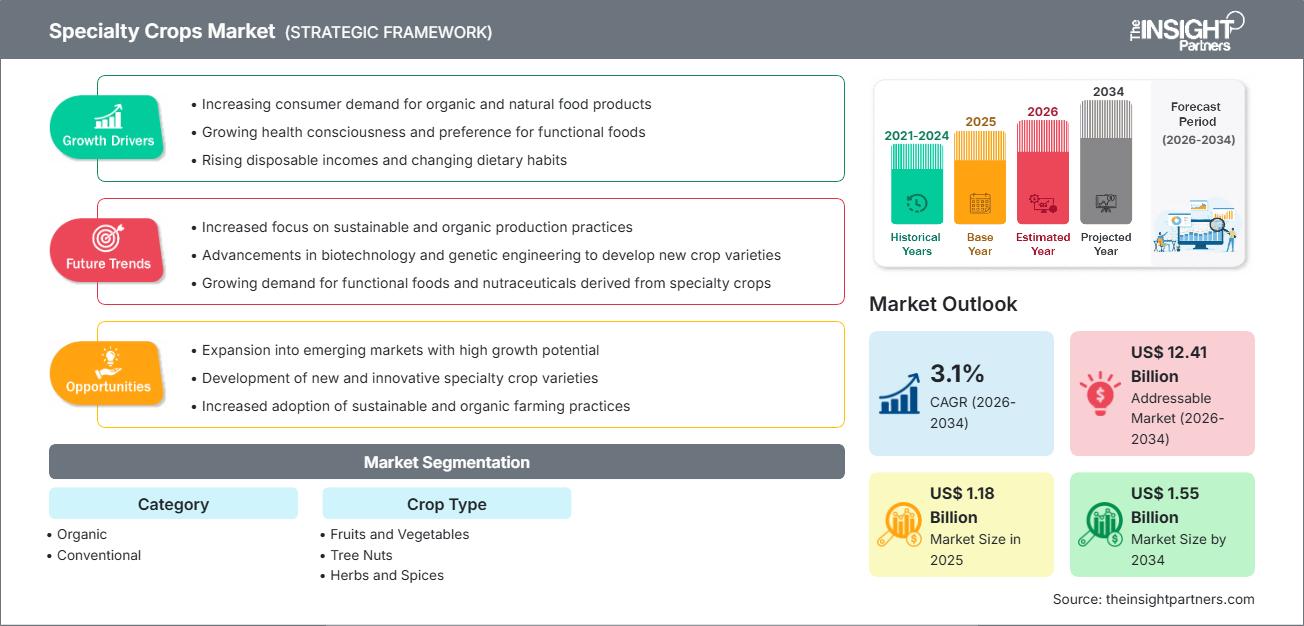
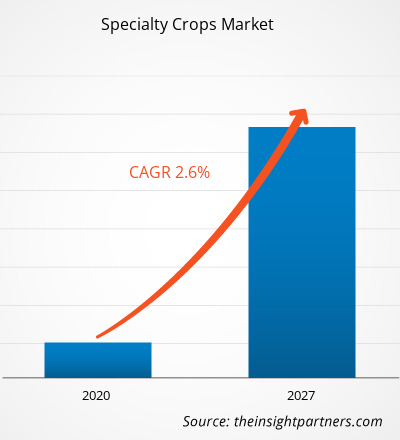
The global Specialty Crops market size is projected to reach US$ 1.55 billion by 2034 from US$ 1.18 billion in 2025. The market is anticipated to register a CAGR of 3.1% during the forecast period 2026–2034. Key market dynamics include a rising global demand for nutrient-dense, high-value agricultural products, the expansion of the "farm-to-fork" movement, and increasing government support for crop diversification. Additionally, the market is expected to benefit from the growing popularity of plant-based diets, advancements in precision agriculture for high-value horticulture, and the rising inclusion of exotic fruits and ancient grains in mainstream retail and foodservice segments.
Specialty Crops Market Analysis
The specialty crops market analysis reveals a decisive shift toward high-value, climate-resilient agriculture as farmers seek to move away from low-margin commodity grains. Strategic opportunities are emerging in Controlled Environment Agriculture (CEA) and vertical farming, where specialty crops like leafy greens and medicinal herbs can be produced with high resource efficiency and minimal pesticide use. Analysis suggests that market entry for new players is increasingly dictated by the ability to secure Cold Chain Integrity, as the perishability of specialty fruits and vegetables remains a significant hurdle. Furthermore, the analysis highlights that competitive differentiation is no longer based on yield alone but on traceability and sustainability credentials. Producers who can provide "clean label" transparency through blockchain or IoT-enabled tracking are capturing higher margins in premium export markets, particularly in North America and Europe.
Specialty Crops Market Overview
Specialty crops are transitioning from niche local production to a globalized premium agricultural market. Encompassing fruits, vegetables, tree nuts, herbs, and spices, this market accounts for a substantial portion of global agricultural value despite occupying less acreage than staple row crops. Historically rooted in regional cuisines, these crops are now seeing globalized demand due to the mainstreaming of ethnic flavors and "superfoods" like avocados, blueberries, and turmeric. The market features a blend of small-scale artisanal growers and massive agribusiness conglomerates. While conventional production still holds the largest volume, the organic segment is the primary value-growth engine. For instance, the market in the US represents a high-value agricultural cornerstone, accounting for over one-third of domestic crop sales. Driven by the "health-as-wellness" trend, the sector is pivoting toward automation and precision horticulture to combat rising labor costs. While conventional fruits and nuts lead in volume, organic segments now command significant premium retail growth.
Customize This Report To Suit Your Requirement
Get FREE CUSTOMIZATIONSpecialty Crops Market: Strategic Insights
-
Get Top Key Market Trends of this report.This FREE sample will include data analysis, ranging from market trends to estimates and forecasts.
Specialty Crops Market Drivers and Opportunities
Market Drivers:
- Rising Consumer Health Consciousness: Increasing awareness regarding the medicinal and nutritional benefits of fruits, nuts, and herbs, particularly their high antioxidant and vitamin content, is fueling a global shift toward plant-heavy diets.
- Expansion of the Gourmet and Global Cuisines: The globalization of taste has led to a surge in demand for non-native specialty crops. Spices like saffron and exotic fruits like dragon fruit are moving from specialty stores to mainstream supermarkets.
- Supportive Government Initiatives: Programs such as the USDA's Specialty Crop Block Grant Program and similar EU subsidies encourage farmers to diversify into high-value crops to enhance farm income and rural economic stability.
Market Opportunities:
- Development of Climate-Resilient Varieties: As climate change impacts traditional growing zones, significant opportunities exist for companies specializing in seed technology to develop drought-tolerant and heat-resistant specialty crop varieties.
- Growth in the Nutraceutical and Cosmetic Industries: Beyond food, specialty crops like botanical herbs and nut oils are seeing massive demand as key ingredients in "clean beauty" products and functional health supplements.
- Advancements in Precision Agri-Tech: There is a growing opportunity to integrate AI-driven crop management and automated harvesting technologies specifically designed for the delicate handling requirements of specialty fruits and vegetables.
Specialty Crops Market Report Segmentation Analysis
The Specialty Crops Market share is analyzed across various segments to provide a clearer understanding of its structure, growth potential, and emerging trends. Below is the standard segmentation approach used in most industry reports:
By Category:
- Organic: This segment is the fastest-growing niche, driven by health-conscious consumers and environmental regulations. It commands a significant price premium but requires rigorous certification and chemical-free soil management.
- Conventional: The dominant volume driver, conventional cultivation utilizes standard fertilizers and pest control. It remains the backbone of the global supply chain due to its lower cost of production and established infrastructure.
By Crop Type:
- Fruits and Vegetables: The largest segment, encompassing everything from leafy greens to exotic berries. This segment is characterized by high perishability and a strong focus on fresh-market aesthetics.
- Tree Nuts: Includes almonds, walnuts, and pistachios. This is a high-margin, export-heavy segment that has benefited significantly from the global "healthy snacking" trend.
- Herbs and Spices: A rapidly expanding category driven by the food processing and pharmaceutical industries. It includes culinary herbs, medicinal plants, and concentrated spices.
- Others: Includes floriculture (flowers), nursery crops, and Christmas trees, which cater to the ornamental and landscaping markets.
By Geography:
- North America
- Europe
- Asia Pacific
- South & Central America
- Middle East & Africa
Specialty Crops Market Report Scope
| Report Attribute | Details |
|---|---|
| Market size in 2025 | US$ 1.18 Billion |
| Market Size by 2034 | US$ 1.55 Billion |
| Global CAGR (2026 - 2034) | 3.1% |
| Historical Data | 2021-2024 |
| Forecast period | 2026-2034 |
| Segments Covered |
By Category
|
| Regions and Countries Covered |
North America
|
| Market leaders and key company profiles |
|
Specialty Crops Market Players Density: Understanding Its Impact on Business Dynamics
The Specialty Crops Market is growing rapidly, driven by increasing end-user demand due to factors such as evolving consumer preferences, technological advancements, and greater awareness of the product's benefits. As demand rises, businesses are expanding their offerings, innovating to meet consumer needs, and capitalizing on emerging trends, which further fuels market growth.
Specialty Crops Market Share Analysis by Geography
Asia-Pacific is expected to grow fastest in the coming years. Emerging markets in South & Central America, the Middle East, and Africa also have many untapped opportunities for high-value fruit exporters and organic herb producers to expand. The specialty crops market is undergoing a significant transformation, moving from regional agricultural niches to a global high-value functional food engine. Growth is driven by the rising prevalence of plant-based diets, a surge in "superfood" demand, and the expansion of the luxury botanical and nut sectors. Below is a summary of market share and trends by region:
1. North America
- Market Share: Holds the largest share globally, anchored by the robust horticultural infrastructure of California's Central Valley and the Upper Midwest.
- Key Drivers:
- Technological Leadership: Extensive implementation of automated machinery and AI-powered laser weeders to mitigate severe labor shortages.
- Government Support: Robust funding through the USDA's Specialty Crop Block Grant Program and enhanced federal crop insurance for fruits and berries.
- Consumer Demand: Widespread mainstreaming of "superfoods" and high-protein tree nuts in the snacking and health-food sectors.
- Trends: A rapid shift toward Precision Agriculture-as-a-Service (Agri-TaaS) to reduce capital expenditure and the expansion of indoor vertical farming for year-round berry and leafy green production.
2. Europe
- Market Share: Accounted for a significant portion of global revenue, driven by high-value Mediterranean exports and a massive organic consumer base.
- Key Drivers:
- Regulatory Framework: Strict EU mandates for chemical-free production and the "Action Plan for the Development of Organic Production."
- Appellation Value: Deep-seated Protected Designation of Origin (PDO) ecosystems for specialty oils, wines, and nuts in Italy, Spain, and Greece.
- Sustainability Mandates: Strategic prioritization of circular economy models, utilizing plant residue for sustainable nutrient solutions.
- Trends: Increasing focus on zero-residue produce and the digitization of pasta-wheat and olive oil supply chains for enhanced blockchain traceability and food security.
3. Asia-Pacific
- Market Share: The fastest-growing region globally, fueled by dietary diversification and the expansion of high-tech farming in China, India, and Japan.
- Key Drivers:
- Urbanization and Income: Rising middle-class disposable incomes leading to a preference for westernized "luxury" fruits and temperate nuts.
- Smart Farming Initiatives: Heavy government investment in "Smart Agriculture" to improve yield per hectare and export quality in emerging economies.
- Hypoallergenic Nutrition: Growing demand for specialty plant-based extracts and botanical ingredients for the nutraceutical and beauty industries.
- Trends: Massive reliance on mobile-based e-commerce for direct-to-consumer delivery and the scaling of high-margin greenhouse horticulture for exotic vegetables.
4. South and Central America
- Market Share: Emerging market with a growing export-oriented sector, specializing in tropical and counter-seasonal specialty crops.
- Key Drivers:
- Climatic Advantage: Diverse microclimates allow for the year-round cultivation of high-value exports like avocados, berries, and specialty coffee.
- Trade Liberalization: Favorable free trade policies facilitating the flow of organic tropical fruits to North American and European premium markets.
- Cost Efficiency: Competitive labor costs and increasing modernization of small-scale farms into commercial-grade export hubs.
- Trends: Growth of "climate-resilient" varieties and the formalization of small-hold cooperatives to meet international organic and fair-trade certification standards.
5. Middle East and Africa
- Market Share: Developing market transitioning from traditional horticulture toward formalized, technology-driven commercial production.
- Key Drivers:
- Food Security Focus: Strategic investments in desalination-powered hydroponics and climate-controlled greenhouses to reduce import reliance.
- Regional Specialties: High global demand for indigenous specialty crops such as dates, spices, and essential oils for the fragrance industry.
- Smart Irrigation: Implementation of IoT-enabled drip irrigation systems to maximize growth in arid climates and reduce water waste.
- Trends: Implementation of Blockchain Traceability for high-value data and olive oil exports, and a shift toward high-nutrient specialty powders for the pediatric nutrition segment.
High Market Density and Competition
Competition is intensifying due to the presence of established leaders such as DIAMOND FRUIT CO., Harbor Spice Co., Inc., Olam International, Oregon Spice Company, The Specialty Crop Company, BanaBay Limited, Rice Fruit Company, Fisher Nut Company, and Simped Foods Pty Ltd, which also contribute to a diverse and rapidly expanding market landscape.
This competitive environment pushes vendors to differentiate through:
- Premiumization and functional branding position Specialty Crops as a superior nutritional alternative to cow and goat milk by emphasizing its higher protein, calcium, and A2-type protein content for health-conscious consumers.
- Specialty Crops products now include more than just liquid milk. Companies offer gourmet cheeses like Feta and Pecorino, probiotic yogurts, and high-end infant formula made from Specialty Crops.
- Producers manage the entire supply chain, from breeding East Friesian and Lacaune sheep to local processing. This approach ensures quality, transparency, and meets ethical clean-label standards.
- New processing technologies, like spray-drying and membrane filtration, help create high-quality Specialty Crops powders used in nutraceutical and cosmetic products worldwide.
Opportunities and Strategic Moves
- Strategic Partnerships for Global Distribution: Form collaborations between Western producers and major retail aggregators in the Asia-Pacific region. For instance, recent moves by North American nut exporters to partner with Asian e-commerce giants have enabled direct access to high-margin middle-class segments.
- Expansion into the Nutraceutical and Cosmeceutical Sectors: Beyond fresh consumption, there is a significant opportunity to supply specialty crop extracts, such as turmeric, kale, and almond oils, to the pharmaceutical and beauty industries, where demand for botanical, plant-based ingredients is surging.
- Adoption of Precision Agriculture and Automation: Incorporate autonomous harvesting and real-time sensor technology to mitigate labor shortages. Companies that invest in "Decision-Grade Intelligence" to optimize resource usage are better positioned to maintain profitability in high-cost environments.
Major Companies operating in the Specialty Crops Market are:
- DIAMOND FRUIT CO.
- Harbor Spice Co., Inc.
- Olam International
- Oregon Spice Company
- The Specialty Crop Company.
- BanaBay Limited
- Rice Fruit Company
- Fisher Nut Company
- Simped Foods Pty Ltd.
- SVZ Industrial Fruit & Vegetable Ingredients
Disclaimer: The companies listed above are not ranked in any particular order.
Specialty Crops Market News and Recent Developments
- In September 2025, the US Department of Agriculture (USDA) announced that it had awarded US$ 72.9 million in grant funding to 56 states and territories. This investment supported 586 distinct projects through the Specialty Crop Block Grant Program (SCBGP). The program funded innovative initiatives designed to enhance the competitiveness of Specialty Crops through targeted marketing, education, and research. These efforts were administered by the USDA's Agricultural Marketing Service (AMS) to strengthen the market position of high-value agricultural products.
- In April 2025, Bayer AG launched a new line of climate-resilient vegetable seeds specifically engineered for high-heat environments. This move was intended to support growers of Specialty Crops in arid regions, helping them maintain yield consistency despite shifting climate patterns.
Specialty Crops Market Report Coverage and Deliverables
The "Specialty Crops Market Size and Forecast (2021–2034)" report provides a detailed analysis of the market covering below areas:
- Specialty Crops Market size and forecast at global, regional, and country levels for all the key market segments covered under the scope
- Specialty Crops Market trends, as well as market dynamics such as drivers, restraints, and key opportunities
- Detailed PEST and SWOT analysis
- Specialty Crops Market analysis covering key market trends, global and regional framework, major players, regulations, and recent market developments
- Industry landscape and competition analysis covering market concentration, heat map analysis, prominent players, and recent developments in the Specialty Crops Market.
- Detailed company profiles
Frequently Asked Questions

- Historical Analysis (2 Years), Base Year, Forecast (7 Years) with CAGR
- PEST and SWOT Analysis
- Market Size Value / Volume - Global, Regional, Country
- Industry and Competitive Landscape
- Excel Dataset
Recent Reports
Testimonials

The Insight Partners' SCADA System Market report is comprehensive, with valuable insights on current trends and future forecasts. The team was highly professional, responsive, and supportive throughout. We are very satisfied and highly recommend their services.
RAN KEDEM Partner, Reali Technologies LTDs
I requested a report on a very specific software market and the team produced the report in a few days. The information was very relevant and well presented. I then requested some changes and additions to the report. The team was again very responsive and I got the final report in less than a week.
JEAN-HERVE JENN Chairman, Future Analytica
We worked with The Insight Partners for an important market study and forecast. They gave us clear insights into opportunities and risks, which helped shape our plans. Their research was easy to use and based on solid data. It helped us make smart, confident decisions. We highly recommend them.
PIYUSH NAGPAL Sr. Vice President, High Beam Global
The Insight Partners delivered insightful, well-structured market research with strong domain expertise. Their team was professional and responsive throughout. The user-friendly website made accessing industry reports seamless. We highly recommend them for reliable, high-quality research services
YUKIHIKO ADACHI CEO, Deep Blue, LLC.
This is the first time I have purchased a market report from The Insight Partners.While I was unsure at first, I visited their web site and felt more comfortable to take the risk and purchase a market report.I am completely satisfied with the quality of the report and customer service. I had several questions and comments with the initial report, but after a couple of dialogs over email with their analyst I believe I have a report that I can use as input to our strategic planning process.Thank you so much for taking the extra time and making this a positive experience.I will definitely recommend your service to others and you will be my first call when we need further market data.
JOHN SUZUKI President and Chief Executive Officer, Board Director, BK Technologies
I wish to appreciate your support and the professionalism you displayed in the course of attending to my request for information regarding to infectious disease IVD market in Nigeria. I appreciate your patience, your guidance, and the fact that you were willing to offer a discount, which eventually made it possible for us to close a deal. I look forward to engaging The Insight Partners in the future, all thanks to the impression you have created in me as a result of this first encounter.
DR CHIJIOKE ONYIA MANAGING DIRECTOR, PineCrest Healthcare Ltd.Reason to Buy
- Informed Decision-Making
- Understanding Market Dynamics
- Competitive Analysis
- Identifying Emerging Markets
- Customer Insights
- Market Forecasts
- Risk Mitigation
- Boosting Operational Efficiency
- Strategic Planning
- Investment Justification
- Tracking Industry Innovations
- Aligning with Regulatory Trends




 Get Free Sample For