
Virtual Reality Headset Market Growth, Trends & Demand by 2034
Coverage: By Product (Standalone, Smartphone-enabled, Standalone PC-connected); End-device (Low-end Device, Mid-range Device, High-end Device); Application (Gaming, Healthcare, Media & Entertainment, Manufacturing, Retail, Education, Telecommunications, Others), and Geography (North America, Europe, Asia Pacific, and South and Central America)
- Status : Data Released
- Report Code : TIPTE100000323
- Category : Electronics and Semiconductor
- No. of Pages : 150
- Available Report Formats :


- Last update date : September 22, 2026


2025 Market Size
US$ 17.1 Bn
Base year value
2034 Forecast
US$ 162.71 Bn
Projected by 2034
CAGR 2026-2034
28.44 %
Growth rate
Addressable Market
US$ 657.40 Bn
(2026-2034)
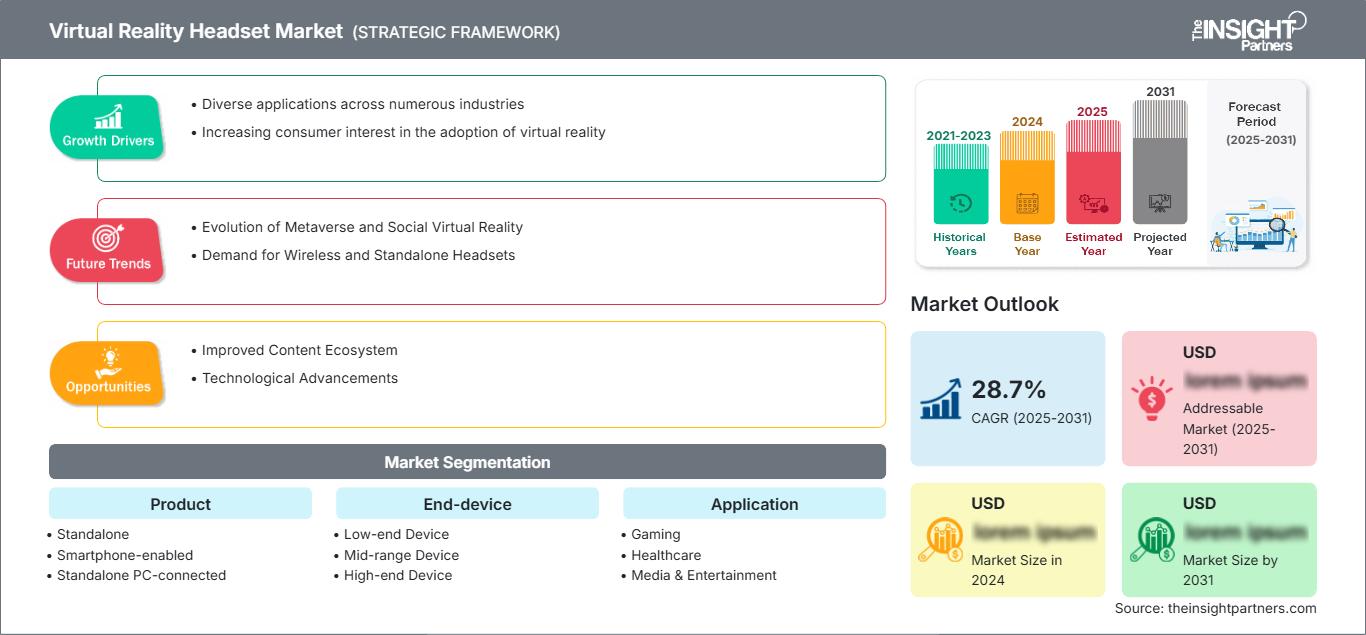
The Virtual reality headset market reached US$ 17.1 Billion in 2025 and is projected to reach US$ 162.71 Billion by 2034, expanding at a CAGR of 28.44% during 2026–2034. The market encompasses immersive head-mounted computing systems supporting gaming, enterprise visualization, digital collaboration, simulation, and spatial content consumption, with advances in displays, processors, tracking, passthrough, and interaction technologies reshaping product capabilities and commercial adoption.
North America is expected to remain a leading regional contributor, supported by strong enterprise digitization, gaming ecosystems, spatial computing investment, and established technology infrastructure. The virtual reality headset market size in the region is expected to expand at approximately 29–32% CAGR between 2026 and 2034, while healthcare simulation, defense training, industrial design, and immersive entertainment provide structural demand beyond consumer gaming.
Virtual Reality Headset Market Assessment and Insights
- North America: The region is expected to account for 34–38% share in 2025 and grow at a CAGR of 29–32% between 2026–2034, supported by gaming, enterprise simulation, healthcare training, and spatial computing investments.
- US: The US is expected to represent 72–76% of North America's 2025 share, growing at a CAGR of 28–31% between 2026–2034 through strong consumer and enterprise adoption.
- Europe: Europe is projected to hold 22–26% share in 2025 and grow at 27–30% CAGR through 2034, led by Germany, the UK, France, Italy, and Spain, with industrial training supporting demand.
- Asia Pacific: Asia Pacific is expected to command 30–34% share in 2025 and expand at 30–33% CAGR, led by China, Japan, South Korea, and India, where electronics manufacturing and digital entertainment reinforce adoption.
- Largest Segment: Standalone products are expected to hold a 58–62% market share in 2025 and grow at 29–32% CAGR during 2026–2034, reflecting convenience and processing integration.
- High Growth Segment: Smartphone-enabled products are estimated at 12–16% market share in 2025 and are expected to grow at 32–35% CAGR as lower-cost immersive experiences broaden access.
- Key companies analyzed in detail: FOVE, Inc.; Google LLC; LG Electronics Inc.; Merge Labs, Inc.; Microsoft Corporation; Oculus (Facebook Technologies, LLC); Samsung Electronics Co., Ltd.; Sony Corporation; VIVE (HTC Corporation); ZEISS International; Apple Inc.; Meta Platforms, Inc.; PICO Technology Co., Ltd.
Source: The Insight Partners' analysis based on proprietary research, government publications, company annual reports, investor presentations, industry databases, and expert interviews.
The virtual reality headset market evolution is being shaped by the transition from smartphone-dependent viewers and PC-tethered systems toward integrated standalone platforms. Enhancements in the area of pancake optics, OLED and HD LCD screens, inside-out tracking, eye-tracking, hand tracking, spatial sound, and camera pass-through have increased functionality. The development of semiconductor technology has also decreased the reliance on external computing, and platform ecosystems have become the defining factors in content provision, developer incentives, and user engagement.
The changes are turning the devices from gaming-oriented peripherals to universal spatial computing terminals.
Further growth of the sector will rely on the manufacturing capabilities of the Asia Pacific, software investments in North America, and industry applications in Europe. Biometric data privacy, child protection, cybersecurity, and ergonomic considerations will play an important role in corporate procurement requirements. AI interfaces, energy-efficient processing, and mixed reality technologies will also receive more investment. Google's Android XR initiative, developed with Samsung and Qualcomm, illustrates how operating-system standardization could encourage broader device participation and reduce ecosystem fragmentation, according to the Virtual Reality Headset Market report.
Virtual Reality Headset Market Report Scope
| Report Attribute | Details |
|---|---|
| Market size in 2025 | US$ 17.1 Billion |
| Market Size by 2034 | US$ 162.71 Billion |
| Global CAGR (2026 - 2034) | 28.44% |
| Historical Data | 2021-2024 |
| Forecast period | 2026-2034 |
Virtual Reality Headset Market Analysis
Demand is increasingly diversified across gaming, media, healthcare, education, industrial training, and remote collaboration. The virtual reality headset market growth is supported by improved standalone performance, declining component costs, wider software libraries, and greater availability of immersive content. The value chain covers components such as display panels, optics, processors, sensors, batteries, controllers, operating systems, content platforms, and application software development. Competitive forces will still be heavily driven by semiconductors and displays.
Standalone devices ease implementation due to the integration of computing, tracking, display, and wireless capability in one device. PC-based products will still have a place in cases where high graphics performance is crucial, especially in simulation and high-end gaming. Phone-enabled versions will cater to budget-conscious customers and provide education. Throughout the ecosystem, component suppliers will emphasize light hardware, effective battery technology, fast wireless connections, and efficient passthrough. Competition will, therefore, become more about the overall experience and not just display resolution.
Competitive positioning is driven by firms with the power to dominate operating systems, content, semiconductor partnerships, or gaming ecosystems. The advantages held by Meta Platforms, Inc. include the Quest ecosystem, whereas those of Sony Corporation include PlayStation distribution and content. Samsung Electronics Co., Ltd. has an advantage because of its display technology and Android XR platform, and Google LLC has an advantage in terms of software, AI, and services. Apple Inc. is still positioned on the premium side due to spatial computing. HTC, ZEISS, FOVE, Merge Labs, LG Electronics, and PICO add specialized capabilities, as highlighted in the Virtual Reality Headset Market forecast.
Priority investments are now based more on ecosystem scale than on hardware margin alone. Developer tools, immersive entertainment, assistants, spatial interfaces, and business partnerships are being invested in to enhance platform value per use. The investment of Meta's Reality Labs demonstrates the level of commitment that can be made long term, but Android XR opens another path for hardware and software partners. Differentiation will henceforth come down to libraries, developer interest, compatibility, artificial intelligence capability, optics, comfort, and workflow.
● REPORT CUSTOMIZATION
Tailor This Report To Align With Your Specific Business Requirements
This report can be customized to align precisely with your business objectives, scope, and target markets. Customization options include tailored segmentation, geography, competitive analysis, and strategic insights to support informed decision-making.
Customize This Report →WHAT YOU CAN ADJUST
- ● Segmentations
- ● Geography
- ● Competitive Analysis
- ● Language Preferences
Virtual Reality Headset Market: Strategic Insights
Regional Insights
North America Virtual Reality Headset Market
North America is expected to represent 34–38% of the Virtual Reality Headset Market share in 2025 and expand at a CAGR of 29–32% through 2034. The USA continues to be the main demand source due to the existence of gaming systems, enterprise software solutions, healthcare simulations, defense training needs, and venture investments. Canada offers technological development, immersive media production, education, and industrial solutions.
Deployment of immersive systems for enterprise purposes has gained significance as enterprises consider immersive systems for providing remote assistance, training employees, visualizing products, and designing solutions collaboratively. Simulated environments in the health care sector are being used for education and procedural training. Infrastructure with superior broadband capabilities and the ability to purchase high-end products and strong developer communities result in the availability of better content. Comfort, privacy settings, interoperability, and life cycle management become important criteria for regional buyers.
U.S. Virtual Reality Headset Market
The U.S. is estimated to account for 72–76% of North America's 2025 Virtual Reality Headset Market share and is projected to grow at a CAGR of 28–31% through 2034. While consumer gaming still holds relevance, enterprise applications are expanding into healthcare, defense, educational, retail visualization, and industrial training uses. The big platform providers have a large presence commercially and developmentally.
The market demand is becoming more affected by individual hardware, spatial computing, AI-driven interface, and mixed reality passthrough technologies. Universities and training institutions utilize immersive technologies to conduct repeatable simulations, whereas entertainment industries are exploring interactive storytelling and location-based entertainment. Purchase decisions become more focused on data governance, device management, software compatibility, and total cost of ownership considerations. The abundance of technology developers, cloud providers, game publishing houses, and venture capitalists creates an ecosystem advantage for the country.
Europe Virtual Reality Headset Market
Europe is expected to hold 22–26% share of the Virtual Reality Headset Market in 2025 and grow at 27–30% CAGR through 2034. Germany is a leading country due to its industrial base and mandatory industrial training, while the UK leads in gaming, creative media, and technology applications. France is also a contributing region in the fields of aerospace, automotive, healthcare, and digital content.
Additional regions contributing include Italy and Spain due to their need for tourism, education, retail, entertainment, and industrial visualization. European application trends are becoming increasingly inclined towards productivity applications rather than gaming alone, especially in instances where immersive simulation can lower costs associated with travel, physical prototypes, or training. Buyers are motivated to adopt solutions that offer privacy by design, local processing of data, security controls, and transparent consent mechanisms.
APAC Virtual Reality Headset Market
APAC is estimated at 30–34% share of the Virtual Reality Headset Market in 2025 and is projected to grow at 30–33% CAGR through 2034. China dominates the region in terms of scale, thanks to electronics manufacturing, gaming, digital commerce, and digital economy initiatives by the government. Japan and South Korea add to it through gaming, displays, consumer electronics, and entertainment uses.
Demand is being built in India through education and training, tourism, and enterprise digitization, while Australia adds to it through health care, mining, defense, and education. The advantage of manufacturers from the region lies in displays, semiconductors, sensors, and component manufacturing. Government digitalization initiatives, increased investment in immersive content, and competitive hardware pricing will aid adoption, whereas China is projected to stay as the dominant APAC country due to its manufacturing and digital-consumer base.
Middle East & Africa Virtual Reality Headset Market
The Middle East and Africa Virtual Reality Headset Market is expected to account for approximately 4–6% share in 2025 and grow at 24–27% CAGR through 2034. The adoption drivers in the region include intelligent city, tourism, entertainment, education, and infrastructure-related initiatives by Saudi Arabia and the UAE. South Africa’s contribution is through mining, healthcare, education and enterprise training.
The demand is also related to energy and infrastructure modernization, which can be used for safety training, collaboration and engineering processes. There are destination development initiatives in the Gulf region that can offer possibilities for interactive entertainment and visitor experiences, while Africa continues to be a cost-sensitive market. The factors behind regional adoption will include localization of content, connectivity, low cost of devices and business models for enterprises. Saudi Arabia will continue to lead the way in regional contributions.
Segmentation Analysis
Product
The Product segment is led by integrated standalone platforms because consumers and enterprises increasingly prefer devices that do not require external computing equipment. Standalone systems simplify deployment, reduce setup complexity, and support wireless experiences. The segment is expected to grow at a CAGR of 29–32% during 2026–2034 as processors, optics, battery systems, and tracking capabilities improve, reflecting key Virtual Reality Headset Market trends.
- Standalone: Standalone devices provide integrated processing, displays, tracking, and connectivity, making them strategically important for consumer gaming, enterprise training, education, and location-based experiences where deployment simplicity matters.
- Smartphone-enabled: Smartphone-enabled products remain relevant in price-sensitive markets because they leverage existing computing hardware. Their strategic importance lies in entry-level access, education programs, promotional experiences, and emerging-market affordability.
- Standalone PC-connected: PC-connected systems retain demand among professional users and premium gamers requiring higher rendering performance. Their position remains important for simulation, engineering visualization, demanding interactive content, and specialized enterprise workflows.
End-device
The End-device segment is increasingly shaped by the balance between affordability, performance, comfort, and application requirements. Mid-range devices are positioned to capture broader adoption because they can deliver capable processing and immersive features without premium hardware costs. The segment is projected to expand at a CAGR of 28–31% during 2026–2034, reflecting evolving demand patterns across the Virtual Reality Headset Market.
- Low-end Device: Low-end devices support affordability-focused deployments and introductory experiences, particularly in education, retail demonstrations, and developing markets where acquisition cost strongly influences purchasing decisions.
- Mid-range Device: Mid-range products provide a balance between performance and price, supporting gaming, media, training, and collaboration. Their broad application compatibility makes them strategically important for volume expansion.
- High-end Device: High-end devices address professional visualization, premium entertainment, advanced simulation, and spatial-computing applications. Buyers prioritize display quality, tracking precision, processing capability, and sophisticated interaction features.
Application
The Application segment is expected to expand at a CAGR of 27–30% during 2026–2034 as immersive computing moves beyond entertainment. Games still play an important role, and health care, manufacturing, education, retail, and telecommunications serve as other areas where virtual reality is deployed. In enterprise solutions, simulation, collaboration, and assistance become the key features.
- Gaming: Gaming remains the largest application because immersive interaction, spatial audio, motion tracking, and dedicated content provide clear user value. Developers continue expanding multiplayer and room-scale experiences.
- Healthcare: Healthcare applications include clinical education, procedural simulation, rehabilitation, and patient engagement. Adoption is supported by repeatable training environments and the ability to visualize complex anatomy or procedures.
- Media & Entertainment: Media and entertainment companies use immersive formats for interactive storytelling, virtual venues, tourism, and premium content. Adoption depends heavily on compelling content economics and audience engagement.
- Manufacturing: Manufacturing applications include design reviews, assembly training, maintenance simulation, and digital-twin visualization. Industrial users value reduced physical prototyping, standardized training, and safer simulated environments.
- Retail: Retail applications include virtual product demonstrations, store visualization, digital showrooms, and immersive marketing. The segment benefits when immersive experiences improve product understanding without requiring physical inventory.
- Education: Education deployments support laboratories, historical visualization, technical training, and remote experiential learning. Institutions prioritize content availability, classroom management, device durability, and manageable deployment costs.
- Telecommunications: Telecommunications companies can use immersive environments for training, network visualization, customer experiences, and collaborative operations. Adoption is supported by improvements in network capacity and low-latency connectivity.
Opportunity Snapshot
| Application | Revenue Contribution | Trend Tag | Adoption Stage |
| Gaming | High | Immersive Gaming | Mature |
| Healthcare | Medium | Clinical Simulation | Scaling |
| Media & Entertainment | High | Spatial Content | Scaling |
| Manufacturing | Medium | Digital Training | Scaling |
| Retail | Medium | Virtual Showrooms | Emerging |
| Education | Medium | Immersive Learning | Scaling |
| Telecommunications | Low | XR Collaboration | Emerging |
| Others | Low | New Workflows | Emerging |
Virtual Reality Headset Market Growth Drivers and Impact Analysis
AI-enabled interaction and spatial computing integration
There is a shift in how the intent of users, their environment, voice interactions, and vision are interpreted in immersive devices due to the advancements in artificial intelligence. AI-powered assistants can help lower the dependency on traditional menu options by enabling people to query about something, interact with applications, get a summary, or receive contextual support. This is seen in the Android XR platform from Google that uses Gemini as part of its headset interface and developers’ toolkit. In addition to increased usability, there is a commercial significance to these devices since they can ease the onboarding of new users due to natural language support. Enterprise use cases can be enabled through maintenance, training, design reviews, and remote collaboration.
Expansion of enterprise simulation and specialized training
Enterprise adoption creates an entirely new basis for demand because the organization can validate the need for immersive hardware in terms of measurable training, visualization, safety, and productivity benefits. Hospitals can utilize simulated training procedures, manufacturing firms can visualize their equipment and procedures, while industrial companies can train their employees without disturbing their production assets. Defense and infrastructure organizations can also create hazardous or expensive environments in controlled situations. The effect is maximized wherever physical training is expensive, geographically widespread, or difficult to replicate. Buyers consider factors such as management of the device, security, software integration, analytics, and life cycle support in addition to the visual experience. As purchasing shifts from individual hardware units to device fleets, the vendors with enterprise administration capabilities and application development support can create more sustainable business models than consumer-focused device makers.
Improving standalone hardware economics and usability
The standalone format has mitigated the challenges presented by external PCs, cords, and installation-specific hardware. The combination of faster processing units, smaller optical components, inside-out tracking technology, wireless capabilities, and built-in power sources has enabled companies to create competent immersive hardware through increasingly practical form factors. This new trend opens up a wider market since users can utilize devices in various settings, such as homes, learning institutions, training centers, and temporary business spaces, without requiring any specific hardware. It alters the supply chain in terms of emphasis on semiconductor engineering for mobility, thermal solutions, optics engineering, and battery management. The competitive nature drives suppliers to create lighter and more ergonomic products without sacrificing processing capacity. With the passage of time, lower levels of complexity can allow wider distribution, subscription-based content delivery, and the use of multiple devices.
Virtual Reality Headset Market Future Trends
AI-native immersive operating environments
The next generation of immersive platforms is expected to see AI as an essential operational layer versus an add-on application. More headsets will incorporate voice control, gaze tracking, hand gestures, spatial mapping, and vision recognition to understand user intention constantly. It is likely to help applications tailor their interfaces based on the physical environment, the tasks to be performed, and personal preferences. Google Android XR strategy has already incorporated Gemini into headsets and glasses usage, whereas Samsung Galaxy XR shows how AI can be leveraged in spatial interactions. This means that competition is going to be serious since the intelligence of software could be as significant as display capabilities.
Convergence of VR headsets with lighter XR devices
Immersive hardware is likely to converge into a wider set of devices rather than focusing on one dominant headset category. Headsets that weigh heavily can provide high-quality visuals and computing capacity, while light glasses and display-oriented devices can provide access to information in everyday life. Convergence will promote commonality of platforms, SDKs for developers, and synchronization of users' profiles between different types of devices. Development of Android XR together with Samsung, Qualcomm, and other participants of the ecosystem exemplifies such a platform-oriented approach. Increasingly, manufacturers will create headsets as an intermediary product that provides spatial interfaces, content ecosystem, and AI interactions in preparation for the moment when light hardware is going to become feasible.
Virtual Reality Headset Market Opportunities
Industrial digital-twin and remote-assistance deployments
The industrial market presents a promising opportunity as immersive visualization can link engineering designs, on-site engineers, training programs, and operations data. Companies can provide products that let people examine machinery digitally, get instructional directions, visualize the maintenance process, and collaborate with remote experts. Industrial applications are especially valuable in manufacturing, energy production, utilities, aerospace, and infrastructure industries, where travel and downtime result in tangible expenses. Integration with corporate software, digital twins, industrial cameras, and secure cloud computing would be a better differentiation factor compared to mere focus on headset features. Collaboration with engineering firms and industrial automation companies may boost the growth of the market since users may need to customize their workflows. Subscription-based software and management services will be beneficial for enterprise implementations.
Localized immersive content ecosystems in emerging markets
Examples of emerging markets for applications around education, tourism, healthcare training, retail visualization, and vocational training exist. Content designed for local language, curriculum, culture, and job needs would be able to overcome any issues of adoption that global entertainment content may not be able to. Examples of areas include India, Southeast Asia, the Middle East, and Latin America, among others. It is possible for companies to package cheap hardware with subscriptions to content and institutional funding, along with centralized management of devices. Telecommunication firms can bundle connectivity along with immersion, allowing for a means of delivery other than electronics retail. Strategic investments need to be made in areas such as content generation, local developer communities, and universities, hospitals, tourism, and training institutions.
Frequently Asked Questions

- Comprehensive Market Sizing and Forecast Analysis
- Detailed Segmentation Analysis
- In-Depth Market Dynamics Assessment
- Regional and Country-Level Insights
- Competitive Landscape and Company Benchmarking
- Strategic Business Intelligence
Recent Reports
Testimonials

The Insight Partners provided valuable market intelligence that supported our global go-to-market strategy. Their team was professional, responsive, and attentive to our feedback, providing thoughtful analysis and helpful methodological clarifications throughout the project.
Junmo Kim Chief Financial Officer (CFO), Enertech Co., Ltd.
The Insight Partners' SCADA System Market report is comprehensive, with valuable insights on current trends and future forecasts. The team was highly professional, responsive, and supportive throughout. We are very satisfied and highly recommend their services.
RAN KEDEM Partner, Reali Technologies LTDs
I requested a report on a very specific software market and the team produced the report in a few days. The information was very relevant and well presented. I then requested some changes and additions to the report. The team was again very responsive and I got the final report in less than a week.
JEAN-HERVE JENN Chairman, Future Analytica
We worked with The Insight Partners for an important market study and forecast. They gave us clear insights into opportunities and risks, which helped shape our plans. Their research was easy to use and based on solid data. It helped us make smart, confident decisions. We highly recommend them.
PIYUSH NAGPAL Sr. Vice President, High Beam Global
The Insight Partners delivered insightful, well-structured market research with strong domain expertise. Their team was professional and responsive throughout. The user-friendly website made accessing industry reports seamless. We highly recommend them for reliable, high-quality research services
YUKIHIKO ADACHI CEO, Deep Blue, LLC.
This is the first time I have purchased a market report from The Insight Partners.While I was unsure at first, I visited their web site and felt more comfortable to take the risk and purchase a market report.I am completely satisfied with the quality of the report and customer service. I had several questions and comments with the initial report, but after a couple of dialogs over email with their analyst I believe I have a report that I can use as input to our strategic planning process.Thank you so much for taking the extra time and making this a positive experience.I will definitely recommend your service to others and you will be my first call when we need further market data.
JOHN SUZUKI President and Chief Executive Officer, Board Director, BK Technologies
I wish to appreciate your support and the professionalism you displayed in the course of attending to my request for information regarding to infectious disease IVD market in Nigeria. I appreciate your patience, your guidance, and the fact that you were willing to offer a discount, which eventually made it possible for us to close a deal. I look forward to engaging The Insight Partners in the future, all thanks to the impression you have created in me as a result of this first encounter.
DR CHIJIOKE ONYIA MANAGING DIRECTOR, PineCrest Healthcare Ltd.Reason to Buy
- Informed Decision-Making
- Understanding Market Dynamics
- Competitive Analysis
- Identifying Emerging Markets
- Customer Insights
- Market Forecasts
- Risk Mitigation
- Boosting Operational Efficiency
- Strategic Planning
- Investment Justification
- Tracking Industry Innovations
- Aligning with Regulatory Trends





 Get Free Sample for