Mobile Satellite Services Market Size & Overview
The mobile satellite services market was valued at US$ 5.71 Billion in 2025 and is projected to reach US$ 8.59 Billion by 2034, registering a CAGR of 4.65% during 2026–2034. The market is witnessing sustained adoption across communication, navigation, safety, and connectivity applications as organizations seek reliable satellite-based solutions for remote and mission-critical environments.
The mobile satellite services market size is influenced by increasing demand for uninterrupted connectivity across maritime, aviation, defense, government, and enterprise sectors. North America is expected to maintain a strong position, supported by satellite infrastructure investments, rising demand for resilient communication networks, and expanding commercial applications requiring connectivity beyond terrestrial networks.
Increasing connectivity demands in remote and mobile contexts are promoting the expansion of mobile satellite services market as there is a need for reliable communication channels beyond the range of terrestrial services. Marine operators utilize satellite communication in order to facilitate vessel management, navigation support and communication between the crew members, and aviation companies are beginning to utilize satellite connectivity as well in order to improve passengers' connectivity and streamline their operations. The value chain comprises satellite service operators, ground facilities providers, network integrators, terminal producers and end users. The supply chain dynamics are affected by the growing capacity of satellites, technological advances in terminals and increasing collaboration between satellite and telecommunication firms. The availability of modern satellite networks has enhanced the availability of satellite services and diminished limitations of remote connectivity needs.
Competitive analysis of the mobile satellite services market report suggests a competitive landscape impacted by network growth, strategic alliances, and satellite technologies. Organizations such as Iridium Communications Inc., Inmarsat, Viasat, Globalstar USA, LLC, and Intelsat General Corporation have increased their market share due to satellite network coverage, specific communication platforms, and industry-specific services. Competition takes place with regards to service reliability, network coverage, technology innovations, and customer-oriented solutions. Positioning of market players becomes more affected by alliances between satellite companies and communications services providers. Singtel, Telstra, Skyvision Ltd., New York Mobile Satellite, LLC, Orbcomm, Thuraya Telecommunications Company, and EchoStar Corporation increase their influence in the market due to enterprise connectivity solutions, IoT connectivity, and specialized communication services. Investment activity includes network optimization, hybrid connectivity model support, and rising demand satisfaction from commercial and government sectors.
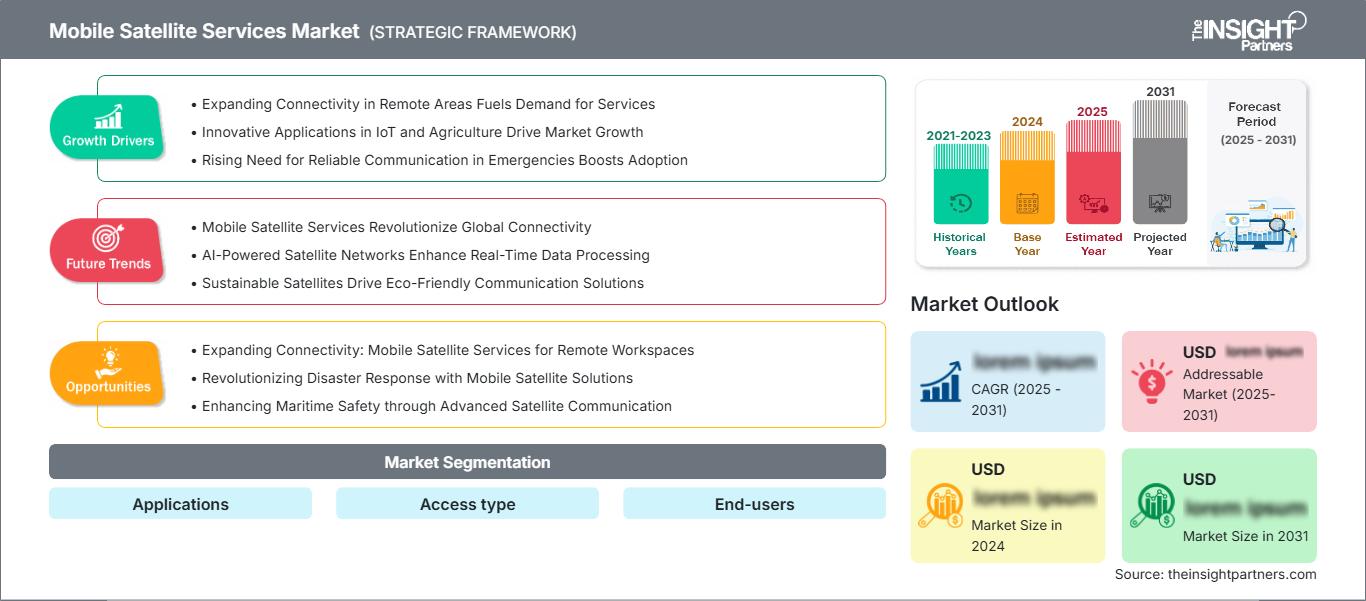
Mobile Satellite Services Market Assessment and Insights
- North America: North America demonstrates strong satellite communication adoption, supported by defense modernization, aviation connectivity, and enterprise applications. The region accounted for an estimated 34–38% share in 2025 and is projected to grow at a CAGR of 4.8–5.6% between 2026–2034 due to advanced satellite infrastructure.
- US: The US represents the leading national contributor within North America, supported by government, defense, and commercial connectivity demand. It held an estimated 26–30% share in 2025 and is expected to expand at a CAGR of 5.0–5.8% during 2026–2034.
- Europe: Europe continues to develop satellite-enabled communication ecosystems through maritime, aviation, and government initiatives. Countries including the UK, Germany, France, and Italy contribute significantly, with the region holding an estimated 25–29% share in 2025 and growing at a CAGR of 4.2–5.0% between 2026–2034.
- Asia Pacific: Asia Pacific is experiencing increasing adoption due to expanding transportation networks, disaster management requirements, and digital connectivity programs in China, Japan, India, South Korea, and Australia. The region represented approximately 22–26% share in 2025 and is forecast to grow at a CAGR of 5.2–6.0% during 2026–2034.
- Largest Segment:Based on end-user adoption, the government and defense segment maintained a leading position with an estimated market share of 32–36% in 2025 and is projected to grow at a CAGR of 4.7–5.5% during 2026–2034.
- High Growth Segment:Commercial aviation and maritime applications represent high-growth opportunities, accounting for an estimated market share of 18–22% in 2025 and expanding at a CAGR of 5.5–6.3% between 2026–2034.
- Key companies analyzed in detail:Intelsat General Corporation, Globalstar USA, LLC, Inmarsat, Iridium Communications Inc., Singtel, Telstra, Skyvision Ltd., New York Mobile Satellite, LLC, Viasat, Orbcomm, Thuraya Telecommunications Company, and EchoStar Corporation.
Source: The Insight Partners' analysis based on proprietary research, government publications, company annual reports, investor presentations, industry databases, and expert interviews.
Mobile Satellite Services Market Trends
Integration of Hybrid Satellite and Terrestrial Networks
The future development of satellite communication in the Mobile Satellite Services Market Trends is expected to focus on hybrid network architectures combining satellite and terrestrial connectivity. These integrated systems will improve coverage, reduce connectivity gaps, and provide users with flexible communication options. Telecommunications companies and satellite operators are increasingly exploring partnerships to deliver seamless connectivity across different environments. Hybrid models are expected to support applications requiring continuous communication, including transportation, emergency services, and enterprise operations. Advancements in network management technologies will allow automatic switching between satellite and terrestrial connections, improving reliability and user experience across multiple industries.
Development of Advanced Satellite Constellations
Next-generation satellite constellations are expected to influence future service capabilities through improved coverage, reduced latency, and enhanced bandwidth availability. The expansion of advanced satellite networks will support applications requiring faster data transmission and greater operational efficiency. Emerging technologies in satellite manufacturing, launch systems, and network optimization are enabling more scalable communication solutions. Commercial sectors including aviation, maritime, and logistics are expected to benefit from improved service performance. Continued investment in satellite infrastructure will likely encourage new applications and strengthen connectivity solutions for regions with limited terrestrial network access.
Mobile Satellite Services Market Growth Factors
Expansion of Connectivity Requirements in Remote Locations
Growing interest in connectivity services in hard-to-reach and difficult geographic terrains is opening up new possibilities for satellite communication providers. Mining, oil and gas industries, shipping, and emergency services need a reliable network of connectivity where conventional communication systems fail to offer uninterrupted connectivity. This need has led to investments in satellite technology, satellite communication terminals, and communication platforms. There is also an increasing trend of relying on satellite communication by organizations to ensure uninterrupted operation, coordination among staff members, and tracking of remotely located resources. The rural connectivity programs being undertaken in developing countries are also helping in widening the scope of satellite communication.
Growing Adoption of Satellite-Based IoT Solutions
The merging of satellite communications with IoT technology is opening up new avenues for demand in various sectors. The use of connected sensors and systems by companies is on the rise for logistics, agriculture, energy, and environment purposes. The use of satellite-based IoT technology will enable organizations to transmit their operational data even in areas that have no network connections. There is also an increase in the production of small satellites that require less energy. This is making it easier for enterprises to adopt the technology.
Increasing Need for Resilient Communication Networks
The need for dependable communication systems in emergency situations and network outages has become a driving factor for the growth of satellite services among governments and businesses. Various natural disasters and issues of security have emphasized the need for communication systems that can function independently of terrestrial infrastructure. Governments, militaries, and various vital industries are using satellites for communication to enhance their preparedness. Satellites offer wide area coverage, quick deployment, and flexibility even under tough circumstances. There has been an increasing emphasis on building resilient infrastructure, which has resulted in collaborations among satellite operators, telecommunication companies, and the government.
Mobile Satellite Services Market Opportunities
Expansion Across Emerging Economies
Emerging economies present significant opportunities as governments and businesses seek reliable connectivity solutions for underserved regions. Investments in digital infrastructure, rural communication programs, and industrial development are increasing demand for satellite-enabled services. Countries across Asia Pacific, Africa, and the Middle East are exploring satellite technologies to support transportation, energy, agriculture, and public services. Service providers can capitalize on these opportunities by developing cost-effective solutions tailored to regional requirements. The availability of flexible satellite platforms and partnerships with local communication providers can accelerate adoption. Expanding connectivity initiatives are expected to create long-term opportunities for satellite operators and technology companies.
Growth of Commercial Satellite Applications
Commercial applications represent an important opportunity area as businesses increasingly adopt satellite communication for operational efficiency and data-driven decision-making. Logistics companies, airlines, maritime operators, and enterprises are exploring satellite solutions to improve tracking, communication, and asset management. Investment in specialized services designed for industry-specific requirements can help providers capture additional demand. The development of advanced terminals and scalable service models will support wider commercial deployment. Companies focusing on customized connectivity platforms and integrated solutions are positioned to benefit from increasing business reliance on satellite technologies. The mobile satellite services market Forecasts indicate continued opportunities through expanding commercial applications and technology innovation.
Segmentation Analysis
Applications
The applications segment is expected to expand at a CAGR of 4.5–5.3% during 2026–2034 as satellite-based connectivity becomes increasingly important across communication, tracking, monitoring, and safety operations. Demand is supported by aviation, maritime, defense, and enterprise users requiring reliable services in areas where terrestrial infrastructure is limited. The growing adoption of satellite-enabled IoT and real-time data exchange solutions is further improving application diversity.
- Voice Communication: Voice communication remains an essential application for remote operations, emergency response teams, and government users. Its continued relevance comes from reliable connectivity requirements in locations with limited terrestrial network availability and mission-critical communication needs.
- Data Communication: Data communication adoption is increasing due to demand for broadband connectivity, operational data transfer, and enterprise applications. Industries such as transportation, energy, and logistics rely on satellite networks for consistent information exchange across distributed assets.
- Tracking and Monitoring: Tracking and monitoring solutions are gaining importance through asset management, fleet monitoring, and maritime operations. Satellite-based tracking enables visibility across remote environments and supports improved operational efficiency for industries managing geographically dispersed resources.
- Remote Connectivity: Remote connectivity applications support organizations operating in isolated locations, including research facilities, offshore platforms, and rural regions. These services provide dependable communication infrastructure where traditional networks cannot deliver sufficient coverage or reliability.
Access type
The access type segment is projected to register a CAGR of 4.7–5.5% during 2026–2034 due to increasing demand for flexible satellite communication solutions across consumer, commercial, and institutional users. Improvements in satellite bandwidth, terminal design, and network management capabilities are encouraging adoption of different access models. Service providers are focusing on scalable connectivity options to address diverse operational requirements.
- Mobile Satellite Services: Mobile satellite access remains central to users requiring communication while moving across maritime, aviation, and transportation environments. Its strategic importance is supported by demand for uninterrupted connectivity during travel, logistics operations, and remote field activities.
- Fixed Satellite Services: Fixed satellite access supports stationary locations requiring dependable connectivity, including remote offices, industrial sites, and government facilities. Adoption is influenced by infrastructure limitations and the need for reliable broadband services in underserved locations.
End-users
The end-users segment is expected to grow at a CAGR of 4.9–5.7% during 2026–2034, driven by increasing reliance on satellite communication across government, commercial, and industrial sectors. The mobile satellite services market scope continues expanding as organizations prioritize resilient connectivity, operational efficiency, and communication continuity during network disruptions.
- Government and Defense: Government and defense users represent a major adoption category due to requirements for secure communication, surveillance support, and emergency coordination. Satellite services provide strategic connectivity advantages for military operations and public safety applications.
- Commercial Aviation: Commercial aviation users are adopting satellite connectivity for passenger communication, aircraft operations, and real-time monitoring. Airlines increasingly prioritize digital services that enhance passenger experience and improve operational visibility.
- Maritime: Maritime users depend on satellite solutions for navigation support, fleet management, safety communication, and offshore operations. The segment continues benefiting from regulatory requirements and increasing digitalization of vessel operations.
- Enterprise: Enterprise adoption is expanding through applications including remote workforce connectivity, asset monitoring, and industrial communication. Businesses operating across geographically distributed locations increasingly use satellite networks to maintain reliable operations.
- Energy and Utilities: Energy and utility companies utilize satellite services for remote infrastructure monitoring, field communication, and operational control. The segment benefits from increasing investment in offshore, renewable, and geographically dispersed energy projects.
Opportunity Snapshot
| End Users | Revenue Contribution (High/Medium/Low) | Trend Tag | Adoption Stage |
|---|---|---|---|
| Government and Defense | High | Secure Networks | Mature |
| Commercial Aviation | Medium | Aircraft Connectivity | Scaling |
| Maritime | Medium | Fleet Communication | Mature |
| Enterprise | Medium | Remote Operations | Scaling |
| Energy and Utilities | Medium | Asset Monitoring | Emerging |
Regional Insights
North America Mobile Satellite Services Market
The dominance in the use of satellites for communication in North America was due to its advanced aerospace system infrastructure, defense-related uses, and business connectivity needs. The region accounted for around 34-38% in 2025, and it is expected to grow at a CAGR of 4.8-5.6% during the forecast period of 2026-2034. The already existing satellite communication operators and rising demand for communication systems contribute to the growth of the region.
USA and Canada are major contributors to the growth owing to investments by their governments, aviation communication systems, maritime communication needs, and business applications. Rising use of IoT through satellites and the requirement of robust communication systems has motivated communication companies to upgrade their coverage capabilities.
U.S. Mobile Satellite Services Market
The US continues to be the top contributor among the countries of North America based on military, government, aviation, marine, and enterprise communication needs. In 2025, the region contributed 75-80% of the total North America share, and it is predicted to experience a CAGR of 5.0-5.8% during the period of 2026-2034 due to well-developed technology and infrastructure.
Leading players such as Iridium Communications Inc., Viasat, Intelsat General Corporation, and Globalstar USA, LLC are operating actively in this region. Growth in the need for aircraft connectivity, asset monitoring, and secure communication network is encouraging the use of satellite solutions in different sectors.
Europe Mobile Satellite Services Market
Europe held an estimated market share of 25-29% in 2025 and is expected to witness a CAGR of 4.2-5.0% during 2026-2034. Europe offers benefits of a well-established maritime industry, need for aviation connectivity, and government initiatives favoring development of safe communication infrastructure. The UK continues to be a key player owing to investment in satellite services and aerospace & defense.
Germany shows strong adoption of SATCOM services with applications in industrial connectivity, logistics and communications needs. France, Italy, and Spain are making their contributions in the market via their maritime industry, aviation and public safety communications. The regulatory framework in favor of innovation in satellites and development of digital infrastructure in Europe is facilitating investments.
APAC Mobile Satellite Services Market
The APAC region accounts for 22%-26% of the Mobile Satellite Services Market share in 2025 and is anticipated to grow with a CAGR of 5.2%-6.0% between 2026-2034. China dominates this region through their investment in communication infrastructure, aerospace segment, and industrial applications.
Japan, South Korea, India, and Australia are expanding their use of satellites in various applications including transportation, military purposes, disaster management, and remote connectivity. Digital inclusion projects sponsored by government and commercial investment in satellites are some of the drivers for the growth of this market.
Middle East & Africa Mobile Satellite Services Market
The Middle East and Africa region is projected to grow steadily with increasing requirements for communication infrastructure in remote areas. Saudi Arabia and the UAE are leading regional adoption through energy sector connectivity, government modernization programs, and satellite infrastructure investments.
Satellite services are being used in South Africa and other African regions for connecting remote areas, mining activities, disaster relief purposes, and monitoring of infrastructure facilities. It is predicted that the African region will grow at a CAGR of 3.8–4.6% during the period 2026–2034, fueled by energy projects, transport, and digitalization efforts.
Mobile Satellite Services Market Report Scope
| Report Attribute | Details |
|---|---|
| Market size in 2025 | US$ 5.71 Billion |
| Market Size by 2034 | US$ 8.59 Billion |
| Global CAGR (2026 - 2034) | 4.65% |
| Historical Data | 2021-2024 |
| Forecast period | 2026-2034 |
| Segments Covered | Applications, Access type, End-users |
| Region scope | North America, Europe, Asia-Pacific, South and Central America, Middle East and Africa |
Frequently Asked Questions

Recent Reports






