The rapid evolution of digital technologies is reshaping how businesses connect devices, process information, and deliver services. Among the most transformative innovations are 5G Internet of Things (IoT) and Edge Artificial Intelligence (Edge AI). While each technology is powerful on its own, their integration is creating a new era of intelligent connectivity where data is analyzed almost instantly, enabling faster decisions, greater efficiency, and smarter automation.
As industries continue to embrace digital transformation, the need for high-speed communication and real time data processing has never been greater. Traditional cloud-based systems often struggle to support applications that require immediate responses. This challenge has accelerated the adoption of Edge AI, which processes data closer to where it is generated, while 5G provides the ultra-fast, low-latency connectivity needed to keep billions of connected devices communicating seamlessly.
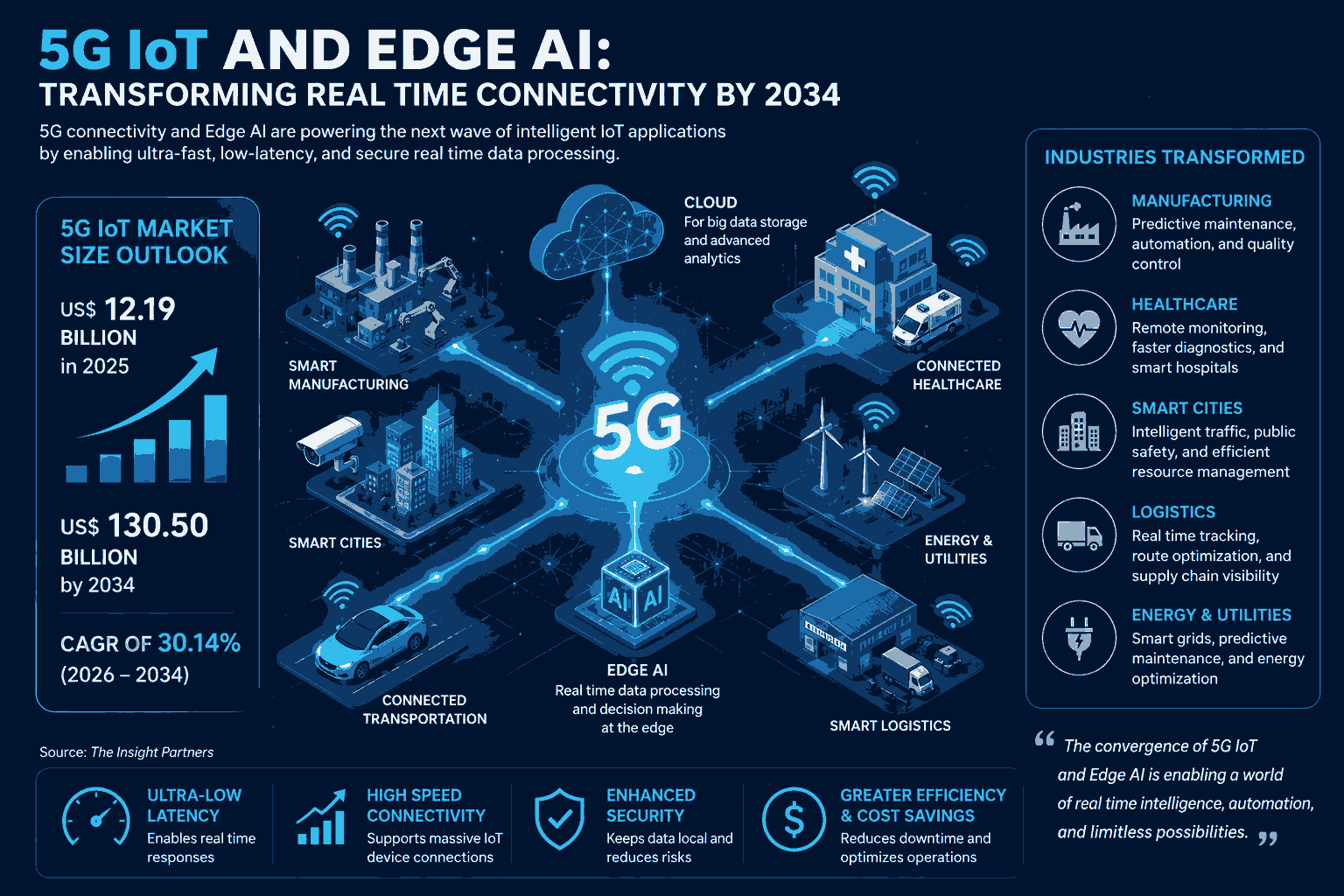
According to The Insight Partners, the 5G IoT market is expected to grow from US$ 12.19 billion in 2025 to US$ 130.50 billion by 2034, registering an impressive CAGR of 30.14% during 2026 to 2034. The market's expansion reflects rising investments in industrial automation, smart infrastructure, connected healthcare, and enterprise digital transformation.
The Perfect Partnership Between 5G and Edge AI
Over the past decade, IoT has connected everything from manufacturing equipment and medical devices to vehicles and household appliances. These connected systems generate enormous amounts of data every second. Sending every bit of that information to distant cloud servers can introduce delays, consume significant bandwidth, and increase operating costs.
This is where Edge AI makes a significant difference. Instead of relying solely on centralized data centers, intelligent algorithms process information directly on devices or nearby edge servers. When combined with the speed and reliability of 5G networks, organizations gain the ability to analyze information and respond almost instantly.
The result is an ecosystem where machines, sensors, and applications work together with minimal delay, creating faster and more intelligent operations.
Why Real Time Intelligence Matters More Than Ever
Businesses today operate in environments where even a few seconds of delay can affect productivity, safety, or customer satisfaction. Manufacturing lines require immediate detection of equipment issues, hospitals depend on uninterrupted patient monitoring, and logistics companies need continuous tracking of shipments moving across global supply chains.
With 5G IoT and Edge AI working together, these systems no longer have to wait for cloud servers to process information. Decisions can be made locally within milliseconds, allowing operations to continue without interruption.
This ability to respond instantly is becoming a competitive advantage across nearly every industry.
Manufacturing Is Leading the Transformation
The manufacturing sector has become one of the strongest adopters of 5G-enabled IoT solutions. Modern factories are increasingly equipped with connected machines, robotics, automated inspection systems, and thousands of smart sensors that continuously monitor production.
Edge AI analyzes this information in real time, helping manufacturers detect unusual equipment behavior before failures occur. Predictive maintenance reduces unexpected downtime, improves equipment lifespan, and lowers maintenance expenses.
At the same time, 5G ensures uninterrupted communication between machines, enabling fully connected production environments that support Industry 4.0 initiatives. As manufacturers continue investing in intelligent factories, the demand for advanced connectivity solutions is expected to grow steadily through 2034.
Healthcare Is Becoming Smarter and More Connected
Healthcare is another sector benefiting significantly from this technological combination. Hospitals and healthcare providers are increasingly deploying connected medical devices, wearable health monitors, and remote patient monitoring systems.
These devices generate continuous streams of patient information that often require immediate analysis. Edge AI allows critical health data to be processed locally, enabling faster clinical decisions while reducing dependence on centralized cloud infrastructure.
Combined with reliable 5G connectivity, healthcare professionals can monitor patients remotely, improve emergency response, and expand access to quality medical care, particularly in underserved regions.
Smart Cities Are Moving Beyond Connectivity
Cities around the world are investing heavily in digital infrastructure to improve public services and urban living. Intelligent transportation systems, smart street lighting, environmental monitoring, and public safety networks all rely on connected devices operating continuously.
The integration of Edge AI allows these systems to respond automatically to changing conditions. Traffic signals can adjust based on congestion levels, surveillance systems can identify unusual activities, and energy networks can optimize electricity distribution without waiting for cloud-based instructions.
This combination improves operational efficiency while making cities more sustainable and resilient.
Private 5G Networks Are Creating New Opportunities
An important trend shaping the future of the market is the growing adoption of private 5G networks. Unlike public mobile networks, private deployments are built specifically for individual enterprises, offering greater security, dedicated bandwidth, and enhanced reliability.
Industries such as manufacturing, mining, logistics, airports, and energy are increasingly investing in private 5G infrastructure to support mission-critical applications.
When integrated with Edge AI, these networks provide secure environments where sensitive operational data can be processed locally, reducing cybersecurity risks while delivering consistent performance.
Artificial Intelligence Is Making IoT More Intelligent
The true value of IoT lies not only in connecting devices but also in understanding the information they generate. Artificial intelligence transforms raw sensor data into meaningful insights that help organizations improve efficiency and make informed decisions.
Edge AI continuously learns from operational patterns, identifies anomalies, predicts failures, and automates responses without requiring constant human intervention. This intelligent automation helps businesses reduce operational costs while improving productivity and customer experiences.
As AI models become more advanced, Edge AI will continue expanding into areas such as autonomous vehicles, industrial robotics, precision agriculture, and intelligent energy management.
As communication technologies continue to evolve, businesses are increasingly recognizing that high-speed connectivity alone is not enough. Intelligent data processing at the network edge is becoming equally essential for delivering faster, more secure, and highly reliable digital services.
Looking Ahead
The convergence of 5G IoT and Edge AI represents far more than a technological upgrade. It is redefining how industries operate by enabling real time intelligence across connected ecosystems.
From manufacturing plants that predict equipment failures before they happen to hospitals that monitor patients remotely with minimal delay, the possibilities continue to expand. Governments are building smarter cities, logistics providers are optimizing global supply chains, and enterprises are creating more efficient, data-driven operations through intelligent connectivity.
As adoption continues to accelerate, organizations that invest in these technologies today will be better positioned to improve operational efficiency, enhance customer experiences, and remain competitive in an increasingly connected world. By 2034, 5G IoT and Edge AI are expected to serve as the digital backbone of next-generation industries, supporting innovation at a scale that was once difficult to imagine.
.jpg)