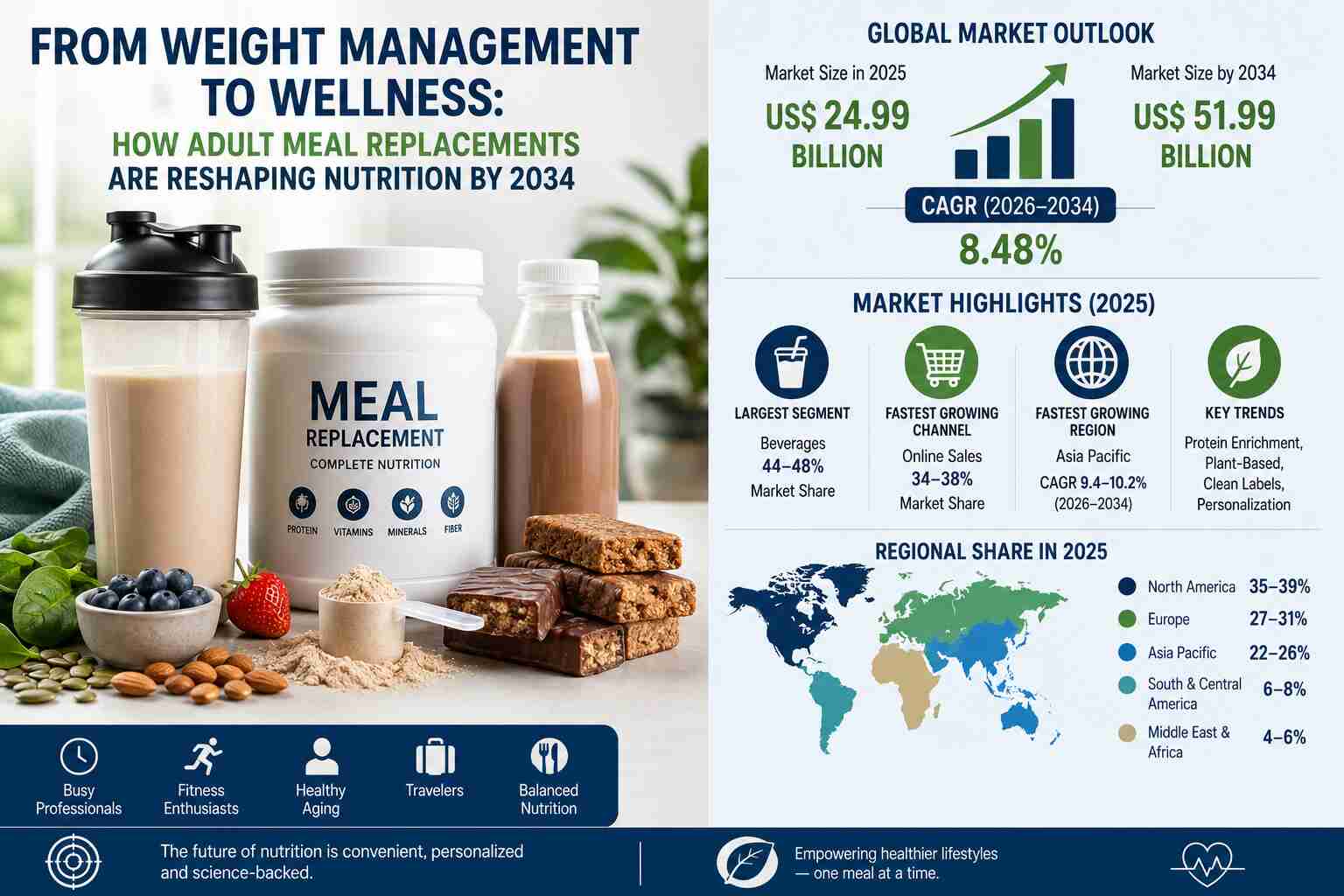
For decades, adult meal replacement products were primarily associated with weight loss and calorie control. Today, that perception is changing rapidly. Consumers are increasingly looking for convenient nutrition solutions that support broader wellness goals, including adequate protein intake, active lifestyles, healthy aging, digestive health, energy management, and balanced nutrition. This transition from a weight-management-focused category to a broader wellness ecosystem is creating significant opportunities across the global adult meal replacement market.
According to The Insight Partners, the adult meal replacement market was valued at US$ 24.99 billion in 2025 and is projected to reach US$ 51.99 billion by 2034, registering a CAGR of 8.48% during 2026–2034. Growing demand for quick nutritional interventions, increasing awareness of weight management, and rising interest in nutritious and convenient products among professionals, sports enthusiasts, and older adults are among the key factors supporting this growth.
The Adult Meal Replacement Market Is Moving Beyond Weight Loss
The role of meal replacement products is expanding as consumers become more conscious of what they eat and how nutrition fits into their everyday routines. Instead of being viewed exclusively as diet products, meal replacements are increasingly positioned as practical solutions for consumers who want controlled portions, balanced nutrients, and convenience.
Working professionals, students, travelers, athletes, and individuals with demanding schedules often have limited time to prepare nutritionally balanced meals. Meal replacement products can provide a convenient combination of protein, carbohydrates, vitamins, minerals, and other nutrients in easily consumable formats.
At the same time, growing awareness of lifestyle-related health concerns is encouraging consumers to pay greater attention to nutrition quality. This is creating demand for products that go beyond calorie reduction and provide functional benefits such as protein enrichment, micronutrient fortification, lower sugar content, digestive support, and muscle management.
Consequently, manufacturers are increasingly developing products designed around specific consumer needs rather than relying on a single weight-management proposition.
Convenience Is Becoming a Core Nutrition Requirement
Modern lifestyles are one of the strongest forces shaping the adult meal replacement market. Long working hours, commuting, flexible work arrangements, travel, and increasingly busy personal schedules are creating demand for convenient nutritional alternatives.
This trend is particularly visible in the beverage segment. Beverages accounted for approximately 44–48% of the market in 2025, making them the largest product category. Their popularity is closely associated with portability, immediate consumption, consistent nutritional composition, and availability through retail and digital channels.
Ready-to-drink meal replacement beverages can be consumed without preparation, making them particularly attractive to professionals and active consumers. Meanwhile, powders continue to appeal to fitness-conscious consumers because they offer flexible serving sizes and can be incorporated into personalized nutrition routines. Bars provide another convenient option, particularly for travel, work, and outdoor activities.
This diversification demonstrates how the category is becoming integrated into everyday nutrition rather than remaining limited to structured dieting programs.
Protein, Plant-Based Ingredients, and Clean Labels Reshape Product Innovation
Product formulation is another major area undergoing transformation. Consumers are becoming increasingly interested in products that combine convenience with recognizable ingredients and meaningful nutritional value.
Protein enrichment is expected to remain a major product development focus. Protein-based formulations can appeal to fitness enthusiasts, active consumers, and older adults seeking nutritional support for muscle maintenance. Manufacturers are also exploring both dairy-based and plant-based protein sources to broaden consumer choice.
Plant-based formulations represent another important opportunity. As interest in vegan, vegetarian, allergen-conscious, and environmentally responsible products increases, manufacturers are exploring proteins derived from plants and other alternative sources.
At the same time, consumers are paying greater attention to labels. Reduced sugar, transparent ingredient lists, micronutrient enrichment, and science-backed formulations are becoming important differentiators. This shift is pushing companies to compete not only on taste and convenience but also on formulation quality, nutritional efficiency, transparency, and consumer trust.
Digital Commerce Is Changing How Consumers Buy Meal Replacements
Distribution is undergoing an equally important transformation. Retail stores continue to play a significant role because they offer product visibility, immediate availability, and opportunities for consumers to compare different brands and formulations.
However, online sales are emerging as one of the fastest-growing distribution channels. Online sales represented approximately 34–38% of the market in 2025 and are projected to expand at a CAGR of around 10.0–10.8% during 2026–2034.
The growth of e-commerce is being supported by subscription purchasing, home delivery, personalized promotions, product reviews, and extensive product selection. Digital platforms also allow manufacturers to establish direct relationships with consumers and gather insights into purchasing behavior.
Subscription models are particularly relevant to meal replacements because these products are often purchased repeatedly. Instead of making individual purchases, consumers can subscribe to regular deliveries, creating greater convenience while providing companies with more predictable recurring revenue.
Personalization Could Define the Next Phase of Market Growth
One of the most significant future trends is the integration of personalized nutrition into meal replacement products and services.
Consumers increasingly expect nutrition solutions to reflect their individual objectives, lifestyles, age groups, activity levels, and dietary preferences. Digital nutrition applications and health-tracking technologies can potentially help companies recommend products based on individual consumer profiles.
Future meal replacement ecosystems could therefore combine products with digital platforms, nutritional tracking, customized recommendations, and subscription programs.
For manufacturers, personalization also creates opportunities for premium positioning. Products designed around specific goals such as muscle maintenance, healthy aging, digestive wellness, energy management, or weight management may command greater consumer interest than generic formulations.
Regional Markets Present Different Growth Opportunities
North America remains a critical contributor to the global adult meal replacement market. The region accounted for approximately 35–39% of global revenue in 2025 and is projected to grow at a CAGR of 7.8–8.6% through 2034. High awareness of functional nutrition, strong product availability, developed retail infrastructure, and established consumer demand support regional growth.
The US represents approximately 78–82% of the North American market, supported by strong consumer awareness, premium product adoption, sports nutrition demand, and broad distribution networks.
Europe accounted for approximately 27–31% of global revenue in 2025. The UK, Germany, and France remain important markets, supported by wellness-focused consumption patterns, mature nutrition categories, and growing interest in convenient and balanced dietary solutions.
However, Asia Pacific is expected to be the fastest-growing regional market, with a projected CAGR of approximately 9.4–10.2% between 2026 and 2034. China, Japan, India, and South Korea are key growth markets. Urbanization, rising disposable incomes, expanding e-commerce infrastructure, and increasing awareness of nutrition-focused lifestyles are creating significant opportunities.
This regional expansion could become particularly important as manufacturers develop localized flavors, formulations, pricing strategies, and digital distribution models.
Competition Will Shift Toward Science, Trust, and Functionality
The competitive environment is also evolving. Companies are increasingly differentiating products based on nutritional functionality, ingredient quality, scientific validation, taste, convenience, and brand credibility.
Major companies analyzed in the market include Abbott Laboratories, Herbalife Ltd., Kellanova, Nestlé S.A., SlimFast, Glanbia plc, Haleon plc, The Nature's Bounty Co., Nutiva Inc., and Onnit Labs, Inc.
Going forward, companies that combine strong product portfolios with omnichannel distribution, digital engagement, personalized nutrition, and transparent health communication are likely to be better positioned.
Regulatory attention toward transparent labeling and responsible health claims is also expected to raise industry standards. As consumers become more knowledgeable, companies may need stronger scientific evidence and clearer communication to establish long-term trust.
What Will Drive the Adult Meal Replacement Market Through 2034?
The market's future will likely be shaped by several interconnected trends:
- Growing demand for convenient and nutritionally balanced meal alternatives
- Increasing awareness of lifestyle-related health concerns
- Rising demand for high-protein and functional nutrition products
- Expansion of plant-based and clean-label formulations
- Increasing adoption of ready-to-drink beverages
- Rapid growth of online sales and subscription-based purchasing
- Greater integration of personalized nutrition technologies
- Rising demand from fitness enthusiasts and healthy-aging consumers
- Expansion into emerging markets
- Increasing investment in clinically supported premium nutrition solutions
Together, these trends indicate that adult meal replacements are becoming part of a much broader consumer wellness landscape.
The adult meal replacement market is undergoing a fundamental transformation. What was once largely associated with weight loss and calorie restriction is becoming a broader category focused on convenience, balanced nutrition, functional benefits, fitness, healthy aging, and personalized wellness.
As consumer expectations continue to evolve, the companies that successfully combine nutritional quality, convenience, personalization, transparency, and digital engagement could capture significant opportunities in the adult meal replacement market through 2034.