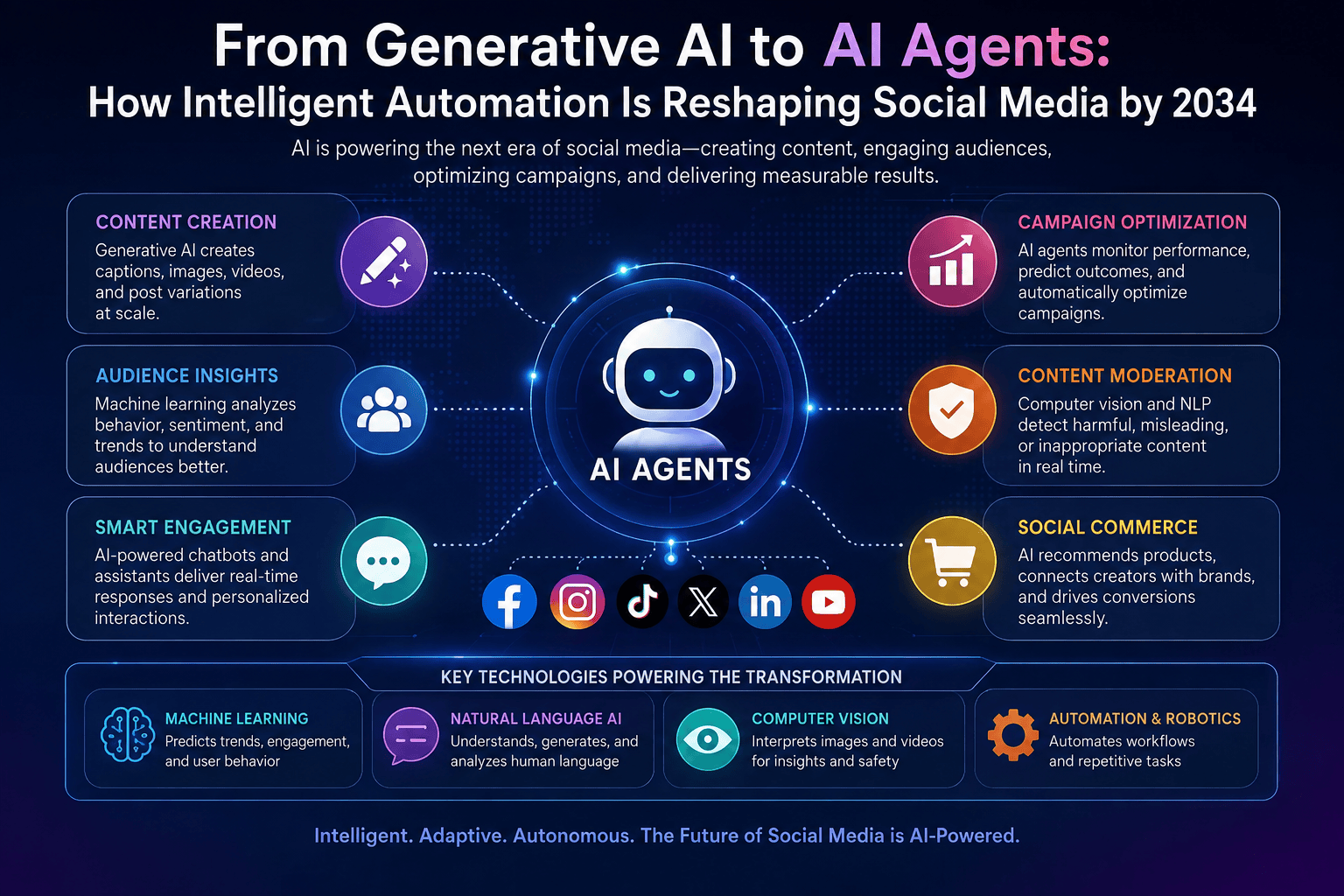
Social media is moving beyond simple automation. For years, brands relied on scheduling tools, keyword monitoring, basic chatbots, and rule-based campaign management to handle growing volumes of digital interactions. Today, artificial intelligence (AI) is fundamentally changing how organizations create content, understand audiences, manage campaigns, moderate platforms, and engage with customers. The next phase of this transformation is being driven by generative AI and AI agents, which can move social media operations from automated tasks toward intelligent, adaptive workflows.
According to The Insight Partners, the AI in Social Media Market is projected to grow from US$3.63 billion in 2025 to US$24.56 billion by 2034, registering a 23.66% CAGR during 2026–2034. The market encompasses machine learning, computer vision, natural language learning, and robotics and automation across SMEs and large enterprises and across cloud and on-premise deployments.
This rapid expansion reflects a broader shift in how businesses approach social media. AI is no longer being used only to automate repetitive activities. Increasingly, organizations are using AI to interpret behavioral signals, generate content, predict engagement, optimize advertising, support customers, and make real-time decisions.
From Automation to Intelligent Social Media Operations
Traditional social media automation typically followed predefined rules. A marketer could schedule a post, configure a keyword alert, or establish an automated response. These systems improved efficiency but depended heavily on human-defined instructions.
Generative AI introduces a more flexible approach. Large language models and multimodal AI systems can create captions, campaign concepts, images, video scripts, summaries, and localized content based on contextual instructions. Instead of simply executing predefined tasks, AI can assist marketers in developing and adapting content at scale.
The next evolution is AI agents. These systems are designed to perform sequences of tasks based on objectives rather than individual commands. An AI agent could potentially analyze campaign performance, identify underperforming content, recommend a new creative direction, generate variations, schedule approved content, monitor engagement, and report results.
This transition from task automation to intelligent workflow orchestration is expected to become an important contributor to the AI in social media market growth through 2034.
Generative AI Is Changing Social Media Content Creation
One of the most visible applications of AI in social media is content creation. Marketing teams increasingly need to produce platform-specific content at high frequency while maintaining consistent brand messaging.
Generative AI can accelerate this process by supporting:
- Social media captions and post ideas
- Short-form video scripts
- Advertising copy
- Image and creative concepts
- Content repurposing
- Multilingual content adaptation
- Hashtag and keyword recommendations
- Campaign variations for different audience segments
Instead of creating one piece of content for multiple platforms, marketers can use AI to adapt messaging according to the characteristics of each channel.
For example, a campaign concept can be transformed into a short-form video script, a professional business post, an image caption, and an advertising headline. This capability can help SMEs and agencies increase content output without proportionally increasing their workforce.
However, the future is unlikely to be based on completely autonomous content production. Brand guidelines, human approval, factual accuracy, disclosure requirements, and content safety will remain important. Consequently, the market is moving toward governed generative AI, where automated content creation operates within predefined organizational controls.
AI Agents Could Transform Campaign Management
Generative AI creates content, but AI agents could potentially manage broader social media workflows.
Consider a marketing campaign promoting a new product. An AI agent could monitor social conversations, analyze audience sentiment, identify emerging topics, suggest content opportunities, generate campaign variations, and track performance.
The agent could then continuously evaluate campaign results and recommend adjustments based on engagement data.
This creates a feedback loop:
Audience signals → AI analysis → Content generation → Campaign execution → Performance measurement → Optimization
Such capabilities could reduce the time between identifying a trend and responding to it. For agencies and enterprises managing multiple brands or channels, this could significantly improve operational efficiency.
The development of AI agents also increases demand for integration with customer relationship management systems, advertising platforms, analytics dashboards, commerce systems, and social media management software.
Machine Learning Remains the Foundation
Despite the excitement surrounding generative AI and AI agents, machine learning remains a fundamental technology within the AI in social media ecosystem.
The Insight Partners' analysis indicates that machine learning accounted for approximately 38–42% of the market in 2025, making it the largest technology segment.
Machine learning supports recommendation engines, audience segmentation, predictive analytics, ad targeting, engagement prediction, and content optimization. These capabilities provide the intelligence required by more advanced AI systems.
For example, machine learning can identify patterns in user interactions and determine which types of content are likely to generate higher engagement among specific audience groups. This intelligence can then be incorporated into automated campaign workflows.
As AI agents become more sophisticated, their effectiveness will depend heavily on the quality of the underlying data, predictive models, and real-time analytics infrastructure.
Natural Language AI Will Drive Conversational Engagement
Natural language learning is another important growth area. The segment held an estimated 24–28% market share in 2025 and is expected to grow at a faster rate than several other technology categories.
Natural language AI enables organizations to analyze conversations and respond to customers across social platforms. Applications include:
- Sentiment analysis
- Comment classification
- Automated customer support
- Chatbots
- Social listening
- Multilingual engagement
- Caption generation
- Influencer assessment
As businesses expand globally, multilingual AI will become particularly important. Organizations need to understand local languages, cultural nuances, sentiment, and customer intent rather than simply translating text word-for-word.
This creates opportunities for AI vendors to develop localized models capable of supporting regional campaigns while maintaining brand and compliance requirements.
Computer Vision Will Strengthen Visual Intelligence
Social media is increasingly visual, particularly with the expansion of short-form video, image-based content, and creator marketing. Computer vision therefore represents another important technology within the market.
AI-powered computer vision can analyze images and videos to identify objects, logos, products, scenes, and potentially unsafe or inappropriate material. These capabilities can support visual trend detection, brand monitoring, content moderation, and advertising safety.
Combined with natural language processing, computer vision enables multimodal AI, allowing systems to interpret text, images, video, and audio together.
This is particularly important for future social media intelligence. Rather than analyzing a caption separately from an image or video, AI systems can evaluate the entire content experience and determine how different creative elements influence audience response.
AI-Powered Moderation and Brand Safety Will Become Essential
The growth of user-generated content and AI-generated content is creating new challenges for social platforms and brands.
Manual moderation cannot efficiently handle the enormous volume of content generated across modern social networks. AI can help identify harmful, misleading, inappropriate, or policy-violating content at scale.
Natural language learning can analyze text and conversations, while computer vision can evaluate images and videos. These capabilities can support faster moderation and help brands reduce the risk of advertisements appearing alongside unsuitable content.
As synthetic media becomes more common, organizations will also need systems capable of identifying AI-generated or manipulated content. Consequently, AI governance, synthetic media controls, auditability, and brand safety are expected to become increasingly important areas of investment.
Cloud Deployment Will Accelerate AI Adoption
Cloud-based AI is expected to remain the dominant deployment approach because social media workloads require scalability, continuous model updates, and integration with multiple platforms.
Cloud deployment allows SMEs, agencies, and enterprises to access generative AI, analytics, automation, and conversational tools without making extensive investments in infrastructure.
On-premise deployment will continue to have a role, particularly among organizations with strict data-security, privacy, compliance, or internal model-hosting requirements.
The choice between cloud and on-premise infrastructure will therefore increasingly depend on organizational risk tolerance, data sensitivity, regulatory requirements, and integration needs.
Regional Adoption Will Create New Growth Opportunities
North America remains the most mature regional market, accounting for an estimated 35–38% share in 2025. Strong digital advertising activity, major technology vendors, cloud infrastructure, and enterprise AI experimentation are supporting adoption.
The US represents the largest portion of the North American market, with companies investing in AI-assisted content creation, customer engagement, advertising optimization, creator monetization, and social analytics.
Asia Pacific is expected to experience particularly strong growth, with an estimated 25–27% CAGR during 2026–2034. China, Japan, South Korea, India, and Australia are benefiting from mobile-first consumer behavior, social commerce, creator ecosystems, and rapid digital adoption.
Europe is also expanding its AI use cases, although privacy, transparency, governance, and disclosure requirements are particularly important considerations for buyers.
Social Commerce Could Become a Major AI Opportunity
One of the most promising opportunities lies at the intersection of AI, social media, and commerce.
AI can help retailers and consumer brands identify products from social content, recommend relevant products, analyze creator performance, understand purchase intent, and connect engagement data with conversions.
AI agents could eventually assist with portions of the customer journey by identifying potential products, answering questions, recommending alternatives, and routing customers toward purchase.
This could be particularly valuable in fashion, beauty, consumer electronics, retail, and direct-to-consumer businesses where social media increasingly influences purchasing decisions.
The Future: Governed, Multimodal, and Autonomous
By 2034, social media AI is likely to look very different from today's scheduling and analytics platforms.
The market will increasingly move toward multimodal creative intelligence, autonomous workflow management, predictive analytics, conversational AI, and governed automation.
Organizations will not simply ask whether AI can generate content. They will ask whether AI can generate the right content, for the right audience, at the right time, while maintaining brand safety, regulatory compliance, and measurable business outcomes.
AI agents could become a new operational layer between social media data and marketing decisions. Meanwhile, machine learning will continue powering predictions, natural language AI will strengthen conversations, computer vision will improve visual intelligence, and automation technologies will connect these capabilities into scalable workflows.