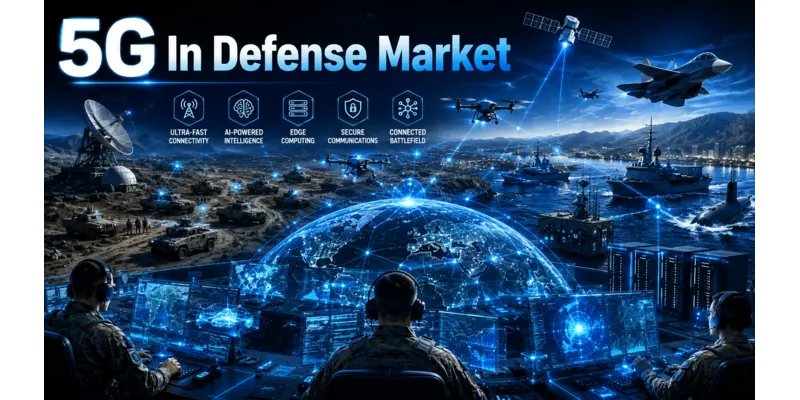
Modern defense operations are rapidly evolving beyond traditional communication systems. As military organizations embrace digital transformation, the integration of Artificial Intelligence (AI), Edge Computing, and 5G is redefining how armed forces communicate, coordinate, and execute missions across land, naval, and airborne platforms. These technologies are enabling faster decision-making, real-time intelligence sharing, autonomous military systems, and highly secure battlefield communications—forming the backbone of next-generation defense infrastructure.
According to The Insight Partners, the 5G in Defense Market is projected to grow from US$ 1.45 billion in 2025 to US$ 6.32 billion by 2034, registering an impressive CAGR of 25.78% during 2026–2034. This remarkable growth reflects increasing investments in private military networks, AI-powered command systems, mobile edge computing, and network virtualization technologies that are supporting military modernization worldwide.
The Evolution of Military Communications
Traditional military communication systems were designed primarily for voice transmission and limited data exchange. However, modern defense operations generate enormous volumes of data from satellites, surveillance systems, unmanned vehicles, radar networks, sensors, and intelligence platforms. Processing and distributing this information quickly has become essential for mission success.
The emergence of 5G technology provides the bandwidth, ultra-low latency, and network reliability needed to support these complex defense environments. Combined with AI and edge computing, 5G enables military personnel to analyze critical information closer to the battlefield while maintaining secure, uninterrupted communications.
This technological convergence is helping defense organizations transition toward network-centric warfare, where every platform, sensor, and command center operates as part of a connected ecosystem.
AI Is Making Defense Communications Smarter
Artificial Intelligence has become one of the most significant innovations in military communications. Instead of simply transmitting information, AI can analyze vast datasets, identify threats, prioritize intelligence, and support commanders with real-time decision-making.
Some of the key AI applications include:
- Automated target recognition
- Predictive threat analysis
- Autonomous surveillance
- Intelligent battlefield management
- Cybersecurity monitoring
- Mission planning optimization
When integrated with 5G networks, AI systems receive continuous streams of real-time data from multiple defense assets, significantly improving situational awareness.
For example, AI-powered command centers can instantly process data from drones, satellites, radar systems, and ground sensors to recommend tactical responses much faster than traditional communication networks.
Why Edge Computing Is Becoming Mission Critical
One of the biggest limitations of cloud-based communication is latency. Sending battlefield data to distant data centers before processing can delay critical decisions.
This is where Mobile Edge Computing (MEC) and Fog Computing are transforming defense communications.
Instead of transmitting every piece of information to centralized servers, edge computing processes data near its source. Military units can therefore analyze surveillance footage, sensor data, and intelligence directly at forward operating bases or tactical command centers.
Key advantages include:
- Faster intelligence processing
- Reduced communication delays
- Improved operational resilience
- Lower network congestion
- Enhanced cybersecurity through localized processing
- Greater support for disconnected battlefield environments
According to The Insight Partners, Mobile Edge Computing represents one of the fastest-growing technologies within the 5G in Defense Market, reflecting growing demand for real-time battlefield analytics and autonomous military operations.
5G Enables Truly Connected Battlefields
Unlike previous wireless generations, 5G has been designed to support mission-critical communications requiring extreme reliability.
Three major network capabilities are driving military adoption:
Enhanced Mobile Broadband (eMBB)
Defense forces increasingly depend on high-resolution satellite imagery, live drone feeds, video surveillance, and battlefield mapping. Enhanced Mobile Broadband provides sufficient bandwidth to support these data-intensive applications without compromising communication quality.
Ultra-Reliable Low-Latency Communications (URLLC)
Military operations often involve autonomous systems, remote-controlled platforms, missile defense systems, and tactical communications where milliseconds matter.
URLLC minimizes delays while ensuring highly reliable connectivity for mission-critical operations.
Massive Machine Type Communications (mMTC)
Modern defense ecosystems include thousands of connected sensors, surveillance devices, logistics trackers, and autonomous platforms.
mMTC enables secure communication among these connected assets, creating a highly intelligent military Internet of Things (IoT) ecosystem.
Virtualized Networks Are Increasing Military Flexibility
Modern military communications are also shifting toward software-driven architectures.
Technologies such as:
- Software-Defined Networking (SDN)
- Network Functions Virtualization (NFV)
allow defense organizations to replace hardware-intensive communication infrastructure with flexible, scalable software platforms.
These technologies help military operators:
- Reconfigure networks rapidly
- Improve resource utilization
- Strengthen cybersecurity
- Deploy communications faster during emergencies
- Support multi-domain military operations
Virtualized networks also simplify future technology upgrades without requiring complete infrastructure replacement.
Autonomous Defense Systems Depend on AI, Edge, and 5G
The increasing deployment of autonomous military systems is creating enormous demand for next-generation communications.
Examples include:
- Unmanned aerial vehicles (UAVs)
- Autonomous ground vehicles
- Robotic combat systems
- Unmanned naval vessels
- Intelligent surveillance platforms
These systems continuously exchange massive volumes of operational data that require secure, real-time transmission.
AI enables autonomous decision-making.
Edge computing processes data instantly.
5G provides reliable, high-speed connectivity.
Together, these technologies allow autonomous systems to operate efficiently even in highly dynamic battlefield environments.
Regional Defense Investments Continue to Accelerate
North America Leads Market Adoption
North America remains the largest regional market, accounting for approximately 36%–40% of global revenue in 2025.
The region benefits from:
- Large defense modernization budgets
- Advanced telecommunications infrastructure
- Military-grade private wireless network deployments
- Strong collaboration between defense agencies and technology providers
The United States continues to drive regional growth through investments in AI-enabled command systems, secure communications, and autonomous military technologies.
Asia Pacific Emerges as the Fastest-Growing Region
Countries including China, Japan, South Korea, India, and Australia are rapidly modernizing defense communications.
Military digitalization, border surveillance upgrades, indigenous technology development, and increasing investments in secure communications are expected to make Asia Pacific the fastest-growing regional market through 2034.
Europe Expands Defense Digitalization
European countries are strengthening military interoperability through defense modernization initiatives and NATO-supported communication programs.
Germany, the UK, and France continue investing in secure wireless infrastructure, mission-critical communication systems, and software-defined military networks.
Private Military Networks Create New Growth Opportunities
Governments worldwide are increasingly deploying dedicated private wireless networks for military installations.
Unlike commercial networks, private military 5G systems offer:
- Greater cybersecurity
- Complete operational control
- Reliable mission-critical performance
- Secure classified communications
- Enhanced spectrum efficiency
Defense agencies are also investing heavily in resilient communication infrastructure capable of operating during cyberattacks or contested battlefield environments.
This trend is creating significant opportunities for telecommunications providers, semiconductor manufacturers, software developers, cybersecurity companies, and defense contractors.
The Road Ahead
Future military operations will depend on highly connected, intelligent, and autonomous defense ecosystems.
AI will automate battlefield decision-making.
Edge computing will process intelligence closer to operational environments.
5G will deliver secure, ultra-fast connectivity across land, naval, airborne, cyber, and space domains.
As governments continue prioritizing military modernization, investments in advanced communication infrastructure will remain a strategic priority.



.png)