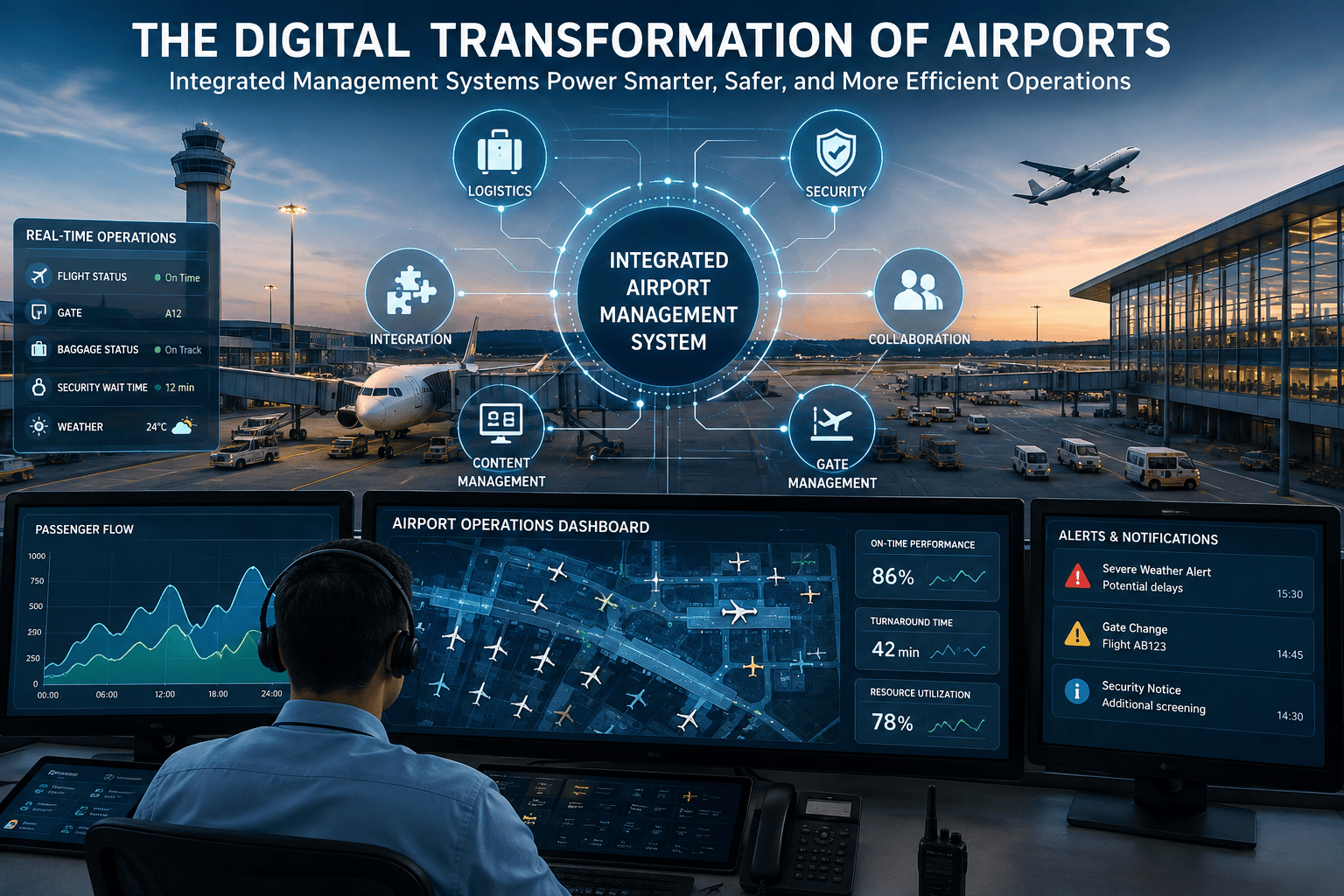
Airports are evolving from traditional transportation hubs into highly connected, data-driven ecosystems. Rising passenger volumes, constrained terminal capacity, increasingly complex security requirements, and growing expectations for seamless travel are forcing airport operators to rethink how daily operations are managed. In this environment, integrated airport management systems are becoming essential infrastructure, connecting airport operations, security, logistics, gate management, passenger communications, and stakeholder collaboration through centralized digital platforms.
The transformation is also creating sustained demand for airport management technologies. According to The Insight Partners' analysis, the Airport Management System Market was valued at US$6.56 billion in 2025 and is projected to reach US$8.87 billion by 2034, registering a CAGR of 3.41% from 2026 to 2034. The market covers software and services used across airport classifications and applications, including logistics, security, content management, integration, collaboration, and gate management.
Why Airports Are Moving Beyond Disconnected Systems
Historically, airports have relied on multiple standalone systems to manage different operational functions. Flight information, baggage handling, security monitoring, gate allocation, passenger communications, and ground operations could operate independently, making it difficult for airport teams to obtain a unified view of activities.
This fragmented approach becomes increasingly challenging as passenger traffic grows. A delay at one point in the airport can create consequences across multiple operations. A late aircraft can affect gate availability, baggage handling, ground crews, passenger boarding, flight information displays, and subsequent flight schedules.
Integrated airport management systems address this challenge by bringing operational data together. Instead of relying on isolated applications, airport authorities can use connected platforms to monitor events, share information, coordinate resources, and make faster decisions.
The result is a transition from reactive airport management to proactive and predictive operations.
Passenger Growth Is Accelerating Digital Transformation
Passenger growth is one of the strongest factors encouraging airports to modernize their technology infrastructure. Increasing passenger throughput puts pressure on terminals, gates, baggage systems, security checkpoints, and airport personnel.
Physical expansion is not always the fastest or most practical solution. Airports often operate in environments where additional terminals, runways, gates, or baggage facilities require substantial investment and lengthy planning processes.
Digital management systems provide another way to increase operational efficiency. By analyzing real-time information, airport operators can improve gate allocation, monitor passenger flows, coordinate baggage movement, optimize resources, and respond more effectively to disruptions.
For example, an integrated platform can connect flight schedules with gate availability and operational status. When a flight is delayed, the system can provide relevant information to teams responsible for gates, ground handling, passenger communication, and resource allocation. This type of coordination can reduce the impact of disruptions throughout the airport.
Integration Is Becoming the Foundation of Smart Airports
The modern airport is not operated by a single organization. Airlines, airport authorities, ground handlers, security agencies, border-control organizations, retailers, maintenance teams, and technology providers all contribute to airport operations.
Consequently, integration has become one of the most important capabilities within airport management systems.
Integrated platforms can connect operational databases and applications across multiple stakeholders, enabling information to move more efficiently between departments and organizations. This is particularly important during irregular operations caused by weather events, technical problems, security incidents, staffing shortages, or flight disruptions.
The increasing adoption of cloud technologies and modular software is further supporting this transition. Rather than replacing every existing system, airports can integrate new digital modules with established infrastructure and gradually modernize their technology environment.
AI Is Taking Airport Management from Visibility to Prediction
The next phase of airport digital transformation is expected to be increasingly influenced by artificial intelligence and predictive analytics.
Traditional airport management systems primarily provide visibility into what is happening. AI-enabled platforms can potentially help airport teams understand what is likely to happen next.
Predictive technologies can analyze operational information to identify potential passenger congestion, gate conflicts, baggage delays, resource shortages, or other disruptions. This allows airport personnel to take preventive action rather than responding after an operational problem has already occurred.
For example, predictive passenger-flow analytics could identify increasing congestion at a security checkpoint and support proactive staffing or resource allocation. Similarly, predictive gate-management tools could help identify conflicts before they affect aircraft turnaround operations.
AI therefore has the potential to transform airport management systems from information platforms into intelligent decision-support environments.
Security Is Becoming an Integrated Operational Function
Airport security is another major area driving digital transformation. Modern airports increasingly rely on biometric identity verification, access control, surveillance, incident monitoring, and integrated security alerts.
Security systems can no longer operate completely independently from airport operations. A security event may affect passenger movement, gate operations, terminal access, flight schedules, and communications.
Integrating security information with broader airport management platforms can provide airport authorities with better situational awareness. Security alerts can be coordinated with operational teams, passenger communication systems, and resource management processes.
The security application segment is particularly significant in the Airport Management System Market. Based on the supplied market assessment, security accounted for an estimated 19–22% share in 2025 and is projected to grow at a CAGR of 4.1–4.8% during 2026–2034, making it one of the faster-growing application areas.
Digital Identity and Contactless Passenger Processing
Digital identity is also changing the way passengers move through airports. Biometric authentication, automated baggage drop, self-service check-in, and contactless boarding can reduce manual intervention while improving passenger processing.
However, these technologies require secure information exchange between multiple systems. Passenger identity information, flight details, boarding information, security processes, and border-control requirements must work together while maintaining appropriate privacy and cybersecurity protections.
This makes interoperability increasingly important. Airports adopting digital travel credentials and biometric solutions will need management platforms capable of connecting different systems and stakeholders.
Regional Digitalization Trends
The pace of airport digital transformation varies by region.
North America remains a major adoption center, accounting for an estimated 34–37% of the airport management system market in 2025. Large hub airports are investing in operational control, passenger processing, cybersecurity, biometrics, and collaborative decision-making.
Europe, with an estimated 26–29% market share in 2025, is focusing on operational resilience, security, sustainability, passenger processing, and efficient use of airport infrastructure.
Asia Pacific represents one of the fastest-growing regional opportunities. The region accounted for an estimated 23–26% share in 2025 and is expected to grow at a CAGR of 4.0–4.7% during 2026–2034. Rapid airport construction, rising passenger traffic, and smart-terminal initiatives in countries such as China, India, Japan, South Korea, and Australia are supporting technology adoption.
The Middle East is also emerging as an important market as major aviation hubs invest in advanced passenger processing, biometric journeys, automation, and high-capacity airport infrastructure.
Cloud and Modular Platforms Will Expand Adoption
Another important development is the increasing availability of cloud-based and modular airport management solutions.
Large international airports may require highly customized and complex platforms, but smaller and mid-sized airports often need scalable solutions that can be deployed without major infrastructure investments.
Cloud-based platforms can provide a more flexible approach. Airports can adopt specific capabilities such as gate management, content management, security monitoring, collaboration, or operational dashboards and expand functionality over time.
This creates opportunities for vendors offering modular solutions, integration services, cybersecurity capabilities, and long-term technical support.
The Future of Airport Management Is Integrated, Intelligent, and Collaborative
The digital transformation of airports is moving beyond the installation of individual technologies. The real opportunity lies in connecting those technologies into a unified operational ecosystem.
Future airport management systems are likely to combine AI, cloud computing, IoT, biometrics, predictive analytics, digital identity, cybersecurity, automation, and real-time collaboration. These capabilities can help airport operators improve operational visibility while responding faster to changing passenger demand and unexpected disruptions.
The Airport Management System Market is therefore not simply about replacing legacy software. It represents a broader transformation in how airports operate, collaborate, and make decisions.
As passenger volumes increase and airport capacity remains under pressure, integrated management platforms will become increasingly important for maximizing existing infrastructure. Airports that successfully connect logistics, security, gate management, passenger communication, and stakeholder collaboration will be better positioned to deliver efficient, resilient, and seamless operations.
Ultimately, the airport of the future will not be defined only by larger terminals or advanced aircraft. It will increasingly be defined by how intelligently its digital infrastructure connects people, systems, data, and decisions.