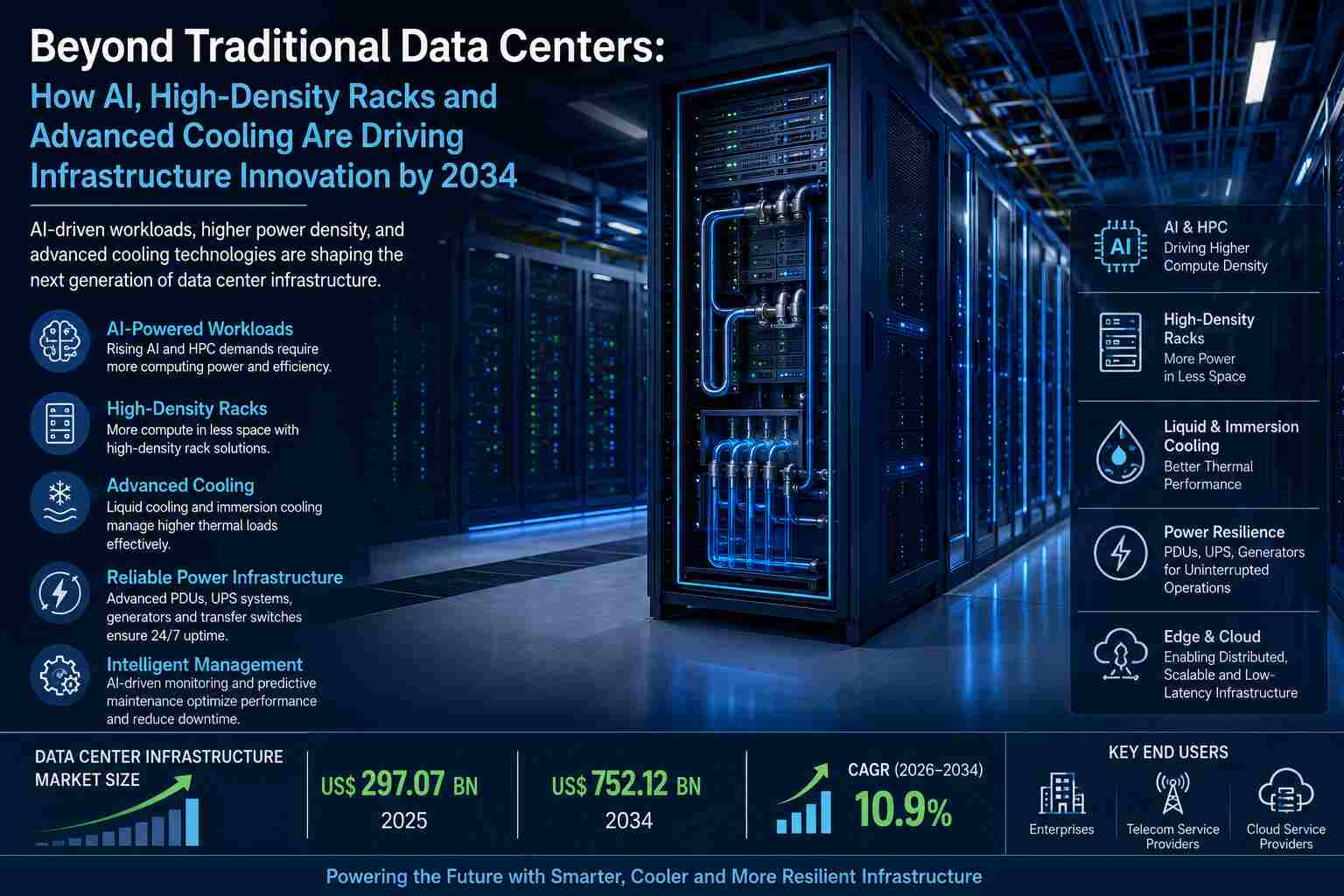
The Data Center Infrastructure Market is entering a major transformation as artificial intelligence (AI), cloud computing, big data analytics, edge computing, and digital services reshape the requirements of modern computing facilities. Traditional data centers were primarily designed around conventional enterprise workloads, predictable power consumption, and air-based cooling systems. However, the rapid deployment of AI and high-performance computing (HPC) is creating significantly higher power and thermal demands, encouraging operators to rethink how data centers are designed, powered, cooled, and managed.
According to The Insight Partners, the global Data Center Infrastructure Market was valued at US$ 297.07 billion in 2025 and is projected to reach US$ 752.12 billion by 2034, registering a 10.9% CAGR from 2026 to 2034. The market's expansion reflects increasing investments in advanced infrastructure capable of supporting cloud platforms, AI workloads, hyperscale facilities, edge environments, and next-generation digital applications.
AI Is Changing the Architecture of Data Centers
AI is one of the most important forces transforming data center infrastructure. The growing adoption of machine learning, generative AI, large language models, and other data-intensive applications requires powerful computing resources and significantly greater processing capacity. AI workloads often depend on large clusters of high-performance processors and accelerators, increasing requirements for power delivery, networking, storage, and thermal management.
As organizations deploy increasingly sophisticated AI applications, data centers must accommodate workloads that can generate substantially higher computational and thermal loads than traditional enterprise applications. This is encouraging operators to invest in infrastructure that can deliver reliable power while maintaining optimal operating temperatures.
The expansion of cloud computing and AI workloads is therefore creating opportunities across multiple infrastructure categories, including power distribution units, UPS systems, generators, transfer switches, racks, cooling and thermal systems, and professional infrastructure services.
High-Density Racks Are Redefining Data Center Design
One of the most visible changes associated with AI adoption is the emergence of high-density computing environments. Conventional racks were designed to support relatively moderate computing loads. AI and HPC applications, however, can require substantially greater computing capacity within a smaller physical footprint.
High-density racks allow operators to deploy more computing resources within limited space, but they also introduce challenges related to power distribution and heat generation. Data center operators must ensure that electrical infrastructure can deliver sufficient power while cooling systems can efficiently remove the resulting heat.
This shift is increasing demand for advanced rack designs, high-capacity power distribution, intelligent monitoring, and thermal management solutions. It is also encouraging data center operators to reconsider facility layouts and infrastructure planning.
The growing importance of high-density environments is particularly relevant to cloud service providers and hyperscale data centers. According to the market analysis, the Cloud Service Providers segment is expected to be the fastest-growing end-user segment, with a CAGR of 13.1% during the forecast period.
Advanced Cooling Becomes a Strategic Infrastructure Priority
Cooling has traditionally been one of the fundamental components of data center infrastructure. However, rising computing density is pushing conventional cooling technologies toward their performance limits in certain applications.
The growing deployment of AI and HPC workloads is accelerating interest in liquid cooling, immersion cooling, and other advanced thermal management technologies. These solutions can help data centers manage the heat generated by high-density computing environments while supporting greater computing capacity.
The market analysis identifies Cooling and Thermal Systems as the fastest-growing mechanical infrastructure category, with a projected CAGR of 13.7%. This reflects the growing importance of thermal management as data center operators seek to balance computing performance, reliability, energy efficiency, and operating costs.
Liquid cooling and immersion cooling can also support future infrastructure designs where conventional air cooling may become less efficient or practical. As rack densities continue to increase, cooling is likely to become an increasingly important factor when organizations plan new data center facilities or modernize existing sites.
Power Infrastructure Moves to the Center of Data Center Innovation
AI-driven computing does not only increase demand for cooling. It also places greater pressure on electrical infrastructure. Reliable power is essential for data centers because interruptions can affect critical workloads, cloud services, enterprise applications, and digital services.
Power Distribution Units (PDUs), UPS systems, generators, and transfer switches are therefore becoming increasingly important components of modern data center architecture. Operators are looking for scalable power infrastructure capable of supporting high-density computing while maintaining reliability and operational efficiency.
The growing focus on sustainability is also encouraging organizations to improve energy efficiency. Governments and companies are implementing energy efficiency standards and carbon reduction initiatives, creating demand for infrastructure technologies that can help reduce power consumption and improve overall facility performance.
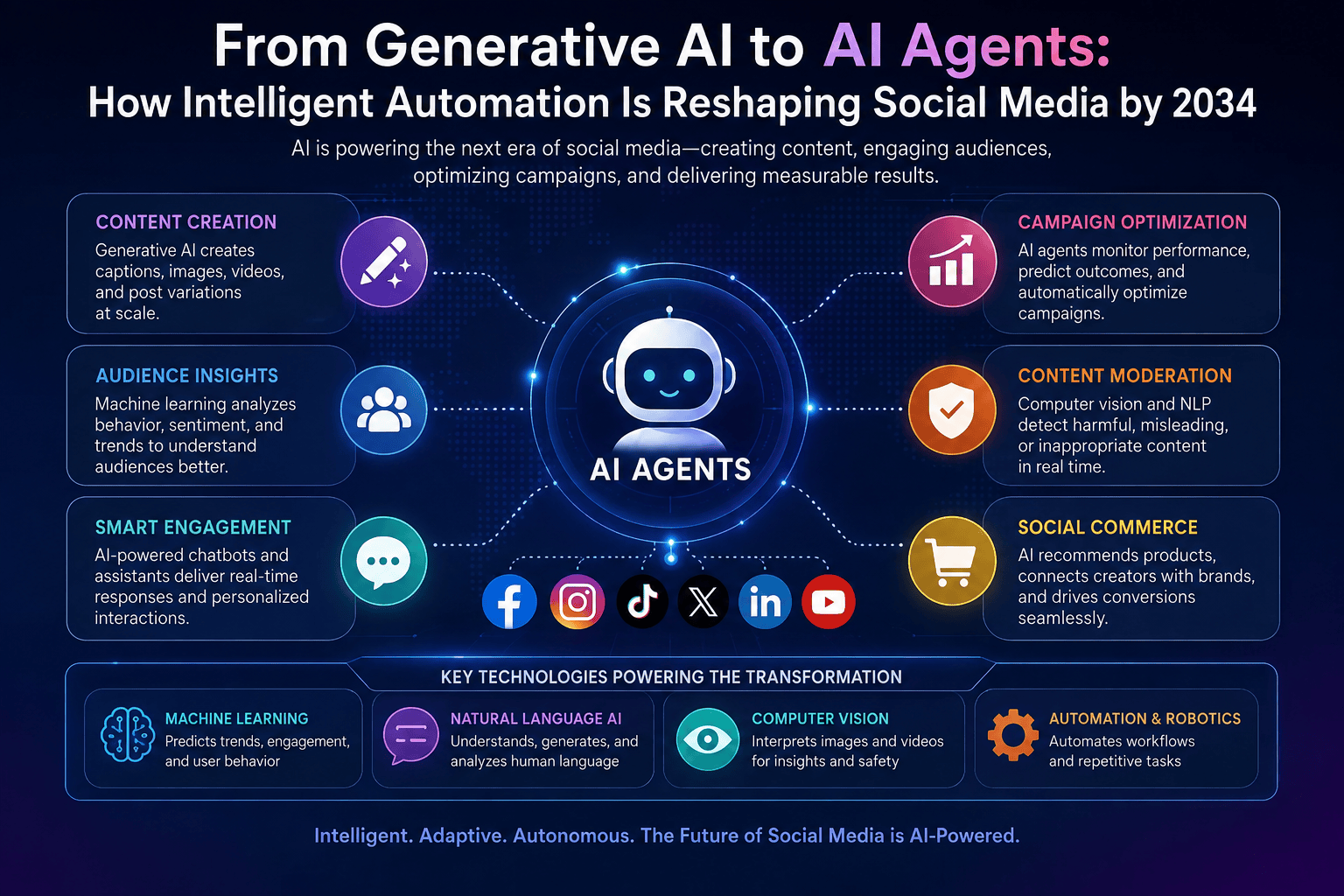
AI can further support this transformation through intelligent infrastructure management. AI-driven analytics can help operators optimize workloads, monitor equipment behavior, identify potential failures, and improve cooling and energy management.
AI-Driven Infrastructure Management and Predictive Maintenance
The evolution of data centers is not limited to physical hardware. Services and intelligent management technologies are also becoming increasingly important.
AI-powered monitoring and predictive analytics can analyze infrastructure and equipment behavior to identify potential issues before they develop into operational failures. This approach can support predictive maintenance for power, cooling, and IT systems while helping operators improve uptime and reduce unplanned downtime.
The market analysis highlights the growing role of AI-driven data center optimization, including real-time workload management, smart cooling optimization, predictive maintenance, and improved energy efficiency.
Professional services are also an important component of the market. The Professional Services segment accounted for 62.1% of the service market share in 2024, demonstrating the importance of specialized expertise in designing, deploying, maintaining, and optimizing increasingly complex data center environments.
Hyperscale and Edge Data Centers Expand Infrastructure Opportunities
The transformation of data center infrastructure is occurring across different facility sizes and deployment models. Hyperscale data centers continue to attract significant investments as cloud computing and AI applications require massive amounts of processing and storage capacity.
At the same time, edge computing is creating demand for smaller and distributed infrastructure. The expansion of 5G networks and low-latency applications requires computing resources to be positioned closer to users and connected devices.
This creates opportunities for modular and scalable data center infrastructure that can be deployed in geographically distributed locations. Small, mid-sized, and large data centers may therefore adopt different infrastructure configurations depending on workload requirements, location, power availability, and connectivity.
The Mid-Sized Data Center segment is projected to be the fastest-growing data center size category, registering a 13.6% CAGR during the forecast period.
Tier 3 Infrastructure Continues to Play a Major Role
Reliability requirements also influence data center infrastructure investments. The market is segmented into Tier 1, Tier 2, Tier 3, and Tier 4 facilities, with different levels of redundancy and reliability.
The Tier 3 segment accounted for 37.8% of the market in 2024, highlighting the importance of infrastructure capable of supporting high availability and maintenance requirements.
As organizations increasingly depend on cloud applications, digital platforms, AI services, and connected systems, infrastructure reliability will remain a key consideration. Power redundancy, cooling resilience, backup systems, and intelligent monitoring can help operators minimize service interruptions and maintain operational continuity.
Regional Markets Reflect Different Infrastructure Priorities
Data center infrastructure development varies considerably by region due to differences in cloud adoption, digital transformation, AI deployment, connectivity, energy availability, and government initiatives.
North America held the largest market share, accounting for 34.9% in 2024, supported by the presence of major hyperscale cloud providers and continued investment in advanced computing infrastructure. The US market is also projected to grow at a 11.2% CAGR during the forecast period.
Asia Pacific is expected to be one of the fastest-growing regional markets, with a projected 12.4% CAGR. Expanding cloud adoption, AI investments, digital transformation programs, increasing internet connectivity, and 5G deployment across countries such as China, India, Japan, Singapore, and South Korea are supporting infrastructure expansion.
Europe is emphasizing sustainability and energy efficiency, while South and Central America are benefiting from growing digitalization and cloud adoption. Meanwhile, the Middle East and Africa are experiencing increased investments linked to smart cities, 5G networks, cloud infrastructure, and government-led digital economy initiatives.
The Competitive Landscape Is Becoming More Technology-Driven
Competition in the Data Center Infrastructure Market is intensifying as technology companies and infrastructure providers seek to address the changing requirements of AI-enabled facilities. Key companies analyzed in the market include Dell Technologies, Cisco Systems, Hewlett Packard Enterprise, ABB, Equinix, NVIDIA, Intel, Huawei Technologies, Eaton, Mitsubishi Electric, Legrand, Delta Electronics, Seagate Technology, Lenovo Group, and OSI Global IT, among others.
Companies are increasingly differentiating themselves through integrated infrastructure solutions that combine computing, networking, power, cooling, monitoring, and services. Partnerships between cloud providers, semiconductor companies, networking companies, and infrastructure specialists are also expected to play an important role in developing AI-ready data centers.
Recent industry developments reinforce this direction. In January 2026, Vertiv launched Vertiv Next Predict, an AI-powered managed service designed to identify potential infrastructure risks before failures occur. In February 2026, Cisco introduced Silicon One G300, a 102.4 Tbps switching silicon designed for large AI cluster deployments, supporting the networking requirements of high-density AI data centers.
The Road Ahead: Building AI-Ready Data Centers
The next generation of data centers will be fundamentally different from traditional facilities. AI and high-performance computing are driving greater rack densities, while advanced cooling technologies are becoming essential for thermal management. At the same time, reliable power distribution, backup power, intelligent monitoring, modular architecture, and energy-efficient systems are becoming increasingly important.
Ultimately, the future of data centers will not be defined simply by how much computing capacity a facility can accommodate. It will be defined by how efficiently that capacity can be powered, cooled, connected, monitored, and scaled. AI-ready infrastructure, high-density racks, liquid and immersion cooling, intelligent power systems, and predictive management technologies are therefore positioned to become central elements of the data center landscape through 2034.