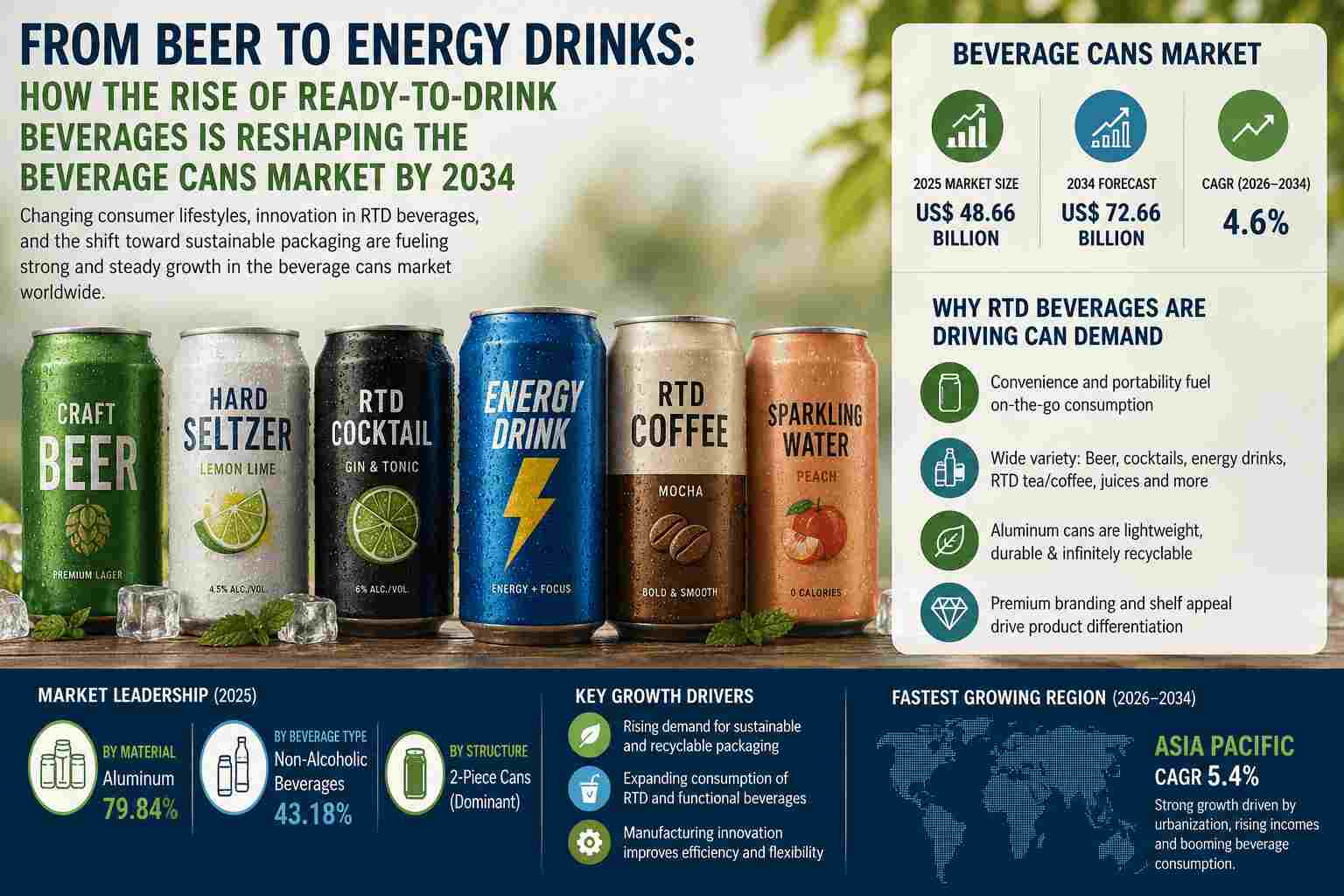
The beverage packaging industry is undergoing a significant transformation as consumers increasingly seek convenient, portable, sustainable, and ready-to-consume beverages. From beer and hard seltzers to energy drinks, sparkling beverages, and ready-to-drink (RTD) coffee, the growing popularity of these products is creating new opportunities for metal packaging manufacturers. Beverage cans, particularly aluminum cans, are emerging as a preferred packaging format because they combine lightweight construction, recyclability, durability, portability, and strong branding potential.
According to The Insight Partners, the Beverage Cans Market was valued at US$ 48.66 billion in 2025 and is projected to reach US$ 72.66 billion by 2034, registering a CAGR of 4.6% from 2026 to 2034. The market is being supported by increasing consumption of packaged beverages, rising demand for recyclable metallic packaging, investments in high-speed can production technologies, and the rapid expansion of ready-to-drink beverage categories.
RTD Beverages Are Changing Beverage Consumption Patterns
Ready-to-drink beverages have moved beyond their traditional association with beer and soft drinks. Consumers today have access to an expanding range of canned products, including RTD cocktails, hard seltzers, RTD wine, ciders, energy drinks, sports drinks, RTD juices, iced tea, coffee, sparkling water, and functional beverages.
This diversification is an important factor influencing beverage can demand. Modern consumers increasingly prioritize convenience and portability, particularly in urban environments. Single-serve cans can be easily transported, chilled, opened, and consumed without additional preparation, making them suitable for convenience stores, supermarkets, vending machines, foodservice outlets, sporting events, travel, and outdoor activities.
The expansion of RTD beverages is also allowing brands to enter new consumption occasions. For example, canned cocktails provide an alternative to traditionally prepared alcoholic drinks, while canned coffee and energy beverages offer convenient solutions for consumers seeking functional products during work, travel, or exercise.
Aluminum Cans Remain at the Center of the Transformation
The shift toward RTD beverages is closely connected to the increasing adoption of aluminum cans. According to The Insight Partners' analysis, aluminum accounted for 79.84% of the beverage cans market in 2025, making it the leading material type.
Aluminum offers several advantages for beverage manufacturers. Its lightweight characteristics can reduce transportation requirements, while its durability supports distribution across multiple retail channels. Aluminum also provides strong protection against external factors that can affect beverage quality and offers an effective surface for high-quality branding and decoration.
Most importantly, aluminum supports the industry's move toward circular packaging. Beverage manufacturers and packaging companies are increasingly focusing on recycled content, collection systems, and closed-loop recycling. As sustainability becomes an increasingly important purchasing consideration for consumers and a strategic priority for beverage brands, aluminum cans are well positioned to benefit.
Steel also remains relevant in selected beverage applications because of its strength, durability, and cost efficiency. However, the continued development of lightweight aluminum alloys and recycling infrastructure is expected to reinforce aluminum's leading position through 2034.
Alcoholic RTD Beverages Create New Demand
Beer has historically represented an important application for beverage cans, but the alcoholic beverage landscape is becoming considerably broader. RTD cocktails, hard seltzers, RTD wine, ciders, and other flavored alcoholic beverages are creating additional demand for convenient metal packaging.
The appeal of these beverages is closely connected to portability and ease of consumption. Cans also provide beverage brands with a large printable surface that can be used to communicate premium positioning, flavor information, product identity, and promotional campaigns.
Premiumization is another important factor. Beverage brands are increasingly using sophisticated graphics, specialty finishes, digital printing, and distinctive can formats to differentiate products on crowded retail shelves. This creates opportunities for can manufacturers to move beyond basic container production toward value-added packaging solutions.
Energy and Functional Beverages Accelerate Can Demand
While alcoholic RTD products are expanding the addressable market for beverage cans, non-alcoholic beverages represent an especially important growth opportunity. The Insight Partners identifies non-alcoholic beverages as the fastest-growing beverage category, with a 5.0% CAGR during 2026–2034.
Energy and sports drinks are particularly well suited to cans because consumers often purchase them as portable, single-serving products. The same trend is visible across functional beverages, sparkling drinks, RTD tea, RTD coffee, and other innovative beverage categories.
As beverage companies introduce new flavors, formulations, functional ingredients, and limited-edition products, they require packaging formats capable of supporting rapid product launches and strong visual differentiation. Beverage cans can meet these requirements while offering convenient single-serve formats.
Can Sizes Are Evolving With Consumer Preferences
The expansion of RTD beverages is also influencing the demand for different can sizes. The market covers below 250 ml, 250–330 ml, 330–500 ml, and above 500 ml formats.
Smaller cans can support portion control, premium products, energy shots, and specialty beverages, while 250–330 ml cans remain widely used for soft drinks, beer, sparkling beverages, and other single-serve products.
Meanwhile, 330–500 ml formats are particularly relevant for energy drinks, sports beverages, premium beer, iced tea, and RTD coffee. Larger cans above 500 ml can address value-oriented consumption, family occasions, and selected foodservice applications.
This broad range gives beverage manufacturers flexibility to align packaging with product positioning, price points, consumption occasions, and target audiences.
Manufacturing Innovation Is Making Cans More Efficient
The growth of RTD beverages is occurring alongside major technological developments in can manufacturing. Producers are investing in high-speed production lines, lightweight alloys, automated inspection systems, advanced necking technologies, digital printing, and energy-efficient manufacturing equipment.
Lightweighting is particularly important because reducing the amount of metal required per can can improve material efficiency and lower transportation-related impacts. At the same time, manufacturers must maintain structural strength and product performance.
Digital printing is also becoming an increasingly valuable technology. It allows beverage brands to create customized designs, seasonal campaigns, regional promotions, limited editions, and smaller production runs without relying entirely on conventional printing processes. This flexibility is particularly useful for RTD brands that frequently introduce new products and flavors.
Asia Pacific Emerges as a Major Growth Opportunity
Geographically, Asia Pacific accounted for 35.12% of the global beverage cans market in 2025 and is projected to register the highest regional CAGR of 5.4% from 2026 to 2034.
China remains an important market due to its large beverage manufacturing base, while India, Japan, South Korea, and Southeast Asian countries are benefiting from urbanization, increasing disposable incomes, expanding modern retail networks, and rising packaged beverage consumption.
India and other developing Asian economies represent particularly attractive opportunities for beverage can manufacturers because the growth of RTD beverages is occurring alongside the expansion of domestic beverage production. Investments in new manufacturing capacity located close to beverage filling facilities can help companies reduce transportation costs and strengthen supply-chain resilience.
North America and Europe, meanwhile, remain important mature markets. North America represented 24.60% of the global market in 2025, while Europe accounted for 27.56%. Strong recycling infrastructure, established beverage industries, premium beverage innovation, and sustainability initiatives continue supporting demand in these regions.
Sustainability Will Remain a Defining Market Trend
Sustainability is increasingly becoming a fundamental part of beverage packaging strategies. Governments and companies are introducing initiatives focused on recycling, waste reduction, recycled content, and circular economy principles.
For beverage can manufacturers, this creates opportunities to increase the use of recycled aluminum, improve collection systems, and establish closed-loop relationships with beverage companies and metal suppliers. Higher recycled content can reduce dependence on primary raw materials while supporting the environmental objectives of beverage brands.
The combination of sustainability and RTD growth could therefore create a powerful long-term demand cycle. As consumers purchase more canned beverages, effective collection and recycling can return more metal to the packaging supply chain, strengthening the circularity of the industry.
What Will Define the Beverage Cans Market Through 2034?
The beverage cans industry is transitioning from a conventional packaging segment into a technology- and sustainability-driven part of the global beverage value chain. Several trends are expected to influence the market through 2034:
- Rapid expansion of RTD cocktails, hard seltzers, ciders, and other alcoholic beverages
- Increasing consumption of energy, sports, functional, and sparkling beverages
- Continued dominance of lightweight and recyclable aluminum cans
- Growing use of recycled aluminum and closed-loop recycling systems
- Rising demand for smaller and differentiated can formats
- Greater adoption of digital printing and customized packaging
- Investments in high-speed and automated can manufacturing
- Expansion of beverage production capacity across Asia Pacific
- Increasing focus on premium packaging and brand differentiation
The rise of ready-to-drink beverages is fundamentally changing the role of cans in the global beverage industry. What was once primarily a packaging solution for beer and carbonated soft drinks is now supporting a much broader ecosystem of alcoholic RTD beverages, energy drinks, sports beverages, RTD coffee and tea, sparkling drinks, juices, and functional beverages.




.png)