Sensing Cable Market Size & Overview
The Sensing Cable Market size is projected to grow from US$ 1.00 Billion in 2025 to US$ 1.85 Billion by 2034; it is estimated to register a CAGR of 7.01% from 2026 to 2034. The demand is growing due to the increasing use of monitoring sensors by industry players to continuously monitor leaks, heat, acoustic measurements, strain, and power cables instead of conducting periodic inspections.
North America is forecast to grow at a CAGR of 6.5%-7.0% from 2026-2034 owing to pipeline integrity regulations, thermal monitoring of data centers, and investment in robustness of power grids. The key focus in North America for industrial operators is on deploying early warning systems due to unplanned downtimes, exposure to the environment, and insurance considerations.
The demand is based on industries where leakages, heat incidents, vibration or stress lead to safety, environment and operational concerns. Pipelines for oil and gas, refineries, power lines, tunnels, data centers, and business premises have seen an increased need for continuous measurements since manual rounds do not detect quickly developing incidents. Sensing Cable Market forecast will be affected by this trend toward measureable risk management. Sensing cable value chain is composed of sensing cable producers, suppliers of optical fiber, compounders of polymers, interrogator producers, engineering companies, system integrators and software firms. Supply side dynamics include supply of optical fiber, special coating technology, robust connections, and know-how of installation process. Buyers are becoming more focused on assessing overall reliability, rather than on cable cost only.
The level of specialization in the market is somewhat high. nVent Electric plc and RLE Technologies target detection solutions in buildings, data centers, and facilities, whereas Silixa Ltd and Sensornet Limited target distributed fiber optic sensing for industry applications. The Sensing Cable market report focuses on the key players including TTK S.A.S., THERMOCOAX SAS, Cable USA, NKT Photonics A/S, PCB Piezotronics, Inc., and Yokogawa Electric Corporation will be competing in the areas of depth of application, accuracy of detection, channels, and integration capabilities. Trends in investments indicate the tendency of buyers towards multi-parameter monitoring, connectivity to cloud diagnostics, and analytics reducing the number of false positives. The strategic positioning is changing from providing hardware products to delivering outcome-based monitoring, when vendors will compete by offering commissioning assistance, calibration stability, and integration with plant control systems. This will benefit Sensing Cable in the Sensing Cable market development.
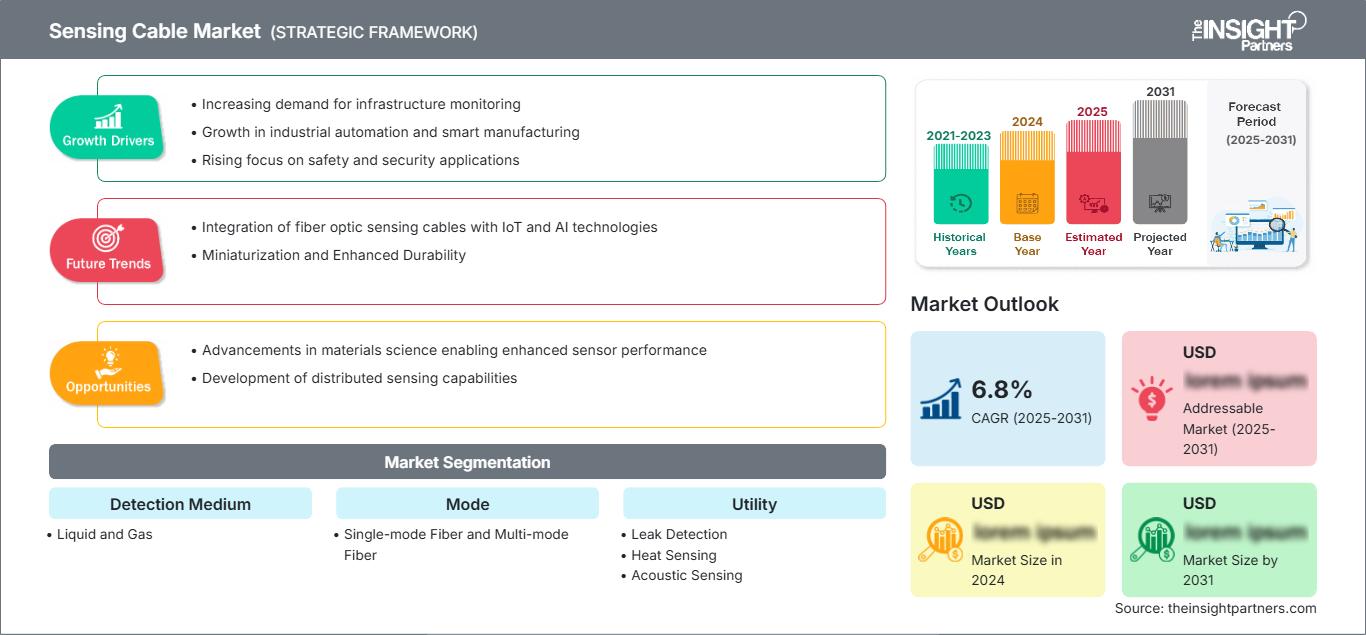
Sensing Cable Market Assessment and Insights
- North America held 32–35% of the Sensing Cable Market share in 2025 and is expected to grow at a CAGR of 6.5–7.0% during 2026–2034, led by regulated pipeline monitoring, hyperscale data centers, and utility asset modernization.
- The US represented 76–80% of North America in 2025 and is projected to grow at a CAGR of 6.6–7.1% through strong oil, gas, telecommunications, and building safety adoption.
- Europe accounted for 24–27% share in 2025 and may grow at a CAGR of 6.0–6.6%, with Germany, the UK, and France leading demand for energy transition infrastructure and fire safety systems.
- Asia Pacific captured 25–29% share in 2025 and is forecast to expand at a CAGR of 7.8–8.4%, supported by China, Japan, India, and South Korea infrastructure digitization.
- Leak Detection was the largest segment, with 34–38% market share in 2025 and CAGR of 6.8–7.3%, as operators seek continuous fluid and gas incident identification.
- Acoustic Sensing is the high growth segment, with 12–15% share in 2025 and CAGR of 8.2–8.8%, driven by intrusion, vibration, and pipeline event monitoring.
- Key companies analyzed in detail: Cable USA, NKT Photonics A/S, nVent Electric plc, PCB Piezotronics, Inc., RLE Technologies, Sensornet Limited, Silixa Ltd, THERMOCOAX SAS, TTK S.A.S., Yokogawa Electric Corporation.
Source: The Insight Partners' analysis based on proprietary research, government publications, company annual reports, investor presentations, industry databases, and expert interviews.
Sensing Cable Market Trends
AI-Assisted Event Classification
Future systems will increasingly combine sensing cables with analytics that classify events rather than only triggering alarms. Acoustic signatures, thermal gradients, strain patterns, and leak propagation profiles can be interpreted to distinguish real incidents from maintenance activity, weather effects, or benign vibration. This development will reduce nuisance alarms, improve operator confidence, and make systems more acceptable in complex environments. Vendors that build validated event libraries and integrate results into dashboards will gain stronger differentiation. The trend also broadens Sensing Cable trends from hardware reliability toward decision support, where faster interpretation creates operational value.
Embedded Sensing in New Infrastructure
More sensing cable will be embedded during construction rather than added after commissioning. New tunnels, wind connections, data centers, industrial parks, and pipelines can include sensing routes in the original engineering package, lowering installation disruption and improving coverage quality. This approach makes monitoring part of the asset design philosophy, similar to power, communications, and safety systems. Over the forecast period, contractors and engineering firms will play a larger role in specifying cable type, routing, and interface requirements. Early integration can reduce retrofit cost and improve long-term maintainability.
Sensing Cable Market Growth Factors
Continuous Monitoring for Critical Infrastructure
Owners of critical infrastructures are switching from scheduled inspection to continuous sensing because any leak, overheat, breach, or strain may worsen during the waiting period between inspections. Critical infrastructure such as pipelines, tunnels, substations, data centers, and commercial buildings have hidden infrastructure whose access can be problematic, and the timing of reaction affects how much loss occurs. Sensing cables provide location of the incident based on the distance, which enables isolation of the affected area before further damage. It will have the most impact on those infrastructures whose downtime is expensive or whose surroundings pose a danger to their proper functioning.
Data Center and Digital Facility Expansion
Data Centers, Telecom Rooms, and Digital Campuses have become major sources of demand for the industry due to the fact that even minor issues, such as a leak of water or thermal issues, will lead to disruption of equipment and service operation and thus impact their contracts. Cables are laid under the floor, in the cooling circuit, cable trays, and mechanical rooms to identify any potential problem at the stage when it is still outside the server room or switchgear room. It creates positive dynamics for the Sensing Cable Market forecast since the provision of uptime protection becomes a part of design, not an additional facility.
Regulatory Pressure on Energy and Environmental Risk
Energy, chemical, and utility operators face increasing pressure to identify leaks faster, document response actions, and reduce environmental releases. Sensing cable systems help convert regulatory expectations into measurable monitoring coverage, especially across pipelines, tanks, process lines, and high-voltage corridors. Their value rises when operators must show that assets are monitored continuously rather than inspected periodically. The Sensing Cable Market impact is visible in procurement specifications that require alarm zoning, event logs, and integration with control rooms. This driver supports both replacement projects and new installations where compliance risk influences engineering design.
Sensing Cable Market Opportunities
Retrofit Programs for Aging Utility Assets
Aging water, power, and fuel infrastructure creates a strong retrofit opportunity for suppliers that can simplify deployment without major shutdowns. Many utilities operate long linear assets with limited visibility, making leak, thermal, and strain sensing attractive when replacement budgets are constrained. Vendors can target retrofit packages that combine rugged cable, compact interrogators, commissioning services, and integration templates for control rooms. The commercial opportunity is strongest where asset owners need measurable risk reduction but cannot rebuild entire networks. Financing models linked to avoided losses, reduced inspection labor, or lower outage exposure can accelerate purchasing decisions.
Integrated Monitoring Services for Industrial Buyers
Industrial buyers increasingly want reliable outcomes rather than standalone components, creating opportunities for service-led sensing cable offerings. Suppliers can bundle design, installation, alarm configuration, periodic validation, analytics, and lifecycle support into recurring monitoring programs. This model is attractive for refineries, chemical plants, data centers, and energy sites that lack specialized sensing expertise. It also helps vendors differentiate in the Sensing Cable market where cable specifications can appear similar to non-specialists. By assuming responsibility for system performance, providers can improve retention, expand aftermarket revenue, and support higher customer confidence in complex deployments.
Segmentation Analysis
Detection Medium
Detection Medium is expected to grow at a CAGR of 6.7–7.3% during 2026–2034. Liquid monitoring remains the broader installed base because water, hydrocarbon, and chemical leaks create immediate operational and environmental consequences. Gas detection is gaining relevance as methane controls, confined-space safety, and pipeline integrity programs become more structured across energy and industrial sites.
- Liquid sensing cables are widely used in data centers, buildings, tanks, pipelines, and process areas where water or hydrocarbon exposure can interrupt operations and damage high-value assets.
- Gas sensing adoption is increasing in oil and gas, utilities, and enclosed industrial spaces as operators strengthen leak visibility, safety response, and environmental compliance programs.
Mode
Mode is projected to grow at a CAGR of 7.0–7.6% from 2026 to 2034. Single-mode fiber is favored for long-distance distributed sensing because it supports extended reach and high-resolution event location. Multi-mode fiber retains value in shorter, cost-sensitive installations where detection coverage, ease of handling, and integration simplicity are more important than extreme distance.
- Single-mode fiber supports long pipelines, tunnels, utility corridors, and perimeter routes where distributed acoustic, temperature, or strain monitoring requires distance, precision, and low attenuation.
- Multi-mode fiber serves shorter facilities and building applications where installation flexibility, lower system complexity, and moderate sensing distances align with project economics.
Utility
Utility is expected to grow at a CAGR of 7.1–7.7% during 2026–2034. Leak detection remains the largest use case because it protects buildings, pipelines, and process assets from fluid and gas incidents. Heat, acoustic, strain, and power cable monitoring are expanding as operators seek integrated asset condition intelligence rather than isolated alarms.
- Leak Detection leads adoption in buildings, oil and gas, water infrastructure, and industrial facilities where rapid event location reduces damage, downtime, and environmental exposure.
- Heat Sensing is strategically important for fire detection, cable trays, tunnels, and high-temperature industrial environments where continuous thermal visibility improves response confidence.
- Acoustic Sensing is gaining traction for pipeline intrusion, vibration, flow anomaly, and security applications because it detects dynamic events along extended assets.
- Strain Monitoring supports structural health, geotechnical, pipeline, and civil infrastructure projects where deformation patterns provide early warning before visible failure occurs.
- Power Cable Monitoring is increasingly relevant for transmission, offshore wind, substations, and urban grids where thermal overload and insulation stress can trigger costly outages.
Industry Vertical
Industry Vertical is projected to grow at a CAGR of 6.9–7.5% from 2026 to 2034. Oil and gas remains a major adopter because distributed monitoring supports leak detection and pipeline integrity. Building and construction, IT and telecommunication, and energy are expanding demand as dense infrastructure, digital facilities, and electrified grids require continuous visibility into hidden cable routes.
- Building and Construction uses sensing cables for water leaks, fire detection, and concealed infrastructure monitoring, particularly in hospitals, commercial towers, airports, and high-value facilities.
- Oil and Gas relies on sensing cables for pipeline leak detection, well monitoring, tank farms, refineries, and perimeter surveillance where operational risk is high.
- IT and Telecommunication adoption is driven by data center water leak detection, thermal monitoring, and uptime protection across server rooms, cable trays, and network hubs.
- Energy applications include power cable monitoring, substations, renewable interconnections, district energy, and transmission corridors where fault visibility supports grid reliability.
Opportunity Snapshot
| Industry Vertical | Revenue Contribution | Trend Tag | Adoption Stage |
| Building and Construction | High | Leak Safety | Mature |
| Oil and Gas | High | Pipeline Integrity | Scaling |
| IT and Telecommunication | Medium | Data Centers | Scaling |
| Energy | High | Grid Monitoring | Scaling |
| Others | Low | Asset Protection | Emerging |
Regional Insights
North America Sensing Cable Market
North America held 32–35% share in 2025 and is projected to grow at a CAGR of 6.5–7.0% from 2026 to 2034. Pipeline safety, aging water infrastructure, dense data centers, and hardened power grids continue to drive procurement efforts. The Sensing Cable category performs well wherever there is a requirement for verifiable monitoring over lengthy distances, underground, and in tough industrial conditions.
The regional Sensing Cable market is influenced by both insurance requirements and business continuity needs. Leak detection is common in critical facilities, while distributed acoustic and temperature sensing are gaining interest for use in pipelines and utilities cabling. Field service capabilities and integrators are key differentiators for vendors since installation quality has a direct impact on performance.
U.S. Sensing Cable Market
The US accounted for 76–80% of North America in 2025 and is expected to record a CAGR of 6.6–7.1% during 2026–2034. Demand is concentrated in interstate pipelines, refineries, hyperscale data centers, commercial campuses, and utility corridors. Strong engineering contractor participation improves adoption because sensing systems require route design, commissioning, and alarm validation.
Company presence is broad, with Cable USA, nVent Electric plc, PCB Piezotronics, Inc., and RLE Technologies addressing domestic monitoring applications alongside international specialists. Application trends favor water leak detection in data centers, linear heat detection in facilities, and fiber optic acoustic sensing for pipeline security. Buyers increasingly require open interfaces to existing building and industrial systems.
Europe Sensing Cable Market
Europe represented 24–27% share in 2025 and is forecast to grow at a CAGR of 6.0–6.6% during 2026–2034. Demand in Germany arises from industrial automation, district energy, chemical processes, and power cable condition monitoring. Customers prioritize certification with regards to fire safety, environmental compliance, and durable equipment in complex renovation environments.
The United Kingdom demand arises from the expansion of data centers, monitoring of rail infrastructure, minimizing water utility leaks, and offshore energy assets. Demand is highest in cases where there is need for continuous evidence based on thermal or acoustic signals for decision-making, regulatory requirements, and reduced response time.
France, Italy, and Spain provide demand from the upgrading of building safety systems, refineries, renewable energy grid connections, and transport tunnels. There is often preference for European reference cases, local services, and compatibility with building management systems. The trends in regional sensing cables therefore include safety compliance and energy infrastructure resilience.
APAC Sensing Cable Market
APAC held 25–29% share in 2025 and is projected to grow at a CAGR of 7.8–8.4% from 2026 to 2034. China is the leading country, supported by industrial parks, energy pipelines, rail systems, and smart city monitoring.
Japan and South Korea prioritize high-reliability sensing for data centers, tunnels, power cables, and manufacturing facilities. India shows faster adoption as infrastructure corridors, refineries, and urban utilities add digital monitoring to reduce losses and downtime.
Australia contributes through mining, energy, and transport applications where long-distance sensing reduces site visits. Policy support for grid modernization, industrial safety, and water conservation strengthens regional adoption, especially where skilled inspection labor remains constrained.
Middle East & Africa Sensing Cable Market
Middle East and Africa is expected to grow at a CAGR of 6.7–7.3% from 2026 to 2034. Saudi Arabia is the leading country because oil, gas, utilities, and giga-project infrastructure require early leak, heat, and intrusion detection.
The UAE Sensing Cable market benefits from data centers, airports, district cooling, high-rise buildings, and water-sensitive facilities. South Africa shows demand in mining, power distribution, and industrial facilities where cable monitoring can reduce outage risk.
Rest of MEA adoption remains project-led, especially in pipelines, desalination, ports, and commercial developments. Harsh environments make rugged construction, installation quality, and remote diagnostics central to lifecycle value.
Sensing Cable Market Report Scope
| Report Attribute | Details |
|---|---|
| Market size in 2025 | US$ 1.0 Billion |
| Market Size by 2034 | US$ 1.85 Billion |
| Global CAGR (2026 - 2034) | 7.01% |
| Historical Data | 2021-2024 |
| Forecast period | 2026-2034 |
| Segments Covered | Detection Medium, Mode, Utility, Industry Vertical |
| Region scope | North America, Europe, Asia-Pacific, South and Central America, Middle East and Africa |
Recent Developments
- March 2026: VIAVI Solutions Inc. has announced the introduction of a revolutionary new next-gen fiber test head for DAS (FTH-DAS) to improve its NITRO Fiber Sensing system. This FTH-DAS is a true phase DAS interrogator with an integrated AI and ML engine. It is a network edge-based interrogator that allows multi-event detection and localization with event classification in real time over multiple fibers.
- June 2026: Elisa, the Finnish Border Guard and the Finnish Navy tested the securing of submarine cables successfully. The observation equipment attached to Elisa's submarine cable is being employed for the monitoring of the submarine cable and to detect any threat towards it. Now the functionality of the system has been tested through different scenarios, like dragging of anchors. The equipment installed by Elisa provides the possibility of acoustic monitoring of submarine cables in the Gulf of Finland, thereby giving a wider range of monitoring of the seabed security. This project is built upon the principle of Distributed Acoustic Sensing (DAS), where Elisa's submarine cable operates as a sensor measuring unusual vibrations of the seabed. In this process, the DAS equipment analyzes the changes brought about by the vibrations in the reflection of the light travelling through the optical fibre.
- July 2024: Viavi Solutions Inc. announces the introduction of NITRO Fiber Sensing, an integrated asset monitoring and analytics platform for the security of critical infrastructure assets from pipelines, electrical power transmissions, borders/perimeter security, and data center interconnects.
Frequently Asked Questions

Recent Reports






