
3D Printing Ceramics Market Demand, Trends & Forecast by 2034
Coverage: By Type (Glass, Fused Silica, Quartz, Others); Form (Filament, Liquid, Powder); End-Use (Aerospace and Defense, Healthcare, Automotive, Consumer Goods and Electronics, Manufacturing and Construction, Others) , and Geography (North America, Europe, Asia Pacific, and South and Central America)
- Status : Data Released
- Report Code : TIPRE00009539
- Category : Electronics and Semiconductor
- No. of Pages : 150
- Available Report Formats :


- Last update date : July 15, 2026


2025 Market Size
US$ 125.23 Mn
Base year value
2034 Forecast
US$ 981.3 Mn
Projected by 2034
CAGR 2026-2034
25.70 %
Growth rate
Addressable Market
US$ 4,186.24 Mn
(2026-2034)
The 3D Printing Ceramics Market is valued at US$ 125.23 Million in 2025 and is projected to reach US$ 981.3 Million by 2034, registering a CAGR of 25.70% from 2026 to 2034. The market reflects demand for high-performance ceramic parts made through additive manufacturing across aerospace and defense, healthcare, automotive, electronics, manufacturing, and construction applications.
North America is entering a production-readiness phase as defense qualification, medical device customization, and semiconductor equipment demand increase. The 3D Printing Ceramics Market size in the region is expected to expand at a 23.0–26.0% CAGR during 2026–2034, supported by ceramic cores for aircraft engines, bioceramic implants, and process innovation from standards-focused bodies such as NIST and ASTM committees.
3D Printing Ceramics Market Assessment and Insights
- North America: North America held a 28–32% share in 2025 and is growing at a 23.0–26.0% CAGR between 2026–2034, led by aerospace qualification, medical customization, and semiconductor tooling.
- US: The US represented 74–78% of North America in 2025 and is growing at a 22.0–25.0% CAGR between 2026–2034, supported by defense, healthcare, and materials research.
- Europe: Europe accounted for a 35–39% share in 2025 and is growing at a 24.0–27.0% CAGR between 2026–2034, with Germany, France, Austria, the UK, and Italy leading adoption.
- Asia Pacific: Asia Pacific held a 24–28% share in 2025 and is growing at a 27.0–30.0% CAGR between 2026–2034, driven by China, Japan, South Korea, India, and Australia.
- Largest Segment: Powder led with a 42–46% market share in 2025 and a 24.0–27.0% CAGR between 2026–2034 because it suits binder jetting and ceramic feedstock flexibility.
- High Growth Segment: Healthcare held a 18–22% market share in 2025 and is growing at a 29.0–32.0% CAGR between 2026–2034 as patient-specific implants and dental ceramics scale.
- Key companies analyzed in detail: 3D Systems, Inc., 3DCeram Sinto, CRP Technology S.r.l., EOS GmbH, ExOne Global Holdings, Lithoz GmbH, Materialise NV, Prodways Group, Renishaw plc, and Stratasys Ltd.
Source: The Insight Partners' analysis based on proprietary research, government publications, company annual reports, investor presentations, industry databases, and expert interviews.
Ceramic additive manufacturing is shifting from laboratory prototyping toward qualified, low-volume production where conventional pressing, machining, or casting restrict geometry. Technical ceramics such as alumina, zirconia, fused silica, and quartz are being printed into cores, insulators, medical structures, and precision components that need heat resistance, chemical stability, and dielectric performance. The 3D Printing Ceramics Market is therefore evolving around material qualification, sintering control, dimensional repeatability, and application-specific post-processing.
Forward momentum will come from aerospace investment, healthcare personalization, and Asian electronics manufacturing ecosystems. IATA’s long-term passenger traffic recovery supports aircraft engine efficiency programs, while WHO attention to aging populations strengthens implant and dental demand. Regulatory tailwinds will favor suppliers that document powder handling, biocompatibility, traceability, and repeatable sintering because buyers increasingly require industrial validation before moving from prototypes to approved production.
3D Printing Ceramics Market Report Scope
| Report Attribute | Details |
|---|---|
| Market size in 2025 | US$ 125.23 Million |
| Market Size by 2034 | US$ 981.3 Million |
| Global CAGR (2026 - 2034) | 25.70% |
| Historical Data | 2021-2024 |
| Forecast period | 2026-2034 |
3D Printing Ceramics Market Analysis
3D Printing Ceramics Market growth is being driven by the need for lightweight thermal barriers, high-wear parts, biocompatible implants, and electrically insulating structures. Aerospace and defense users value complex ceramic cores and ultra-high-temperature parts, while healthcare buyers use additive routes for porous implant geometries. Supply chains are also reassessing ceramics as substitutes for metals where corrosion, heat, or dielectric limits reduce component life.
The ecosystem includes ceramic powder and slurry suppliers, printer OEMs, software developers, debinding and sintering specialists, contract manufacturers, inspection providers, and end-use engineering teams. Feedstock stability remains central because shrinkage, viscosity, and particle loading directly affect accuracy. Buyers are increasingly asking suppliers to provide design-for-ceramic-AM support, validated firing recipes, and quality documentation rather than standalone equipment or materials.
3D Printing Ceramics Market analysis shows a competitive landscape divided between ceramic specialists, broader additive manufacturing platforms, and industrial service providers. Lithoz GmbH and 3DCeram Sinto focus on high-precision ceramic systems, while 3D Systems, Inc., EOS GmbH, Renishaw plc, Stratasys Ltd., and Prodways Group bring broader additive manufacturing capabilities. Materialise NV supports software and services, and ExOne Global Holdings strengthens binder-jet casting routes.
Investment trends are moving toward production cells, process monitoring, automated cleaning, and traceable medical workflows. CRP Technology S.r.l. contributes experience in high-performance engineering materials and motorsport-grade applications, which informs lightweight design practices. Strategic positioning will depend on repeatability, validated materials, build economics, and customer ability to move from design trials to qualified production without excessive engineering rework.
● REPORT CUSTOMIZATION
Tailor This Report To Align With Your Specific Business Requirements
This report can be customized to align precisely with your business objectives, scope, and target markets. Customization options include tailored segmentation, geography, competitive analysis, and strategic insights to support informed decision-making.
Customize This Report →WHAT YOU CAN ADJUST
- ● Segmentations
- ● Geography
- ● Competitive Analysis
- ● Language Preferences
3D Printing Ceramics Market: Strategic Insights
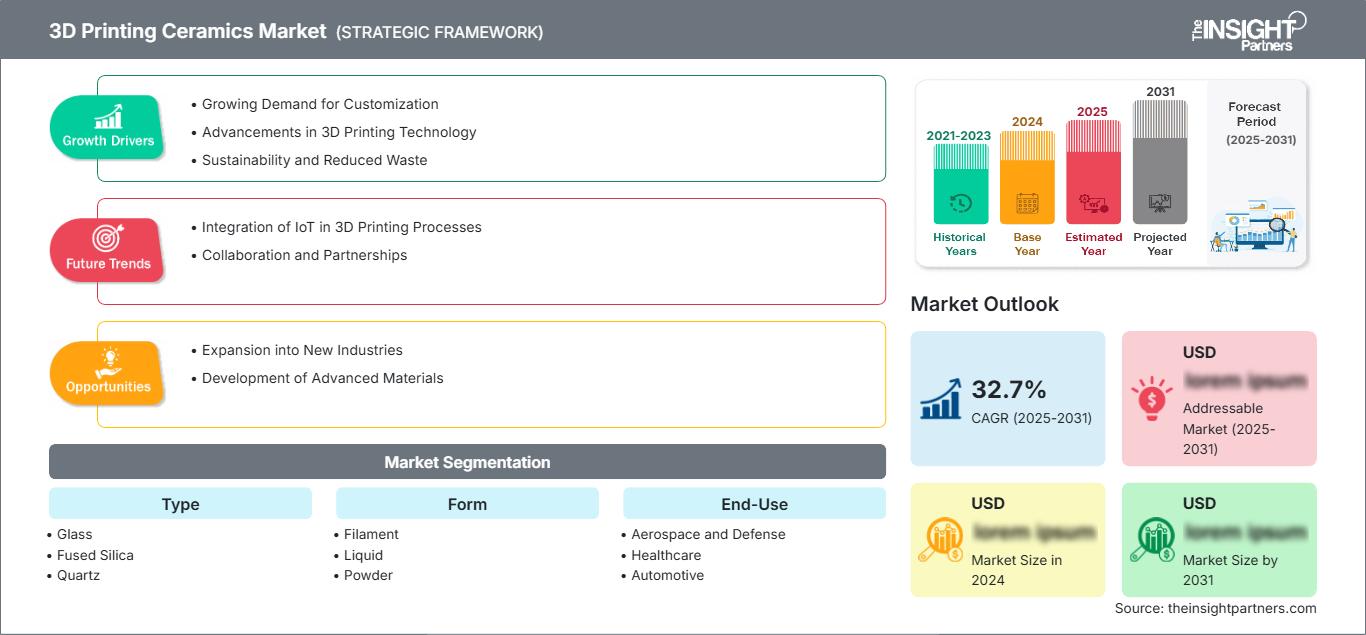
Regional Insights
North America 3D Printing Ceramics Market
North America accounted for a 28–32% share in 2025 and is expected to grow at a 23.0–26.0% CAGR during 2026–2034. The 3D Printing Ceramics Market share in the region is supported by aerospace engine programs, defense-funded materials research, medical implant customization, and semiconductor equipment demand. U.S. standards work around ceramic additive manufacturing also helps reduce buyer uncertainty.
Adoption remains strongest in high-value parts where ceramic performance offsets slower throughput and post-processing cost. Aircraft turbine cores, dental restorations, bone substitute structures, RF components, and foundry tooling are moving from trials toward repeatable use. Regional suppliers benefit from established quality systems, defense supply chains, and customers willing to qualify smaller production lots before scaling volumes.
U.S. 3D Printing Ceramics Market
The U.S. represented 74–78% of North America in 2025 and is expected to grow at a 22.0–25.0% CAGR during 2026–2034. Demand is anchored in aerospace and defense qualification, university and national laboratory research, medical device prototyping, and advanced manufacturing grants. Application priorities include ceramic casting cores, dielectric components, dental structures, and high-temperature tooling.
Company presence is broad across printer platforms, software, and engineering services. 3D Systems, Inc., ExOne Global Holdings, Materialize NV, Stratasys Ltd., and Renishaw plc affect USA customers’ evaluation criteria through their system, service, or process integration. The importance of repeatability, powder safety, traceability, and shrink prediction in ceramics lies in qualification costs being the major barrier.
Europe 3D Printing Ceramics Market
Europe held a 35–39% share in 2025 and is expected to grow at a 24.0–27.0% CAGR during 2026–2034. Germany is the leading country because advanced ceramics, semiconductor equipment, and aerospace engineering converge with strong contract manufacturing. Austria benefits from Lithoz GmbH’s ceramic printer ecosystem, while France is supported by 3DCeram Sinto and aerospace supply chains.
UK expertise lies in precision engineering, metrology, and medical device design, with Renishaw plc adding value in additive manufacturing in the region. Italy and Spain have increased applications in dental labs, automotive prototyping, and foundry tools. The uptake of additive manufacturing in Europe is also influenced by considerations such as CE-marking, traceable medical manufacturing, energy efficiency goals, and pressure to reduce high-value ceramic part lead times.
APAC 3D Printing Ceramics Market
APAC represented a 24–28% share in 2025 and is projected to expand at a 27.0–30.0% CAGR during 2026–2034. China is the leading country through electronics, electric vehicles, medical manufacturing, and industrial policy support for advanced materials. Japan and South Korea add precision ceramics and semiconductor equipment demand.
India is emerging in medical devices, dental laboratories, and university manufacturing facilities, while Australia is dominant in mining, defense, and research. Development in the region is being driven by electronics supply chains, economic service bureaus, and government efforts to develop additive manufacturing capabilities for strategic parts.
Middle East & Africa 3D Printing Ceramics Market
The Middle East & Africa market will experience growth at a 20.0%-23.0% CAGR during 2026-2034. In this region, Saudi Arabia holds the leadership position in the adoption of ceramic additively manufactured parts due to greater requirements for energy diversification, aerospace MRO, and industrialization.
Energy and infrastructure construction offer opportunities for corrosion, thermal, and wear-resistant ceramic parts. Growth will be restricted by the lack of ceramic AM capabilities in the region, as well as the lack of local ceramic AM expertise, qualification capabilities, and finishing options. Supply companies that offer equipment, training services, and application engineering can drive demand in the aerospace and healthcare industries.
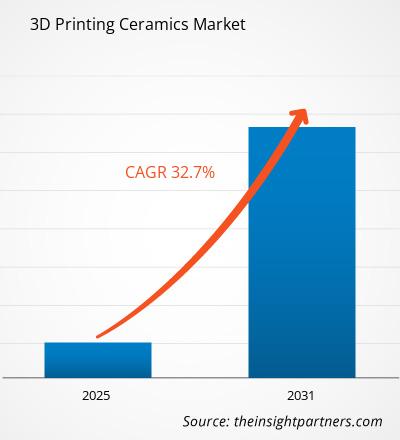
Segmentation Analysis
Type
The Type segment is forecast to grow at a 25.0–28.0% CAGR during 2026–2034. 3D Printing Ceramics Market scope across type is shaped by material purity, thermal resistance, dielectric behavior, and sintering response. Buyers choose glass, fused silica, quartz, or specialty formulations based on mechanical tolerance, optical stability, biocompatibility, and compatibility with printer chemistry.
- Glass: Glass materials support optical, dental, and microfluidic applications where surface finish, transparency, and chemical stability are strategically important for customized low-volume production.
- Fused Silica: Fused silica is favored for aerospace casting cores, semiconductor fixtures, and high-temperature components because it combines thermal shock resistance with dimensional stability after firing.
- Quartz: Quartz serves electronics, photonics, and laboratory equipment applications where purity, electrical insulation, and resistance to thermal cycling are essential for repeatable part performance.
Form
The Form segment is projected to grow at a 24.0–28.0% CAGR during 2026–2034. Powder currently leads because it supports binder jetting, material flexibility, and casting-related workflows, while liquids enable high-resolution vat photopolymerization. Filaments are relevant where extrusion affordability and distributed manufacturing matter, although densification consistency remains critical.
- Filament: Filament adoption is strongest in cost-sensitive prototyping, education, and early industrial trials where equipment simplicity offsets lower density and slower qualification.
- Liquid: Liquid ceramic feedstocks support precision medical, dental, and micro-component production because photopolymerization can deliver fine features, smooth surfaces, and repeatable layer control.
- Powder: Powder holds the strongest position due to flexible material selection, scalable binder jetting, and suitability for complex cores, molds, and industrial ceramic structures.
End-Use
The End-Use segment is expected to grow at a 26.0–30.0% CAGR during 2026–2034 as aerospace, healthcare, electronics, and industrial manufacturers adopt ceramic AM for parts that need heat resistance, bioactivity, insulation, or design freedom. Healthcare is the high-growth area, while aerospace and defense remain the most qualification-intensive demand base.
- Aerospace and Defense: Aerospace and defense users prioritize ceramic cores, thermal barriers, radomes, and ultra-high-temperature parts where performance gains justify qualification cost and longer development cycles.
- Healthcare: Healthcare demand centers on dental restorations, porous bone substitutes, cranial implants, and patient-specific devices that require biocompatibility, traceability, and precise anatomical customization.
- Automotive: Automotive applications include sensors, catalyst supports, heat-resistant prototypes, and motorsport components where lightweight thermal management and rapid design iteration create strategic value.
- Consumer Goods and Electronics: Electronics and consumer applications use ceramic AM for insulating substrates, wear parts, luxury components, acoustic structures, and small precision items requiring high surface quality.
- Manufacturing and Construction: Manufacturing and construction demand includes molds, cores, tooling, architectural ceramics, filters, and wear-resistant parts that reduce lead times for complex low-volume components.
Opportunity Snapshot
| Market Opportunity Snapshot | Market Opportunity Snapshot | Market Opportunity Snapshot | Market Opportunity Snapshot |
| End-Use | Revenue Contribution | Trend Tag | Adoption Stage |
| Aerospace and Defense | High | Engine Cores | Scaling |
| Healthcare | High | Custom Implants | Scaling |
| Automotive | Medium | Thermal Parts | Emerging |
| Consumer Goods and Electronics | Medium | Insulating Substrates | Scaling |
| Manufacturing and Construction | Medium | Complex Tooling | Scaling |
| Others | Low | Specialty Uses | Emerging |
3D Printing Ceramics Market Growth Drivers and Impact Analysis
Aerospace Efficiency Requirements Strengthen Ceramic AM Demand
Airplane engine producers face increasing demands for higher thermal efficiency with respect to weight and fuel consumption. Ceramic 3D printing helps address these challenges by enabling the use of complex casting cores and geometries that are resistant to high temperatures and cannot be made by machining or molding. IATA traffic projections make this even more important in the long term, while military programs will call for materials that can withstand heat, wear, and severe conditions. The most significant effect on the commercial market is seen in applications where additive manufacturing of ceramic materials reduces the time needed to develop turbine blades, radomes, sensors, and thermal protection components.
Healthcare Personalization Moves Toward Industrial Production
Healthcare professionals require personalized devices that meet the requirements for fit, biocompatibility, and excellent surface quality. Ceramic additive manufacturing processes can fabricate porous bone implants, cranial constructs, dental prostheses, and hearing devices with complex geometries that are impossible to produce using traditional manufacturing methods. WHO statistics on an aging population predict growth in demand for restorative treatment, while dental labs seek automation to reduce variability. The market effect will depend on tracking materials, post-production verification, and documentation that adheres to regulations. Those who match up 3D printing technologies, bioceramics, design software, and quality management systems will be able to go from prototypes to full-scale production.
Electronics and Semiconductor Tools Need Stable Ceramics
Electronics manufacturers require materials with electrical insulation, dimensional stability, corrosion resistance, and performance under thermal cycling. Printed ceramics address these requirements in substrates, fixtures, sensor housings, laboratory parts, and semiconductor process equipment where metals or polymers can fail. As chip production becomes more capital-intensive, small improvements in tooling life and contamination control can justify higher component costs. The impact on the 3D Printing Ceramics Market is a broader customer base beyond aerospace and medical applications. Producers that offer quartz, fused silica, alumina, and specialty ceramic options with tight tolerances are better positioned for electronics qualification.
3D Printing Ceramics Market Future Trends
Closed-Loop Process Control Becomes Essential
3D Printing Ceramics Market trends are moving toward closed-loop control across printing, cleaning, debinding, and sintering because final density and tolerance depend on every process step. Future production cells will capture viscosity, exposure, layer behavior, furnace profiles, shrinkage, and inspection results in one traceable record. This will reduce trial-and-error for regulated medical, aerospace, and semiconductor buyers. Automation will also make smaller batch production more economical by lowering operator variability. The trend favors companies that combine hardware, software, materials, and metrology rather than suppliers offering isolated machines without process intelligence.
Hybrid Ceramic AM Supports Larger and Functional Parts
The future adoption of the technology will entail hybrid processes that combine ceramic additive manufacturing with machining, coating, infiltration, joining, and inspection to achieve large-scale or multifunctional parts. Such an approach compensates for current constraints in build volume, surface quality, and post-sintering tolerances while retaining flexibility in the design of inner passages and lightweight geometries. The aerospace, energy, and industrial machinery industries will especially profit from this because, although they require complex geometries, they cannot afford any looseness in fit or evidence. Hybrid workflows also help service bureaus quote more predictable outcomes, since critical interfaces can be finished conventionally after ceramic geometry is printed and densified.
3D Printing Ceramics Market Opportunities
Certified Medical Ceramic Production Networks
3D Printing Ceramics Market Forecasts indicate attractive investment potential in certified production networks for dental, orthopedic, cranial, and hearing-related ceramic devices. Instead of selling printers only, suppliers can build regional hubs that provide validated materials, design services, traceable production, and regulatory documentation. This system will mitigate the risks of technology adoption for clinics, hospitals, and medical device companies that lack expertise with ceramic AM systems. Furthermore, the model provides recurring revenues by manufacturing parts, providing maintenance services, and supplying materials. The ideal solution is one in which patient-specific design processes are married to standardized quality control.
Semiconductor and Energy Tooling Partnerships
There are high-value partnerships to be made with semiconductor manufacturing equipment suppliers, hydrogen technologies companies, battery companies, and energy systems suppliers. The latter require ceramics capable of withstanding heat, plasma, chemicals, and electric loads, but they frequently manufacture products in small lots and constantly modify their designs. Ceramic AM companies should present themselves as engineering partners by offering material selection, simulation, prototyping, and qualification services. Joint ventures can mitigate the risks associated with commercialization while simultaneously generating proprietary application knowledge. This is particularly applicable to those areas seeking supply chain security in the electronics and renewable energy industries.
Recent Developments
- March 2026: Ceramic AM pioneer Lithoz launched three new technical ceramics for its Lithography-based Ceramic Manufacturing (LCM) technology. The new ceramic slurries are upgrades of Lithoz’s top-selling materials. The three new ceramic consumables for 3D printing are an upgraded LithaLox, a new LithaCon zirconia variant, and a Medical-Grade LithaCon ATZ.
- July 2025: Roland DG participated in TCT Japan 2025, the Home of 3D Printing and Additive Manufacturing Intelligence in Japan, held at Tokyo. At this event, the company unveiled their newly announced powder 3D printers, the PB-600 and PB-400, for the first time.
- January 2026: Ceramic additive manufacturing (AM) specialist Prodways Printers has signed an exclusive partnership with Lodestar3D, a provider of advanced manufacturing solutions in India, making the company the sole distributor of Prodways’ ceramic 3D printing solutions in the country.
Frequently Asked Questions

- Comprehensive Market Sizing and Forecast Analysis
- Detailed Segmentation Analysis
- In-Depth Market Dynamics Assessment
- Regional and Country-Level Insights
- Competitive Landscape and Company Benchmarking
- Strategic Business Intelligence
Recent Reports
Testimonials

The Insight Partners' SCADA System Market report is comprehensive, with valuable insights on current trends and future forecasts. The team was highly professional, responsive, and supportive throughout. We are very satisfied and highly recommend their services.
RAN KEDEM Partner, Reali Technologies LTDs
I requested a report on a very specific software market and the team produced the report in a few days. The information was very relevant and well presented. I then requested some changes and additions to the report. The team was again very responsive and I got the final report in less than a week.
JEAN-HERVE JENN Chairman, Future Analytica
We worked with The Insight Partners for an important market study and forecast. They gave us clear insights into opportunities and risks, which helped shape our plans. Their research was easy to use and based on solid data. It helped us make smart, confident decisions. We highly recommend them.
PIYUSH NAGPAL Sr. Vice President, High Beam Global
The Insight Partners delivered insightful, well-structured market research with strong domain expertise. Their team was professional and responsive throughout. The user-friendly website made accessing industry reports seamless. We highly recommend them for reliable, high-quality research services
YUKIHIKO ADACHI CEO, Deep Blue, LLC.
This is the first time I have purchased a market report from The Insight Partners.While I was unsure at first, I visited their web site and felt more comfortable to take the risk and purchase a market report.I am completely satisfied with the quality of the report and customer service. I had several questions and comments with the initial report, but after a couple of dialogs over email with their analyst I believe I have a report that I can use as input to our strategic planning process.Thank you so much for taking the extra time and making this a positive experience.I will definitely recommend your service to others and you will be my first call when we need further market data.
JOHN SUZUKI President and Chief Executive Officer, Board Director, BK Technologies
I wish to appreciate your support and the professionalism you displayed in the course of attending to my request for information regarding to infectious disease IVD market in Nigeria. I appreciate your patience, your guidance, and the fact that you were willing to offer a discount, which eventually made it possible for us to close a deal. I look forward to engaging The Insight Partners in the future, all thanks to the impression you have created in me as a result of this first encounter.
DR CHIJIOKE ONYIA MANAGING DIRECTOR, PineCrest Healthcare Ltd.Reason to Buy
- Informed Decision-Making
- Understanding Market Dynamics
- Competitive Analysis
- Identifying Emerging Markets
- Customer Insights
- Market Forecasts
- Risk Mitigation
- Boosting Operational Efficiency
- Strategic Planning
- Investment Justification
- Tracking Industry Innovations
- Aligning with Regulatory Trends





 Get Free Sample for