
3D Printing Robot Market Size, Trends & Growth by 2034
3D Printing Robot Market Size and Forecasts (2021 - 2034), Global and Regional Share, Trends, and Growth Opportunity Analysis Report Coverage : By Component (Robot Arms, 3D Printing Heads, Software), Robot Type (Articulated Robots, Cartesian Robots, SCARA Robots, Polar Robots, Delta Robots), Application (Prototyping, Tooling, Functional Part Manufacturing), End-user Industry(Automotive, FMCG, Aerospace & Defense, Construction, Culinary, Other End-user Industry)
- Status : Data Released
- Report Code : TIPRE00039690
- Category : Electronics and Semiconductor
- No. of Pages : 150
- Available Report Formats :


- Last update date : July 14, 2026


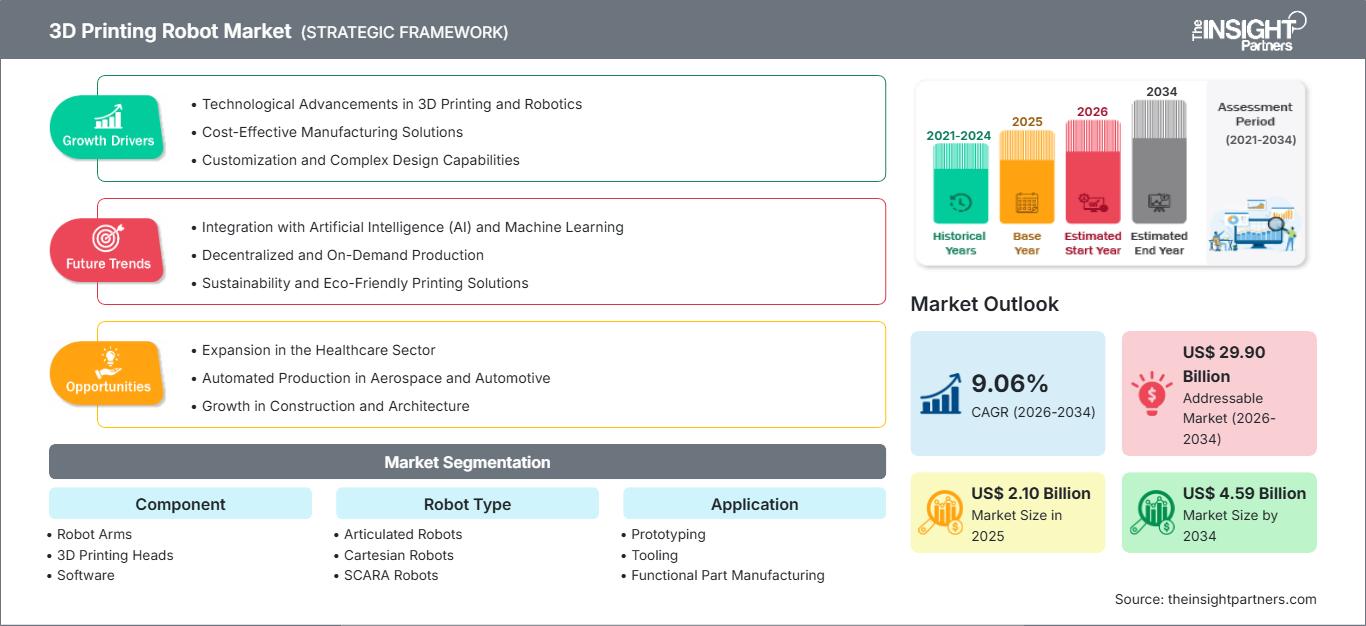
2025 Market Size
US$ 2.10 Bn
Base year value
2034 Forecast
US$ 4.59 Bn
Projected by 2034
CAGR 2026-2034
9.06 %
Growth rate
Addressable Market
US$ 29.90 Bn
(2026-2034)
The 3D printing robot Market is valued at US$ 2.10 billion in 2025 and is projected to reach US$ 4.59 billion by 2034, advancing at a CAGR of 9.06% from 2026 to 2034. Growth reflects wider industrial use of robotic additive manufacturing for large parts, automated tooling, customized components, and flexible production workflows across automotive, aerospace, defense, construction, FMCG, culinary, and other end-user industries.
North America is expected to advance at an estimated 8.6%–9.2% CAGR, supported by aerospace tooling programs, defense maintenance requirements, advanced automotive prototyping, and strong integration capability. Regional buyers are prioritizing robotic cells that reduce tooling lead times, improve material efficiency, and support localized production. Demand is also reinforced by mature robotics adoption and university-backed additive manufacturing research.
3D Printing Robot Market Assessment and Insights
- North America: The region represented 34%–39% share in 2025 and is growing at a 8.6%–9.2% CAGR between 2026–2034, led by aerospace tooling, defense repair, automotive prototyping, and mature automation integrators.
- US: The country accounted for 76%–82% of North America 3d printing robot market size in 2025 and is growing at a 8.8%–9.4% CAGR, supported by defense, aerospace, and advanced manufacturing institutes.
- Europe: Europe held 27%–32% share in 2025 and is expanding at a 8.4%–9.1% CAGR, with Germany, the UK, France, Italy, and Spain leading industrial, composites, and robotic additive adoption.
- Asia Pacific: APAC 3d printing robot market captured 24%–29% share in 2025 and is growing at a 9.8%–10.6% CAGR, driven by China, Japan, South Korea, India, and Australia through automation, policy support, and manufacturing localization.
- Largest Segment: Robot Arms held 48%–53% of the 3d printing robot market share in 2025 and is expanding at a 8.7%–9.3% CAGR, as reach, payload, and multi-axis control define system capability.
- High Growth Segment: Functional Part Manufacturing held 21%–26% of the 3d printing robot market share in 2025 and is growing at a 10.1%–10.8% CAGR as qualified end-use parts and repairs gain traction.
- Key companies analyzed in detail: KUKA AG, ABB Ltd, Yaskawa Electric Corporation, FANUC Corporation, Universal Robots A/S, Massive Dimension, CEAD B.V., Caracol S.r.l., WEBER Maschinenfabrik GmbH, Meltio3D, Comau S.p.A., and Dobot Robotics Co., Ltd.
Source: The Insight Partners' analysis based on proprietary research, government publications, company annual reports, investor presentations, industry databases, and expert interviews.
The 3D printing robot market report is evolving from demonstration-led adoption toward production cells that combine industrial robot arms, extrusion heads, metal deposition systems, and simulation software. Technology shifts include pellet-fed large-format printing, wire-laser metal deposition, non-planar toolpaths, and hybrid print-mill workflows. Production dynamics are changing as manufacturers evaluate repeatability, safety, material traceability, and post-processing efficiency rather than build volume alone.
Future adoption will broaden in emerging geographies where industrial automation, infrastructure expansion, and localized manufacturing policies converge. Investment is expected to favor application-ready cells, qualified material packages, and digital workflows that shorten commissioning. Regulatory tailwinds around lower waste, supply-chain resilience, and energy-efficient manufacturing will strengthen the 3d printing robot market growth outlook, where users can validate part performance.
3D Printing Robot Market Report Scope
| Report Attribute | Details |
|---|---|
| Market size in 2025 | US$ 2.10 Billion |
| Market Size by 2034 | US$ 4.59 Billion |
| Global CAGR (2026 - 2034) | 9.06% |
| Historical Data | 2021-2024 |
| Forecast period | 2026-2034 |
3D Printing Robot Market Analysis
Demand is being shaped by manufacturers that need larger build envelopes, shorter tooling cycles, and automated deposition beyond conventional printers. Robotic arms enable six-axis movement, angled deposition, and printing on curved surfaces, supporting molds, fixtures, composite structures, repair features, and architectural components. The 3D printing robot size expansion is linked to automation spending and the need for low-volume, high-mix production.
The ecosystem includes robot manufacturers, printhead suppliers, material providers, simulation platforms, safety systems, integrators, and finishing equipment. ABB Ltd’s RobotStudio 3D Printing PowerPac can translate slicer output into robot code and support processes such as welding, granule printing, and concrete printing, demonstrating how software reduces manual programming barriers in robotic additive manufacturing.
The competitive landscape is divided between global robotics suppliers and specialist additive cell providers. KUKA AG, ABB Ltd, Yaskawa Electric Corporation, FANUC Corporation, and Universal Robots A/S contribute motion platforms and automation networks, while Massive Dimension, CEAD B.V., Caracol S.r.l., WEBER Maschinenfabrik GmbH, Meltio3D, Comau S.p.A., and Dobot Robotics Co., Ltd. strengthen application-specific offerings.
Investment trends favor large-format polymer extrusion, wire-laser metal deposition, hybrid additive-subtractive cells, and AI-assisted toolpath optimization. Strategic positioning increasingly depends on validated outcomes rather than robot availability. Companies that demonstrate shorter lead times, lower material waste, repeatable quality, and practical integration support are better placed to capture 3d printing robot share across industrial accounts.
● REPORT CUSTOMIZATION
Tailor This Report To Align With Your Specific Business Requirements
This report can be customized to align precisely with your business objectives, scope, and target markets. Customization options include tailored segmentation, geography, competitive analysis, and strategic insights to support informed decision-making.
Customize This Report →WHAT YOU CAN ADJUST
- ● Segmentations
- ● Geography
- ● Competitive Analysis
- ● Language Preferences
3D Printing Robot Market: Strategic Insights
Regional Insights
North America 3D printing robot Market
North America 3D printing robot market held 34%–39% share in 2025 and is expected to grow at a 8.6%–9.2% CAGR through 2034. Demand is led by aerospace tooling, defense repair, automotive prototyping, construction automation trials, and research institutes that need large-format deposition. The region benefits from mature robot integrators, additive service bureaus, and customers capable of funding qualification programs.
Development in structural design is facilitated by localized production methodologies, automation, manpower, and high levels of acceptance of digital manufacturing. Robotic machines are used for molds, jigs, layup tools, metal repairs, and replacement parts when traditional methods take too long. The regional 3D printing robot market trends highlight software integration, compliance, and ROI.
U.S. 3D printing robot Market
The U.S. accounted for 76%–82% of North America in 2025 and is forecast to grow at a 8.8%–9.4% CAGR. Adoption is strongest in aerospace, defense, automotive engineering, advanced manufacturing institutes, and repair-intensive sectors. Application demand includes pellet-extruded tooling, robotic metal deposition, fixture production, and functional prototypes for complex industrial parts.
Company presence is further strengthened through ABB Ltd., KUKA Robotics Corporation, FANUC America, Yaskawa America, partners of Universal Robots A/S, Massive Dimension, CEAD’s operations in the U.S., and Meltio3D commercialization channels. Repeatability, operator safety, inspectability, and qualification documentation are key considerations of U.S. customers. The country has exhibited early demand for construction printing and military sustainment applications.
Europe 3D printing robot Market
Europe 3D printing robot market represented 27%–32% share in 2025 and is projected to grow at a 8.4%–9.1% CAGR. Germany is the leading country because of automation depth, automotive engineering, machine building, and robotics expertise. KUKA AG, ABB Ltd, CEAD B.V., Caracol S.r.l., WEBER Maschinenfabrik GmbH, and Meltio3D reinforce the European supplier base.
The UK 3D printing robot market is seeing applications in aerospace tooling, defense prototype development, innovative construction, and academia through research and studies on additive manufacturing technology. Clients generally start with pilot projects and proceed to production when the robotic cells demonstrate the ability to consistently deposit layers, reduce tooling expenses, and process composites and polymers. Integrators assist with translating prototypes into production.
Contributors from France, Italy, and Spain include the aerospace, composites, design and manufacturing, and infrastructure sectors. The contributions of Italy include robotic additive manufacturing by Caracol S.r.l., while Spain has the advantage of Meltio3D and CEAD-composite manufacturing initiatives. Customers in Europe value energy savings, tested materials, traceability, and regulatory approval.
APAC 3D printing robot Market
APAC 3D printing robot market held 24%–29% share in 2025 and is growing at a 9.8%–10.6% CAGR. China is the leading country, supported by automation investment, construction pilots, electric vehicle supply chains, and policy focus on advanced manufacturing. The 3d printing robot market scope is expanding from prototyping into tooling and functional support parts.
Japan and South Korea leverage their capabilities in robotics, shipbuilding, electronics, automobile manufacturing, and defense manufacturing. FANUC Corporation and Yaskawa Electric Corporation are some companies that help Japan, while South Koreans use robots in deposition processes for lightweight products. Reliability and factory compatibility define purchases.
India and Australia emerge from manufacturing localization, mining maintenance, infrastructure construction, marine repairs, and engineering education. Government support for localization and waste reduction helps accelerate adoption. The 3D Printing Robots Market Analysis in the region suggests that countries will adopt the technology more quickly when integrators provide education, materials, and services.
Middle East & Africa 3D printing robot Market
Middle East & Africa 3D printing robot market is projected to grow at a 7.7%–8.5% CAGR from a smaller installed base. Saudi Arabia is the leading country, supported by industrial diversification, construction megaprojects, energy maintenance, and investment in advanced manufacturing. Robotic printing supports local production of molds, fixtures, repair features, and infrastructure components.
Growth in demand in the UAE is driven by aviation, construction, manufacturing, and design and technology demo applications. Users of energy and infrastructure prefer larger-format systems for formwork, replacement parts, and repair functions. Demand is still selective, as customers require local training, financing, and technical support.
South Africa and the rest of MEA have potential in mining, educational institutions, infrastructure, and local spare parts production. Energy users can consider repairs using metal additive technologies, whereas construction users may explore automated printing. Growth will depend on the availability of materials and integrators.
Segmentation Analysis
Component
The component segment is expected to grow at a 8.8%–9.5% CAGR during 2026–2034. Demand is shaped by complete robotic cells that combine motion platforms, deposition heads, and software. Buyers increasingly assess compatibility, process monitoring, safety, and integration support, making component interoperability essential for repeatable industrial production.
- Robot Arms: Robot arms form the core platform because reach, payload, repeatability, and axis flexibility determine print volume, deposition angle, and suitability for large-format industrial applications.
- 3D Printing Heads: Printing heads define material capability, thermal stability, layer consistency, and deposition quality across polymer pellet extrusion, concrete printing, metal wire deposition, and hybrid additive workflows.
- Software: Software enables slicing, toolpath generation, simulation, collision avoidance, robot programming, process monitoring, and print optimization, making it critical for repeatable production outcomes.
Robot Type
The robot type segment is projected to expand at a 8.9%–9.6% CAGR during 2026–2034. Adoption depends on workspace geometry, payload, reach, speed, and toolpath complexity. Articulated systems dominate industrial applications, while Cartesian, SCARA, polar, and delta robots serve more specialized production environments.
- Articulated Robots: Articulated robots lead adoption because six-axis movement supports non-planar printing, complex tool orientation, large parts, and integration with machining, inspection, or repair tasks.
- Cartesian Robots: Cartesian robots suit structured printing environments where linear movement, dimensional stability, and predictable toolpaths are prioritized for repeatable builds and controlled large-format deposition.
- SCARA Robots: SCARA robots serve selective applications requiring fast planar movement, compact footprints, and efficient repetitive deposition, though their geometry limits broader large-format robotic printing use.
- Polar Robots: Polar robots offer rotational movement advantages for curved or radial printing tasks, but adoption remains niche where specific part geometry justifies specialized robotic architecture.
- Delta Robots: Delta robots provide high-speed motion for lightweight deposition or experimental printing setups, but payload and workspace constraints restrict their role in heavy industrial additive manufacturing.
Application
The application segment is forecast to grow at a 9.0%–9.7% CAGR during 2026–2034. Prototyping remains important, but tooling and functional part manufacturing are becoming stronger revenue drivers. Users are shifting from experimental printing toward workflows that cut lead times, reduce waste, and support qualified production.
- Prototyping: Prototyping benefits from robotic printing because teams can create large design iterations, validate shapes quickly, reduce mold dependence, and explore complex geometries before tooling investment.
- Tooling: Tooling is a strategic application as manufacturers use robotic additive systems to produce molds, jigs, fixtures, patterns, and composite layup tools faster and with less material waste.
- Functional Part Manufacturing: Functional part manufacturing is expanding, where robotic systems deliver structural polymers, metal repairs, lightweight components, or low-volume parts that meet performance and lead-time requirements.
End-user Industry
The end-user industry segment is expected to grow at a 9.1%–9.8% CAGR during 2026–2034. Automotive and aerospace remain core adopters, while construction, FMCG, culinary, and other sectors use robotic deposition for customization, rapid tooling, localized production, and process experimentation.
- Automotive: Automotive users adopt robotic printing for design validation, lightweight prototypes, tooling, fixtures, and replacement parts that support faster vehicle development and flexible manufacturing.
- FMCG: FMCG applications focus on packaging prototypes, custom molds, production aids, and fast tooling changes where speed, customization, and reduced downtime improve operational responsiveness.
- Aerospace & Defense: Aerospace and defense users prioritize lightweight structures, composite tooling, metal repair, certified prototypes, and localized part production where supply resilience and performance matter.
- Construction: Construction applications include architectural components, formwork, concrete structures, and customized building elements that use robotic reach to print larger geometries with design freedom.
- Culinary: Culinary use remains emerging, focused on experimental food deposition, automated presentation, and customized edible structures where precision movement supports creative production.
Opportunity Snapshot
| End-user Industry | Revenue Contribution | Trend Tag | Adoption Stage |
| Automotive | High | Rapid Tooling | Scaling |
| FMCG | Low | Packaging Molds | Emerging |
| Aerospace & Defense | High | Lightweighting | Scaling |
| Construction | Medium | Concrete Printing | Emerging |
| Culinary | Low | Food Automation | Emerging |
| Other End-user Industry | Medium | Custom Fabrication | Scaling |
3D Printing Robot Market Growth Drivers and Impact Analysis
Rising demand for automated large-format additive manufacturing
Robotics is being used for additive manufacturing due to the inefficiency of traditional closed printers in creating large molds, fixtures, boat parts, architectural pieces, or tooling from composites. The advantages of robotics include extended reach, multi-axis motion, and flexibility in deposit angles. The benefits for the market are shorter product development time, reduced material waste, and faster iterations. This driver is favorable for adoption by KUKA AG, ABB Ltd, CEAD B.V., Caracol S.r.l., WEBER Maschinenfabrik GmbH, and Massive Dimension, which address industrial users moving additive manufacturing from prototype rooms to production floors.
Need for flexible tooling and faster product iteration
Increased tooling demand comes at a time when automotive, aerospace, FMCG, and industrial equipment producers are trying to cut down their design cycles amid cost fluctuations. Robot printers help achieve a higher rate of manufacturing of jigs, fixtures, molds, trimming tools, and composite lay-up tools than traditional methods. The implications for the market include a shift from single-printer purchases to an end-to-end process change. Buyers will be on the lookout for solutions integrating design data, slicing, motion control, deposition, inspection, and finishing into repeatable processes. Vendors that reduce programming complexity can unlock broader mid-market adoption.
Metal repair and localized production strengthening business cases
Metal-based AM processes that utilize robots become more compelling when replacement parts are costly, time-consuming to acquire, and hard to come by. Wire-laser deposition and similar directed-energy processes facilitate repair, feature addition, and net-shape manufacturing for energy, defense, mining, marine, and heavy machinery companies. Meltio3D emphasizes the use of wire-laser metal deposition for both printing and repair using wire raw material with zero wastage. The market impact is greater spare-part resilience, lower downtime, and stronger justification for localized robotic additive cells.
3D Printing Robot Market Future Trends
Hybrid additive-subtractive robotic cells will gain priority
One such emerging trend is the creation of hybrid robot cells that incorporate both additive and subtractive processes within the same system. Parts produced by large-scale printing processes often need to be cut, drilled, milled, and surface-finished to be usable, and transporting parts from one machine to another incurs additional costs and introduces potential sources of inaccuracy. The combination of methods could improve efficiency, accuracy, and capacity within production processes involving composite molds, aerospace tools, marine parts, and industrial structures. In the future, competition would be among vendors that combine additive design, subtractive processes, tool changing, and feedback into a single unit.
Software-led automation will reduce robotic printing complexity
The software will play an increasingly significant role as robotic additive manufacturing technology develops further beyond the experienced user. Deposition path programming depends on orientation control, collision avoidance, layer strategy, heat management, speed control, and material flow management. ABB RobotStudio 3D Printing PowerPac is an example of how standard slicer output could be transformed into instructions for robots to minimize programming efforts. Future software will enable the integration of CAD modeling, simulation, monitoring, quality control, and production documentation, helping manufacturers scale from prototyping to controlled industrial output.
3D Printing Robot Market Opportunities
Industrial tooling packages for automotive and aerospace buyers
A major opportunity is packaging robotic additive systems specifically for tooling users in the automotive and aerospace industries. These buyers need molds, fixtures, trim tools, prototype supports, and composite layup tools that can be produced quickly and modified easily. The 3d printing robot market forecast indicates vendors can accelerate adoption by providing validated materials, predefined print parameters, machining capabilities, operator training, and cost models that compare robotic printing with traditional tooling methods. The strongest commercial path is to sell repeatable tooling outcomes rather than generic robotic printer hardware.
Robotic metal repair for energy, defense, and marine assets
Robotic metal repair provides an excellent value proposition for organizations that require expensive parts with lengthy acquisition times. Energy plants, naval fleets, mining operations, and military maintenance units may employ robots to refurbish worn-out parts, enhance their functionality, or produce near-net-shape replacement parts. Suppliers need to develop repair programs for each sector that include qualification, inspections, material compatibility, training, and cost recovery. Their success will be based on reduced downtime, scrap rates, and supply chain exposure while maintaining confidence in part performance.
Recent Developments
- December 2025: Meltio3D — Meltio confirmed 2025 as an inflection point for wire-laser metal deposition adoption, citing industrial demonstrations, its Meltio Robot Cell, defense deployments, and use cases across automotive, defense, mining, naval, oil and gas, and repair-focused supply chains. The update reinforced rising interest in robotic metal additive manufacturing for localized production and maintenance.
- September 2025: CEAD B.V. — Stack3d integrated a CEAD Hybrid Flexbot system into its River Falls facility to expand large-format additive manufacturing for aerospace, building and construction, furniture, signage, and thermoforming applications. The system combines multi-axis 3D printing and CNC machining, supporting rapid end-to-end production from prototypes to low-volume industrial parts.
- July 2025: KUKA Robotics Corporation — KUKA announced it would showcase additive manufacturing at CMTS 2025 through a robotic 3D printing cell with system partner Dyze Design. The demonstration highlighted how high-precision robotic reach can support automated plastic part production and broader industrial additive manufacturing workflows in machine shops and advanced manufacturing environments.
Frequently Asked Questions

- Comprehensive Market Sizing and Forecast Analysis
- Detailed Segmentation Analysis
- In-Depth Market Dynamics Assessment
- Regional and Country-Level Insights
- Competitive Landscape and Company Benchmarking
- Strategic Business Intelligence
Recent Reports
Testimonials

The Insight Partners provided valuable market intelligence that supported our global go-to-market strategy. Their team was professional, responsive, and attentive to our feedback, providing thoughtful analysis and helpful methodological clarifications throughout the project.
Junmo Kim Chief Financial Officer (CFO), Enertech Co., Ltd.
The Insight Partners' SCADA System Market report is comprehensive, with valuable insights on current trends and future forecasts. The team was highly professional, responsive, and supportive throughout. We are very satisfied and highly recommend their services.
RAN KEDEM Partner, Reali Technologies LTDs
I requested a report on a very specific software market and the team produced the report in a few days. The information was very relevant and well presented. I then requested some changes and additions to the report. The team was again very responsive and I got the final report in less than a week.
JEAN-HERVE JENN Chairman, Future Analytica
We worked with The Insight Partners for an important market study and forecast. They gave us clear insights into opportunities and risks, which helped shape our plans. Their research was easy to use and based on solid data. It helped us make smart, confident decisions. We highly recommend them.
PIYUSH NAGPAL Sr. Vice President, High Beam Global
The Insight Partners delivered insightful, well-structured market research with strong domain expertise. Their team was professional and responsive throughout. The user-friendly website made accessing industry reports seamless. We highly recommend them for reliable, high-quality research services
YUKIHIKO ADACHI CEO, Deep Blue, LLC.
This is the first time I have purchased a market report from The Insight Partners.While I was unsure at first, I visited their web site and felt more comfortable to take the risk and purchase a market report.I am completely satisfied with the quality of the report and customer service. I had several questions and comments with the initial report, but after a couple of dialogs over email with their analyst I believe I have a report that I can use as input to our strategic planning process.Thank you so much for taking the extra time and making this a positive experience.I will definitely recommend your service to others and you will be my first call when we need further market data.
JOHN SUZUKI President and Chief Executive Officer, Board Director, BK Technologies
I wish to appreciate your support and the professionalism you displayed in the course of attending to my request for information regarding to infectious disease IVD market in Nigeria. I appreciate your patience, your guidance, and the fact that you were willing to offer a discount, which eventually made it possible for us to close a deal. I look forward to engaging The Insight Partners in the future, all thanks to the impression you have created in me as a result of this first encounter.
DR CHIJIOKE ONYIA MANAGING DIRECTOR, PineCrest Healthcare Ltd.Reason to Buy
- Informed Decision-Making
- Understanding Market Dynamics
- Competitive Analysis
- Identifying Emerging Markets
- Customer Insights
- Market Forecasts
- Risk Mitigation
- Boosting Operational Efficiency
- Strategic Planning
- Investment Justification
- Tracking Industry Innovations
- Aligning with Regulatory Trends





 Get Free Sample for