
3d Projector Market Size, Growth & Demand by 2034
3D Projector Market Size and Forecasts (2021 - 2034), Global and Regional Share, Trends, and Growth Opportunity Analysis Report Coverage : By Type (DLP, LCD, and LCoS), Resolution (XGA, HD and Full HD, and 4K), Application (Cinema, Gaming, Events & Large Venues, Education, Home Theatre, and Others)
- Status : Data Released
- Report Code : TIPRE00039691
- Category : Electronics and Semiconductor
- No. of Pages : 150
- Available Report Formats :


- Last update date : July 09, 2026


2025 Market Size
US$ 4.55 Bn
Base year value
2034 Forecast
US$ 8.22 Bn
Projected by 2034
CAGR 2026-2034
6.80 %
Growth rate
Addressable Market
US$ 57.72 Bn
(2026-2034)
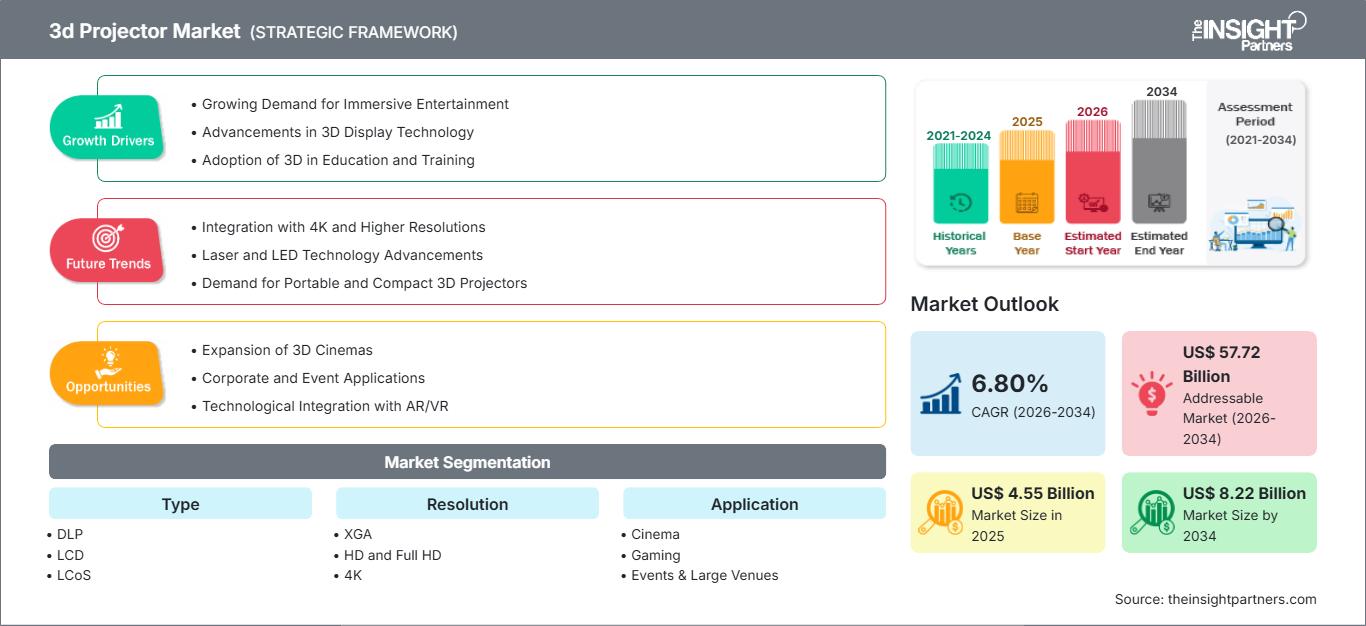
The 3D Projector Market is positioned for steady expansion as immersive visualization becomes more important across cinema, gaming, education, events, and home theatre. The market size is estimated at US$ 4.55 Billion in 2025 and is projected to reach US$ 8.22 Billion by 2034, reflecting a CAGR of 6.80% from 2026 to 2034. Demand is shaped by 3D Projector trends in laser brightness, 4K resolution, and shared large-format viewing.
North America remains a high-value market, with an estimated regional CAGR of 6.3%–6.8% through 2034, supporting the long-term 3D Projector Market Forecast. Structural growth is supported by premium home theatre upgrades, esports venues, university visualization labs, and professional AV replacement cycles. The region benefits from established integrator networks, strong after-sales support, and faster adoption of laser-based high-brightness systems for museums, auditoriums, simulation rooms, and large public venues.
3D Projector Market Assessment and Insights
- North America and US: 27%–31% share, 6.3%–6.8% CAGR; US 72%–78%, 6.5% CAGR; home theatre, simulation.
- Europe: 24%–29% share, 5.8%–6.4% CAGR; Germany, UK, France lead cinema, events, industrial visualization.
- Asia Pacific: 34%–39% of the 3D Projector market share, 7.2%–7.8% CAGR; China, Japan, South Korea drive cinema, gaming, education.
- Largest Segment: Cinema application, 28%–33% share, 6.1%–6.6% CAGR; premium screen modernization drives demand.
- High Growth Segment: Gaming application, 7.8%–8.5% CAGR; low-latency 4K entertainment accelerates consumer adoption.
- Key companies analyzed in detail: Seiko Epson Corporation, Sony Group Corporation, Optoma Technology, Inc., Barco NV, Delta Electronics, Inc., BenQ Corporation, Panasonic Projector & Display Americas LLC, Sharp Corporation, Holotronica Limited, VIRTUAL ON LTD
Source: The Insight Partners' analysis based on proprietary research, government publications, company annual reports, investor presentations, industry databases, and expert interviews.
The 3D Projector Market has shifted from cinema-centered deployment toward a broader visual infrastructure category. Earlier demand relied on theatre screens and premium home systems, while current adoption includes simulation, museums, esports, higher education, and experiential retail. Production dynamics are moving toward laser light engines, compact high-lumen chassis, improved cooling, and software calibration. These changes reduce service burden and make complex multi-projector installations more practical in professional environments.
Forward demand will be influenced by emerging geographies, public digital infrastructure, tourism-led venues, and institutional investment in shared visualization. Asia Pacific and the Gulf states are expected to add capacity through cinemas, theme parks, smart campuses, and event districts. Regulatory pressure for energy efficiency favors laser systems with longer operating lives, while education digitization and training modernization increase the 3D Projector scope across public and private buyers.
3D Projector Market Report Scope
| Report Attribute | Details |
|---|---|
| Market size in 2025 | US$ 4.55 Billion |
| Market Size by 2034 | US$ 8.22 Billion |
| Global CAGR (2026 - 2034) | 6.80% |
| Historical Data | 2021-2024 |
| Forecast period | 2026-2034 |
3D Projector Market Analysis
The demand for drivers relates to the requirement for a collaborative immersive experience, bigger images, and adaptability. The requirement for brightness and color consistency is important for cinema operators, whereas the importance for gamers lies in lower latency and motion clarity. These use cases support 3D Projector growth because projection can scale to room-sized experiences more economically than many direct-view display walls.
Value chain participants include imaging chip makers, optical engine developers, projector producers, lens manufacturers, software developers, integrators, distributors, and venues. Improved supply conditions are taking place due to the standardization of laser modules, DLP chips, LCD panels, and 4K technology. The 3D Projector analysis also shows stronger demand for calibration, glasses compatibility, media servers, and maintenance contracts, especially in large venues.
The competitive landscape remains fragmented across consumer, education, professional AV, and cinema-grade systems. Seiko Epson Corporation competes through 3LCD and laser platforms, Sony Group Corporation through premium imaging, Barco NV through cinema and simulation, and Panasonic Projector & Display Americas LLC through high-brightness professional systems. Optoma Technology, Inc. and BenQ Corporation remain visible in gaming, education, and value-oriented 4K categories.
Investment trends favor laser illumination, compact high-lumen platforms, wider lens ranges, edge blending, and remote fleet management. Strategic positioning is shifting from hardware specifications to vertical solutions for classrooms, attractions, simulation rooms, and premium entertainment, a transition highlighted in this 3D Projector Market Report. Delta Electronics, Inc., Sharp Corporation, Holotronica Limited, and VIRTUAL ON LTD strengthen the ecosystem through displays, immersive formats, specialist visualization, and application-specific deployments.
● REPORT CUSTOMIZATION
Tailor This Report To Align With Your Specific Business Requirements
This report can be customized to align precisely with your business objectives, scope, and target markets. Customization options include tailored segmentation, geography, competitive analysis, and strategic insights to support informed decision-making.
Customize This Report →WHAT YOU CAN ADJUST
- ● Segmentations
- ● Geography
- ● Competitive Analysis
- ● Language Preferences
3D Projector Market: Strategic Insights
Regional Insights
North America 3D Projector Market
North America accounts for 27%–31% of 2025 revenue and is expected to expand at a 6.3%–6.8% CAGR. Demand is supported by premium entertainment infrastructure, institutional AV spending, and simulation requirements across aerospace, healthcare, and defense training. The region also has a mature channel base that can specify, install, calibrate, and service complex 3D projection systems.
Replacement cycles for lamps and laser-based projectors remain a major factor, as consumers are always seeking reduced maintenance and greater brightness reliability. The 3D projector market share in North America is driven not only by advancements in home theaters but also by those in gaming centers, museums, universities, and even hybrid workspaces.
U.S. 3D Projector Market
The U.S. represents 72%–78% of North America’s revenue and is expected to grow at a 6.5% CAGR. Demand is concentrated in home theatre, cinema modernization, esports venues, universities, medical training, and corporate experience centers. A large installed base creates steady replacement demand for laser and 4K-capable systems that improve brightness, reliability, and image detail.
The presence of these companies in the channel includes Seiko Epson Corporation, Sony Group Corporation, Optoma Technology, Inc., BenQ Corporation, Barco NV, Panasonic Projector & Display Americas LLC, and Sharp Corporation. Some application trends that have emerged include multi-projector immersion rooms, projection mapping, and game-oriented projectors. Evaluating the software bundled with the projector is becoming a key requirement.
Europe 3D Projector Market
Europe holds a 24%–29% share and is expected to grow at a 5.8%–6.4% CAGR. The UK benefits from live events, higher education, museum installations, and home cinema demand. London’s creative production ecosystem supports projection mapping, while universities and training centers use 3D visuals for technical education and collaborative design.
Germany is the dominant player in Europe due to the applicability of industrial automation, car design, simulation, and engineering education in terms of true 3D visualization. There is demand generated through trade shows, company innovation centers, and entertainment centers. Buyers typically prioritize optics, reliability, and service support over entry-level pricing in mission-critical installations.
France, Italy, and Spain contribute through cinema chains, cultural heritage venues, tourism attractions, and event production, strengthening the regional 3D Projector Market Share. France shows strength in immersive museums and digital art, Italy benefits from design and exhibition use cases, and Spain gains from tourism-led venues. Adoption is steady as laser and 4K upgrades replace older lamp-based fleets.
APAC 3D Projector Market
APAC is the leading and fastest-growing region, holding 34%–39% share and advancing at a 7.2%–7.8% CAGR. China leads through cinema infrastructure, education digitization, theme parks, esports, and domestic large-screen entertainment demand.
Japan and South Korea contribute through premium home theatre, gaming culture, and advanced display technology ecosystems. Industrial visualization, product design, and simulation create opportunities for high-resolution systems across engineering and manufacturing environments.
India and Australia are expanding from a smaller base, driven by education technology, cinema additions, corporate AV upgrades, and live events. Policy-backed digital learning and infrastructure spending support long-term adoption across schools, universities, and public venues.
Middle East & Africa 3D Projector Market
Middle East & Africa is expected to grow at a 5.6%–6.2% CAGR, with the UAE leading adoption through tourism, exhibitions, entertainment, and premium retail. Saudi Arabia is scaling opportunities through mega-projects and cultural venues.
The significance of the energy and infrastructure environment is that airports, hospitality facilities, smart-city areas, museums, and event locations need large-format projectors. High ambient light calls for high-lumen laser projectors, while rental companies require rugged transportable models.
3D projectors are used in South Africa and the MEA region for learning institutions, worship centers, corporate events, and public presentations. Budgeting issues have prevented the adoption of top-end models, but rugged Full HD and budget laser projectors are getting adopted.
Segmentation Analysis
Type
The type segment is expected to grow at a 6.4%–7.0% CAGR from 2026 to 2034. Adoption depends on image quality, brightness, contrast, maintenance cost, and installation flexibility. DLP, LCD, and LCoS technologies serve distinct price and performance tiers, allowing vendors to address cinema, gaming, education, simulation, and home theatre requirements without relying on a single display architecture.
- DLP: DLP projectors lead in many cinema, gaming, and venue environments because they offer strong contrast, compact optical design, fast response, and reliable 3D image handling.
- LCD: LCD projectors remain attractive for education, offices, and home theatre buyers seeking bright color output, accessible pricing, and dependable performance across mid-range installations.
- LCoS: LCoS serves premium home cinema, simulation, and professional visualization applications where high native contrast, smooth image reproduction, and refined color accuracy are central purchasing criteria.
Resolution
The resolution segment is expected to grow at a 6.7%–7.3% CAGR from 2026 to 2034. Demand is moving toward sharper imaging as screen sizes increase and immersive content becomes more detailed. XGA remains relevant in price-sensitive settings, HD and Full HD support mainstream installations, and 4K gains strategic importance in cinema, simulation, gaming, and premium home theatre.
- XGA: XGA remains relevant in cost-sensitive classrooms, training rooms, and basic presentation settings where affordability, content compatibility, and simple replacement cycles outweigh ultra-high-definition image requirements.
- HD and Full HD: HD and Full HD projectors serve mainstream education, gaming, home theatre, and small venue demand by balancing image clarity, price accessibility, and broad content availability.
- 4K: 4K projectors are gaining share in premium cinema, gaming, simulation, and immersive venues where sharper detail, larger screen formats, and high-quality visual realism justify higher investment.
Application
The application segment is expected to grow at a 6.8%–7.4% CAGR from 2026 to 2034. Cinema remains the largest revenue contributor, while gaming is the high-growth application. Events, education, and home theatre create diversified demand, making the 3D Projector size less dependent on theatrical releases and more connected to broader immersive media adoption.
- Cinema: Cinema remains the largest application as exhibitors upgrade projection systems to improve brightness, depth perception, color consistency, and audience immersion for premium 3D releases.
- Gaming: Gaming demand is rising as players seek large-screen immersive formats, low input lag, high refresh performance, and 4K-capable projectors for console and PC experiences.
- Events & Large Venues: Events and large venues require high-lumen projectors for projection mapping, concerts, exhibitions, festivals, and immersive brand activations where reliability and installation flexibility are critical.
- Education: Education adoption is supported by interactive science, engineering, anatomy, architecture, and technical training use cases that benefit from spatial visualization and collaborative learning environments.
- Home Theatre: Home theatre buyers are upgrading to 3D-capable Full HD and 4K systems for cinematic viewing, gaming, and sports experiences on larger screens.
Opportunity Snapshot
| Application | Revenue Contribution | Trend Tag | Adoption Stage |
| Cinema | High | Premium Screens | Mature |
| Gaming | Medium | Low Latency | Scaling |
| Events & Large Venues | High | Projection Mapping | Scaling |
| Education | Medium | Visual Learning | Scaling |
| Home Theatre | Medium | 4K Cinema | Mature |
3D Projector Market Growth Drivers and Impact Analysis
Rising Demand for Immersive Cinema and Venue Experiences
Immersion-based entertainment plays an essential role as movie theaters, theme parks, museums, and event planners vie for unique customer experiences. 3D projection enables immersion through scale and sharing that is impossible to achieve on individual display screens. This technology affects the industry the most where ticket pricing is influenced by visual quality, such as premium theaters, brand entertainment, cultural venues, and events. Venue operators are investing in brighter laser systems, improved contrast, and reliable calibration to reduce downtime, contributing to the steady expansion of the 3D Projector Market Size. This supports hardware demand while expanding spending on lenses, mounts, glasses, media servers, maintenance contracts, and professional integration services.
Shift Toward 4K, Laser, and Lower Ownership Costs
The transition from lamp-based systems to laser and hybrid light sources is reshaping purchasing decisions across the 3D Projector Market. The focus for buyers is on longevity of use, constant illumination, reduced maintenance, and low energy consumption. At the same time, the 4K resolution is getting affordable, enabling projectors to cover large screens without loss of quality. The implications are felt in schools, theaters, business offices, and even home cinemas. Companies that manage to unite optics and easy configuration will have a better chance of getting contracts.
Expansion of Digital Learning, Simulation, and Training
Education and professional training are becoming important demand centers because 3D visualization improves understanding of spatial, technical, and scientific concepts. There is increasing demand for shared immersion display systems in engineering, medical, architectural, aviation, military, and manufacturing training settings, where collaboration in viewing objects or simulated environments becomes necessary. This goes beyond the sale of equipment into curriculum development, simulation software, content creation, and AV integration. Facilities are more likely to make purchases when projector systems can deliver connectivity, reliable image quality, and continuous operation.
3D Projector Market Future Trends
Growth of Projection Mapping and Spatial Experiences
Projection mapping is becoming a defining trend because it expands 3D projector use beyond flat screens into buildings, stages, domes, galleries, retail spaces, and themed environments, reflecting broader 3D Projector Market Trends. As content tools improve, more organizations can create spatial storytelling without constructing permanent sets. Forward-looking demand will be shaped by experiential marketing, destination entertainment, digital art, and mixed-use commercial developments. The trend favors suppliers that support integrators with flexible lenses, color matching, compact form factors, and dependable high-lumen output from early design stages.
Convergence of Gaming, Home Cinema, and Smart Connectivity
The user end of the 3D Projector Market is heading towards devices that provide features such as cinema-grade imagery, a gaming experience, the ability to stream content, and ease of setup. Consumers increasingly demand 4K capability, low latency, HDR compatibility, wireless connection, and smart interface features all combined in one device. Such trends may lead to the development of mini lasers, ultra-short throw projectors, automatic focus, enhanced audio capabilities, and application control. Companies targeting both recreational and home theater enthusiasts can benefit from this market.
3D Projector Market Opportunities
Immersive Education and Professional Training Infrastructure
Education and training offer a strong opportunity because many institutions are moving from static presentation tools toward experiential, collaborative learning environments. 3D projection systems will be useful for anatomy labs, engineering visualizations, architecture studios, flight simulations, safety training, and maintenance instruction in industries. The investment strategy for such equipment must involve selling complete classroom or laboratory kits rather than 3D projectors alone. Partnerships between vendors and other players, such as integrators, software companies, and educational technology companies, can develop such solutions.
Large-Venue Upgrades and Experience-Led Commercial Spaces
Large venues present attractive opportunities as stadiums, museums, visitor centers, auditoriums, theme parks, retail flagships, and hospitality spaces look for visual differentiation, supporting the long-term 3D Projector Market Size through expanding commercial installations. 3D projectors can generate dynamic environments without removing the architectural surfaces; they can be used in temporary events and even long-term installations. The suppliers have to focus on integrators and venue designers who will need high-lumen projector solutions that are ruggedized and easily serviced via software and flexible lenses.
Recent Developments
- June 2026: Epson today announced the new EB-XQ2030B 30,000-lumen,1 4K Laser 3LCD projector. The EB-XQ2030B pairs stunning 3-chip 3LCD color, impressive black levels and vivid 4K detail at up to 30,000 lumens1 of brightness, enabling large-scale visuals with the depth and clarity demanded by world-class immersive environments.
- May 2026: Optoma Technology, a leader in cutting-edge visual display solutions, is excited to announce the new ZK1000 4K UHD+ WQUXGA interchangeable lens laser projector, adding to its line of high brightness ProScene Series, Optoma’s ZK1120 and ZK1320 awarded “InfoComm 2025 Best of Show,” by ProjectorCentral, Sound & Video Contractor and AV Technology. Optoma’s ProScene Series 4K UHD+ WQUXGA laser projectors are designed to meet the demand for high brightness products offering easy installation with an available ultra-short throw lens, for any large venue, immersive, rental and staging, corporate, and education environment.
- February 2026: Panasonic Projector & Display Americas LLC announced additions to its MEVIX brand of visual solutions designed to empower professionals in the AV industry to create life-like visual experiences that connect audiences. On display at ISE 2026 (booth #3J500), the new solutions respond to the growing need for high-quality, dynamic visuals across markets. Each new projector and display represents a significant advancement of core technology, taking the MEVIX line to the next level in accordance with the expanding needs of the location-based entertainment, sports simulation, and public sector industries.
Frequently Asked Questions

- Comprehensive Market Sizing and Forecast Analysis
- Detailed Segmentation Analysis
- In-Depth Market Dynamics Assessment
- Regional and Country-Level Insights
- Competitive Landscape and Company Benchmarking
- Strategic Business Intelligence
Recent Reports
Testimonials

The Insight Partners' SCADA System Market report is comprehensive, with valuable insights on current trends and future forecasts. The team was highly professional, responsive, and supportive throughout. We are very satisfied and highly recommend their services.
RAN KEDEM Partner, Reali Technologies LTDs
I requested a report on a very specific software market and the team produced the report in a few days. The information was very relevant and well presented. I then requested some changes and additions to the report. The team was again very responsive and I got the final report in less than a week.
JEAN-HERVE JENN Chairman, Future Analytica
We worked with The Insight Partners for an important market study and forecast. They gave us clear insights into opportunities and risks, which helped shape our plans. Their research was easy to use and based on solid data. It helped us make smart, confident decisions. We highly recommend them.
PIYUSH NAGPAL Sr. Vice President, High Beam Global
The Insight Partners delivered insightful, well-structured market research with strong domain expertise. Their team was professional and responsive throughout. The user-friendly website made accessing industry reports seamless. We highly recommend them for reliable, high-quality research services
YUKIHIKO ADACHI CEO, Deep Blue, LLC.
This is the first time I have purchased a market report from The Insight Partners.While I was unsure at first, I visited their web site and felt more comfortable to take the risk and purchase a market report.I am completely satisfied with the quality of the report and customer service. I had several questions and comments with the initial report, but after a couple of dialogs over email with their analyst I believe I have a report that I can use as input to our strategic planning process.Thank you so much for taking the extra time and making this a positive experience.I will definitely recommend your service to others and you will be my first call when we need further market data.
JOHN SUZUKI President and Chief Executive Officer, Board Director, BK Technologies
I wish to appreciate your support and the professionalism you displayed in the course of attending to my request for information regarding to infectious disease IVD market in Nigeria. I appreciate your patience, your guidance, and the fact that you were willing to offer a discount, which eventually made it possible for us to close a deal. I look forward to engaging The Insight Partners in the future, all thanks to the impression you have created in me as a result of this first encounter.
DR CHIJIOKE ONYIA MANAGING DIRECTOR, PineCrest Healthcare Ltd.Reason to Buy
- Informed Decision-Making
- Understanding Market Dynamics
- Competitive Analysis
- Identifying Emerging Markets
- Customer Insights
- Market Forecasts
- Risk Mitigation
- Boosting Operational Efficiency
- Strategic Planning
- Investment Justification
- Tracking Industry Innovations
- Aligning with Regulatory Trends





 Get Free Sample for